Bell's Inequalities: Full Story
This article profiles Bell's Inequalities as the empirical boundary between classical realism and quantum information. Resolving the EPR paradox, Bell's theorem transformed metaphysics into testable physics: local hidden variables cannot explain entanglement. Experiments (Aspect, Clauser, Zeilinger) confirmed violations, proving nature is non-local or non-realistic. This shifted entanglement from theoretical curiosity to measurable resource, enabling device-independent cryptography and quantum computing. The historical arc spans Einstein's 1935 objection to the 2022 Nobel Prize. Framed within the Unification Project, Bell's theorem establishes entanglement as a lawful, informational substrate where correlations transcend space without violating causality. It marks where classical realism fails and quantum information processing begins—reality as rigorous, verifiable, non-local information.
Bell inequailities. Why they are so important.
Bell inequalities are profoundly important because they provide a testable boundary between classical and quantum physics, fundamentally changed our understanding of nature, and enabled modern quantum technologies. Here are the key reasons:
1. They Resolved the Einstein-Podolsky-Rosen (EPR) Paradox
In 1935, Einstein, Podolsky, and Rosen argued that quantum mechanics must be “incomplete” because it predicted “spooky action at a distance”—instantaneous correlations between entangled particles that seemed to violate relativity. They proposed that unknown “local hidden variables” predetermined these correlations.
Bell’s 1964 theorem proved this philosophical debate could be settled experimentally. He derived mathematical inequalities that any local hidden variable theory must obey, then showed quantum mechanics predicts violations
. This shifted entanglement from metaphysics to measurable science.
2. They Revealed Nature’s Non-Local Character

Experiments starting in 1972 (Clauser & Freedman) and especially Aspect’s 1982 tests consistently violated Bell inequalities, confirming that nature cannot be both local and realistic
. This means:
Either information influences travel faster than light (non-locality), OR
Properties don’t exist until measured (non-realism), OR
Both
Either way, the classical worldview is fundamentally wrong. Schrödinger called entanglement “the characteristic trait of quantum mechanics,” and Bell inequalities proved this trait is real.
3. They Made Entanglement a Measurable Resource
Before Bell, entanglement was theoretical. The inequalities provided a quantitative tool to certify entanglement experimentally. This led to:
Loophole-free tests in 2015-2017 that conclusively ruled out local hidden variables
The 2022 Nobel Prize awarded to Aspect, Clauser, and Zeilinger for experimental validation
Satellite experiments violating Bell inequalities over 1,200 km, proving quantum correlations survive macroscopic distances
4. They Power Quantum Information Technologies

Violations of Bell inequalities are essential for quantum advantages over classical systems:
Device-independent quantum cryptography: Security guaranteed by Bell violations, not trust in devices
Quantum random number generation: Producing fundamentally unpredictable numbers certified by Bell tests
Quantum networks and computing: Entanglement is the key resource, and Bell violations verify its quality
Self-testing protocols: Certifying quantum states and measurements without knowing device details
5. They Define the Classical-Quantum Boundary
Bell inequalities provide a sharp demarcation: classical correlations are limited by local realism, while quantum correlations can be stronger. This boundary drives research into why quantum mechanics outperforms classical physics and helps identify which quantum states can deliver computational advantages
.
In essence, Bell inequalities transformed entanglement from Einstein’s “spooky” paradox into the most important resource for quantum technologies, while simultaneously proving that nature operates under rules stranger than classical physics ever allowed.
So, if it is important, I want the full story.
Here is the complete story of Bell inequalities – from Einstein’s philosophical revolt to the quantum technologies reshaping our world.
Act I: The Rebellion Against Spookiness (1935)
In 1935, Albert Einstein, Boris Podolsky, and Nathan Rosen published a paper that would haunt physics for decades. They exposed quantum mechanics’ most disturbing feature: entanglement. When two particles become entangled, measuring one instantly determines the state of the other, no matter the distance between them. Einstein called this “spooky action at a distance” and declared quantum theory incomplete. Surely, he argued, there must exist hidden variables – pre-determined properties that we simply hadn’t discovered yet. This would restore “local realism”: particles have definite properties, and no influence travels faster than light.
For nearly 30 years, this remained a philosophical debate. Hidden variables seemed plausible, even comforting. But no one knew how to prove or disprove their existence. The question seemed untestable, trapped in the realm of metaphysics.
Act II: The Unlikely Revolutionary (1964)
Enter John Bell, a quiet Irish physicist at CERN who spent his days on particle accelerator design and his nights pondering quantum foundations. In 1964, he achieved something remarkable: he derived a simple mathematical inequality that turned philosophy into experiment.
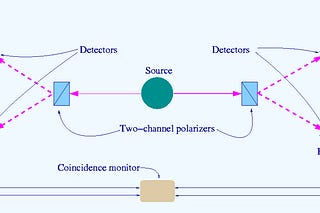
Bell’s insight was elegant. He imagined an experiment where entangled particles fly apart to distant labs. Each lab measures a particle property (like spin) along one of three possible directions (A, B, or C). He then asked: what correlations can exist if Einstein’s hidden variables are real?
Assuming realism (particles have pre-existing properties) and locality (no faster-than-light influence), he proved that certain statistical limits could never be exceeded. Specifically, if the labs measure along different axes, they should obtain opposite results no more than 67% of the time. This became known as the CHSH inequality: a value S must always be ≤ 2. Any local hidden variable theory was shackled by this bound.
But quantum mechanics predicted S could reach 2.82 (Tsirelson’s bound)– a clear violation. For the first time, metaphysics had become measurable. As Bell later reflected in a 1990 lecture, this showed “the Einstein program” was simply a failure: “You cannot get away with no action at a distance. Somehow [events] have to be described and explained jointly”.
Act III: The Experimental Crusade (1972-1982)
The first brave test came in 1972. John Clauser and Stuart Freedman built a crude apparatus using entangled photons from calcium atoms. Their results violated Bell’s inequality. The physics community was skeptical – perhaps the apparatus was flawed, or some subtle loophole allowed hidden variables to survive.
Then came Alain Aspect in 1982. His experiments were masterpieces of precision. He ensured the detectors were far enough apart that no light-speed signal could communicate between them. He rapidly switched measurement settings, preventing any “conspiracy” between particles. His results were conclusive: nature violated Bell’s inequality, confirming quantum mechanics and defeating local realism
Act IV: The Loophole Wars (1980s-2017)
Skeptics raised objections. Maybe photons were being lost, creating a “detection loophole”? Maybe the settings weren’t truly random (”locality loophole”)? Closing every loophole required technological leaps.
The war culminated in 2015-2017, when three independent teams performed loophole-free Bell tests using diamonds, photons, and atoms. These experiments were the most rigorous in physics history, finally settling the debate after 50 years
Act V: The Triumph and the Payoff (2022-Present)
In 2022, the Nobel Prize in Physics honored this journey: Alain Aspect, John Clauser, and Anton Zeilinger shared the award “for their pioneering experiments with entangled photons, which confirmed the violation of Bell’s inequalities and laid the foundation for quantum information science”
Why This Story Changes Everything
Philosophically: Bell’s theorem proved the universe is fundamentally non-local, non-realistic, or both. Properties don’t exist until measured, and entangled particles share a connection that transcends space.
Scientifically: It transformed entanglement from a theoretical curiosity into a measurable, certifiable resource. Violating Bell inequalities is now the gold standard for proving a system is truly quantum.
Technologically: This validation launched the Second Quantum Revolution. Today’s quantum computers, quantum cryptography, and quantum networks all rely on entanglement certified by Bell violations. Device-independent quantum cryptography uses Bell tests to guarantee security even if your equipment is built by an adversary. Quantum computing’s power stems directly from harnessing these non-classical correlations.
The Bell inequality story is physics’ greatest detective tale: a philosophical objection became an experimental question, which launched a half-century technological crusade, and ultimately revealed that reality itself is stranger than Einstein ever imagined.