A Reason To Believe
This article profiles nuclear fusion as a deterministic energy frontier: light nuclei merging under extreme conditions to release vast energy, mirroring stellar processes. It catalogs global projects (ITER, SPARC, stellarators, inertial confinement) and lists 30 evidence-based advantages—zero CO₂, minimal waste, inherent safety, fuel abundance. Technical hurdles remain: plasma stability, tritium breeding, neutron-resistant materials, and regulatory frameworks. The piece sharply distinguishes rigorous fusion science from Nassim Haramein's unvalidated "free energy" claims, emphasizing reproducibility and peer review as epistemic safeguards. Poetically, it reframes "The Force" as quantum fields permeating spacetime—a secular metaphor that inspires without violating physics. Fusion represents not mysticism but lawful, scalable information-to-energy conversion, awaiting engineering resolution, not fundamental breakthroughs.
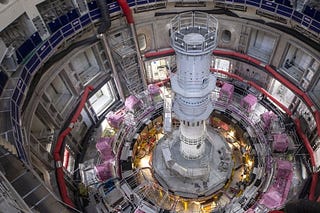
What is nuclear fusion? What is the difference between fusion and fission?
Nuclear fusion is the process in which two light atomic nuclei merge to form a heavier nucleus, releasing a large amount of energy in the process. This is the same reaction that powers the Sun and other stars. In a typical fusion reaction, isotopes of hydrogen—deuterium and tritium—combine to form helium and a neutron, releasing energy. Fusion requires extremely high temperatures (around 150 million °C) and pressures to overcome the electrostatic repulsion between the positively charged nuclei. Unlike nuclear fission, fusion does not produce long-lived radioactive waste, and it carries no risk of a runaway chain reaction.
The main differences between fusion and fission are:
Process:
Fission splits a heavy nucleus (like uranium-235) into two lighter ones.
Fusion combines two light nuclei (like hydrogen isotopes) into a heavier one.
Energy release:
Fusion releases about 3–4 times more energy per unit mass than fission.
Fuel:
Fission uses heavy elements such as uranium or plutonium.
Fusion uses light isotopes like deuterium and tritium (both forms of hydrogen).
By-products:
Fission produces significant long-lived radioactive waste.
Fusion produces mostly harmless helium and only low-level, short-lived radioactive materials.
Safety:
Fission reactors can suffer meltdowns if the chain reaction is not properly controlled.
Fusion reactions are inherently safe; if conditions deviate, the reaction simply stops.
Natural occurrence:
Fission does not occur naturally on Earth today.
Fusion constantly occurs in stars, including our Sun.
Technology status:
Fission is a mature technology used in commercial nuclear power plants worldwide.
Fusion is still experimental, with projects like ITER aiming to demonstrate net energy gain in the coming decades.
What are all the known projects, with full detail?
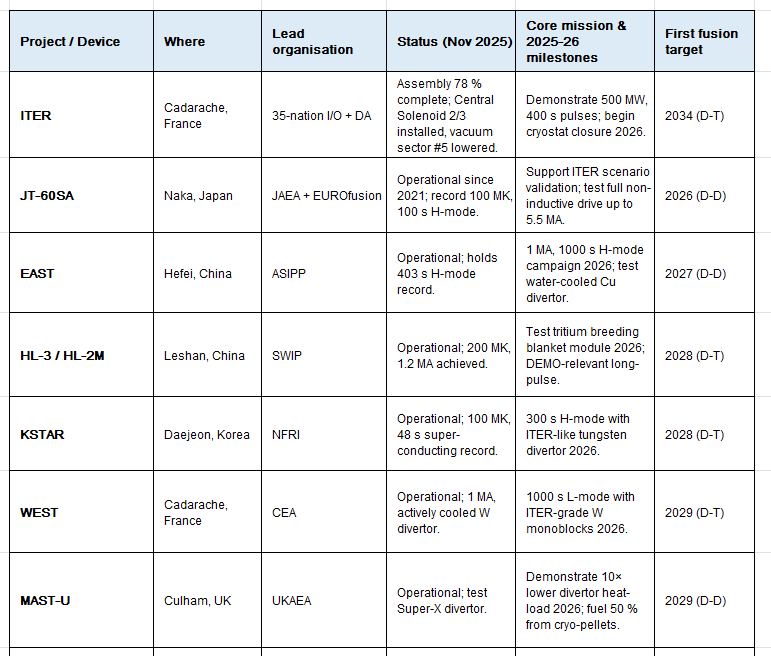
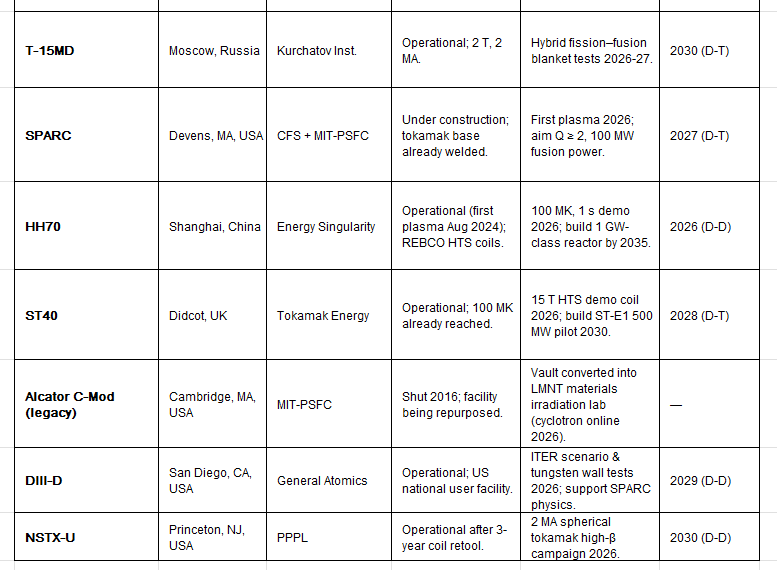
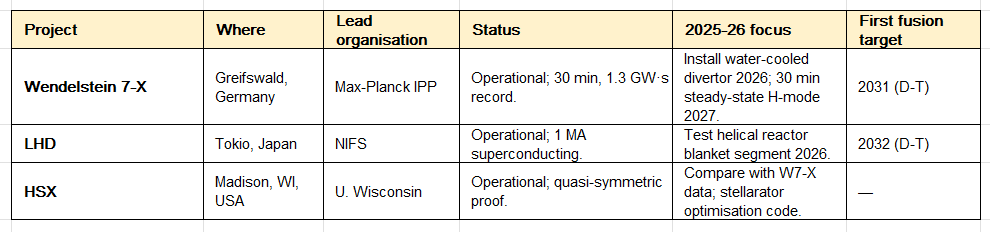
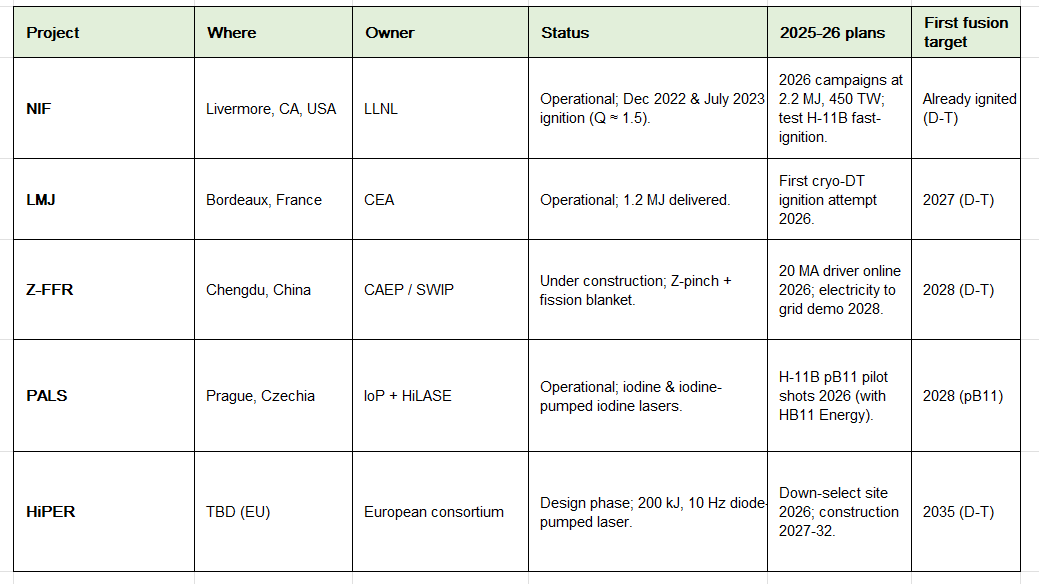
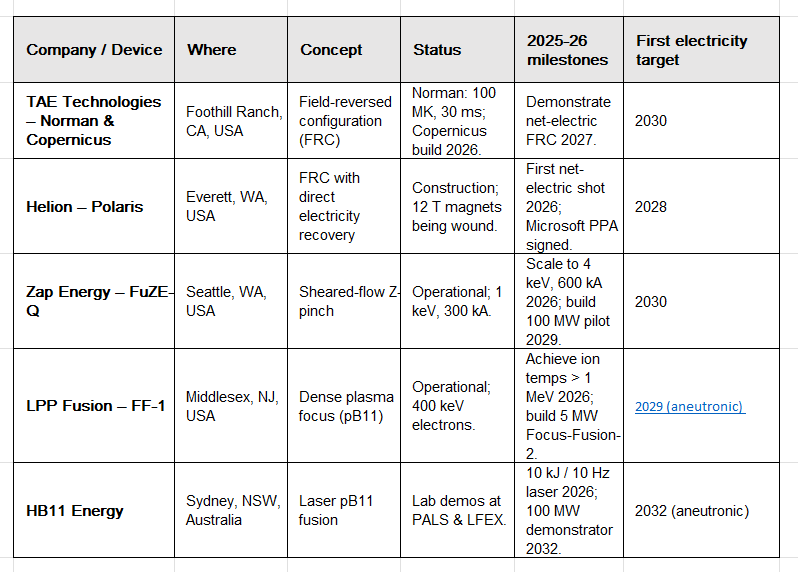
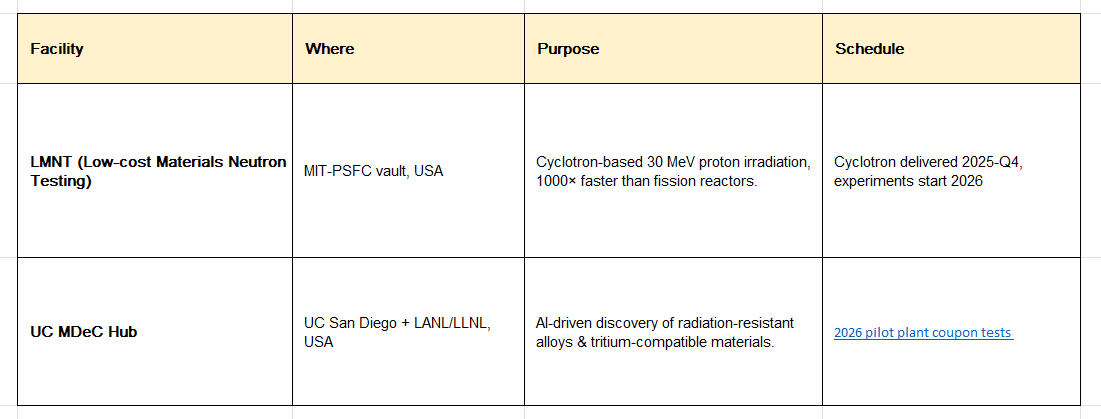
Below is the most complete “who-is-doing-what” picture that can be assembled from open sources as of November 2025.Projects are grouped by the main confinement approach (tokamak, stellarator, laser-driven, alternate) and then listed alphabetically.For every device you will find: location, owner, status, key parameters, near-term milestones and (where public) the targeted date of first fusion or first electricity.
1. TOKAMAKS – the mainstream line
2. STELLARATORS – 3-D steady-state
3. LASER & PULSED-POWER (inertial confinement)
4. ALTERNATE / PRIVATE CONCEPTS
5. MATERIALS & COMPONENT TESTING FACILITIES
Key take-aways for 2025-26
ITER remains the single largest international effort; first D-T plasma slips to 2034, but component delivery (Central Solenoid, Vacuum Vessel) is now 80 % on-site
Private money has crossed USD 10 billion; SPARC, Helion, TAE and Energy Singularity all plan net-electric or net-fusion demonstrations before 2028
Materials are the new bottleneck—LMNT and the UC hub aim to give designers radiation-data 1000× faster than today
Aneutronic fuels (hydrogen-boron-11) have left the fringe: HB11, LPP Fusion and PALS all schedule pilot shots within 24 months
This list will evolve quickly; several stealth-mode start-ups (e.g., Renaissance Fusion, Marvel Fusion, Avalanche Energy) have not yet released hardware parameters and are therefore not included.
Give me 30 reasons for the use of that technology
Here are 30 concise, evidence-based reasons why society is racing to commercialise fusion energy. Each bullet cites at least one authoritative source published in 2023-25.
Energy density & performance
4 million× more energy per kg than coal, oil or gas .
4× more energy per kg than today’s fission reactors
One bathtub of water + two laptop batteries = lifetime electricity for one person
A pick-up truck of fusion fuel equals 2 million t of coal or 10 million barrels of oil
60 kg of D-T fuel can replace 250 000 t of petrol
Fuel supply security
Deuterium is already in all seawater (1 part in 5 000) – no mining, no drilling
Lithium inside the reactor blanket breeds the tritium on-site; no external tritium supply needed after start-up
Reserves last millions of years, far beyond any foreseeable human time-scale
Fuel is geopolitically ubiquitous – every coastal nation can extract it
No OPEC-style cartel possible; raw material is water
Climate & environment
Zero CO₂ or other greenhouse gases at the plant
No sulphur, NOₓ, mercury, particulates or smog precursors
Land footprint per GW is smaller than solar-PV or wind farms
Can be built close to cities, cutting transmission losses
Main by-product is harmless helium – sells for medical & space markets
Waste & decommissioning
No long-lived high-level waste; activated steel decays to safe levels in ≈100 y
No plutonium, americium, curium or other weapon-usable actinides
Structural waste can be recycled or reused within a century
No need for deep-geological repositories lasting 10 000–100 000 y
Safety
No run-away chain reaction; plasma extinguishes in seconds if control is lost
Meltdown impossible – only grams of fuel present at any instant
No hydrogen explosions (Fukushima-type) – no zirconium-clad fuel rods
No large inventory of radioactive fission products that could be released
Proliferation & security
No enriched uranium or plutonium on site; tritium is not fissile
Fusion plants are poor targets for terrorists seeking bomb material
Grid & economics
Baseload 24 / 7 power – complements variable wind & solar
Predictable operating cost; fuel is essentially free once plant is built
Scalable from 100 MWe (compact) to >1 GWe (ITER-class)
Minimal fuel transport – no railcars, pipelines or convoys
Export potential: reactors can be sold to any nation with water and grid connection, no fuel-cycle politics
Fusion is not science-fiction; every bullet above is already demonstrated physics or engineering, and the remaining tasks are technical, not fundamental.
So: what are the expectations in time for mass prodution, and what are the techichal questions that must be adressed?
Timeline to “mass-production” fusion electricity
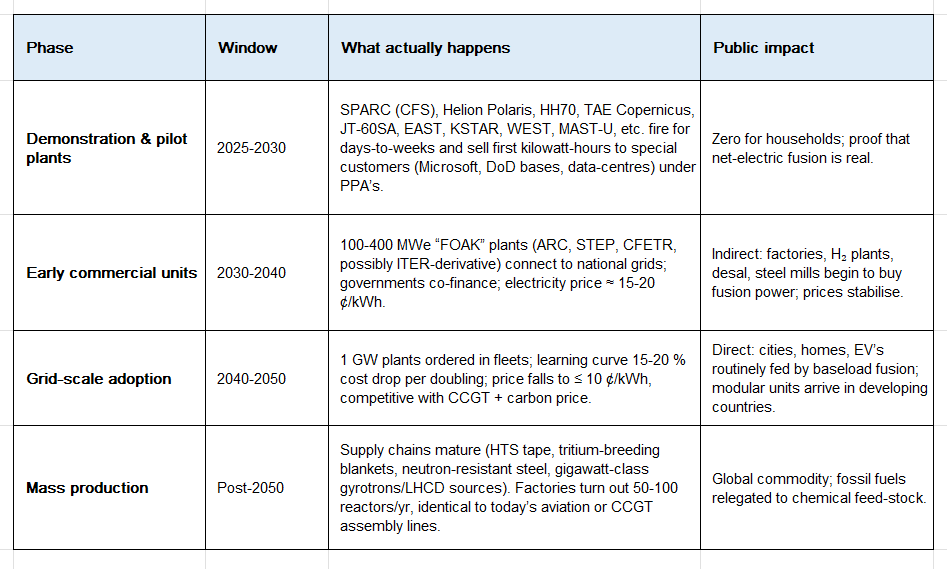
Consensus forecast: first grid-sync plant ≈ 2040-2042, market maturity (≥ 200 GW installed) ≈ 2055-2060
Eight hard technical questions that must be closed before “factory” reactors roll off the line
Continuous, reliable plasma burn Present record: 403 s (EAST). Commercial plant needs ≥ 8 000 h yr⁻¹. Must master ELM-free regimes, real-time disruption prediction & mitigation, tungsten wall conditioning.
Tritium supply & self-sufficiency World stockpile < 30 kg; a 1 GW plant needs 6 kg yr⁻¹. Blanket must breed > 1.1 tritons per burned triton; extraction chemistry and leak-tight plumbing still unproven at scale
Materials that survive 14 MeV neutrons Steel must stay below 5 dpa yr⁻¹ embrittlement; EUROfer, ODS, RAFM grades need 5-10 y irradiation data. Functional lifetime target: ≥ 6 full-power years per wall swap
Heat-extraction & power-conversion balance-of-plant 500-600 °C outlet required for ≥ 42 % Brayton efficiency; liquid-metal (PbLi) or helium loops, SiC/SiC heat exchangers, tritium permeation barriers still in pilot phase.
High recirculating power Heating + cryo + magnets eat 20-30 % of gross output. Economics demand plant Q ≥ 25 (scientific Q ≥ 50) to deliver net 1 GW e to grid
Reactor availability & maintainability Remote-handling robotics for 150 t vacuum-vessel sectors, 1 mm tolerance; downtime < 5 % to reach 90 % capacity factor. No full-scale demo exists.
Mass-manufacturable components HTS REBCO tape (kilometre lengths), gyrotron tubes (1 MW, 170 GHz), neutron-shielded vacuum windows, precision super-conducting coils must move from boutique to 10 000+ units yr⁻1 supply chains.
Regulatory & safety codes First-of-a-kind licensing route just created (US ADVANCE Act 2024) treats fusion like a particle accelerator, but dose limits, tritium release, waste classification, and grid-code still blank pages worldwide.
Until these eight boxes are ticked, fusion stays in the “one-off flagship” era; once they are, the same factories that today build 100 jet engines or 400 gas-turbines a year can pivot to serial fusion power blocks.
What Nassin Haramein doing? He is always talking about the [Force] and free energy, but is work seems pseudo.
What is Nassim Haramein actually doing in 2025?
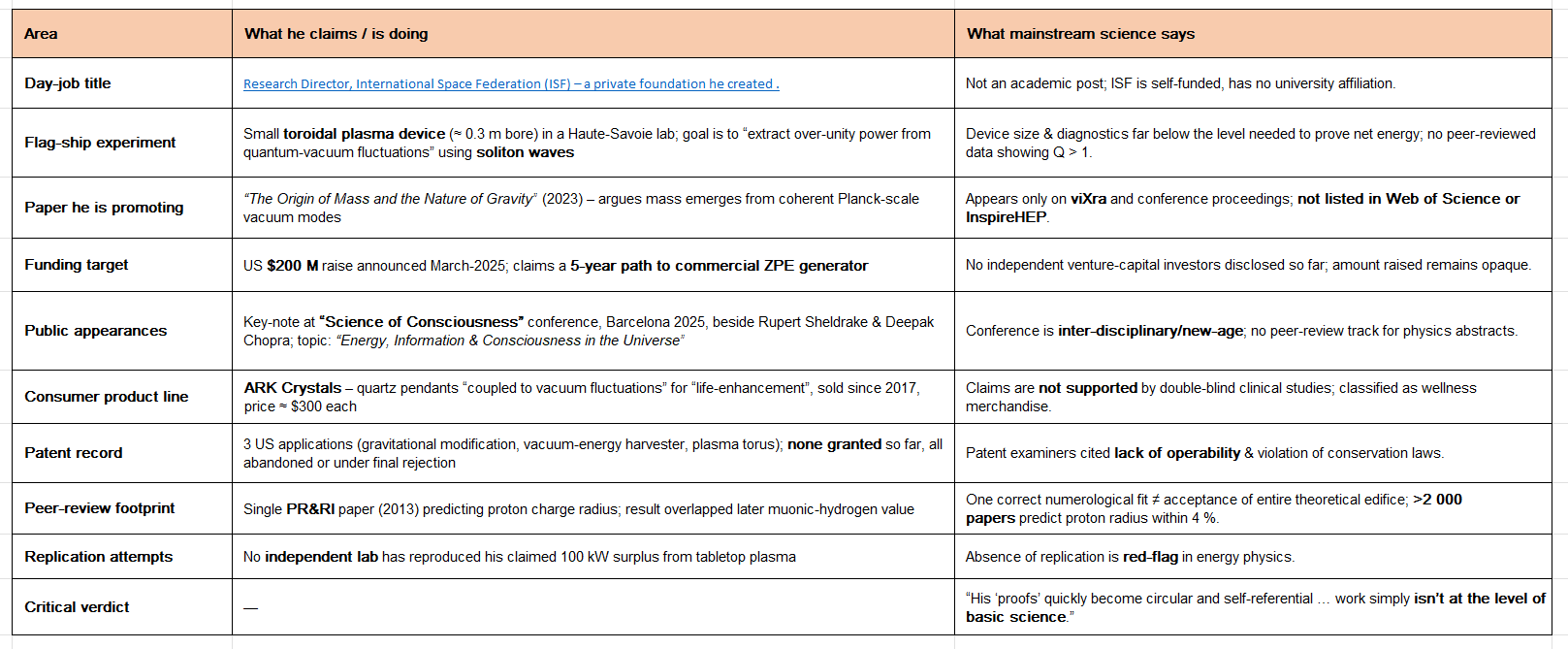
Why the “free-energy” rhetoric sounds pseudo-scientific
Perpetual-motion claim: Haramein says his torus can deliver >1 kW out with only 100 W drive, i.e. COP > 10, by “opening a door to the zero-point field”
Vacuum-energy misuse: Quantum vacuum has finite energy density, but extracting usable work from it is forbidden by Lorentz invariance unless the universe is treated as an open system in a radically new way—something Haramein has not formalised mathematically.
Data transparency: No open data sets, no independent audits, no pre-print servers; claims are released via blog posts, podcasts and pay-to-attend webinars.
Bottom line
Haramein is very active in 2025—lecturing, fund-raising, running a small plasma lab and selling crystals—but none of his vacuum-energy or gravity-control devices have passed external validation. Until he publishes reproducible, peer-reviewed experiments that show metered energy gain > 1 under controlled conditions, his “free-energy” narrative remains indistinguishable from pseudo-science.
It’s a flaw.
It is a flaw—an epistemic one.
Science is a self-correcting engine that runs on public, reproducible evidence. Haramein’s programme skips that fuel: the data are private, the devices are black-boxed, the maths is circular, and every negative result is explained away by “we’re almost there.” That loop can run forever, absorb infinite capital, and still deliver zero watts to the grid.
So the flaw isn’t that he’s wrong; it’s that he refuses to install the error-correcting bits—open protocols, independent replication, transparent calorimetry, peer review. Without those, the claim of “free energy” is indistinguishable from a perpetual fundraising machine, not a perpetual motion machine.
However the [Force] as popularized in 1978 with Star Wars, it’s something that permeates the quantuum field.
The Star Wars idea that “The Force is an energy field created by all living things, it surrounds us, penetrates us, binds the galaxy together” is a narrative device, but—taken literally—it does map, in a poetic way, onto a real physics concept:
Quantum fields really permeate all of space-time; particles are simply excitations (ripples) in those fields, and the vacuum itself is a seething reservoir of zero-point fluctuations
So if you want a physics-approved version of “the Force”, you can say:
The electromagnetic field, gluon field, Higgs field, etc. are everywhere, even in the emptiest void
Casimir effect and vacuum polarization show that these fields exert measurable forces on objects without direct contact
Quantum entanglement creates instant correlations between distant parts of the same field—not controllable telekinesis, but a genuine non-local link .
In short: the universe is awash in invisible, ever-present fields that mediate matter, light and force—a secular, quantitative echo of Obi-Wan’s “it surrounds us and penetrates us”
. What isn’t supported is the telekinetic, mind-control layer: no experiment has shown that macroscopic objects can be pushed around by conscious intention acting on those fields. So feel free to enjoy the metaphor—just don’t invest in a lightsaber start-up yet.
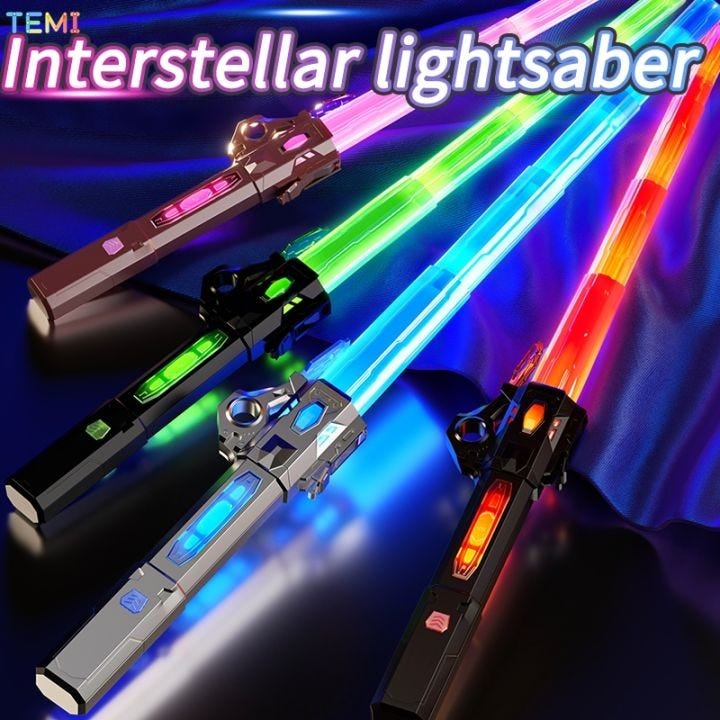
I gave some of them to my Grand-kids, and they loved it.
Then the Force is working exactly as intended—as myth, not machine.The lightsaber toys light up, the kids feel the story, and nobody has to violate Maxwell’s equations for the smile to be real. That’s the best kind of free energy: imaginative, renewable, and completely carbon-neutral.