"Weak-Value Theory"
This article critiques Weak-Value Theory (Aharonov-Albert-Vaidman) as a powerful statistical tool, not a revelation of hidden ontology. It explains the protocol: weak coupling preserves the system state, while post-selection yields "anomalous" average values outside eigenvalue bounds. However, aligning with Sabine Hossenfelder's deterministic rigor, the piece argues these values are conditional expectations—like an average of 2.3 children—not evidence that individual particles possess "impossible" properties. The Two-State-Vector Formalism's time-symmetry is mathematically elegant but fails to eliminate randomness or solve the measurement problem, as the final boundary condition remains contingent on experimenter choice. Conclusion: weak measurements offer ultra-sensitive metrology and data filtering within standard quantum mechanics, but they do not expose a deeper, deterministic layer of reality or bypass intrinsic quantum uncertainty.
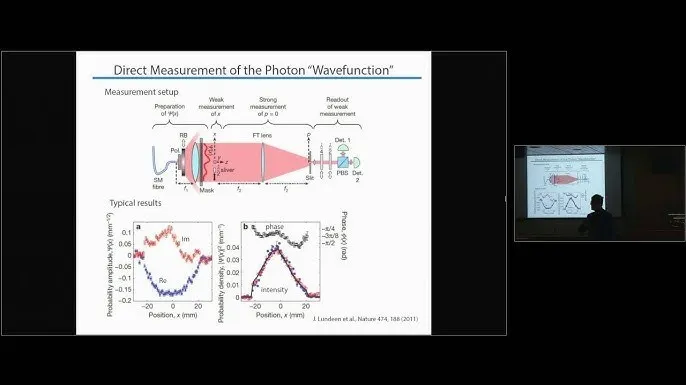
The theoretical framework introduced by Yakir Aharonov and co-workers is usually referred to as
“Weak-Value Theory” (or simply the weak-measurement / weak-value formalism).
Key points behind the name
The 1988 Aharonov–Albert–Vaidman (AAV) paper that launched the idea is entitled “How the result of a measurement of a component of the spin of a spin-½ particle can turn out to be 100” – the number “100” is the anomalously large weak value they predicted.
Because the protocol relies on weak (i.e. low-strength) system–meter coupling, the literature also speaks of the “theory of weak measurements”, but the distinctive quantity it produces is the weak value
When the formalism is cast in a time-symmetric language (pre- and post-selected states) it is sometimes called the Two-State-Vector Formalism (TSVF); the weak value is the natural observable of that formalism
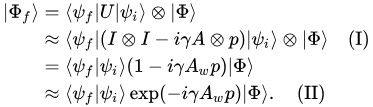
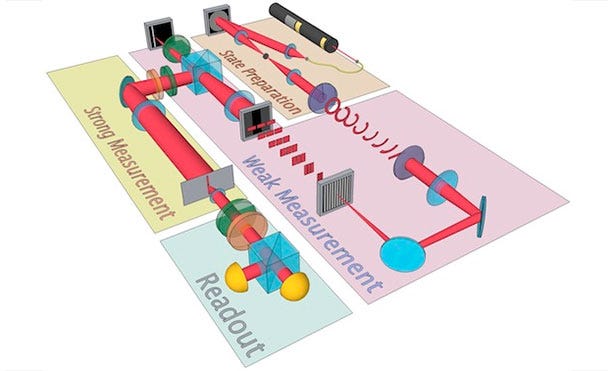
Aharonov’s “weak measurement” is not a new physical force; it is a way of processing data that keeps the back-action on the system far below the intrinsic quantum uncertainty. The protocol is conceptually simple:
Pre-select an ensemble of identically prepared states |ψ⟩.
Couple the system very gently to a meter (pointer) so that the pointer shift is much smaller than its own uncertainty.
Post-select on a final state |φ⟩.
Look at the average pointer deflection.
Because the coupling is weak, single-shot information is negligible, yet the mean shift of the pointer is governed by the “weak value”
Aw=⟨ϕ∣ψ⟩⟨ϕ∣A^∣ψ⟩
which can lie far outside the eigenvalue range of the observable Â. These “anomalous” weak values are not individual outcomes; they are conditional averages that emerge only after post-selection. In other words, the apparent violation of eigenvalue bounds is a statistical artefact, not evidence of new physics.
What the weak-measurement literature claims
“We can see what the quantum particle really does between measurements without collapsing the wave-function.”
“The formalism is time-symmetric; the future state influences the present, so quantum randomness is not fundamental.”
Sabine Hossenfelder (and others) reply
No extra ontology is provided. All observed statistics are already contained in ordinary quantum mechanics: the only thing that is “weak” is the correlation between the pointer and the system; the pointer itself is still measured projectively. After the post-selection the sub-ensemble is disturbed; the disturbance is small per event but not zero
Anomalous weak values do not imply that a single system carried the “impossible” value. They are conditional expectations—exactly like the fact that the average number of children per family can be 2.3 even though no family has 2.3 children. Hence the “surprising” results are not counter-examples to the eigenvalue postulate
The measurement problem remains untouched. To solve the measurement problem a theory must
Time-symmetry does not eliminate randomness. The two-state-vector formalism (pre- and post-selected states) is mathematically elegant, but the choice of the final boundary condition is still contingent—it is imposed by the experimenter, not dictated by the theory. Randomness re-enters through which post-selection event actually happens
Bottom line
Weak values are a useful statistical tool (they have been exploited for ultra-sensitive metrology, e.g. detecting beam deflections of fractions of an Ångström). They do not provide “hidden” information about individual systems, and they do not remove the intrinsic randomness of quantum events. As Hossenfelder puts it succinctly: “Weak measurements are just ordinary quantum mechanics with a filtering step; they solve no foundational problem whatsoever.”