Sommerfeld and the fine structure constant
This article profiles the fine-structure constant ($\alpha \approx 1/137$) as a deterministic, dimensionless invariant governing electromagnetic interaction. Introduced by Arnold Sommerfeld (1916) to explain hydrogen's spectral fine structure via relativistic elliptical orbits, $\alpha$ was later re-derived by Dirac without orbits—as the coupling strength between electron spin and nuclear electric fields. In Quantum Electrodynamics (QED), it serves as the expansion parameter for photon-electron interactions, enabling predictions (e.g., electron magnetic moment) verified to one part in a trillion. The piece emphasizes $\alpha$'s role in fixing atomic scales and light-matter transparency (e.g., graphene), while noting its apparent constancy over cosmic time. Framed within the author's Unification Project, $\alpha$ is not mysticism but a silent, precise informational constraint: a fundamental "fixed point" where relativity, quantum mechanics, and electromagnetism converge—a lawful mystery awaiting deeper geometric explanation.
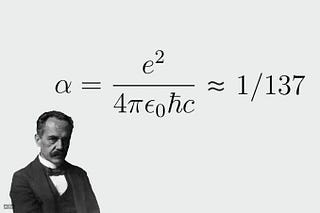
The fine structure constant is a pure number, about one divided by one hundred thirty seven, that Arnold Sommerfeld brought into physics in nineteen sixteen. He needed it to explain why the red glow of hydrogen contains faint companion lines, closer together than Bohr’s simple circle model could allow. Sommerfeld pictured electrons moving on stretched oval tracks, speeding up near the nucleus and slowing as they swing away. Because fast motion adds mass, the oval gradually swivels, and the energy of the orbit shifts by an amount set by the same number, later called alpha. His formula matched the measured splittings to within one part in ten thousand, a striking success for the young quantum idea.
When Dirac wrote down his equation for the electron twelve years later, the same energy pattern reappeared without any orbits at all; the swivel is now understood as the mutual tug between the electron’s own magnet and the electric field of the nucleus. Thus alpha governs how relativity and spin stir the atomic energy levels.
In the modern theory known as quantum electrodynamics, alpha serves as the yardstick for every electromagnetic event. Each time an electron emits or swallows a photon, the probability picks up one factor of this small number, so calculations proceed as a gentle series. The magnetic moment of the electron, for example, is predicted and verified to one part in a trillion, the most accurate test of any physical law.
Across the sciences alpha sets the sizes of many familiar quantities. It fixes the distance of the innermost electron from the nucleus, the width over which an electron scatters light, and the fraction of sunlight that passes through a single layer of carbon atoms. Laboratory crews continually ask whether alpha might drift as the universe ages; so far, any change is smaller than one part in ten million billion per year.
No one knows why this number is what it is. Sommerfeld gave it a name and a place in the equations, yet its origin remains silent, a quiet reminder that even the most precisely known corners of nature still keep their secrets.