Dirac Equation
This article presents the Dirac Equation (1928) as the deterministic bridge between quantum mechanics and special relativity, redefining matter not as static particles but as dynamic field excitations. Dirac's resolution of negative-energy solutions—the "sea" of filled states—predicted the positron, transforming the vacuum from emptiness into a plenum of potentiality where particle-antiparticle pairs emerge via energy input and annihilate via recombination. Framed within Quantum Field Theory, the piece treats creation/annihilation operators as rigorous arithmetic: "virtual" pairs are transient fluctuations bounded by the uncertainty principle, while real pairs require external energy conservation. The core thesis aligns with the author's Unification Project: matter is not "stuff" but activity—a lawful, geometric modulation of the underlying informational field, where appearance and disappearance are merely changes in the field's state, governed by strict, testable conservation laws.
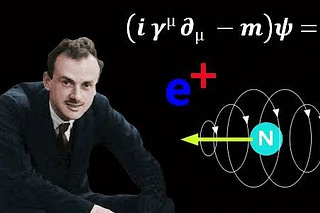
The Dirac equation is the first law of physics that had to treat matter as a field rather than as little billiard balls.
Paul Dirac wrote it in 1928 to make Schrodinger’s wave mechanics agree with Einstein’s special relativity.
The price of success was a strange set of solutions: half of them looked like ordinary electrons, but the other half carried negative energy.
Instead of throwing them away Dirac proposed that all negative energy states are already filled everywhere, an infinite sea we cannot see because it is uniform.
If one electron is missing from that sea the hole behaves exactly like a particle with the same mass as the electron but opposite charge: the positron.
Give the vacuum a kick with at least one million electron volts of energy and you can knock an electron out of the sea and leave a hole behind; what we observe is an electron and a positron appearing together.
Let the new electron fall back into the hole and both vanish, their energy carried off by light.
Quantum field theory turns this picture into arithmetic.
The electron field is written as a sum of creation and annihilation operators.
The operator b creates an electron, the operator d creates a positron, and their partners b dagger and d dagger destroy them.
The vacuum is simply the state with zero electrons and zero positrons, yet the operators still exist, ready to add or remove particles when energy, momentum and charge are available.
What looks like particles popping in and out is just the field shifting from one allowed state to another.
Conservation laws are never broken.
A virtual electron positron pair can live for a time so short that its energy cost is hidden by the uncertainty principle, but it must return the loan before anyone can cash it.
Real pairs require an external source to pay the energy bill: a fast photon, the electric field near a nucleus, or the intense curvature near a black hole.
So empty space is not empty; it is the lowest note of a continuous field that can be made to play higher notes we call electrons and positrons.
The Dirac equation tells us that matter is not stuff but activity, and what we witness as sudden appearance and disappearance is only the field changing its tune.