The Hydrogen and is electron orbit
This article presents the hydrogen electron not as a planetary orbit but as a deterministic probability field governed by the Schrödinger equation. The wavefunction ψ yields |ψ|²—the probability density—while the radial distribution P(r) = r²R(r)² accounts for spherical geometry, ensuring zero probability at the nucleus despite high |ψ|² there. Quantum numbers (n, l, mₗ) define energy, shape, and orientation: 1s orbitals peak at the Bohr radius; 2s exhibits radial nodes; 2p orbitals vanish at the nucleus with dumbbell symmetry. Framed within the author's Unification Project, this is not mysticism but lawful information geometry: the electron's "location" is a testable, mathematical invariant—reality as precise, measurable, and fundamentally informational.
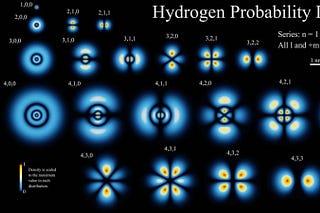
1. The Source: The Wave function (ψ)
In quantum mechanics, we don’t talk about precise orbits like planets around the sun. Instead, the electron is described by a wavefunction, ψ (pronounced “psi”).
· The wavefunction itself has no direct physical meaning.
· The physically meaningful quantity is the probability density.
· For the hydrogen atom, the wavefunction is obtained by solving the Schrödinger equation.
2. The Probability Density (|ψ|²)
The probability of finding the electron in a specific tiny volume dV is given by:
P = |ψ(r, θ, φ)|² dV
Where:
· |ψ|² is the probability density.
· (r, θ, φ) are spherical coordinates, with the proton at the origin.
· dV is the volume element.
3. The Radial Probability Density, P(r)
This is a crucial concept. The probability density |ψ|² tells you the probability per unit volume. To find out how likely you are to find the electron at a specific distance r (regardless of direction), we calculate the Radial Probability Distribution, P(r).
P(r) dr is the probability that the electron is found between r and r+dr from the nucleus.
It is calculated as:
P(r) = r² R(r)²
Where:
· R(r) is the radial part of the wavefunction, which depends on the quantum numbers n and l.
· The r² term is crucial. It comes from the fact that the volume of a spherical shell (4πr² dr) increases with r².
Key Insight: Even if |ψ|² is large at the nucleus (r=0), the probability of finding the electron there is zero because the volume of a shell at r=0 is zero. The r² factor ensures this.
4. Quantum Numbers and the “Shape” of Probability
1. n (Principal Quantum Number): Determines the energy level and the size of the probability cloud. (n = 1, 2, 3,...)
2. l (Azimuthal Quantum Number): Determines the shape of the probability cloud. (l = 0, 1, 2, ..., n-1)
· l=0 → s orbital → Spherical shape
· l=1 → p orbital → Dumbbell shape
· l=2 → d orbital → Cloverleaf shape
3. m_l (Magnetic Quantum Number): Determines the orientation in space. (m_l = -l, -l+1, ..., 0, ..., l-1, l)

Visual Examples of Probability Density
· For 1s orbital (n=1, l=0):
· |ψ|² is highest at the nucleus and decays exponentially as r increases.
· The radial probability P(r) is zero at r=0, peaks at r = a₀ (the Bohr radius, ~52.9 pm), and then falls off.
· This is the most stable, lowest energy state.
· For 2s orbital (n=2, l=0):
· |ψ|² has a spherical shell of higher probability, with a “node” (a region where the probability is zero) between the inner and outer regions.
· The radial probability P(r) has two peaks, with the highest one being farther from the nucleus than the 1s orbital.
· For 2p orbitals (n=2, l=1):
· The probability density is not spherical. It has a dumbbell shape oriented along an axis (e.g., p_x, p_y, p_z).
· A key feature: The probability density is exactly zero at the nucleus (a nodal plane). You will never find a 2p electron at the nucleus.