LIGO - Gravitational Waves
This article profiles LIGO as a deterministic instrument for decoding spacetime: twin 4-km Michelson interferometers detecting gravitational waves via laser interference. When cosmic events (black hole mergers, neutron star collisions) ripple spacetime, arm lengths shift by <1/1000th a proton's width—breaking destructive interference and registering a signal. Enhancements (Fabry–Pérot cavities, power recycling, seismic isolation) amplify sensitivity without sacrificing rigor. Dual detectors (Hanford, Livingston) ensure empirical validation via coincidence. Framed within the author's Unification Project, LIGO treats gravity not as mysticism but as lawful information: geometric distortions propagating at light speed, measurable, testable, and consistent with general relativity—a testament to physics as precise, observable, and fundamentally informational.
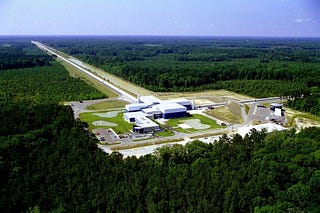
Americans also conduct great scientific experiences.
LIGO (Laser Interferometer Gravitational-Wave Observatory) is basically a pair of giant Michelson interferometers, each with 4-km-long arms, designed to detect the tiniest ripples in spacetime—gravitational waves—from distant cosmic events.
---
1. Core Principle: Interferometry
- A single laser beam is split into two perpendicular arms.
- Each beam bounces back and forth between ultra-smooth mirrors (test masses) at the ends of the arms.
- The beams recombine at a detector.
> Normally, the arms are tuned so the beams cancel out (destructive interference) → no light hits the detector.
---
2. What Gravitational Waves Do
- A passing gravitational wave alternately stretches and compresses spacetime.
- This makes one arm slightly longer, the other slightly shorter.
- The beams now travel different distances, so they no longer cancel.
- A flicker of light appears at the detector → signal!
> The change in arm length is smaller than 1/1000th the width of a proton—that’s why LIGO is one of the most sensitive instruments ever built.
---
3. Key Enhancements
- Fabry–Pérot cavities: Mirrors in each arm form a resonant cavity, so light bounces 100× more, boosting sensitivity.
- Power recycling: A mirror between laser and splitter recycles unused light, increasing power by 8000×.
- Vibration isolation: Mirrors hang from quad pendulums and sit on seismic isolation stacks to block Earth-based noise.
---
4. Two Detectors
- LIGO has two identical detectors—Hanford, WA and Livingston, LA—3000 km apart.
- A real gravitational wave must show up in both, within milliseconds, to be confirmed.
---
TL;DR
LIGO is a giant L-shaped laser ruler that measures subatomic changes in distance caused by gravitational waves from colliding black holes or neutron stars. It works by interfering laser beams and watching for tiny distortions in spacetime itself.