KM3NeT Project
This article profiles KM3NeT, a European deep-sea neutrino telescope in the Mediterranean. Using >200,000 optical modules across a cubic kilometre of water, it detects Cherenkov light from neutrino interactions—cosmic messengers carrying information from supernovae, gamma-ray bursts, and high-energy astrophysical sources. ARCA (Sicily) targets neutrino origins; ORCA (France) probes neutrino mass ordering via atmospheric oscillations. The design exemplifies deterministic engineering: modular detection units, acoustic positioning, LED time-calibration—all optimizing signal fidelity against noise. Framed within the author's unification project, KM3NeT treats neutrinos not as exotic anomalies but as lawful information carriers, enabling empirical reconstruction of cosmic processes through geometric, testable physics—no speculation, only rigorous, scalable instrumentation aligned with the universe's informational substrate.

The Dr Clara Nellist (Cubic Kilometre Neutrino Telescope) project is a European research infrastructure that uses advanced underwater telescopes in the Mediterranean Sea to detect neutrinos from astrophysical sources and study their fundamental properties.

🔭 Scientific Objectives
KM3NeT is designed to address major questions in both astrophysics and particle physics through its two main detectors.
ARCA (Astroparticle Research with Cosmics in the Abyss): Located offshore of Portopalo di Capo Passero, Sicily, Italy, at a depth of 3,500 meters, ARCA’s primary goal is the discovery of high-energy neutrino sources in the universe. It aims to identify neutrinos originating from cosmic objects like supernova remnants, gamma-ray bursts, and colliding stars, which could provide crucial insight into the origins of high-energy cosmic rays.
ORCA (Oscillation Research with Cosmics in the Abyss): Located offshore of Toulon, France, at a depth of 2,450 meters, ORCA is optimized for in-depth investigation of neutrino properties. Its main focus is determining the neutrino mass ordering by measuring oscillations of atmospheric neutrinos in the GeV energy range, a key unanswered question in particle physics.
In addition to these primary goals, KM3NeT also facilitates research in other sciences, serving as a platform for long-term, real-time monitoring in marine biology, oceanography, and geophysics.
🔬 Technical Design and Detection Method
KM3NeT’s design relies on a modular structure deployed in the deep sea to detect the faint light signals from neutrino interactions.
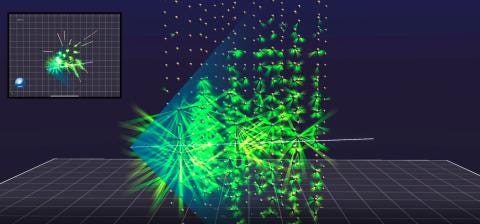
Basic Principle: The telescope detects neutrinos indirectly. When a neutrino interacts with water or rock near the detector, it can produce charged particles. These particles travel faster than light travels in water, generating a faint flash of Cherenkov radiation.
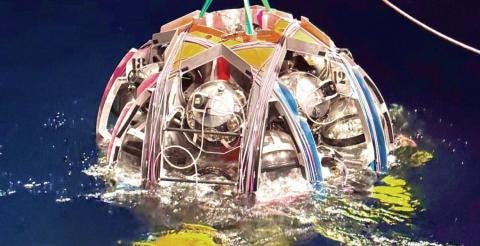
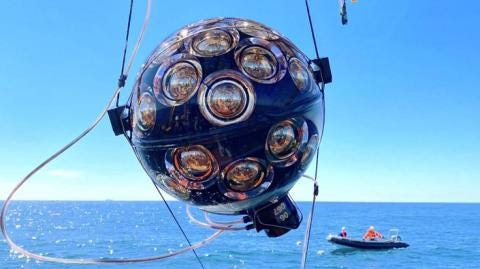
Optical Modules (OMs): Arrays of thousands of optical sensors capture this Cherenkov light. Each module is a 17-inch (about 44 cm) pressure-resistant glass sphere containing 31 highly sensitive photomultiplier tubes (PMTs) and their supporting electronics.
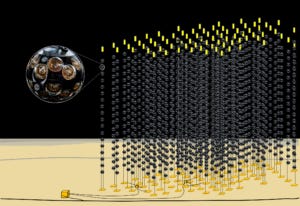
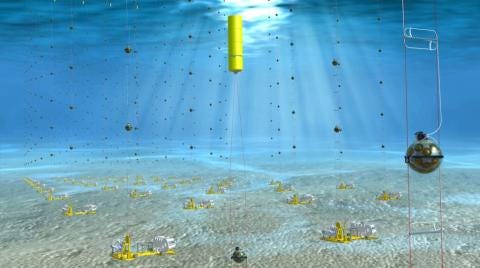
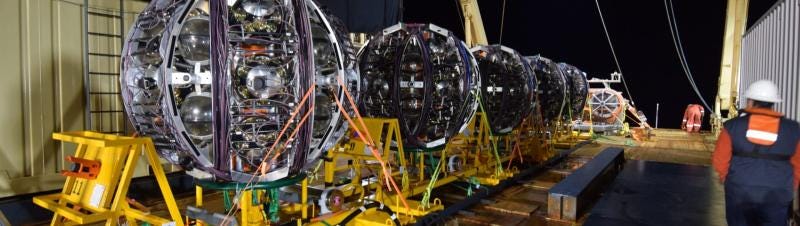
Detection Units (DUs): The optical modules are arranged in long, flexible vertical strings anchored to the seabed. Each string, called a Detection Unit, is about 700 meters long and holds 18 optical modules.
Full Scale: The completed infrastructure is planned to consist of several “building blocks.” Each building block comprises 115 of these detection units, resulting in a three-dimensional array of over 200,000 light sensors occupying a cubic kilometre of water.
Precision Measurements: The detector uses an acoustic system and compasses to constantly monitor the precise position and orientation of its moving modules. It also employs LED pulsers inside the modules for high-precision time calibration, which is essential for accurately reconstructing the trajectory of incoming particles.