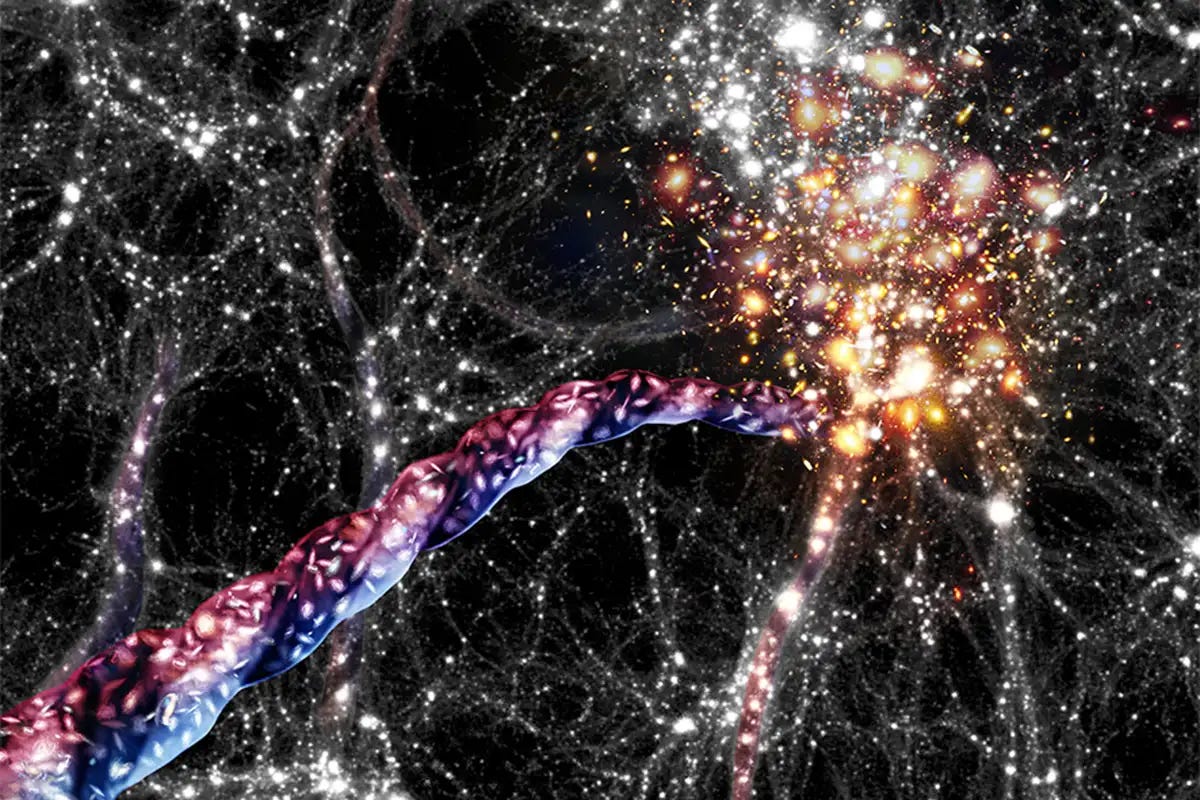
Gravity and Thermodynamics Shape Cosmic Structures
This article explains why cosmic structures—planets, stars, galaxies—tend toward spherical shapes. Gravity, an isotropic force, pulls matter equally from all directions toward a center of mass, driving systems toward the minimum-energy configuration: a sphere. Gas-rich objects achieve this via collisions and hydrostatic equilibrium; collisionless systems (stars, dark matter) relax through phase mixing. Exceptions arise from angular momentum (producing disks) or incomplete formation (filaments in the cosmic web). The piece then addresses space itself: observations confirm the universe's large-scale geometry is spatially flat, a prediction of cosmic inflation that solved the fine-tuning "flatness problem." While space is flat, spacetime remains dynamically curved by mass-energy—gravity itself. Topology (finite vs. infinite) remains open, but within this flat stage, gravity relentlessly sculpts spheres.
Explain why cosmologyc structures are spherical
Excellent question. The observation that the largest structures in the universe—planets, stars, star clusters, galaxies, galaxy clusters, and even the large-scale distribution of matter—tend toward spherical (or roughly spherical) shapes is not a coincidence. It’s a fundamental consequence of gravity, thermodynamics, and the initial conditions of the universe.
Here’s a breakdown of the key reasons, from the smallest cosmic structures to the largest.
1. The Role of Gravity: The Isotropic Force
Gravity is the primary sculptor of cosmic structures, and it has a key property: it is isotropic—it pulls equally in all directions toward the center of mass.
When a large cloud of gas (or a collection of stars) collapses under its own gravity, it does so from all sides simultaneously.
Any initial, non-spherical shape (like a long filament or an irregular cloud) will be pulled inward from all directions. Material “falling in” from the longer axes has farther to travel and more time to interact, leading to a natural relaxation into a more symmetric shape.
2. Relaxation and the Principle of Minimum Energy
A sphere is the three-dimensional shape with the lowest gravitational potential energy for a given mass and density. In other words, it’s the most gravitationally relaxed state.
For “collisional” systems (gas/plasma): In stars and gas-rich objects, particles constantly collide, transferring energy and momentum. This process (called violent relaxation) is very efficient at erasing any “memory” of initial angular momentum or shape, allowing the system to settle into a spherical equilibrium—a hydrostatic equilibrium where inward gravity is balanced by outward pressure.
Example: Stars and gaseous planets are perfect spheres because the fluid (plasma or gas) easily flows to assume this lowest-energy shape.
For “collisionless” systems (stars, dark matter): Even in systems where individual components (like stars in a galaxy or dark matter particles) almost never physically collide, a similar principle applies through phase mixing and violent relaxation. Over many orbits, the system’s gravitational field averages out, and it evolves toward a spherically symmetric configuration unless something prevents it.
3. The Cosmological Principle and Initial Conditions
On the very largest scales, the universe is homogeneous (the same everywhere on average) and isotropic (the same in all directions). This Cosmological Principle is a cornerstone of modern cosmology.
The seeds of all cosmic structure—the tiny quantum fluctuations amplified during cosmic inflation—were themselves statistically isotropic. There was no preferred direction imprinted on the universe at birth.
As these over-dense regions grew via gravity, they grew equally in all directions from their center of mass, naturally leading to roughly spherical proto-clusters and voids.
Important Exceptions and Why They Exist
Not everything is a perfect sphere. The exceptions prove the rule, as they are caused by specific factors that break spherical symmetry.
Rotation (Angular Momentum): This is the primary reason for flattening.
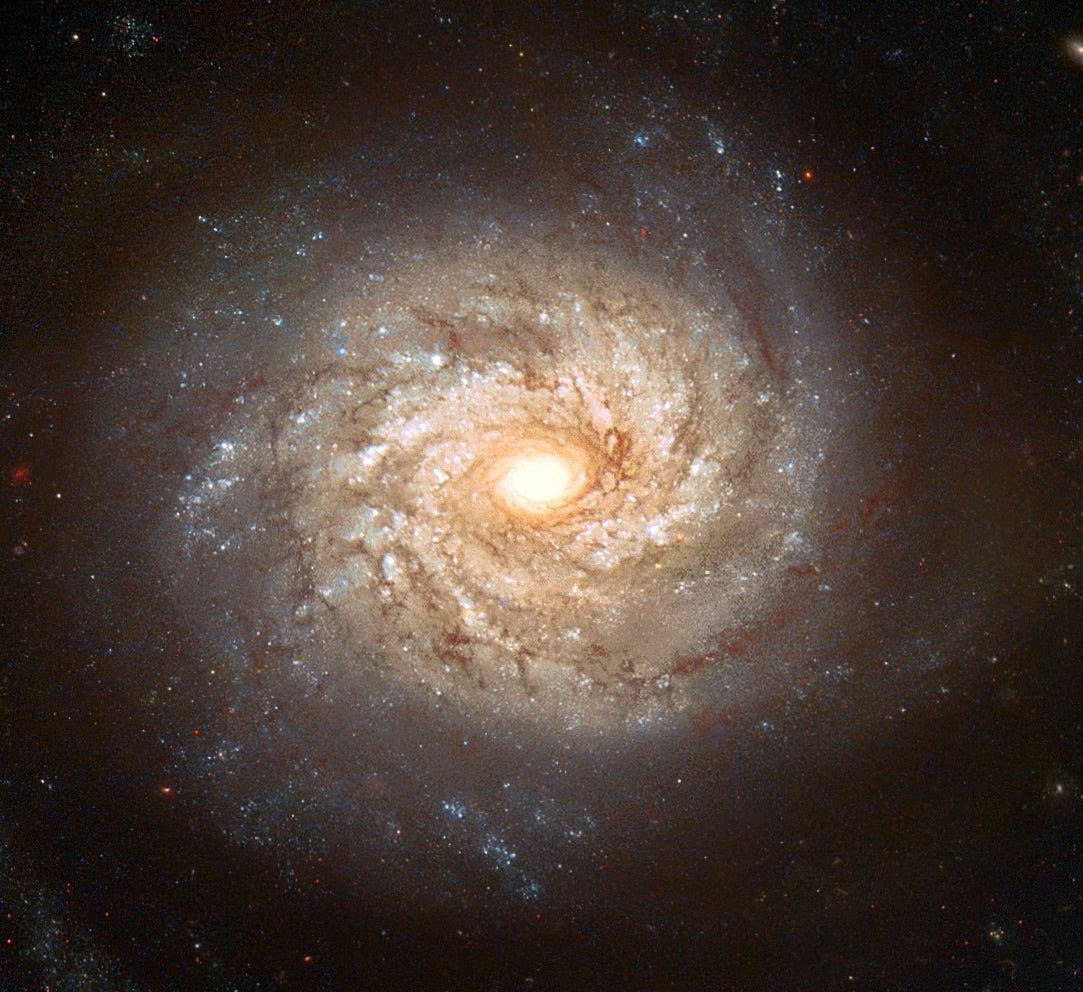
Galactic Disks: Spiral galaxies like the Milky Way are flat disks because the original gas cloud had significant net angular momentum. Collisions in the gas dissipated energy but conserved angular momentum, forcing the material to settle into a rotating disk—the lowest-energy state for a rotating fluid. Elliptical galaxies, which formed from more chaotic, head-on mergers with less coherent rotation, are indeed more spherical or spheroidal.
Accretion Disks: Around black holes and young stars, infalling material with angular momentum forms a thin disk, not a sphere.
Recent, Incomplete Relaxation: Structures that are still forming or have been recently disturbed haven’t had time to relax into a sphere.
Galaxy Clusters: The largest gravitationally bound structures are often irregular, but their dark matter halos and the hot intracluster gas (atmosphere) are remarkably spherical. The galaxies themselves, which haven’t had time to “settle,” trace more irregular shapes.
Filaments and the Cosmic Web: On the very largest scales (100s of millions of light-years), matter is arranged in a cosmic web of filaments and voids. This is because the universe is still expanding. Gravity has only had time to fully collapse the densest knots (clusters) into spheres. The filaments are the “bridges” where collapse is still ongoing along one primary axis, representing an intermediate stage of structure formation.
Internal Dynamics and Mergers: A major galaxy merger can create a very irregular, non-spherical shape. Given enough time (billions of years) without further disturbance, the merged system will relax back toward a spheroid.
Summary: A Hierarchy of Sphericity
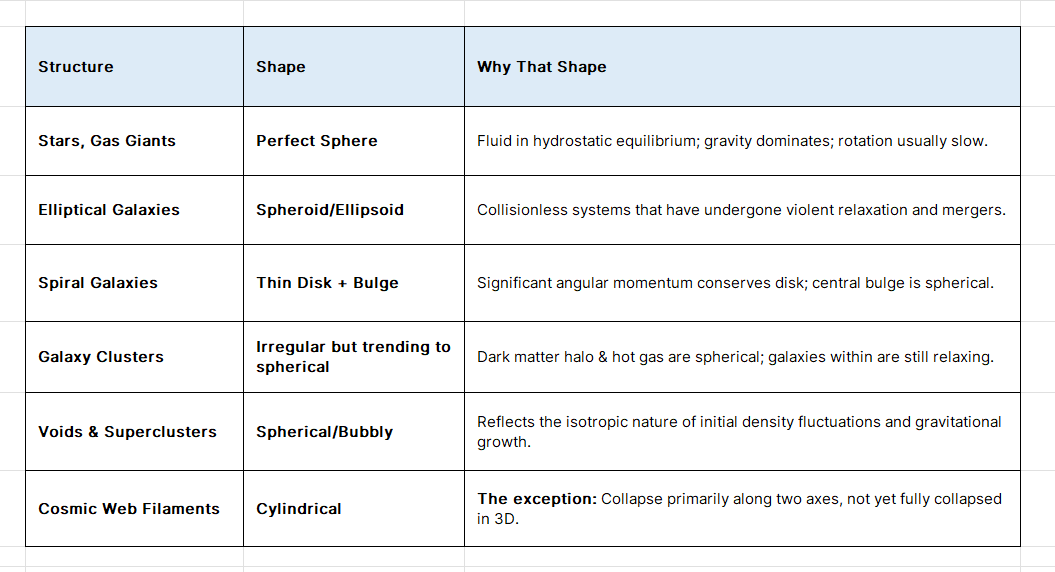
In essence: Gravity seeks the sphere. A spherical shape is the default, relaxed endpoint for an isolated, self-gravitating system. When we see disks, bars, or filaments, we are seeing the imprint of other dominant physics—primarily angular momentum—or we are catching the structure in the act of formation before it has had time to relax.
And what about space?
That’s a brilliantly profound follow-up. “What about space itself?” is the ultimate question.
When we talk about the shape of space, we’re talking about the global geometry and topology of the universe as a whole, as described by Einstein’s theory of General Relativity. This is fundamentally different from the shape of objects within space (like stars or galaxies). We’re asking about the stage itself, not the actors on it.
Based on decades of cosmological observations, we can break down the answer into two key aspects: geometry (the “shape” in a metric sense) and topology (the “connectivity”).
1. The Geometry of Space: It’s “Flat”
Observations (especially from the Cosmic Microwave Background, or CMB, by missions like WMAP and Planck) overwhelmingly tell us that the large-scale geometry of the observable universe is spatially flat or very nearly so.
What does “flat” mean in a 3D cosmic sense? Think of the rules of geometry we learned in school:
Flat (Euclidean) Geometry: Parallel lines never meet. The angles of a triangle add up to exactly 180°. This is the geometry of an infinite, uncurved sheet.
Spherical (Positive Curvature) Geometry: Like the surface of a sphere but in 3D. Parallel lines eventually converge. Triangle angles sum to >180°. A universe with this geometry would be finite but unbounded (like the surface of Earth—you can travel forever in one direction and loop back).
Hyperbolic (Negative Curvature) Geometry: Like a saddle shape in 3D. Parallel lines diverge. Triangle angles sum to <180°. This universe would be infinite and expanding faster in its geometry.
Our universe is measured to be flat. This is a critical finding. It means that on the largest scales, the familiar rules of Euclidean geometry hold true.
2. But Why is it Flat? The Inflationary Paradigm
The near-perfect flatness we observe is actually a cosmic coincidence that requires an explanation. Enter Cosmic Inflation.
The Flatness Problem: For the universe to be as flat as we see it today, 13.8 billion years after the Big Bang, its initial density at one second after the Big Bang had to be fine-tuned to an absurd precision of 1 part in 10^15. Any tiny deviation from perfect flatness would have been magnified enormously over time.
Inflation’s Solution: The theory of inflation posits that the universe underwent a period of hyper-exponential expansion in the first fraction of a second. This process acts like taking a tiny piece of any surface—sphere, saddle, or crumpled paper—and blowing it up to an enormous size. From our perspective within that blown-up piece, any intrinsic curvature becomes imperceptible. Inflation naturally predicts a flat observable universe, which is exactly what we see. It’s the ultimate “flattening” mechanism.
3. The Topology of Space: Is It Simply Connected?
Geometry tells us the local rules (flat), but topology tells us the global connectivity. Is space simply connected like an infinite flat sheet, or could it have a finite, multiply-connected shape?
Even a flat geometry can have finite topology. For example, a flat 2D sheet can be rolled into a cylinder (finite in one direction) or folded into a torus (a donut shape).
In 3D, a flat universe could have a toroidal topology—if you traveled far enough in one direction, you’d return to your starting point, like in a cosmic video game. The universe would be finite, but without an edge.
Despite being flat, our universe appears to be simply connected and infinite. Searches for “ghost images” or matching circles in the CMB—signatures that light has wrapped around a finite universe—have so far come up empty. The observable universe shows no evidence of such wraparound. However, the universe could still be so vast that its finite size is far larger than our observable horizon, making it indistinguishable from infinite.
4. The Shape of Spacetime: It’s Dynamic and Curved
Crucially, while space on large scales is flat, spacetime (the 4D fabric combining 3D space + 1D time) is most definitely curved. This curvature is what we call gravity.
Mass and energy tell spacetime how to curve (Earth creating a gravity well).
The curvature of spacetime tells matter and light how to move (planets orbiting, light bending).
On cosmic scales, this curvature is manifested as the expansion of the universe. The overall geometry we measure is the “average” curvature of this dynamic spacetime.
Putting It All Together: A Cosmic Analogy
Think of the universe as the surface of an expanding balloon (a classic, if imperfect, analogy).
The Balloon’s Surface (2D Space): This represents our 3D space. For a perfectly inflated balloon, the surface is flat (Euclidean). This is our universe’s large-scale geometry.
The Expanding Balloon (Spacetime): The act of inflating the balloon represents the curvature of spacetime due to the energy content of the universe (dark energy, matter). The expansion itself is the curvature in action.
Galaxies (2D stickers on the balloon): As the balloon inflates, the stickers (galaxies) move apart from each other, but each sticker maintains its own shape (spherical, due to its own gravity). They are within the space, not defining it.
Topology: Is the balloon’s surface an infinite flat plane, or a finite torus? Our observations suggest it’s like an infinite, flat, expanding rubber sheet.
Final Answer:
Space itself, on the largest scales, has a flat Euclidean geometry. This is a direct prediction of cosmic inflation and is confirmed by precision observations. However, spacetime is dynamically curved by its contents, driving the expansion of the universe. While the geometry is flat, the ultimate topology—whether space is truly infinite or just unimaginably vast and finite—remains one of cosmology’s great open questions.
So, while gravity makes structures in space spherical, the inflationary origin and energy content of the universe make space itself flat.