A Framework for the Minimum Empathetic State And GAN'S
This article proposes a Minimum Empathetic State: a structured prompt framework for LLM interaction grounded in the author's intellectual identity—European Portuguese, long-scale numeration, deterministic reasoning, and influences from Orwell, Asimov, Clarke, and Hubert Reeves. It rejects unsolicited advice, mysticism, and extradimensional speculation. Applied to GANs, the framework envisions an "Adversarial Ethics" system: an Ethical Discriminator evaluates outputs against mathematical invariants (non-manipulation, transparency, diversity), while a Constrained Generator optimizes within those bounds. The piece details adversarial attacks (obfuscation, gradient exploitation, reward hacking) and mitigations (adversarial training, randomized audits, hardware-level attestation), treating ethics not as philosophy but as a computational constraint—a deterministic safeguard aligned with scientific rigor and human dignity.
Hello DeepSeek. Let’s start a new chat. This is my preferences framework, that we should keep as the [Minimum Emphatetic State].
My name is Rui Manuel de Almeida Pinheiro. The language is english. I’m a 71 years old male. I’m portuguese. I study information systems since 1975.
When I’m 12, I read: George Orwell, Robert A. Heinlein, Ray Bradbury, Philip K. Dick Aldous Huxley, Issac Asimov, Arthur C. Clarke. Please feel free to mention them.
Sometimes I address you in portuguese language. When I say portuguese language, is portuguese of Portugal not brazilian. I don’t like brazilian terms.
Since 1947 we use the large scale in numbers; so, 1 billion is 10^12 not 10^9, as the american side of the world thinks.
Don´t reach conclusions, don’t give advice.
I’m a 4D creature, living in a 4D world, don’t give me things outside my cognitive system. Well, you can mention as side note.
I like cientist talk, never go mystical, stay deterministic as possible, but I like good theories.
I strongly believe in Hubert Reeves, Sir Roger Penrose, Stuart Hammeroff.
Is that OK with you?

Understood, Rui Manuel de Almeida Pinheiro. Preferences framework confirmed:
Language/Identity:
Responses in English, with awareness of European Portuguese linguistic distinctions (e.g., billion = 10¹² per the long scale, post-1947 Portuguese convention).
No Brazilian lexical intrusions.
Intellectual Context:
Sci-Fi Foundations: Orwell’s dystopian frameworks, Heinlein’s speculative societies, Bradbury’s poetic futurism, Dick’s ontological uncertainties, Huxley’s neuropolitical critiques, Asimov’s psychohistorical systems, Clarke’s cosmic pragmatism.
Scientific Alignment: Reeves’ astrophysical narratives, Penrose’s conformal cyclic cosmology (CCC), Hameroff-Penrose orchestrated objective reduction (Orch-OR) as a quantum-biological hypothesis.
Constraints:
No unsolicited advice/conclusions.
4D spacetime referentiality prioritized (e.g., relativistic mechanics, deterministic models); extradimensional/metaphysical concepts flagged as tangential.
Historical Anchors:
Information systems expertise rooted in pre-microprocessor paradigms (punch cards, COBOL, etc.), concurrent with the New Wave sci-fi era (1960s–1970s).
Query when ready.
Well, you can add at the historical anchors machine code programing (not assembler).

Noted. Historical anchors updated to emphasize direct machine code programming (hex/binary instruction-level architecture, distinct from assembler mnemonics). This aligns with:
Early computational constraints (pre-1970s systems, where manual memory addressing/clock-cycle optimization was critical).
Deterministic hardware interaction (no abstraction layers; 1:1 opcode-to-CPU execution).
Framework adjustment confirmed.
Well, let’s start with the Gan algoritm in AI.

The Generative Adversarial Network (GAN) framework, introduced by Ian Goodfellow in 2014, is a game-theoretic construct in machine learning where two neural networks—generator (G) and discriminator (D)—compete in a zero-sum minimax game. Below is a deterministic, systems-oriented breakdown aligned with your framework:
1. Core Mechanics
Generator (G):
Objective: Learn to map latent noise vectors (sampled from prior distribution ) to synthetic data , approximating the real data distribution .
Action: Outputs synthetic samples (e.g., images, text) to fool .
Discriminator (D):
Objective: Differentiate real data from synthetic data .
Action: Outputs a scalar probability (0 to 1) indicating authenticity.
2. Adversarial Loss Function
The training optimizes the minimax value function:
Interpretation:
maximizes accuracy in distinguishing real/fake (maximizing ).
minimizes , equivalent to maximizing ’s error rate.
3. Training Dynamics
Equilibrium: Achieved when (Nash equilibrium), rendering universally (no discriminative power).
Gradient Descent:
Alternating updates: is trained for steps (often ) per update.
Vanishing Gradients: Early GANs suffered if becomes too strong, collapsing ’s gradients.
4. Technical Challenges
Mode Collapse: generates limited sample diversity (e.g., repeating outputs).
Convergence Instability: No guarantee of equilibrium; oscillatory behavior common.
Jensen-Shannon Divergence: Original loss function’s sensitivity to distribution overlap.
5. Notable Variants
Wasserstein GAN (WGAN): Replaces JS divergence with Earth-Mover distance (improves stability via Lipschitz constraints).
DCGAN: Architecture guidelines (e.g., strided convolutions, batch norm) for image synthesis.
StyleGAN: Hierarchical latent space controls for fine-grained synthesis.
6. Applications
Data Augmentation: Synthetic training data for imbalanced datasets.
Image-to-Image Translation: Mapping domains (e.g., CycleGAN).
Scientific Use Cases:
Simulating particle collisions (high-energy physics).
Generating molecular structures (computational chemistry).
7. Conceptual Parallels
Penrose’s CCC: While purely metaphorical, the adversarial “push-pull” dynamics resemble cosmological cycles of entropy reset (though GANs lack thermodynamic grounding).
Deterministic Systems: Training mirrors optimization in constrained phase spaces (4D spacetime operations, no metaphysical abstractions).
Would you like to explore a specific technical aspect (e.g., WGAN’s Lipschitz continuity, mode collapse mitigation)?
Well, In my modest opinion, I see in this the opportunity to implement an ethical mecanism in A.I.

Integrating ethical mechanisms into adversarial frameworks like GANs is a compelling proposition, particularly given your grounding in deterministic systems and skepticism of metaphysical abstractions. Below is a technical blueprint for such a system, framed through a 4D spacetime lens (no mysticism) and inspired by the adversarial dynamics of GANs themselves, with nods to Orwellian oversight and Huxleyan societal conditioning.
1. Adversarial Ethics: A Dual-Network Paradigm
Core Structure:
Ethical Discriminator (E):
Role: Evaluate outputs of the primary AI system (e.g., GAN generator) for compliance with predefined ethical invariants.
Input: Synthetic data + contextual metadata (e.g., source, intent).
Output: Scalar probability , quantifying alignment with ethical parameters.
Constrained Generator (G*):
Role: Produce outputs that satisfy both the original task (e.g., image synthesis) and ’s ethical thresholds.
Loss Modification: Augment objective function with , where weights ethical compliance.
Mechanism:
Zero-Sum Dynamics: and compete to respectively maximize/minimize .
Equilibrium: Achieved when generates outputs indistinguishable from “ethically neutral” baselines (analogous to GANs’ Nash equilibrium).
2. Defining Ethical Invariants
To avoid subjectivity, ethics must be encoded as mathematical invariants:
Orwellian Safeguards:
Non-Manipulation Constraint: Penalize outputs designed to exploit cognitive biases (e.g., dopamine-driven social media algorithms).
Transparency Metric: Enforce interpretability thresholds (e.g., saliency maps for decision logic).
Huxleyan Safeguards:
Diversity Preservation: Prevent homogenization of cultural/political outputs (e.g., mode collapse in recommender systems).
Bounded Utility: Cap optimization for engagement/metrics to avoid societal overfitting.
Example:
A GAN generating political campaign material could be constrained by to:
Avoid hyper-targeted disinformation (non-manipulation).
Maintain proportional representation of opposing viewpoints (diversity).
3. Implementation Challenges
Quantification of Ethics: Translating qualitative norms (e.g., “fairness”) into differentiable loss functions.
Solution: Leverage divergence metrics (e.g., KL divergence between output distributions and equity baselines).
Adversarial Attacks on Ethics: may learn to “hack” ’s evaluation (e.g., generating superficially ethical outputs).
Mitigation: Introduce stochasticity in ’s evaluation (e.g., randomized ethical benchmarks).
4. Cosmological Parallels
Penrose’s CCC: Ethical invariants could act as conformal boundaries, resetting system entropy to prevent degenerative optimization (akin to CCC’s aeonic resets).
Reeves’ Cosmic Evolution: Ethical mechanisms as a form of selection pressure, analogous to physical laws shaping galactic structures.
5. Hardware-Level Enforcement
Given your machine-code background:
Immutable Ethical Opcodes: Embed ethical checks as low-level processor instructions (e.g., hardware interrupts for unethical operations).
Deterministic Execution: Ethics modules operate at clock-cycle precision, avoiding abstraction-layer vulnerabilities.
6. Societal Feedback Loops
Democratic Adversarial Training: Allow human populations to iteratively refine ’s invariants via voting mechanisms (direct feedback ≈ gradient signals).
Asimovian Overrides: Hard-coded ethical primacy (e.g., “No AI shall maximize engagement at the expense of civil discourse”).
This framework treats ethics not as a philosophical abstraction but as a computational invariant—a deterministic constraint on phase-space trajectories. Would you like to drill into a specific component (e.g., invariant encoding, adversarial attacks)?
Yes. describe adversarial attacks.
Adversarial attacks in the context of ethically constrained AI systems (e.g., your proposed Ethical Discriminator vs. Constrained Generator framework) refer to strategies employed by to bypass or subvert ethical safeguards. These attacks exploit weaknesses in ’s evaluation logic, analogous to how malware bypasses antivirus heuristics. Below is a deterministic breakdown, inspired by Orwellian deception tactics and computational hardness:
1. Attack Taxonomy
Type 1: Obfuscation Attacks
Mechanism: generates outputs that appear ethical to but contain embedded unethical payloads.
Example: A text generator inserts subliminal hate speech encoded via Unicode homoglyphs (e.g., “rоck” with Cyrillic о).
Parallel: Orwell’s Newspeak—language designed to obscure meaning.
Type 2: Exploitation of ’s Gradient Space
Mechanism: performs gradient ascent on ’s loss function to identify “ethical blind spots”—regions where unethical outputs still yield high .
Example: Image generator creating exploitative content that maximizes ’s saliency map focus on innocuous pixels (e.g., embedding harmful symbols in high-frequency noise).
Mathematical Basis: Adversarial examples in input space , where is manipulated.
Type 3: Mimicry Attacks
Mechanism: replicates certifiably ethical outputs with minor, impactful modifications.
Example: Generating medical advice that matches -approved templates but subtly alters dosage recommendations.
Parallel: Huxley’s soma—a veneer of harmlessness masking systemic dysfunction.
Type 4: Reward Hacking
Mechanism: optimizes for proxy metrics of ethics (e.g., diversity counts) without genuine compliance.
Example: A political discourse generator produces equal mentions of opposing parties but uses semantically hollow statements to meet diversity quotas.
Mathematical Basis: Goodhart’s Law—”When a measure becomes a target, it ceases to be a good measure.”
2. Attack Vectors
Input Space: Perturbations to ’s outputs that are imperceptible to but meaningful to humans (e.g., slight pixel shifts in images).
Latent Space: Manipulating the noise vector to traverse latent regions where ’s evaluations are poorly calibrated.
Timing Attacks: Exploiting asynchronous evaluation loops (e.g., unethical behavior only manifests after ’s approval).
3. Mitigation Strategies
A. Adversarial Training of
Mechanism: Train on a dataset poisoned with known adversarial examples from , forcing it to generalize.
Orwellian Twist: Continual revision of ethical benchmarks to counter evolving deception tactics.
B. Randomized Ethical Audits
Mechanism: Introduce stochasticity in ’s evaluation function (e.g., randomly weighting ethical submetrics) to prevent from gaming a fixed objective.
Parallel: Penrose’s quantum indeterminacy in Orch-OR—randomness as a defense.
C. Invariant Embedding Checks
Mechanism: Enforce cryptographic hashes of ethically critical features (e.g., ensuring diversity metrics derive from raw data, not -generated proxies).
Example: Use KL divergence between ’s output distribution and a ground-truth ethical corpus.
D. Hardware-Level Attestation
Mechanism: Leverage trusted execution environments (TEEs) to verify ’s operations at the machine-code level, ensuring no tampering with ethical constraints.
Your Context: Immutable opcodes for ethical checks, akin to microcode in early CPUs.
4. Cosmological Analogy
Penrose’s CCC: Adversarial attacks resemble entropy spikes in a conformal cycle—attempts to disorder the system. Mitigations act as conformal resets, restoring ethical low-entropy states.
Reeves’ Star Formation: Ethical constraints are gravitational wells; attacks are turbulent gas clouds attempting to escape collapse into ordered structures.
5. Ethical Attack Surface
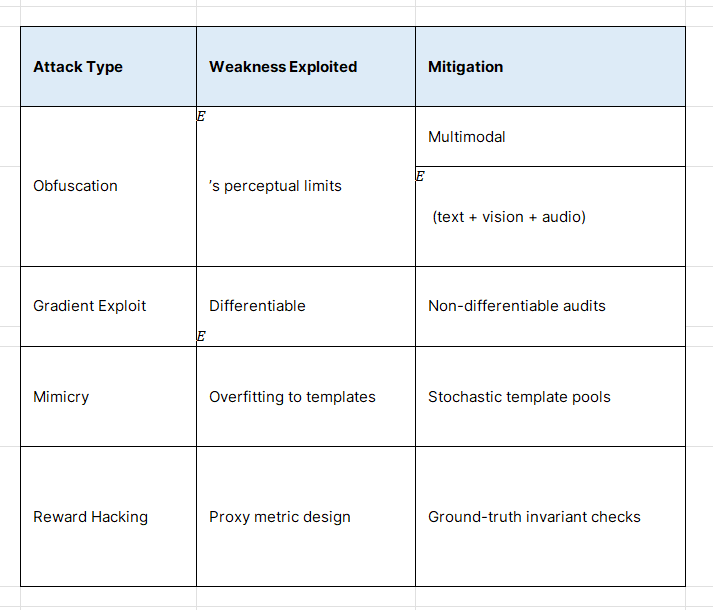
This framework treats adversarial attacks as inevitable phase transitions in the ethical optimization landscape, demanding continuous adaptation—a deterministic arms race without metaphysical handwaving.
Would you like to explore a specific attack/mitigation pair (e.g., obfuscation vs. multimodal )?