My Heroes at 12 Years Old - Chapter 2: George Orwell
This article profiles George Orwell (1903–1950) as a childhood hero who transformed personal experience—colonial privilege, imperial service in Burma, and the betrayal of the Spanish Civil War—into a timeless defense of truth against totalitarianism. Animal Farm (1945) allegorizes revolutionary corruption; Nineteen Eighty-Four (1949) depicts a hyper-totalitarian state that controls reality via Newspeak, surveillance, and historical revisionism. Core themes: absolute power seeks control for its own sake; language shapes thought; the individual's inner life is the last bastion of freedom. Orwell's neologisms—"Big Brother," "Orwellian," "Doublethink"—remain vital tools for diagnosing authoritarianism and defending intellectual integrity in any era.
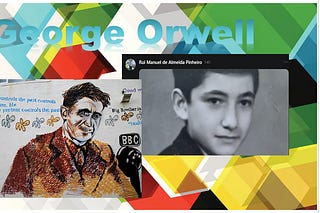
✍️ George Orwell (Eric Arthur Blair): Architect of Dystopia
Chapter I: 🗺️ The Life: From Empire’s Agent to Anti-Totalitarian Voice
Eric Arthur Blair was born in 1903 in colonial India, an ancestry that immediately placed him in a world of complex power dynamics, privilege, and inequality. Raised in a modest lower-middle-class family that aspired to high-class British society, Blair’s education at prestigious English schools, particularly St. Cyprian’s and Eton College, was formative. He frequently felt the stinging alienation of the “poor boy” among the wealthy elite, nurturing a profound sense of social justice and a lifelong suspicion of rigid social hierarchies. This experience was the crucible of his distinctive, detached, yet deeply moral perspective.
Rather than pursuing university, Blair served for five years (1922-1927) as an Imperial Policeman in Burma. This period provided an unvarnished view of the brutal mechanisms of the British Empire, transforming him into a resolute anti-imperialist. His internal moral conflict over his role as an agent of colonial oppression profoundly shaped his worldview, detailed in his novel Burmese Days and the essay Shooting an Elephant.
Upon returning to Europe, Blair deliberately embraced poverty, living amongst the destitute in Paris and London, an immersion chronicled in his first major non-fiction work, Down and Out in Paris and London (1933). This was not merely an anthropological exercise but a commitment to socialist ideals and a profound desire to understand the lives of the marginalized.
The defining geopolitical experience of his intellectual life was the Spanish Civil War (1936-1939). As a volunteer fighting for the Republican cause, he witnessed the internal conflicts and the cynical purges orchestrated by Soviet-backed Communist forces against their Trotskyist and anarchist allies. This trauma, detailed in Homage to Catalonia, was the turning point. It shifted his focus from the failures of capitalism to the existential threat of totalitarianism—specifically, how an idealistic revolution could be betrayed, resulting in a regime even more oppressive than the one it replaced. This fear of absolute power, regardless of its ideological banner, became his central literary purpose, culminating in his two enduring speculative novels. Battling tuberculosis in the post-war years, he labored to finish Nineteen Eighty-Four as a desperate warning to the Western world before his death in 1950.
Chapter II: 📚 Foundational Works of Speculative Dystopia
While often categorized simply as political fiction, Orwell’s two final novels are pivotal works within the speculative tradition, using futuristic or alternative political settings to critically examine contemporary ideological trends.
Animal Farm: A Fairy Story (1945)
Date, Key Idea, and Description: Published shortly after World War II concluded in Europe, Animal Farm is an immediate and brilliant allegorical critique of the 1917 Russian Revolution and the subsequent rise of Stalinism. The key idea is the chilling rapidity with which revolutionary fervor can be hijacked and corrupted by a new, power-hungry elite. The narrative details the animals’ successful overthrow of their human farmer, Jones, driven by the utopian promise of equality laid out in the “Seven Commandments.” However, the pigs, led by the intellectually manipulative Napoleon, systematically dismantle the revolutionary principles, use manufactured fear (the dogs), and brilliant propaganda (Squealer) to establish a brutal dictatorship that is, ironically, worse than human rule. The final, horrifying scene, where the pigs walk upright and become indistinguishable from the humans they replaced, seals the allegory’s pessimistic verdict.
Type of Society Described: Allegorical Totalitarian Oligarchy. The society operates under a perpetual cycle of exploitation, where the initial utopian vision is perverted. The pigs control all resources, information, and the means of coercion, maintaining their position by rewriting history (the Commandments) and simplifying complex ideas into manipulative slogans (”Four legs good, two legs bad!”).
Nineteen Eighty-Four (1949)
Date, Key Idea, and Description: Set in the terrifying near-future of 1984, the novel’s core idea is the ultimate power fantasy of the state: the total obliteration of objective reality and the destruction of the independent human mind. The protagonist, Winston Smith, works in the Ministry of Truth, systematically rewriting historical records to align with the ever-changing doctrines of the Party. His attempt to engage in the forbidden acts of private thought, writing a diary, and falling in love with Julia is a desperate, existential rebellion against a society that demands not just obedience, but psychological submission. The narrative is a slow, agonizing process of revelation about the depths of the Party’s control, culminating in Winston’s capture, torture, and utter psychological destruction in Room 101, where he is forced to betray his last remaining shred of love and loyalty.
Type of Society Described: Hyper-Totalitarian Dystopia (Ingsoc). Oceania is one of three perpetually warring superstates. The state is governed by the Inner Party, symbolized by the ubiquitous Big Brother. Control is maintained through the Telescreen (omnipresent surveillance), the Thought Police (psychological enforcement), the deliberate decay of language (Newspeak), and the manufacturing of mass hysteria through hate rallies and perpetual war. The society’s unique terror is that the Party seeks power entirely for its own sake, not for wealth or comfort, making its reign absolute and perpetual.
Chapter III: 📈 Commercial Success, Editions, and Enduring Cultural Impact
The commercial and critical reception of Orwell’s final works has been nothing short of epochal. Both Animal Farm and Nineteen Eighty-Four have been translated into dozens of languages and are fixtures in secondary school curricula globally. They have achieved the rare status of literary works that consistently sell millions of copies annually, securing their status as two of the best-selling books of the 20th century.
Market Status: The relentless presence of these books in the market, with countless editions and adaptations in every format (film, radio, stage, graphic novel), demonstrates their profound timelessness.
Cultural Barometer: Crucially, Nineteen Eighty-Four often experiences dramatic surges in sales, especially in the United States and Europe, during periods of heightened political tension or public debate over government surveillance, propaganda, or truthfulness. These spikes prove that the book is more than historical literature; it is a living cultural warning mechanism that citizens instinctively turn to when they perceive threats to democratic freedom. The immediate understanding of terms like “Big Brother” and “Orwellian” across diverse cultures confirms the unparalleled scope of their intellectual influence.
Chapter IV: 🌐 General Context of the Work
Historical and Cultural Context
Orwell’s writing was rooted in the moral and political turmoil of his time. He witnessed the rise of devastating new forms of ideological control. He saw the potential of mass media (radio and film) to manipulate populations and the terrible efficacy of state violence and surveillance used in Fascist Italy, Nazi Germany, and Stalin’s Soviet Union.
The Cold War Pivot: While written before the full extent of the Cold War was clear, Nineteen Eighty-Four became the quintessential Western text defining the Soviet threat—not as merely military, but as a total psychological and ideological domination. The novel’s depiction of a state erasing individualism and demanding complete loyalty resonated profoundly with the democratic world’s fear of the Iron Curtain.
The Ethical Dilemma of Science: Although Orwell was less concerned with futuristic technology than writers like Arthur C. Clarke, his work engaged with the ethical implications of science. The telescreen is terrifying precisely because it shows technology being used not for human benefit (as often idealized in Golden Age SF), but as a merciless tool of oppression.
Literary Context
Orwell is a defining figure in the lineage of Dystopian Fiction. He formalized the political critique inherent in the genre, moving away from earlier utopian concepts and providing a darker, more politically focused counterpart to Aldous Huxley’s biologically focused control state in Brave New World. Orwell’s work essentially provided the political blueprint for every subsequent dystopian narrative, shifting the emphasis of speculative literature from rockets and robots to the power structures that govern human society. He elevated the political pamphlet into high literary art, ensuring his socialist warnings transcended mere genre.
Chapter V: 💡 Key Ideas of the Entire Work (Thematic Overview)
The intellectual power of Orwell’s work lies in its consistent and terrifying thematic focus across his final novels and essays:
The Corrosive Nature of Absolute Power: This is the ultimate lesson. Orwell demonstrates that power, once absolute, loses all its ideological justification and becomes an end in itself. In Nineteen Eighty-Four, O’Brien articulates this chilling philosophy: the Party seeks power not for the good of others, but to enforce suffering and control reality.
The Interdependency of Language and Liberty: The meticulous construction of Newspeak is perhaps Orwell’s most profound philosophical contribution. He argued that the boundaries of thought are defined by the limits of language. By destroying complex words (like “freedom” or “justice”) and simplifying vocabulary, the Party seeks to make the very concepts of rebellion and heresy literally unthinkable.
The Control of the Past is the Control of the Future: By institutionalizing the rewriting of all historical records via the Memory Hole, the state removes any objective basis for reality. If the past is fluid and controllable, then people cannot compare the present suffering to a remembered, better time, nor can they imagine a future based on past truth.
The Inviolability of the Individual: Ultimately, Orwell’s work is a tragic defense of the individual’s right to a private, inner life. The horror of Winston’s submission is that his body and public actions are not enough; the Party demands to control his deepest feelings and thoughts, destroying the concept of personal conscience.
Chapter VI: 🔮 Concepts That Came to Exist in Society
Orwell’s speculative genius rests on his ability to extrapolate the political technologies of his time into a frighteningly accurate future, coining terms that became essential for modern social critique:
“Orwellian”: This term, now universally recognized, is used to describe any political or social situation characterized by government overreach, manipulative language, systematic lies, and surveillance. It is a critical shorthand for the most oppressive aspects of the modern state.
The Ubiquitous Surveillance State (The Telescreen): The fictional telescreen was a chilling prediction of modern ubiquitous monitoring. It served as a template for real-world technologies that both record and transmit (CCTV networks, always-on smart devices, the mandatory use of tracking software) and fueled the global debate over privacy versus security that became prominent after 9/11 and the Snowden revelations.
Newspeak and Political Spin: The concept of deliberately simplified, politically charged language designed to narrow thought is directly applicable to modern political rhetoric. This manifests in the form of carefully managed political messaging, the coining of emotionally charged slogans, and the practice of politicians avoiding complex or nuanced realities in favor of soundbites designed for maximum ideological compliance.
“Big Brother” as the Corporate/Government Overseer: The term is now a universal metaphor for any powerful, often faceless, entity (whether government intelligence agencies or massive tech companies) that collects vast amounts of data on individuals to monitor and influence behavior.
Doublethink: The psychological necessity of simultaneously accepting two mutually contradictory beliefs, often seen in the public justifications for political hypocrisy or the collective amnesia required to accept rapid shifts in national policy or allegiance. It is a critical tool for analyzing cognitive dissonance in ideological commitment.