My Heroes at 12 Years Old - Chapter 3: Robert A. Heinlein
This article profiles Robert A. Heinlein (1907–1988) as a childhood hero who championed individual liberty, technical competence, and speculative social experimentation. His "Future History" series imagined societies built on meritocracy, contractual relationships, and frontier ethics—most notably in The Moon Is a Harsh Mistress, where lunar colonists revolt using game theory and decentralized coordination. Heinlein's provocative themes—free love, radical self-reliance, and questioning inherited morality—challenged young readers to think beyond convention. While controversial for his libertarian ideals and occasional didacticism, his narrative ingenuity and respect for readers' intelligence left an indelible mark. For the author at age 12, Heinlein offered not answers, but a method: rigorously imagine alternatives, test them logically, and never confuse tradition with truth.
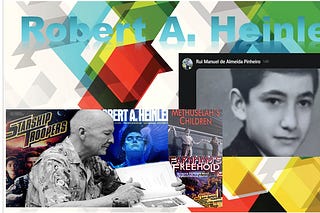
🚀 Robert A. Heinlein: The Dean of Science Fiction
Robert Anson Heinlein (1907–1988) was one of the “Big Three” writers who defined the genre’s Golden Age, alongside Isaac Asimov and Arthur C. Clarke. His work, characterized by its scientific rigor, fierce individualism, and controversial social politics, transformed science fiction from an esoteric pulp genre into a major cultural force.
Chapter I: ⚓ The Life: Competence and the Military Mind
Robert A. Heinlein’s background was instrumental in shaping his fiction, lending his narratives a unique sense of technological pragmatism and hierarchical order. Born in Missouri in 1907, a place and time he often romanticized, he was rooted in the values of the American heartland. However, his life took a defining turn when he attended the United States Naval Academy, graduating in 1929.
His five years as a naval officer, serving on the first modern aircraft carrier, the USS Lexington, instilled in him a profound respect for discipline, teamwork, and, most importantly, technical competence. Heinlein’s heroes are rarely academics; they are engineers, mechanics, pilots, and military professionals who solve problems using applied intelligence and skill. His enforced early retirement from the Navy due to tuberculosis in 1934 marked a sudden end to his first career, but his engineering mindset remained. After studying physics and mathematics, he briefly engaged in politics, running for the California State Assembly as a left-wing candidate backed by the socialist End Poverty in California (EPIC) movement. The failure of this campaign left him broke and disillusioned with conventional political processes, leading him to his final, successful career: professional writer.
His experiences—the rigorous structure of the military, the pragmatism of engineering, and the disillusionment with politics—created the fertile ground for his distinctive “Future History” series and his exploration of radical social structures. Heinlein started writing for Astounding Science Fiction in 1939, and quickly became known for domesticating the future, making the unimaginable feel real and immediate.
Chapter II: 🌌 Foundational Works and Controversial Societies
Heinlein’s career is marked by several pivotal novels that propelled him outside the genre and ignited furious social and political debates.
Starship Troopers (1959)
Key Idea: The political and ethical contract between the individual and the state; the notion that true citizenship (and the right to vote) must be earned through self-sacrificing, dangerous military service.
Description: Told from the perspective of Juan “Johnny” Rico, a young Filipino man who joins the Mobile Infantry to fight in a war against a hostile alien race known as the Arachnids or “Bugs.” The narrative details Rico’s brutal training and subsequent military career in a future society that has outsourced political power to a class of highly trained veterans. The book is structured around military training and philosophical lectures on morality, duty, and effective governance.
Type of Society Described: Militaristic Oligarchy/Franchise Democracy. This society is highly stable and competent, but only citizens who have completed a term of “Federal Service” (often military, but sometimes civil) are granted the political franchise, reserving the right to vote and hold office for those proven willing to prioritize societal needs over personal safety.
Stranger in a Strange Land (1961)
Key Idea: The radical rejection of conventional human social, religious, and sexual norms through the eyes of an innocent, super-competent outsider.
Description: Valentine Michael Smith is a human orphan raised entirely by Martians, who returns to Earth as an adult with psychic powers, vast wealth, and an almost childlike ignorance of human customs. Smith is initially exploited, then educated by lawyer/philosopher Jubal Harshaw, and eventually evolves into a messianic figure. He founds a new religion based on the Martian language and philosophy (”grokking”), advocating for free love, spiritual development, and the transcendence of physical limitations.
Type of Society Described: Culturally Conservative Dystopia undergoing Revolution. Earth society is shown to be materialistic, puritanical, and plagued by shallow religious movements. Smith’s movement represents a counter-cultural, quasi-anarchistic revolution aimed at dissolving entrenched moral and political structures in favor of radical personal freedom and communal, familial bonds.
The Moon Is a Harsh Mistress (1966)
Key Idea: The successful struggle for political independence based on libertarian principles of self-ownership and the efficient use of technology.
Description: Set in the late 21st century, the Moon Colony, known as “Luna,” functions as Earth’s penal colony and resource mine. The Lunar inhabitants (”Loonies”) are effectively governed and exploited by the Earth Federation. The story follows a charismatic group of conspirators—including the one-armed technician Manuel Garcia O’Kelly, the brilliant professor Bernardo de la Paz, and the sentient supercomputer Mike—as they organize a libertarian revolution modeled after the American Revolution. The novel documents the formation of their governance (modeled on radical individualism and free association) and the ensuing war with Earth.
Type of Society Described: Anarchist/Libertarian Commune. The Moon’s government is minimal, based on the non-aggression principle and the foundational economic slogan, TANSTAAFL (”There Ain’t No Such Thing As A Free Lunch”). The revolution establishes a self-governing, highly individualistic, polyandrous society fiercely opposed to centralized control.
Chapter III: 🏆 Success: A Hugo Titan and Counterculture Icon
Heinlein’s commercial and critical success was immense and spanned five decades. He is one of the most decorated authors in science fiction history, having won the prestigious Hugo Award for Best Novel four times (Double Star, Starship Troopers, Stranger in a Strange Land, and The Moon Is a Harsh Mistress). He was also the first recipient of the Science Fiction Writers of America’s highest honor, the SFWA Grand Master Award, in 1975.
His career success can be divided into three phases:
The Golden Age Prolific Writer (1940s): Establishing the “Future History” and defining “hard SF” for the pulp magazines.
The Juvenile Market Star (1947–1959): His series of novels written for Scribner’s (like Red Planet and Have Space Suit—Will Travel) introduced an entire generation of young readers to high-quality, scientifically grounded science fiction, establishing the YA science fiction genre.
The Mainstream Literary Icon (1960s onward): Stranger in a Strange Land became an unexpected cultural phenomenon. Its themes of sexual and religious freedom resonated deeply with the burgeoning counterculture of the 1960s, making Heinlein one of the few SF authors to achieve genuine, multi-million-copy mainstream bestseller status and influence the social zeitgeist outside the genre.
Chapter IV: 🕰️ General Context of the Work
Historical and Cultural Context
Heinlein’s career was inextricably linked to the American political and technological evolution of the mid-20th century. Writing primarily during the Cold War (1947–1989), his work reflected the era’s deep anxieties and grand ambitions.
The Space Race: His early juveniles and “Future History” stories (like Rocket Ship Galileo) were potent cultural drivers, aligning with the real-world drive toward space exploration and lending credibility and urgency to the American space program.
Political Shifts: Heinlein’s personal politics evolved dramatically. Starting as a progressive socialist, his later work became increasingly libertarian, anti-statist, and sometimes controversial—as seen in the military-focused society of Starship Troopers. His later novels openly championed polyamory, radical self-reliance, and the complete skepticism toward institutional authority, making him a complex and contradictory figure whose books appealed equally to military conservatives and social revolutionaries.
Literary Context
Heinlein is a central figure in the Golden Age of Science Fiction, known for pioneering Hard Science Fiction—fiction grounded in known physical laws and engineering possibilities. He was famous for his style of future naturalism, dropping advanced concepts (like a “door dilating”) without explanation, treating the future as simply the present for his characters. This technique made his worlds feel utterly authentic and immersive. His influence is visible across the genre, particularly in military science fiction, libertarian SF, and the entire structure of the “Space Marine” trope.
Chapter V: 💡 Key Ideas of the Entire Work: The Ethics of Competence
Heinlein’s vast bibliography is unified by several philosophical and sociological themes that he explored from multiple, often conflicting, angles:
The Cult of Competence: The most pervasive theme is the concept of the competent human being—a person who can “handle any situation, no matter how complex or dangerous.” His protagonists are self-reliant masters of a trade, be it engineering, piloting, or survival. Heinlein believed that true morality stemmed from self-sufficiency and the ability to contribute usefully to society.
Libertarianism and Self-Ownership: Heinlein was a towering figure in libertarian thought. Novels like The Moon Is a Harsh Mistress and Time Enough for Love passionately advocate for individual sovereignty, minimal government, and the right of adults to make any contract they wish (social, sexual, or economic), so long as it doesn’t infringe upon the liberty of others.
“Heinlein’s Families” and Fluid Social Structures: Heinlein continually interrogated traditional family structures. His later works often featured group marriages (polyandry and polygyny), complex familial bonds that transcend blood ties, and non-monogamous relationships as necessary or superior modes of social organization for future colonization and extended life spans.
The Necessity of Conflict and Experience: Heinlein often argued that soft societies fail. His characters grow through exposure to harsh reality, danger, and conflict. This principle underpins his views on citizenship, suggesting that responsibility (and rights) must be earned through painful, practical experience.
Chapter VI: 🔭 Concepts That Manifested in Society
Heinlein was widely regarded as a remarkably prescient futurist, often successfully predicting social and technological innovations:
The Waterbed: Perhaps his most famous, non-scientific prediction. Heinlein detailed a climate-controlled, therapeutic water mattress in his early, unpublished novel For Us, the Living (written 1938). The concept was later popularized and manufactured in the 1960s.
Personal Communication Devices (Cell Phones/Tablets): In several works, including Space Cadet (1948), he described small, portable, personal telephones carried in a pocket or handbag that could transmit voice and even video. This perfectly anticipates modern smartphones and video calls.
Automated Doors and Lights: Heinlein famously employed the technique of describing advanced concepts without fanfare. His casual mention of “the door dilated” instantly conjured a future where automatic, sensor-driven entrances were commonplace. He also suggested the idea of sensor-driven lights that turn off when a room is empty.
Lunar and Martian Colonization: While not unique to Heinlein, his detailed, scientifically grounded depiction of the engineering, resource management, and social life necessary for permanent, self-sufficient off-world colonies provided the definitive blueprint for many government and private space initiatives.
The Militarization of Space (Space Marines): Starship Troopers effectively created the literary archetype of the Mobile Infantry, the armored, highly specialized soldier capable of fighting in any environment, which serves as the direct ancestor to military concepts like the “Space Marine” found throughout popular culture and military theory.