My Heroes at 12 Years Old - Chapter 4: Ray Bradbury
This article profiles Ray Bradbury (1920–2012) as a childhood hero who redefined science fiction through lyrical, humanistic storytelling. Unlike Asimov or Heinlein, Bradbury prioritized metaphor over technical accuracy, using speculative settings to explore nostalgia, censorship, and memory. The Martian Chronicles critiques colonialism and humanity's self-destructive impulses; Fahrenheit 451 warns against anti-intellectualism and passive distraction via immersive media ("parlor walls," "Seashells"—prescient analogues to streaming and earbuds). Bradbury's library-forged autodidacticism and poetic prose elevated genre fiction into mainstream literature. His enduring insight: culture's fragility depends not on technology, but on our collective commitment to critical thought, memory, and the courage to preserve stories that challenge comfort.
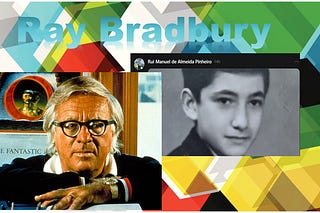
🍂 Ray Bradbury: The Poet of Science Fiction and Memory
Ray Douglas Bradbury (1920–2012) holds a unique place in speculative fiction. Unlike his contemporaries, Robert A. Heinlein and Isaac Asimov, Bradbury was not primarily concerned with scientific accuracy or engineering feasibility (often labeling himself an “idea writer,” not a “science writer”). His genius lay in using the settings and tropes of science fiction and fantasy to explore deep, resonant themes of nostalgia, censorship, technological alienation, and the enduring power of myth and memory.
Chapter I: 🌳 The Life: Midwest Roots, Libraries, and Nostalgia
Ray Bradbury was born in Waukegan, Illinois, in 1920, a setting that heavily influenced the idyllic, small-town Americana present in much of his work, particularly Dandelion Wine and the stories of Green Town. His childhood was marked by a deep and enduring love for fantasy, pulp magazines, comic strips, and the magic of early cinema and vaudeville. He was a lifelong enthusiast of magic and spectacle, seeing the potential for wonder in everyday life.
Bradbury’s family moved to Los Angeles in 1934. Crucially, he could not afford college, a fact that he later turned into a point of pride, proclaiming the library was his true alma mater. He spent his formative years reading and writing obsessively within the walls of the Los Angeles Public Library, educating himself across genres and disciplines. He began publishing in the fan-driven science fiction magazines (fanzines) in the late 1930s, eventually selling his first stories to pulp magazines like Weird Tales.
His professional breakthrough came with the publication of the collected short stories that became The Martian Chronicles in 1950, followed closely by his seminal work, Fahrenheit 451 in 1953. Despite his success, Bradbury famously maintained a strong aversion to many forms of modern technology, including flying and, for many years, driving, viewing technological acceleration with deep skepticism. This skeptical, humanistic perspective became the core philosophical engine of his greatest speculative works.
Chapter II: 📚 Core Works of Lyrical Speculative Fiction
Bradbury’s most famous works use fantastic settings as a mirror for human frailty, cultural prejudice, and societal danger, prioritizing mood and metaphor over scientific realism.
The Martian Chronicles (1950)
Key Idea: The psychological and moral cost of human colonization, presented as a series of lyrical vignettes exploring themes of racism, cultural destruction, and the search for sanctuary.
Description: This is an interlocking collection of short stories detailing the Earthlings’ multiple attempts to colonize Mars, beginning in 1999 and ending in 2026. The colonists, fleeing an impending nuclear war on Earth, bring with them their worst habits: racial prejudice, commercialism, and a devastating lack of respect for the ancient, psychic Martian civilization they displace. The stories are atmospheric, charting the tragic fate of the Martians and the eventual disillusionment and flight of the Earthmen as Earth destroys itself. The final stories show the families that survive finding a new, more respectful life, becoming the “new Martians.”
Type of Society Described: Early Space-Age American Expansionism on an Alien World. The society is a direct, destructive transfer of mid-20th-century Earth culture—consumerism, fear, and ethnic bias—onto the pristine Martian landscape. It serves as a dark mirror reflecting humanity’s inability to escape its own flaws, even light-years away.
Fahrenheit 451 (1953)
Key Idea: The devastating consequences of censorship, anti-intellectualism, and the replacement of complex thought with shallow, immediate electronic entertainment.
Description: Set in a future American city where books are outlawed because they create conflicting, challenging ideas that cause unhappiness. The protagonist, Guy Montag, is a “fireman” whose job is to burn any books found. Montag’s faith in his role is shattered after meeting his free-spirited neighbor, Clarisse McClellan, and witnessing a woman choose to burn with her library. He begins to steal and read books, leading him into conflict with his chief, Captain Beatty, and forcing him to flee the city and join an underground network of intellectuals who memorize entire books to preserve them.
Type of Society Described: Passive, Sensorial Dystopia. The society is stable, wealthy, and comfortable, but profoundly unhappy. It is not governed by terror (like Orwell’s), but by mass distraction, achieved through wall-sized TV “families,” seashell radios (earbuds), and a state-sanctioned hostility toward all forms of critical, reflective thought. People willingly gave up books for the sake of emotional ease and conformity.
Chapter III: 🏆 Success: A Literary Crossover and Enduring Relevance
Bradbury achieved a level of literary acceptance rare for a science fiction writer of his era. His lyrical prose and humanistic themes allowed him to transcend the pulp genre boundaries, establishing him as a mainstream American author.
Critical Acclaim: The Martian Chronicles was praised not just as science fiction, but as an evocative work of poetry and social commentary. Fahrenheit 451 became an instant classic, lauded for its prescient critique of anti-intellectualism and mass media.
Commercial Sales and Editions: Both works have remained continuously in print globally, translated into numerous languages, and are cornerstones of high school and university literature curricula, guaranteeing millions of copies sold over decades.
Awards: While less focused on technical SF awards than Heinlein or Asimov, Bradbury received numerous honors, including a National Book Foundation Medal for Distinguished Contribution to American Letters (2000) and a special citation from the Pulitzer Prize board (2007) for his “distinguished, prolific career.”
Chapter IV: 🕰️ General Context of the Work
Historical and Cultural Context
Bradbury’s defining works were written during two major periods of cultural anxiety that profoundly shaped his themes:
The Nuclear Age and McCarthyism (1950s): The Martian Chronicles is explicitly framed by the looming threat of atomic war, suggesting colonization is driven by necessity (escape) rather than conquest. Fahrenheit 451 is a direct response to the era of McCarthyism, the Cold War’s political paranoia, and the subsequent “witch hunts” that led to blacklisting and censorship. Bradbury feared a society so afraid of complex ideas that it would destroy its own history to achieve peace.
The Rise of Mass Media and Television: Bradbury saw television as the single greatest threat to literacy and reflective thought. He believed TV was inherently superficial, replacing reading and deep conversation with a constant stream of easily digestible, commercialized imagery. Fahrenheit 451‘s parlor walls (immersive, interactive television screens) are a damning indictment of the medium’s potential to isolate and infantilize the population.
Literary Context
Bradbury is a key figure in the transition of science fiction from the “hard” engineering focus of the Golden Age to the more sociological and psychological concerns of the New Wave. He demonstrated that SF could be deeply personal, poetic, and concerned with the why of human behavior rather than the how of space flight. His style—lyrical, melancholic, and deeply sensory—was a deliberate rebellion against the dry, technical prose prevalent in much of 1940s and 1950s SF.
Chapter V: 💡 Key Ideas of the Entire Work: The Fragility of Culture
Bradbury’s work is an enduring meditation on the vulnerability of human culture and the power of intangible qualities like memory and imagination.
The Anti-Intellectual Society: The primary theme, powerfully evident in Fahrenheit 451, is the danger of a society that values comfort and uniformity over critical thought. He warned that censorship doesn’t always come from a dictator; it can arise from the populace itself, seeking refuge from challenging ideas.
The Tragedy of Nostalgia and Lost Innocence: His stories, particularly The Martian Chronicles and Dandelion Wine, are suffused with a melancholic yearning for a simpler, idealized past—the innocence of childhood and the serenity of small-town life. Technology and progress often destroy this innocence, leaving behind a sterile, emotionally empty future.
Humanity’s Propensity for Destruction: In The Martian Chronicles, the colonization of Mars is less a triumph and more a moral failure. Humanity exports its worst traits—war, greed, and cultural myopia—proving that a change in venue does not equate to a change in nature.
The Primacy of Memory and Books: Bradbury elevates books and the act of memorization (the “book people” in Fahrenheit 451) into a sacred, almost spiritual act. Memory and stories are portrayed as the only enduring tools capable of rebuilding civilization after self-destruction.
Chapter VI: 🔮 Concepts That Manifested in Society
Bradbury’s predictions were rarely technological, but often chillingly accurate in predicting social and media saturation trends.
Ubiquitous Media Immersion (The “Parlor Walls”): Fahrenheit 451‘s description of walls covered entirely by interactive screens, engaging people with simplified, commercialized drama and demanding audience participation, is a stunning precursor to modern, wall-sized flat-screen TVs and the total, often isolating, media immersion provided by the internet, virtual reality, and interactive streaming.
Personal Earpieces for Constant Distraction (Seashells): The “Seashells” or “Thimble Radios”—tiny devices that constantly pipe sound, music, and government programming into the user’s ear—perfectly anticipate the use of wireless earbuds (AirPods, etc.) as tools for continuous, personal aural distraction from the real world.
Anti-Intellectualism and Truth Erosion: The novel’s central fear—that the populace would willingly choose to stop reading and engage in complex thought for the sake of comfort—is highly relevant to modern concerns regarding political polarization, the echo chamber effect of social media, and the rapid decline in attention spans driven by hyper-stimulation.
Automated Services (Robotic Hound): While not his focus, the frightening Mechanical Hound in Fahrenheit 451—a programmed, automated device used for law enforcement, injected with powerful narcotics—anticipates the use of highly sophisticated, weaponized AI-driven drones and robotic police units.