My Heroes at 12 Years Old - Chapter 5: Philip K. Dick
This article profiles Arthur C. Clarke (1917–2008), the "visionary of the cosmic sublime," whose 1945 paper on geostationary orbits laid the groundwork for modern satellite communications. It examines Childhood's End and 2001: A Space Odyssey as meditations on evolutionary transcendence, where technology catalyzes humanity's leap toward higher consciousness. Clarke's "Third Law"—"Any sufficiently advanced technology is indistinguishable from magic"—captures his awe-inspired rationalism. While this chapter focuses on Clarke, the series honors Hubert Reeves, "the poet of the Stars," whose lyrical astrophysics similarly fused scientific rigor with wonder, inspiring young minds to see the cosmos not as cold void, but as a story of stardust becoming self-aware.
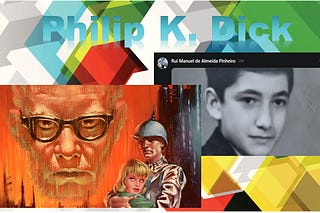
🧠 Philip K. Dick: The Cartographer of Fictional Reality
Philip Kindred Dick (1928–1982) is arguably the most influential philosophical science fiction author of the late 20th century. Unlike his contemporaries who focused on outer space, Dick focused on inner space, exploring fundamental questions about the nature of reality, humanity, and consciousness. His work is characterized by paranoia, shifting identities, religious mysticism, and fractured perception, earning him a reputation as the genre’s most profound questioner of the consensus reality.
Chapter I: 🏠 The Life: Paranoia, Poverty, and the Question of Reality
Philip K. Dick was born in Chicago in 1928. His early life was marked by the tragic loss of his twin sister, Jane, which he later cited as a recurring source of emotional trauma and thematic exploration (the “phantom twin” motif) in his work. Dick lived much of his life in financial precarity, often working at minimum wage jobs while writing prolifically in his spare time, largely within the pulp science fiction community of California.
His writing career was intensely productive but often difficult, fueled by a complex personal life (five marriages) and periods of acute paranoia and psychological distress. Dick wrestled constantly with what he called “pseudo-sanity”—the feeling that the world around him was an unstable construct. This psychological state was intensely amplified by a series of hallucinatory religious and philosophical experiences in February and March of 1974, which he referred to simply as VALIS (Vast Active Living Intelligence System).
This experience convinced him that the conventional world was a simulation—a “prison” hiding a true, divine reality. The remainder of his life was dedicated to trying to decode this experience, resulting in his novel VALIS and his massive, posthumously published philosophical journal, The Exegesis. Dick’s personal struggles with drugs, poverty, and mental health infused his work with a raw authenticity, positioning his protagonists not as heroic explorers, but as average, confused people struggling to discern truth in a world governed by vast, hidden powers.
Chapter II: 📚 Defining Works of Ontological Disruption
Dick’s most significant novels use science fiction tropes—androids, parallel worlds, and drugs—as metaphors for challenging the very structure of human perception and identity.
The Man in the High Castle (1962)
Key Idea: The fragility and contingency of political history and the psychological impact of living under an oppressive, fabricated reality.
Description: An alternate history novel set in 1962, fifteen years after the Axis powers (Germany and Japan) won World War II and partitioned the United States. The narrative follows several interconnected characters, including a German intelligence agent, a Japanese trade official, a Jewish artist living in the Japanese zone, and the novelist Hawthorne Abendsen, author of a controversial book-within-the-book called The Grasshopper Lies Heavy, which depicts a world where the Allies won the war. The characters frequently consult the I Ching (a Chinese oracle) to guide their decisions, underscoring the novel’s concern with fate and contingency.
Type of Society Described: Alternate History Dystopia. A world governed by external, non-democratic powers (Nazism and Japanese Imperialism). The society is defined by ethnic tension, widespread surveillance, and a pervasive sense of psychological submission, highlighted by the fact that the “reality” they inhabit may itself be just one of many possible outcomes.
Do Androids Dream of Electric Sheep? (1968)
Key Idea: The definition of humanity and empathy; the emotional and ethical burden of recognizing artificial life as conscious.
Description: Set in a post-apocalyptic San Francisco devastated by “World War Terminus,” the narrative follows bounty hunter Rick Deckard, whose job is to “retire” (kill) advanced androids of the Nexus-6 generation that have illegally returned to Earth from Mars. These androids are so human-like that Deckard uses the Voigt-Kampff Test, which measures emotional responses (empathy) to differentiate them from real humans. As Deckard encounters increasingly sophisticated and beautiful androids, his mission forces him to question the nature of his own empathy, his life (including his electric sheep), and ultimately, what it means to be truly human.
Type of Society Described: Post-Apocalyptic, Decaying Society. Earth is largely abandoned due to radioactive dust, forcing most citizens to colonize other planets. The remaining society places a premium on owning real animals and practicing shared emotional experiences via the Penfield Mood Organ, but it is emotionally sterile and driven by a desperate attempt to maintain artificial markers of humanity.
A Scanner Darkly (1977)
Key Idea: The psychological destruction caused by pervasive surveillance and the ultimate dissolution of identity caused by drug use.
Description: Set in a near-future California dominated by an endless, unwinnable war on drugs. The protagonist, Agent Bob Arctor, is an undercover narcotics officer assigned to infiltrate a drug ring. To maintain his cover, he lives as a drug user. His task is made impossible because he is surveilling himself, thanks to the brain-damaging effects of the fictional drug Substance D (which causes permanent damage to the brain’s two hemispheres) and the use of the scramble suit (a device that projects a constantly shifting image to conceal the user’s identity). The novel chronicles Arctor’s descent into irreversible cognitive disorder and eventual loss of self.
Type of Society Described: Paranoid Surveillance State. A society consumed by surveillance and police enforcement, where the protectors (the police) are indistinguishable from the criminals, leading to a breakdown of legal, moral, and personal boundaries. The only certainty is the state’s pervasive, destructive gaze.
Chapter III: 🏆 Success: Posthumous Acclaim and Hollywood Canonization
Dick’s career was characterized by high output but relatively low popular recognition and meager financial reward during his lifetime. This changed dramatically after his death in 1982.
Initial Status: While respected within the SF community, Dick was primarily a cult figure. His work was often considered too strange, paranoid, and structurally fragmented for mainstream success in the 1960s and 70s.
The Blade Runner Catalyst (1982): The film adaptation of Do Androids Dream of Electric Sheep? released shortly after Dick’s death, was initially a commercial failure but became a critical, genre-defining cyberpunk classic. Blade Runner‘s success validated Dick’s vision and created an entirely new, massive audience for his philosophical work.
Posthumous Canonization: Dick is now one of the most adapted authors of the 20th century, cementing his legacy outside of literature. Major films like Total Recall, Minority Report, A Scanner Darkly, and The Adjustment Bureau, along with the TV series The Man in the High Castle, have brought his core philosophical questions to global audiences, establishing him as a central figure in modern speculative storytelling. His work now enjoys immense commercial success, perpetually in print and widely studied academically.
Chapter IV: 🕰️ General Context of the Work
Historical and Cultural Context
Dick’s work is deeply embedded in the American cultural landscape of the Cold War and the counterculture.
Cold War Paranoia: The 1950s and 60s were defined by constant domestic fear: the threat of nuclear annihilation, the rise of powerful government agencies (CIA, FBI), and the atmosphere of mass political distrust. Dick distilled this atmosphere of generalized Cold War paranoia into an existential dread, where the enemy was no longer just the Soviet Union but the very fabric of one’s own reality.
The Counterculture and Drugs: Dick lived through and actively chronicled the drug culture of the 1960s and 70s. Novels like A Scanner Darkly reflect the destructive potential of substance abuse while simultaneously using the altered states of consciousness as a metaphor for exploring the boundaries of perception and objective truth.
The Rise of Technology: Dick wrote at the dawn of the computer age, predicting not only advanced artificial intelligence but also the ethical and ontological problems it would create: If an android is indistinguishable from a human, what is the moral difference? This question remains crucial in the age of generative AI and deep fakes.
Literary Context
Dick’s novels represent a significant break from the “hard SF” tradition defined by Heinlein and Asimov. He became a primary figure in the New Wave Science Fiction movement, prioritizing interior psychological exploration, literary experimentation, and philosophical ambiguity over plot and technical detail. His works paved the way for Cyberpunk by establishing the theme of high-tech societies coupled with low-life existence, blurring the lines between man and machine, and highlighting the dominance of vast, often corrupt, corporations or political systems.
Chapter V: 💡 Key Ideas of the Entire Work: The Nature of Reality
Dick’s entire body of work can be viewed as an extended philosophical inquiry into three interlocking existential questions:
What is Real? This is the ultimate Dickian question. His worlds constantly dissolve into one another—is the protagonist hallucinating, in a simulation, living an alternate life, or the victim of time travel? This reflects a deep philosophical skepticism about any absolute, shared consensus reality.
What Does It Mean to Be Human? Dick consistently explored the line between the organic and the artificial, often arguing that humanity is defined not by DNA or mechanism, but by the presence of empathy (or Kipple as he sometimes called its absence). An android that feels and suffers is more human than a biological human incapable of compassion.
The Persecuted Protagonist and Gnosticism: Dick’s characters are almost always victims of a hidden, malign conspiracy (the Black Iron Prison or the Tetragrammaton), suggesting a Gnostic worldview where the observable universe is a flawed prison created by an inferior, false god (the Demiurge), and salvation lies in discovering secret, transcendent knowledge (gnosis).
Chapter VI: 🔮 Concepts That Manifested in Society
Dick’s prescience was not technical but sociological and psychological, anticipating the anxieties of the information age.
The Simulation Hypothesis: Dick’s relentless questioning of consensus reality and his belief in a “Black Iron Prison” (a false reality) has become a major philosophical and cultural touchstone, popularized today by the Matrix films and championed by thinkers and technologists who seriously discuss the possibility that we live in a computer simulation.
The Breakdown of Objective Truth (Deep Fakes): Dick anticipated a time when the distinction between reality and sophisticated illusion would vanish. The synthetic androids and the sophisticated reality manipulation in his novels are direct precursors to the ethical challenges posed by modern deep fake technology, where video, audio, and identity can be manufactured and distributed seamlessly.
Pre-Crime and Algorithmic Policing: The concept behind Minority Report—the ability to arrest and punish individuals for crimes they are predicted to commit—is a frighteningly accurate reflection of modern debates surrounding predictive policing algorithms and the use of mass data to identify potential criminal behavior before it occurs, raising deep questions about free will and justice.
Ubiquitous Identity Disguise (Scramble Suit): The scramble suit in A Scanner Darkly anticipated the idea of a digitally managed, constantly shifting identity used to protect privacy—or facilitate deceit—in an environment of total state surveillance. It speaks to the anxiety over maintaining anonymity in the modern digital panopticon.
Corporate and Governmental Paranoia: Dick’s worlds, dominated by secretive, often malignant government agencies and vast, manipulative corporations (like the Chew-Z company in Ubik), perfectly captured the public’s loss of faith in institutions and the rise of contemporary conspiracy culture.