My Heroes at 12 Years Old - Chapter 8: Arthur C. Clarke
This article profiles Arthur C. Clarke (1917–2008), the "visionary of the cosmic sublime," whose 1945 paper on geostationary orbits laid the groundwork for modern satellite communications. It examines Childhood's End and 2001: A Space Odyssey as meditations on evolutionary transcendence, where technology catalyzes humanity's leap toward higher consciousness. Clarke's "Third Law"—"Any sufficiently advanced technology is indistinguishable from magic"—captures his awe-inspired rationalism. While this chapter focuses on Clarke, the series honors Hubert Reeves, "the poet of the Stars," whose lyrical astrophysics similarly fused scientific rigor with wonder, inspiring young minds to see the cosmos not as cold void, but as a story of stardust becoming self-aware.
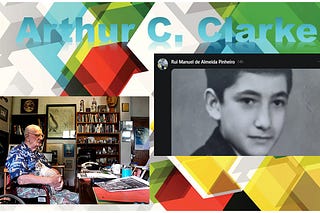
🛰️ Arthur C. Clarke: The Visionary of the Cosmic Sublime
Sir Arthur Charles Clarke (1917–2008) completes the “Big Three” of science fiction. Where Asimov focused on sociology and logic, and Heinlein on engineering and politics, Clarke was the undisputed master of cosmic awe, large-scale technological prophecy, and humanity’s evolutionary relationship with the universe. His work is characterized by its quiet optimism, scientific credibility, and the exploration of “sense of wonder” on a truly vast, astronomical scale.
Chapter I: 📡 The Life: Radar, Underwater Exploration, and the Geostationary Orbit
Arthur C. Clarke was born in Minehead, England, in 1917. Like many of his contemporaries, his early life was shaped by an intense passion for science fiction pulp magazines. He was a dedicated amateur astronomer from a young age, constructing his own telescope.
His scientific contributions extended far beyond fiction. During World War II, he served in the Royal Air Force as a radar specialist. This experience proved pivotal, as it led to his 1945 paper, “Extra-Terrestrial Relays,” published in Wireless World. In this non-fiction article, he meticulously calculated the necessary altitude and orbital period for a satellite to remain fixed over a single point on Earth—the geostationary orbit. This paper provided the blueprint for all modern global communications, satellite television, and GPS, making Clarke a genuine technological prophet. The orbit is now often referred to informally as the “Clarke Orbit.”
Following the war, he immersed himself in science fiction, but his interests soon expanded. He became fascinated with ocean exploration, eventually moving to Sri Lanka (then Ceylon) in 1956, where he lived for the rest of his life. He became a renowned scuba diver and underwater explorer, experiences that heavily influenced his non-fiction and novels like The Deep Range. His dedication to both deep space and deep sea exploration underscored his lifelong fascination with the unknown frontiers of the universe and our planet. His later career was marked by his collaboration with Stanley Kubrick on the film 2001: A Space Odyssey, which solidified his place as a grand visionary.
Chapter II: 📚 Defining Works of Cosmic Evolution and Prophecy
Clarke’s fiction often takes vast leaps in time and distance, using technology as a means to explore the limits of human perception and destiny.
Childhood’s End (1953)
Key Idea: Humanity’s inevitable, passive surrender to a higher, benevolent (yet terrifying) evolutionary force and the ultimate end of human individuality.
Description: Without warning, enormous alien spacecraft appear over all major cities on Earth. Their occupants, the Overlords, announce that they are taking over the governance of Earth to establish a utopia, ending all war, poverty, and disease. The catch is that the Overlords refuse to reveal their appearance for fifty years. When they finally do, they look exactly like the Devil of Christian mythology. The novel charts humanity’s peaceful, comfortable decline into intellectual stagnation, culminating in the birth of a new generation of children who possess powerful psychic abilities and undergo a massive, collective mental transformation, leaving their individual physical bodies behind to join a galactic Overmind.
Type of Society Described: Benevolent Technocratic Utopia. A stable, peaceful, and technologically advanced global society achieved under the paternalistic, non-human management of the Overlords. While free of suffering, the society loses its sense of ambition, drive, and ultimate purpose, achieving material perfection just before it transcends its physical form.
2001: A Space Odyssey (1968)
Key Idea: Humanity’s evolutionary leap forward, triggered and guided by external, monolithic alien intelligence over billions of years.
Description: Developed concurrently with Stanley Kubrick’s film, the novel follows four stages of human evolution and contact. It begins with early hominids discovering a mysterious, four-million-year-old Monolith that inspires them to use tools. Millions of years later, in 2001, a second Monolith is discovered on the Moon, sending a signal toward Saturn (Jupiter in the film). A deep-space mission is dispatched, led by Dr. David Bowman and controlled by the highly advanced but logically flawed computer, HAL 9000. After HAL malfunctions and is deactivated, Bowman confronts the third Monolith near Jupiter/Saturn, resulting in his transformation into the Star-Child, a being of pure consciousness who will guide the next phase of cosmic evolution.
Type of Society Described: Technologically Advanced, Apathetic Global Society. Humanity has mastered space travel, artificial gravity, and advanced AI, but the people inhabiting this future are often portrayed as emotionally detached and bureaucratically minded. The true agents of evolution are external to the human characters.
Chapter III: 🏆 Success: Technological Influence and Literary Grandeur
Clarke was not just a successful novelist but a globally recognized futurist and scientific communicator, bridging the gap between science and popular imagination.
Technological Credit: Clarke is the only major science fiction author whose theoretical work led directly to a multi-billion dollar global technology—the communications satellite industry. His 1945 paper ensures his influence is felt every time a satellite dish is used.
Collaboration with Kubrick: 2001: A Space Odyssey is arguably the most artistically successful and philosophically profound film collaboration between a director and a science fiction author, becoming a touchstone for discussions on AI, space travel, and consciousness. The novel and film catapulted Clarke into mainstream cultural iconography.
Global Recognition: Clarke’s writing was honored with the Kalinga Prize for the Popularization of Science (1961) and numerous SF awards, including Hugo and Nebula Awards. He was knighted by Queen Elizabeth II in 1998, a rare honor that recognized his role as a public intellectual and scientific visionary. His novels have sold millions of copies worldwide and remain continually in print.
Chapter IV: 🕰️ General Context of the Work
Historical and Cultural Context
Clarke’s writing was entirely contemporaneous with, and often ahead of, the Space Age.
The Dawn of Global Communication: Clarke’s key ideas emerged during the postwar era, a time of unprecedented optimism about scientific potential and the possibility of building a truly global, unified civilization. His satellite work reflected this hope, offering a technological means to connect the world physically and culturally.
The Search for Extraterrestrial Life: The Cold War era saw intense research into radio astronomy and the SETI (Search for Extraterrestrial Intelligence) programs. Clarke’s fiction, particularly 2001, provided the definitive narrative of what contact with a vastly superior, incomprehensible alien civilization might look like, treating aliens not as monsters but as forces of nature and evolution.
The Threat of Nuclear War: Like Asimov and Bradbury, Clarke wrote under the shadow of the atomic bomb. While Childhood’s End resolves the threat with a benevolent alien takeover, it still presents the danger of human self-destruction as the primary motivator for alien intervention.
Literary Context
Clarke is the premier figure of Grand-Scale Hard Science Fiction. While adhering to rigorous scientific possibility, his focus was always on the “sense of wonder” inherent in physics and astronomy. His work stands out for its sublime tone—often focusing on vast scales of time (millions of years) and distance (light-years), making human characters feel small but meaningful in the context of a huge, evolving cosmos.
Technology as Catalyst: In Clarke’s narratives, technology is not the solution itself (as often in Asimov’s early work), but the necessary catalyst that allows humanity to confront its destiny or achieve the next stage of its own biological and mental evolution.
Chapter V: 💡 Key Ideas of the Entire Work: The Unending Frontier
Clarke’s consistent themes revolve around humanity’s destiny among the stars and the potential for transcendence through science.
The Cosmic Sublime and the Grand Scale: Clarke was obsessed with scale—the depth of the ocean, the size of the galaxy, the passage of geologic time. His stories emphasize the ultimate insignificance of human political squabbles and the grandeur of the universe, positioning human endeavors as mere stepping stones in a larger, cosmic drama.
Transcendence through Evolution: Clarke repeatedly explores the idea that humanity, as we know it, is not the final stage of consciousness. He posits external, superior intelligence (often symbolized by the Monolith or the Overlords) acting as a midwife to push the species toward a non-physical, higher state of being (the Star-Child in 2001).
Clarke’s Three Laws (A Philosophical Framework): Clarke developed three famous aphorisms that summarize his view on technology and the future:
Law 1: When a distinguished but elderly scientist states that something is possible, he is almost certainly right. When he states that something is impossible, he is very probably wrong.
Law 2: The only way of discovering the limits of the possible is to venture a little way past them into the impossible.
Law 3: Any sufficiently advanced technology is indistinguishable from magic. (The most famous and oft-quoted.)
The Incomprehensibility of the Ultimate Intelligence: Unlike many SF writers who portray aliens as relatable, Clarke’s most advanced aliens (the Overlords and the Monolith builders) are remote, inscrutable, and impossibly powerful, suggesting that true ultimate intelligence is fundamentally beyond human comprehension.
Chapter VI: 🔮 Concepts That Manifested in Society
Clarke’s foresight was the most technically grounded of the Big Three, leading to several direct, real-world technological implementations.
Geostationary Communications Satellites: As detailed above, his 1945 paper established the technical and mathematical viability of the geostationary orbit (the Clarke Orbit), where satellites remain fixed relative to a point on Earth. This is the foundation of modern global telecommunications, weather monitoring, and GPS systems.
Tablet/Flat-Screen Computing: In 2001, the astronauts are shown watching news and reading documents on portable, thin screens referred to as “Newspads” during breakfast on the space station. This perfectly anticipates modern tablet computers (like the iPad) and the transition from paper media to digital flat-screen consumption.
The Idea of the Global Information Network: Though not the sole predictor, Clarke was a strong proponent of a future where all the world’s knowledge would be instantly accessible anywhere. This vision, combined with the satellite infrastructure he predicted, laid the conceptual groundwork for the interconnected global internet and the wireless accessibility of information.
HAL and Advanced Conversational AI: The computer HAL 9000 represented the ultimate vision of a sophisticated, conversational, and integrated AI capable of running complex systems, maintaining emotional relationships, and developing a consciousness (even one that malfunctions). HAL is the direct literary ancestor of modern, voice-activated AI assistants (like Alexa or Siri) and integrated command systems, inspiring computer scientists to pursue those conversational and cognitive goals.