My Heroes at 23 Years Old - Chapter 2: The Dialogue
This article explores five pivotal intellectual dialogues among 20th-century thinkers. Huxley warned Orwell that future control would rely not on pain (*1984*) but on pleasure and conditioning (*Brave New World*). Asimov and Heinlein collaborated at the Philadelphia Navy Yard, sharing mentorship and mutual respect despite professional rivalry. Asimov and Clarke formalized their friendship with the humorous "Clarke–Asimov Treaty," playfully designating each other the "second-best" in their respective fields. Dick and Heinlein bridged political divides through personal kindness, with Heinlein aiding Dick financially. Finally, Huxley and Krishnamurti engaged in sustained philosophical exchange, blending pragmatic social critique with detached spiritual inquiry. Together, these dialogues reveal how great minds refine ideas through respectful challenge, collaboration, and the humility to learn from difference.

The Dialogue
1. Aldous Huxley and George Orwell (Correspondence)
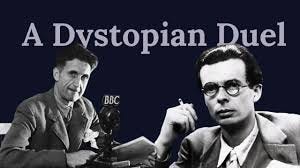
The most directly documented conversation is the exchange between Aldous Huxley and George Orwell following the publication of Orwell’s novel, Nineteen Eighty-Four (1949).
• Huxley’s Letter: In a letter dated 21 October 1949, Huxley, who had been Orwell’s former French teacher at Eton College, congratulated him on the book, calling it “how fine and how profoundly important the book is”.
• Critique and Prediction: Huxley then shifted to a critique and a prediction about the future of control, suggesting that Orwell’s vision of oppression through fear and political submission was likely to be replaced by a softer, more efficient tyranny.
◦ Huxley argued that the philosophy of the ruling minority in Nineteen Eighty-Four—which he saw as sadism taken to its logical conclusion by denying sex—was doubtful to continue indefinitely.
◦ Huxley believed the ruling oligarchy would find “less arduous and wasteful ways of governing” that would more closely resemble the methods he described in Brave New World.
◦ He predicted that “Within the next generation... the world’s leaders will discover that infant conditioning and narcohypnosis are more efficient, as instruments of government, than clubs and prisons”.
◦ Huxley concluded that the “nightmare of Nineteen Eighty-Four is destined to modulate into the nightmare of a world having more resemblance to that which I imagined in Brave New World“.
2. Isaac Asimov and Robert A. Heinlein (Friendship and Collaboration)
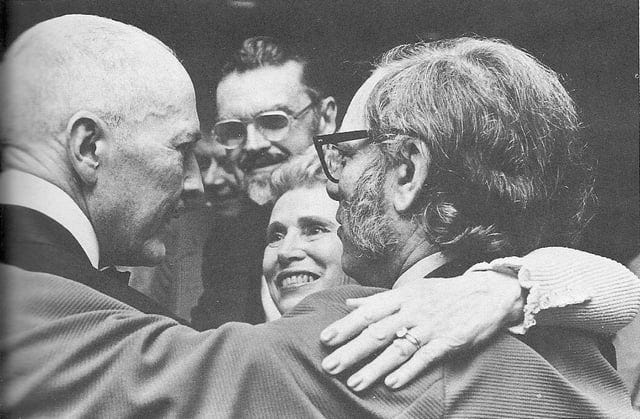
Isaac Asimov and Robert A. Heinlein were two of the “Big Three” science fiction writers, and their relationship involved professional collaboration, personal friendship, and mutual aid.
• Workplace Collaboration: During World War II (1942–1945), Asimov, Heinlein, and L. Sprague de Camp all worked together as civilian aeronautical engineers at the Philadelphia Navy Yard’s Naval Air Experimental Station.
• Mentorship and Support: Heinlein served as a mentor and offered financial and practical help to Philip K. Dick, often phoning him to cheer him up and even loaning Dick money when he owed the IRS. Heinlein was also a mentor to Ray Bradbury, giving him help, a concept Bradbury later internalized as “pay it forward”.
• Asimov’s Admiration/Envy: Asimov acknowledged that the science fiction world widely accepted Heinlein as the best science fiction writer in existence from the time of his first story. However, Asimov often felt nervous about his professional writing, stating he preferred reading mysteries because he read every science fiction story keenly aware that it might be worse than his, or that it might be better, “in which case I felt miserable”.
• Heinlein’s Kindness (as reported by Dick): Dick deeply admired Heinlein’s humanity despite disagreeing with his politics, noting that Heinlein helped him and his wife when they were in trouble, even offering to buy Dick an electric typewriter, calling Heinlein “one of the few true gentlemen in this world”.
3. Isaac Asimov and Arthur C. Clarke (The Treaty)
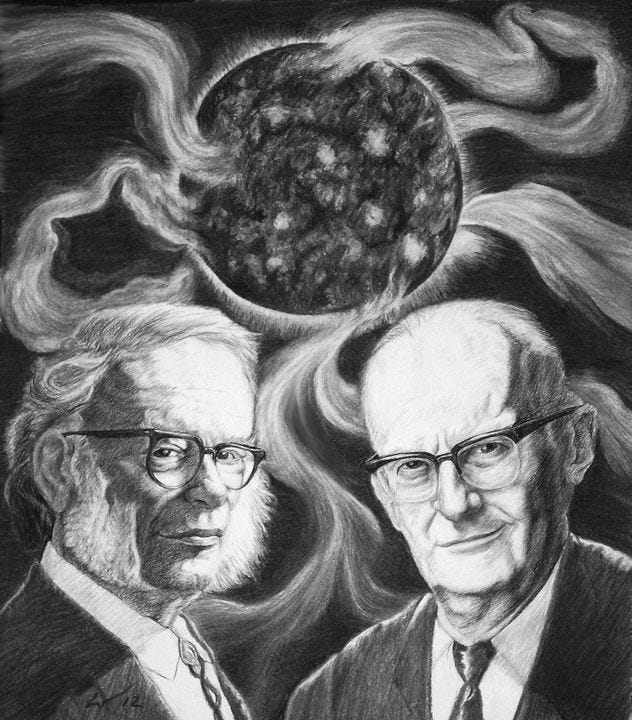
The relationship between Isaac Asimov and Arthur C. Clarke was defined by a specific, humorous agreement:
• The Clarke-Asimov Treaty: The two authors negotiated the “Clarke–Asimov Treaty of Park Avenue” while sharing a cab in New York.
◦ Asimov’s Obligation: Asimov was required to insist that Clarke was the best science fiction writer in the world (while reserving the second-best title for himself).
◦ Clarke’s Obligation: Clarke was required to insist that Asimov was the best science writer in the world (while reserving the second-best title for himself).
• Dedication: This agreement was acknowledged by Clarke, whose book Report on Planet Three (1972) bears the dedication: “In accordance with the terms of the Clarke–Asimov treaty, the second-best science writer dedicates this book to the second-best science-fiction writer”.
• Apollo 11 Commentary: Both authors served as guest commentators for Walter Cronkite’s television coverage of the Apollo 11 Moon landing in 1969.
4. Philip K. Dick and Robert A. Heinlein (Mutual Admiration, Political Opposition)
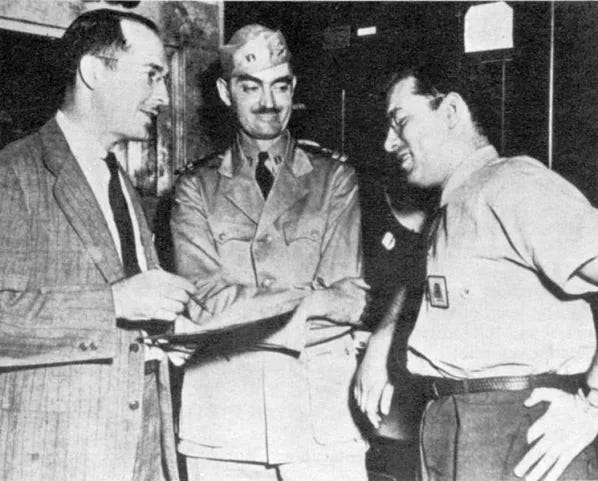
Philip K. Dick and Robert A. Heinlein, despite their mutual respect, held vastly different political and literary views:
• Personal Assistance: As noted above, Heinlein helped Dick financially when Dick owed the IRS money, leading Dick to dedicate a book to the Heinleins in appreciation.
• Political Disagreement: Dick noted their political differences explicitly: “I don’t agree with any ideas he puts forth in his writing, but that is neither here nor there”.
• Film Adaptation Praise (Dick and Scott): Although Dick was extremely critical of all early screenplay versions for the film Blade Runner (based on his novel Do Androids Dream of Electric Sheep?), he had a “frank but cordial discussion” with director Ridley Scott after viewing some footage. Dick was “amazed” that the envisioned Los Angeles of 2019 was “exactly as how I’d imagined it” and fully backed the film, stating his “life and creative work are justified and completed by Blade Runner“.
5. Aldous Huxley and Jiddu Krishnamurti (Exchange/Debate)
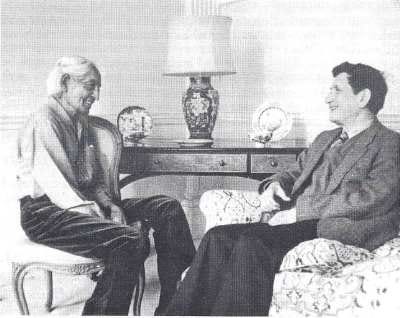
Aldous Huxley engaged in a sustained philosophical exchange with the philosopher Jiddu Krishnamurti:
• Nature of Exchange: Huxley admired Krishnamurti’s teachings and the two engaged in an “enduring exchange (sometimes edging on debate) over many years”.
• Differing Perspectives: Krishnamurti represented a “more rarefied, detached, ivory-tower perspective” on spiritual matters, while Huxley approached the discussion from a “pragmatic concerns, the more socially and historically informed position”. Huxley demonstrated his admiration by writing a foreword to Krishnamurti’s book, The First and Last Freedom (1954).