My Heroes at 23 Years Old - Chapter 4: "1984"
This article analyzes George Orwell's Nineteen Eighty-Four (1949), a foundational dystopian novel warning against totalitarian control. Set in Oceania under Ingsoc, the story follows Winston Smith's futile rebellion against a regime that enforces obedience through telescreen surveillance, Thought Police, historical revisionism, and Newspeak—a language engineered to make dissent unthinkable. Core mechanisms include Doublethink (holding contradictory beliefs) and the erasure of objective truth via the Memory Hole. The piece contrasts Orwell's "dystopia of pain" with Huxley's "dystopia of pleasure," noting that while Orwell feared coercion, Huxley warned of voluntary servitude through comfort. Orwell's neologisms—Big Brother, Orwellian, Thought Police—remain vital cultural tools for diagnosing authoritarianism and defending truth.
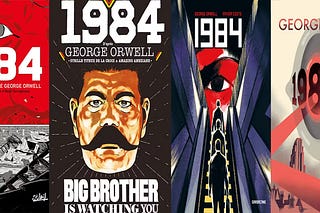
Nineteen Eighty-Four was published in 1949.
More specifically, the novel was published in June 1949 to critical acclaim.
The sources confirm this date in the context of discussions between writers, noting that Aldous Huxley’s critical letter to Orwell, dated 21 October 1949, was written shortly after the novel’s release. George Orwell, whose birth name was Eric Arthur Blair, completed the novel shortly before his death in 1950.
George Orwell’s Nineteen Eighty-Four (1949) is widely regarded as a pivotal work of speculative and dystopian fiction, serving as a political and psychological blueprint for authoritarian control,,. The novel was written by George Orwell (Eric Arthur Blair, 1903–1950) as a deliberate warning to the Western world, fueled by his opposition to totalitarianism and his trauma resulting from observing cynical purges carried out by Communist forces during the Spanish Civil War,,.
The book’s enduring influence is reflected in its critical and commercial success, having won the Prometheus Award in 1984 and remaining a global best-seller that consistently serves as a “living cultural warning mechanism” during periods of heightened political surveillance or public debate over truthfulness,,.
The Dystopia of Oceania
Nineteen Eighty-Four depicts the Hyper-Totalitarian Dystopia of Oceania (governed by the ideology of Ingsoc),. The ruling body, the Inner Party, is symbolized by the ubiquitous figure of Big Brother. The core aim of this state is the total obliteration of objective reality and the destruction of the independent human mind.
Orwell portrays a society where oppression is maintained through fear, violence, and systematic control of external reality,. The government maintains absolute authority over all facets of citizens’ lives, including their thoughts and feelings.
Mechanisms of Total Control
The comprehensive nature of the Party’s control relies on several interconnected mechanisms:
1. Ubiquitous Surveillance and Psychological Enforcement: The entire population is subject to omnipresent monitoring via the Telescreen,. This mass surveillance mechanism is a primary feature of the dystopian society, enforced by the psychological policing of the Thought Police,,. The novel highlights the struggle of the protagonist, Winston Smith, as he attempts an existential rebellion through private thought, knowing the state demands complete psychological submission,.
2. Control of History and Objective Truth: Winston Smith’s job at the Ministry of Truth involves systematically rewriting all historical records. By institutionalizing the destruction of the past via the Memory Hole, the Party removes any objective basis for reality. This mechanism ensures that people cannot compare their current suffering to a remembered better time, granting the Party absolute power over the future.
3. Manipulation of Language and Thought: Orwell’s concept of Newspeak is arguably his most profound contribution. Newspeak is a simplified and politically charged language deliberately constructed to narrow the boundaries of thought, thereby making concepts like “rebellion” or “freedom” literally unthinkable,,,,. The ability of the state to constrain citizens’ capacity to communicate divergent viewpoints is a central element of its power.
4. Enforced Cognitive Dissonance: The Party mandates “Doublethink,” the psychological necessity of holding two mutually contradictory beliefs simultaneously,. This technique is used to justify political hypocrisy and rapid, illogical shifts in national policy.
Literary Legacy and Terminology
The novel’s themes and concepts have had an unparalleled impact on modern discourse:
• The adjective “Orwellian“ is universally used as critical shorthand for oppressive governance, propaganda, manipulated language, and systematic lies,,.
• The concepts of Big Brother, the Thought Police, the Memory Hole, and Newspeak are widely recognized English neologisms derived from the novel,,.
• The novel became the quintessential Western text used to define the threat posed by the Soviet Union during the Cold War—a total psychological and ideological domination.
Comparison to Huxley’s Brave New World
The novel stands in sharp contrast to Aldous Huxley’s Brave New World, yet both are considered defining models of dystopia,.
Huxley, who was Orwell’s former French teacher, congratulated him on the book’s profound importance,. However, Huxley critiqued Orwell’s vision of control based on perpetual fear and political submission (”the policy of the boot-on-the-face”),. Huxley believed that this regime, reliant on sadism and coercion, was likely too “arduous and wasteful” to last indefinitely,.
Huxley argued that the future nightmare would instead modulate into one resembling his own vision: a society governed through infant conditioning and narco-hypnosis (such as the fictional drug Soma), persuading people into willingly loving their servitude through comfort and distraction,. Therefore, while Orwell depicted a dystopia of pain enforced by an all-seeing, hateful state, Huxley described a dystopia of pleasure achieved through biological and psychological manipulation,.