Professor Sean Carroll
This article profiles Sean Carroll (b. 1966), theoretical physicist, cosmologist, and science communicator at Johns Hopkins and Caltech. A Harvard Ph.D., Carroll researches cosmology, dark energy, the arrow of time, and quantum foundations—championing the Many-Worlds Interpretation. He advocates Poetic Naturalism: a worldview where fundamental physics underlies reality, yet emergent "stories" (biology, consciousness, ethics) remain valid descriptive layers. His influential books include The Big Picture (philosophy of meaning), Something Deeply Hidden (quantum mechanics), and the mathematical series The Biggest Ideas in the Universe. Through his podcast Mindscape and public writing, Carroll bridges rigorous science and accessible philosophy, empowering readers to engage deeply with reality's deepest questions—without sacrificing precision or wonder.
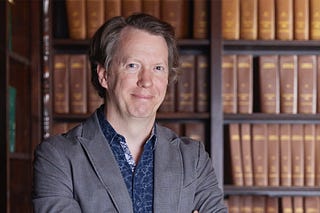
👨🔬 Author Presentation: Sean Carroll
Sean Michael Carroll (b. 1966) is an eminent American theoretical physicist, cosmologist, and philosopher of science, highly regarded for his ability to translate complex scientific concepts into accessible, engaging prose—often with the mathematical details intact. He is the Homewood Professor of Natural Philosophy at Johns Hopkins University and a research professor at the California Institute of Technology (Caltech).
Research Focus and Contributions
Carroll earned his Ph.D. in astronomy from Harvard University in 1993. His research is foundational in areas such as theoretical cosmology (e.g., dark energy), the ultimate origin of the arrow of time (the subject of his book From Eternity to Here), and the foundations of quantum mechanics, where he is a prominent and vocal proponent of the Many-Worlds Interpretation (MWI). His work has received wide recognition, including the Royal Society Winton Prize for Science Books in 2013 for The Particle at the End of the Universe.
Science Communication and Poetic Naturalism
Beyond his technical research, Carroll is a leading public intellectual and advocate for the philosophical worldview he terms Poetic Naturalism. Detailed extensively in his book The Big Picture, this philosophy holds that while the ultimate reality consists only of the fundamental laws of physics (naturalism), humans require multiple, layered, non-reducible descriptive “stories” or vocabularies—like those of biology, consciousness, and morality—to make sense of our complex, emergent experience. Carroll shares his insights through various platforms, including his popular weekly podcast, Mindscape, which consistently tackles the deepest questions at the intersection of science, philosophy, and reality.
📚 Sean Carroll’s Core “Big Ideas” Books (With Dates)
These four published volumes represent the core of Sean Carroll’s recent work on the foundational physics of the universe and its philosophical implications, listed by publication year.
1. The Big Picture: On the Origins of Life, Meaning, and the Universe Itself (2016)
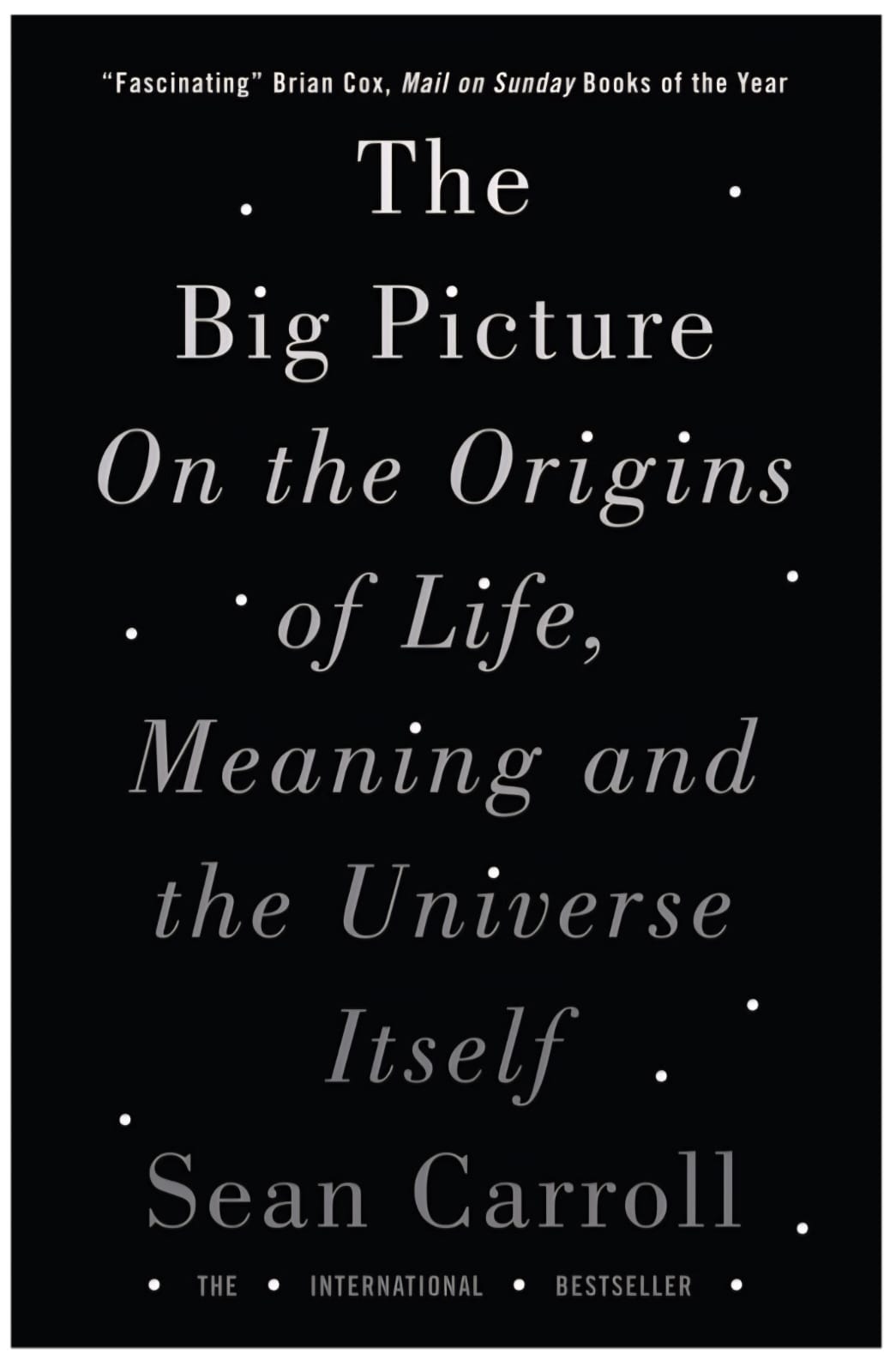
This book is Carroll’s major philosophical work, presenting a comprehensive, modern worldview based on Poetic Naturalism. It starts with the absolute fundamental laws of physics and systematically traces the emergence of complexity, from the early cosmos to life, consciousness, and human systems of morality. Carroll argues that meaning, purpose, and ethics can be fully realized and appreciated within a purely materialistic, naturalistic universe, without recourse to supernatural beliefs.
2. Something Deeply Hidden: Quantum Worlds and the Emergence of Spacetime (2019)
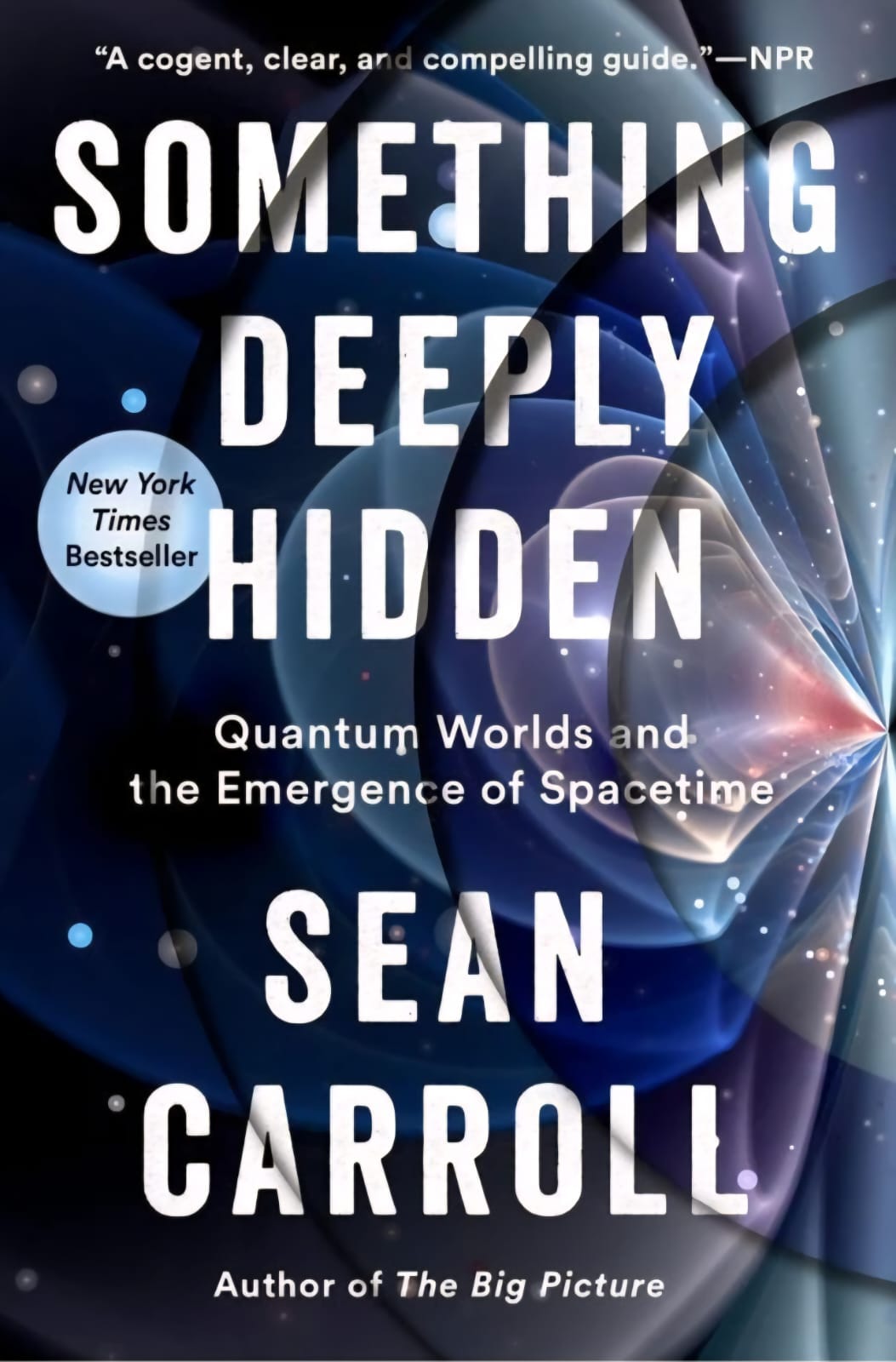
This work provides a deep dive into the mysteries of quantum mechanics. Carroll argues that the conventional interpretation of quantum theory—which requires a “wave function collapse”—is confusing and unnecessary. He champions the controversial Many-Worlds Interpretation (MWI), which posits that every quantum event causes the universe to split into countless parallel, non-interacting worlds, providing a clear and elegant explanation for quantum phenomena and their connection to the classical world of spacetime.
3. The Biggest Ideas in the Universe 1: Space, Time and Motion (2022)
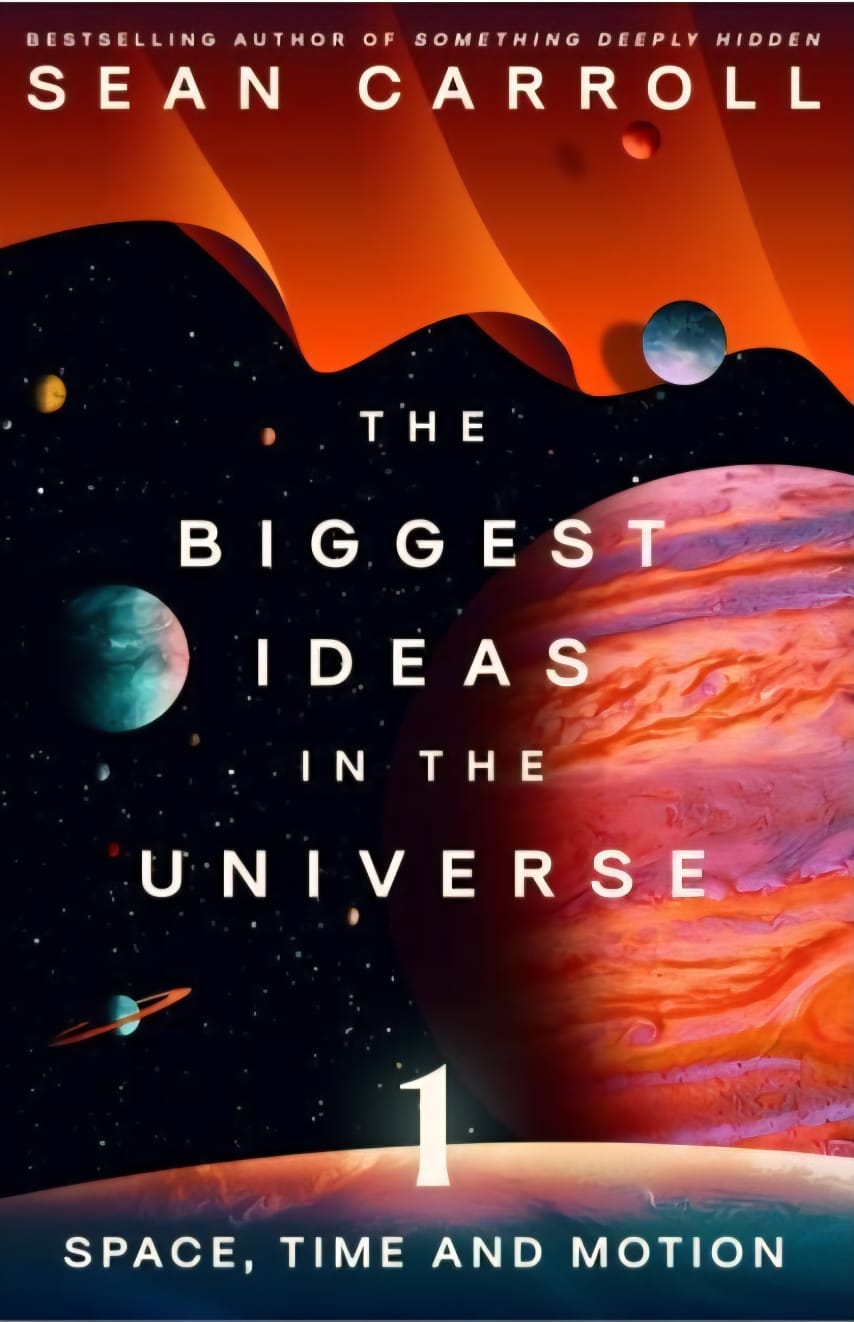
This is the first volume in Carroll’s ambitious series designed to bridge the gap between popular science and university-level physics by explicitly including the necessary mathematics. This volume focuses on the principles of classical physics, including conservation laws, Newtonian mechanics, and the geometry of spacetime, systematically building up the framework for understanding Special and General Relativity and the physics of gravity.
4. The Biggest Ideas in the Universe 2: Quanta and Fields (2024)
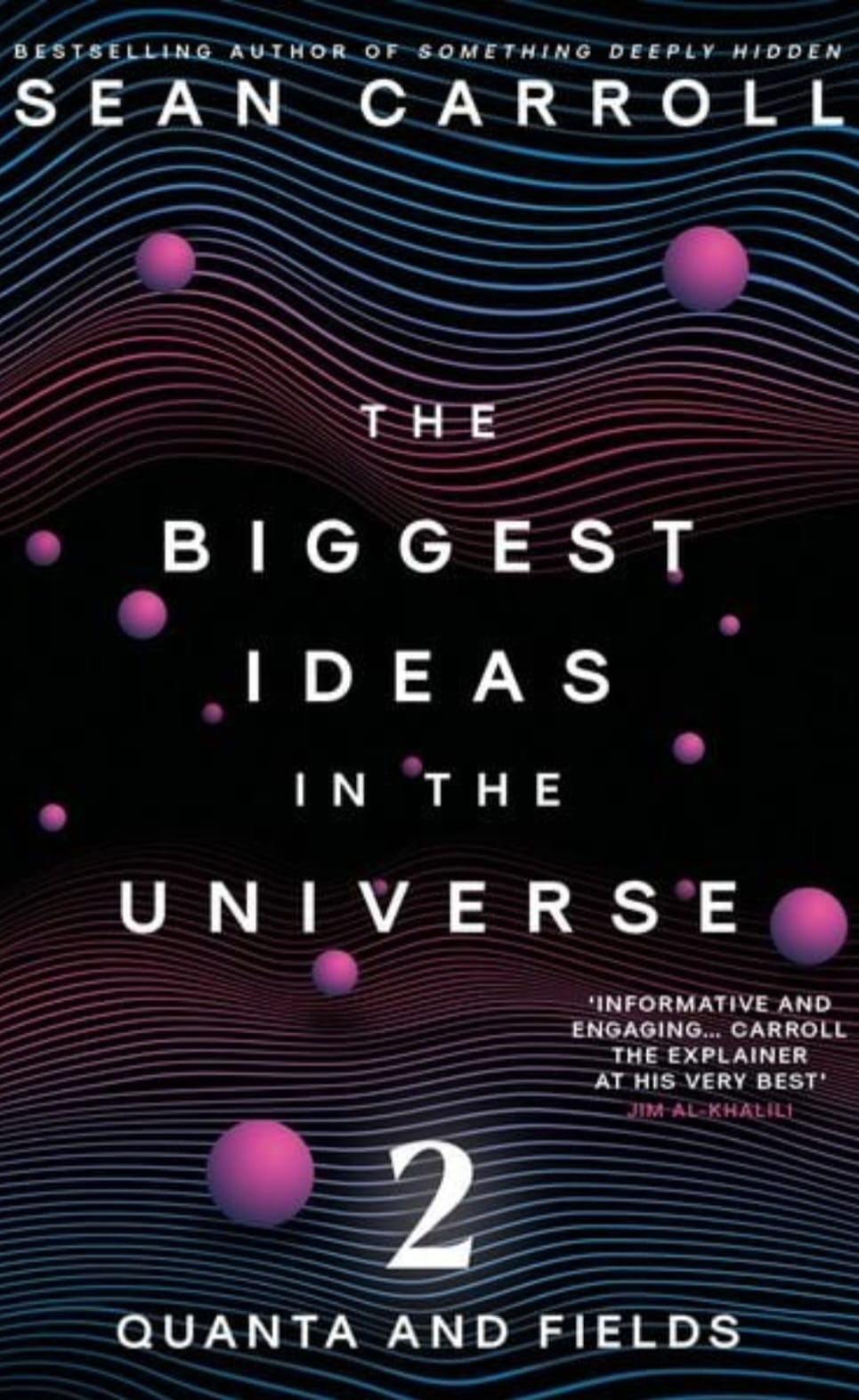
The second volume in the mathematical series, this book tackles the essential concepts of quantum mechanics and quantum field theory (QFT). It explains the startling shift from the classical to the quantum picture, introducing wave functions, entanglement, and the mathematics of fields. It guides the reader through understanding the fundamental forces and particles described by the Standard Model of Particle Physics, showing how QFT is the most profound description of nature we currently possess.