Opposite Contours: The Dialectic of Knowledge Acquisition
This article explores the dialectical tension between opposing contours—conceptual, aesthetic, or existential boundaries that define one another through contrast. Drawing on philosophical traditions from Heraclitus to Hegel, it argues that meaning emerges not from isolated poles but from their dynamic interplay: light requires darkness, freedom implies constraint, identity gains clarity against difference. The piece applies this framework to cognition (analytical vs. intuitive thought), culture (tradition vs. innovation), and personal growth (stability vs. transformation). Rather than seeking resolution, the author advocates embracing productive tension as a source of creativity and insight. True understanding, he suggests, lies not in eliminating opposites but in navigating the fertile space where they intersect—a stance aligned with the user's values of pragmatic reasoning, non-dogmatic inquiry, and adaptive cognition.

Chapter 1: The Progress of Society and Human Knowledge: A Journey of Advances and Setbacks 🧭
When contemplating the trajectory of humanity, we are often tempted to visualize it as a straight, ascending line—a constant and inexorable progress toward an ever-brighter future. However, a closer look reveals a much richer, more complex, and fascinating reality: the path of knowledge and social organization is profoundly non-linear 🔄, marked by advances and retreats, by flashes of genius and long shadows of regression, by paradoxes where every achievement carries within it the seed of new dilemmas.
From the first human settlements to the hyper-connected society of the 21st century, history is not a simple narrative of accumulation. Rather, it is a mosaic of revolutions and resistances, of discoveries that liberate and applications that oppress. The invention of writing 📜, a monumental leap in the preservation and transmission of knowledge, also served to consolidate hierarchies and bureaucracies. The 17th-century Scientific Revolution 🔭, which illuminated the cosmos with the laws of physics, coexisted with dogmatic persecutions and the burning of “witches.” The Enlightenment 🗽, the birthplace of ideals like liberty, reason, and human rights, did not prevent—and in some cases justified—brutal colonialism and unchecked exploitation.
The very concept of “advance“ becomes ambiguous when examined closely. Knowledge does progress, yes, often exponentially, especially in the technological sphere. We have mastered the atom ⚛️, deciphered the code of life 🧬, connected the globe through digital networks 🌐, and launched probes into interstellar space 🚀. These are monumental achievements that bear witness to human creative capacity. Yet, this same technical progress frequently outpaces our ethical and social maturity 🤔. Atomic energy brings light to cities and the shadow of total annihilation; artificial intelligence promises to solve age-old problems while threatening to reconfigure work and human agency in unpredictable ways; the internet, an unprecedented democratic tool for information, also transforms into an arena for surveillance, disinformation, and polarization.
Thus, opposite contours reveal themselves as inherent to the journey. Every intellectual golden age has its dark age; every liberating innovation brings new forms of control; every step toward globalization and multicultural understanding awakens waves of nationalism and intolerance. The illusory linearity dissolves in the face of these back-and-forth movements, where “progress” on one front often generates “regression” on another. Society does not march; it dances 💃—sometimes a measured rhythm, sometimes a chaotic swirl, with steps forward, sideways, and occasionally, backward.
This non-linearity, however, is not a cause for despair or cynicism. It is, instead, the very essence of the human adventure. It reminds us that knowledge is not merely an archive of facts but a dynamic force that constantly compels us to reevaluate our values, our institutions, and our place in the world. The most enduring advances may not lie in the technologies themselves, but in our slow, tortuous, and non-linear capacity to learn from mistakes 🧠, to rise again from the shadows we ourselves create, and to seek, generation after generation, an ever-precarious balance between the power we acquire and the wisdom necessary to wield it with benevolence 🙏.
Therefore, the substance of our progress is this intricate tapestry 🧵, woven with threads of reason and emotion, conquest and humility, utopia and dystopia. Understanding its non-linear nature is the first step toward consciously navigating its opposite contours, accepting that the path toward a wiser and more just society is not a highway, but a winding trail ⛰️, full of sharp turns and breathtaking views, where the final destination is less important than the quality and awareness of the journey.
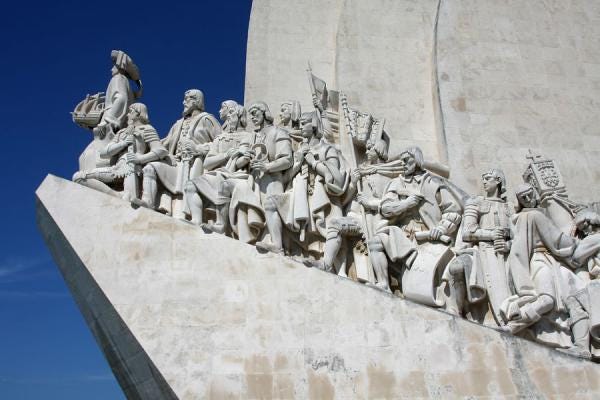
Chapter 2: The Epic Narrative of the Portuguese Discoveries 🗺️
The epic narrative of the Portuguese Discoveries projected a small kingdom onto the vanguard of the known world. It is a complex tapestry where human genius, royal ambition, and social consequences intertwine in a non-linear fashion 🔄.
At its core stands the visionary figure of Prince Henry the Navigator (Infante D. Henrique, 1394-1460), not as a sailor himself, but as the great architect and financier of the expansion. From Sagres, his “right hand,” he promoted the synthesis of nautical, astronomical, and cartographic knowledge, attracting the best pilots, shipbuilders, and geographers of the era 🎓. His motivation was a non-linear mix of religious fervor (the desire to ally with the mythical Prester John and fight Islam), scientific curiosity, and, decisively, “vain ambition“ (vã cobiça) – the search for African gold 💰 and a maritime route to the spices of India, bypassing the Muslim and Italian monopoly.
Belém: The Industrial Stage 🏭
This State project, vigorously continued by subsequent kings, required a colossal infrastructure. This is where Belém, at the gates of Lisbon, becomes the industrial and symbolic stage for the epic. Far from being just a poetic departure point, Belém was a 15th-century industrial-military complex ⚔️.
It housed the Ribeira das Naus, a shipyard where the caravels and carracks that would face the oceans were built and armed. The Belém Tower, built decades later, was not a mere monument, but a defensive fortress to protect this vital national investment. This “industry” represented the collective effort of a kingdom mobilizing its best technical and financial resources for a global objective.
The Dissenting Voice: The Old Man of Restelo 🗣️
However, this glorious vision was never unanimous. In the national literature itself, in Camões’ Os Lusíadas, the dissonant and prophetic voice of the “Old Man of Restelo“ emerges. At the moment Vasco da Gama’s fleet was departing, he rises on the beach of Belém to condemn the adventure 😟.
He accuses the navigators of seeking the “glory of command“ (glória de mandar), of “vain ambition“ (vã cobiça), and of sending the youth to a “certain death“ in search of “vain fame.” This character represents the internal criticism, the human cost hidden behind the glory, the fear of the unknown, and a conservative view that saw expansion as a reckless escape rather than a manifest destiny.
Global Recognition and its Shadow ⚫
The global recognition 🌍 of this undertaking is, in itself, a non-linear paradox. For the West, it represented the start of the first globalization, irreversibly linking continents, trade routes, and civilizations. It was an unprecedented feat of navigation and geography, mapping the planet.
Yet, that same recognition carries its shadow: for many peoples in Africa, Asia, and the Americas, the Discoveries marked the beginning of the era of colonialism ⛓️, with its entire legacy of exploitation, slavery, and cultural domination.
Thus, the “recognition” is dual: technical and strategic admiration, mixed with a critical and painful evaluation of its human consequences. The epic, therefore, is not a straight line of progress, but a complex arc that starts from the vision of a prince, is forged in the industry of Belém, questioned by the “old men” of its own society, and culminates in a profound and ambiguous alteration of the world, whose echoes and opposite contours still resonate today.

Chapter 3: The Non-Linear Journey of Human Knowledge in the 21st Century 🧠💻
The “non-linear journey” of human knowledge in the 21st century is vividly illustrated by a fundamental educational debate pitting two global approaches against each other: Sweden 🇸🇪 versus China 🇨🇳. Both countries are technologically advanced, yet they are charting opposing educational paths to prepare their future generations. This debate goes far beyond the choice between paper and screen, reflecting a deeper antagonism over which cognitive foundations, social values, and future visions should guide education.
📚 The Swedish Path: A Critical Return to the Basics
After pioneering the total digitalization of classrooms, Sweden is now promoting one of the most significant global backtracks regarding the use of technology in education. This move is not an abandonment of technology, but a course correction based on evidence and a humanistic vision of learning.
Central Motivation: The decision was driven by a measurable decline in reading performance 📉. Between 2016 and 2021, the average score of Swedish students in the international PIRLS test dropped from 555 to 544 points. The government and experts associated this decline with the excessive and uncritical use of screens, which can impair deep text comprehension, concentration, and memory.
Concrete Action: The government is investing massively in the return of physical books 📖, with a fund of 685 million Swedish Kronor (approx. £50 million) for purchases in 2023, and another 500 million annually in 2024 and 2025. The emphasis is on handwriting ✍️, silent reading of printed books, and direct teacher-student interaction, especially in the early years.
Underlying Philosophy: The shift reflects a belief that fundamental cognitive skills — such as focus, deep critical thinking, and logical reasoning — are best developed through traditional, digital-free methods. The goal is to form citizens with a solid foundation, capable of using technology responsibly and critically in the future, rather than being used by it.
🤖 The Chinese Path: Accelerating Toward the Digital Future
In contrast, China is actively integrating cutting-edge technology into the core of its educational curriculum. The initiative to teach Artificial Intelligence (AI) 💡 in primary schools is part of a broad national strategy to lead the next technological revolution.
Central Motivation: The stated goal is to build a highly skilled workforce for the future, aligning education with the needs of a country in accelerated technological advancement and industrial upgrading. This is a policy of “investment in people“ with a clear focus on global competitiveness 🏆.
Broader Context: This initiative fits into ambitious educational reforms. China plans to significantly expand free education and is considering increasing the years of compulsory schooling as part of its 15th Five-Year Plan (2026-2030). The focus on AI from an early age aims to democratize access to these crucial skills.
Underlying Philosophy: The approach reflects a vision of education as an engine for economic development and technological sovereignty. The priority is to equip students, from a young age, with the conceptual and practical tools to not just use, but also create and master the technologies that will define the 21st century.
⚖️ The Core Debate: Which “Basic” for the Future?
The antagonism between these visions reveals the central question: what constitutes the essential “foundation” for 21st-century education?
The Swedish view argues that the foundation is neurocognitive and humanistic. Before programming an algorithm, the child needs to develop the capacity for deep concentration, sustained critical thinking, and empathy that arises from direct human interaction and immersion in complex texts. Technology, introduced later and judiciously, would serve these fundamentals.
The Chinese view understands that the foundation is techno-strategic and practical. In a world increasingly defined by AI systems, advanced digital literacy and computational thinking have become as fundamental as reading and writing. Postponing this learning would put future generations at a disadvantage in a global race 🏃.
Both approaches recognize the crucial importance of technology, but they diverge radically on the hierarchy, timing, and purpose of its introduction. Sweden fears that early, unmediated technology will hinder the human brain’s development for complex thought. China fears that an excessive emphasis on analog methods will create a disconnect between the classroom and the demands of the real economy.
💡 Conclusion: A Civilizational Dilemma
This debate is ultimately about the type of society and human being we want to cultivate. The choice between reflective depth and technological agility, between humanistic critique and applied effectiveness, does not have an easy answer.
As observed in Sweden, research shows that the worst educational outcome does not come from the use of technology itself, but from its use misaligned with a solid pedagogical methodology. The future of education, therefore, may not lie in the absolute victory of one model over the other, but in the difficult and continuous negotiation between these two poles. The challenge for nations will be to find their own balance on this non-linear journey, ensuring that the advances in human knowledge make us, simultaneously, wiser and more capable 💪.

Chapter 4: The Paradigm of Knowledge Acquisition in the 21st Century (A Future Discussion) 🌟
The paradigm of human knowledge acquisition over time remains for another conversation. The paradigm of knowledge acquisition in the 21st century is too vast and multifaceted to conclude here, as it emerges precisely from this fundamental antagonism we have discussed. The debate between the Swedish model of “return to basics“ 🇸🇪 and the Chinese model of “digital immersion“ 🇨🇳 is not a mere pedagogical detail; it is the concrete expression of a civilizational crossroads 🚧.
The 20th century consolidated a model of linear, encyclopedic, and often centralized knowledge. The 21st century, conversely, has dissolved those certainties. Information is abundant, instantaneous, and decentralized. The challenge is no longer accessing it, but filtering it, contextualizing it, and endowing it with meaning 🤔. In this new ecosystem, what is truly at stake is the hierarchy of competencies.
Sweden and China represent two extreme, yet logical, responses to this new reality. One prioritizes the foundational skills of deep human thought (concentration, critical spirit, reflection), viewing technology as a subsequent tool to be mastered. The other prioritizes literacy in the code and logic that governs the emerging world (computational thinking, algorithmic mastery), integrating technology as a native language 🤖.
Therefore, the paradigm that remains for another conversation is precisely this: How do we build a model of knowledge acquisition that neither sacrifices deep human cognition on the altar of digital agility, nor ignores the new grammars of power in a world governed by artificial intelligence? The answer will not be found in a single country or a single method. It will be, like the history of knowledge itself, a non-linear, tortuous, and creative synthesis ✨, forged in the permanent tension between these two visions of the human future.