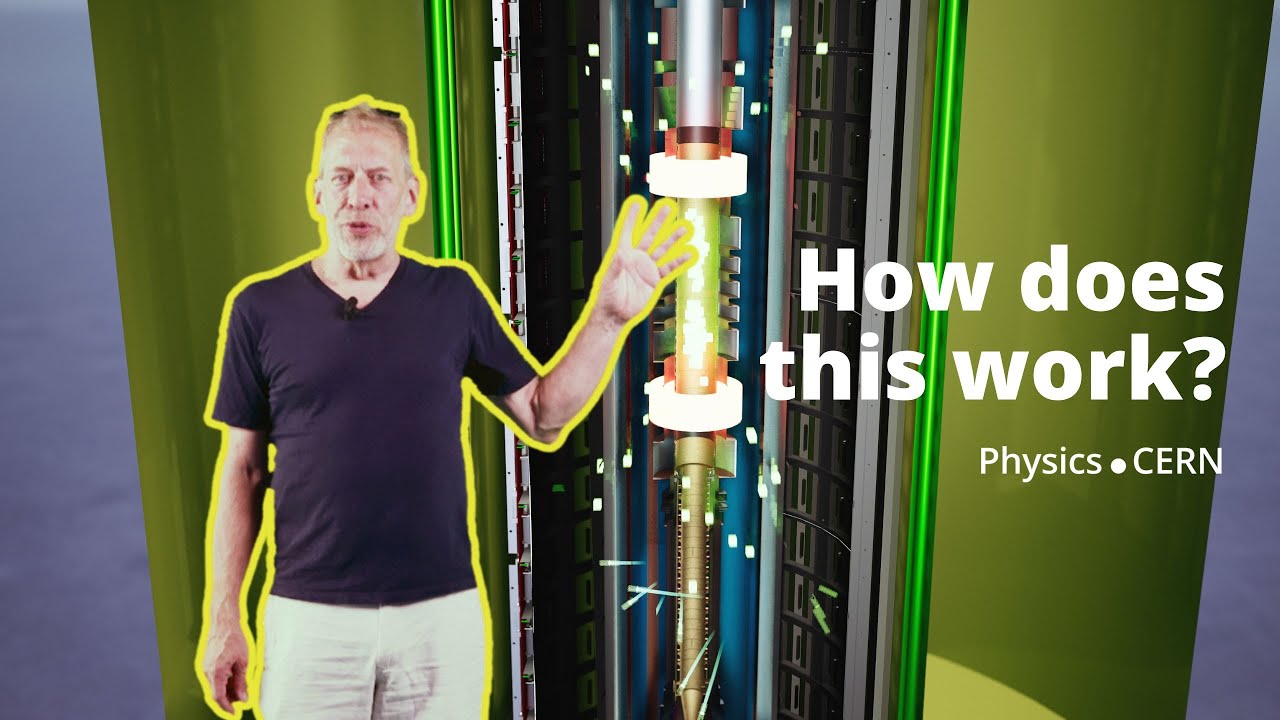
Antimatter at CERN
This article examines the "antimatter factor"—the profound mystery of why the observable universe consists almost entirely of matter, despite the Big Bang theoretically producing equal amounts of matter and antimatter. It details CERN's Antiproton Decelerator experiments (ALPHA, BASE, ASACUSA, GBAR, AEgIS), which trap and compare antihydrogen to hydrogen with unprecedented precision, testing CPT symmetry and gravitational behavior. So far, antimatter mirrors matter perfectly within experimental limits. The piece also addresses the staggering technical challenges and costs of antimatter production and conservation, emphasizing that finding even a minuscule asymmetry—a "crack in the mirror"—could finally explain why we exist at all.
🔎 The Antimatter Factor: A Text Transformation
The “antimatter factor” is fundamentally the unresolved question of why our universe is composed almost entirely of matter, despite the expectation that the Big Bang should have generated equivalent quantities of matter and antimatter.
1. The Core Mystery: Matter-Antimatter Asymmetry
According to the laws of physics, every particle is associated with an antimatter counterpart, sharing an identical mass but possessing an opposite charge. The Big Bang should have resulted in equal production of matter and antimatter. Their inevitable mutual annihilation would have left a universe of pure energy.
However, the fact of our existence proves otherwise. For every billion matter-antimatter pairs, a single matter particle survived. This minute initial imbalance represents the “factor” requiring explanation.
2. CERN’s Approach: Extreme Precision Comparison
CERN is unique globally as the only facility capable of producing and studying low-energy antiprotons in dedicated experiments. The objective is to determine if antimatter behaves exactly as matter does, as any subtle deviation could account for the universe’s matter dominance.
Key experiments have yielded the following precision comparisons:
ALPHA: This experiment traps and analyzes neutral antihydrogen atoms (composed of an antiproton and a positron). Its spectral lines (how it interacts with light) have been measured with extreme accuracy. So far, the measurements show that antihydrogen is identical to ordinary hydrogen to within a few parts in a million million.
BASE: This experiment compares the magnetic properties (specifically, the magnetic moment) of protons and antiprotons. They have achieved the most precise comparison to date, determining that the two properties are identical to within $0.0000000016$ per cent (or one hundred and sixty parts in a hundred thousand million million, or one hundred and sixty parts in $10^{17}$).
ASACUSA, GBAR, and AEGIS: These experiments continue the investigation, with GBAR and AEGIS specifically designed to test a crucial aspect of Einstein’s Equivalence Principle: whether antimatter falls at the same gravitational rate as matter.
3. The “Production Factor” at the LHC
At the Large Hadron Collider (LHC), high-energy collisions create matter-antimatter particle pairs, such as bottom quarks and anti-bottom quarks. Physicists examine minute differences in their behaviour—a phenomenon known as CP Violation—to assess if the asymmetry observed today could have been generated within the very early universe.
Summary
The “antimatter factor” is not a single numerical value but a multi-faceted research endeavour focused on two main areas:
Precision Comparison: Testing if antimatter atoms possess the exact same properties (including spectra, magnetism, and response to gravity) as matter atoms.
Symmetry Breaking: Actively searching for any violation of fundamental symmetries, such as CP-symmetry, which might favor the creation or survival of matter over antimatter.
The ultimate goal is to find a “crack in the mirror”—any measurable difference between matter and antimatter—that would finally resolve the mystery of our existence.
The “antimatter factor” is, in essence, the search to answer physics’ most profound question: “Where did all the antimatter go, and why are we here?” CERN is addressing this by creating, trapping, and scrutinizing antimatter with unprecedented accuracy.
The Experiments
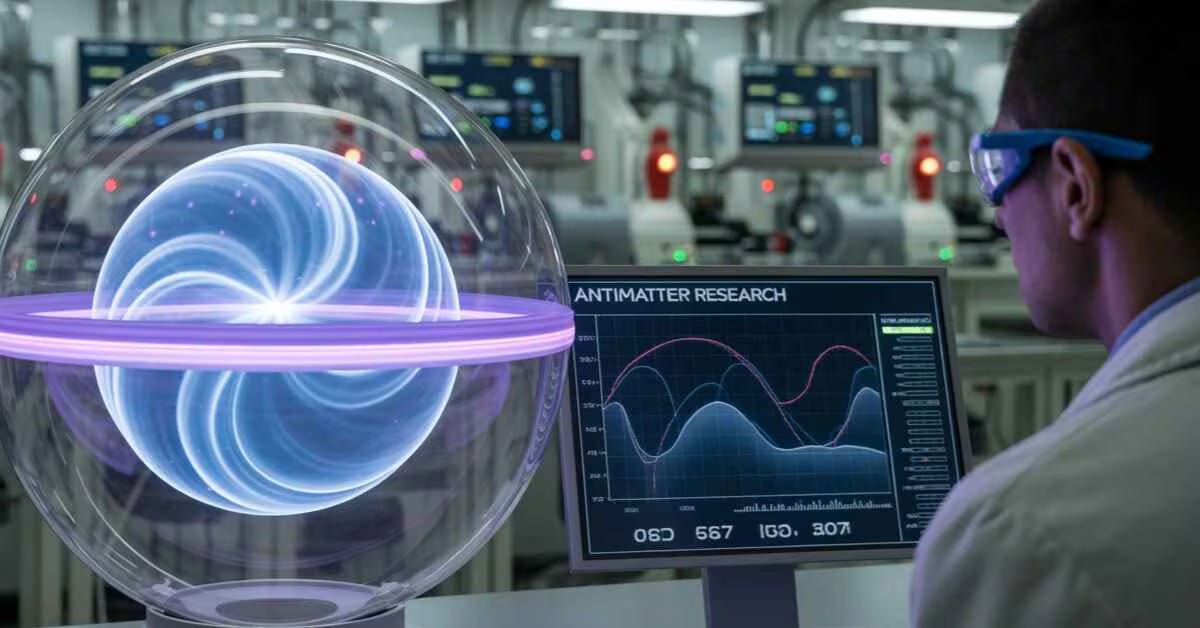
The heart of CERN’s antimatter research is the Antiproton Decelerator (AD) facility, which supplies slow antiprotons to several dedicated experiments. This allows physicists to perform precision tests on the fundamental properties of antimatter.
Here is a breakdown of the currently running experiments (often referred to as the “AD experiments”):
🔬 CERN’s Antimatter Factory Experiments
1. ALPHA (Antihydrogen Laser Physics Apparatus)
Goal: The primary objective is the high-precision spectroscopic comparison of neutral antihydrogen ($\bar{H}$) with ordinary hydrogen (H). This tests the CPT symmetry theorem, which predicts they must be perfectly symmetrical.
Method: ALPHA is the pioneer in trapping antihydrogen atoms.
It creates antihydrogen by combining cold antiprotons and positrons in a Penning trap system.
It uses a sophisticated magnetic minimum trap to hold the neutral, but slightly magnetic, anti-atoms for long periods (minutes).
Key Results: ALPHA has successfully measured the spectral lines of antihydrogen, finding them to be identical to hydrogen’s within a few parts per trillion. They also recently completed the ALPHA-g test, which demonstrated for the first time that antihydrogen falls down under gravity, consistent with regular matter.
2. BASE (Baryon Antibaryon Symmetry Experiment)
Goal: To perform the most precise direct comparison of the fundamental properties of the proton ($p$) and the antiproton ($\bar{p}$).
Method: BASE uses an intricate setup of Penning traps cooled to cryogenic temperatures (near 4 Kelvin) to isolate and hold a single antiproton.
It precisely measures the charge-to-mass ratio ($q/m$) and the magnetic moment (g-factor) of the trapped antiproton.
Key Results: BASE has achieved record-breaking precision, showing the charge-to-mass ratios and the magnetic moments of the proton and antiproton are identical to within a few parts in a trillion.
3. ASACUSA (Atomic Spectroscopy And Collisions Using Slow Antiprotons)
Goal: To measure the properties of the antiproton by studying exotic antiprotonic atoms and to measure the hyperfine structure of antihydrogen.
Method:
Antiprotonic Helium: ASACUSA creates hybrid atoms called antiprotonic helium (a helium nucleus orbited by one electron and one antiproton). By hitting these with a laser, they can precisely measure the antiproton’s mass and compare it to the proton’s mass.
Antihydrogen Beam: It is also designed to create a beam of antihydrogen atoms to measure their hyperfine structure (the energy difference between electron spin-flip states) in a field-free region, offering another ultra-precise CPT test.
⬇️ The Gravity Experiments
These three experiments share the ultimate goal of directly measuring the acceleration of antihydrogen under gravity ($g$).
4. GBAR (Gravitational Behaviour of Antihydrogen at Rest)
Goal: To measure the free-fall acceleration of ultra-cold neutral antihydrogen with high precision.
Method: GBAR follows a unique path to achieve extremely low temperatures for the anti-atoms.
It first creates a positive antihydrogen ion ($\bar{H}^+$), which is an antiproton and two positrons.
Since it is charged, this ion can be laser-cooled to micro-Kelvin temperatures (just above absolute zero).
A final laser pulse then removes the extra positron (photo-detachment), leaving an ultra-cold, neutral antihydrogen atom whose free-fall time can be measured over a known distance.
5. AEgIS (Antimatter Experiment: gravity, Interferometry, Spectroscopy)
Goal: To measure the gravitational acceleration of antihydrogen using a beam deflection technique.
Method: AEgIS aims to create a pulsed horizontal beam of cold, neutral antihydrogen atoms.
It measures the tiny vertical displacement (the “sag”) of this horizontal beam due to gravity as it travels a short distance, using a device called a Moiré deflectometer.
This direct measurement of the deflection angle will allow them to determine the value of $g$ for antimatter.
(Sub-Experiment) ALPHA-g
Note: This is an apparatus built by the ALPHA collaboration specifically to measure gravity’s effect on antihydrogen by measuring the vertical position where the trapped atoms annihilate when the confining magnetic field is turned off.
These experiments collectively form a multi-pronged assault on the matter-antimatter asymmetry problem, rigorously testing the laws of physics with antimatter to find the subtle difference that explains our universe.
⚛️ Antimatter Conservation Methods and Cost
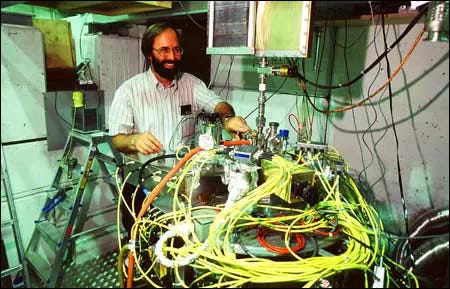
The ability to conserve and study antimatter is one of the most significant technological achievements in modern physics, primarily driven by the experiments at CERN’s Antiproton Decelerator (AD) facility, sometimes referred to as the Antimatter Factory.1
Conservation Methods: Magnetic Trapping
Since matter and antimatter immediately annihilate upon contact, conservation methods must entirely prevent any physical interaction with ordinary matter, including the walls of the container and even dust particles.2
Creating the Antiparticles: Antiprotons (the heavy, negatively charged component of antihydrogen) are produced by smashing high-energy protons into a stationary metal target.3 These antiprotons are then slowed down and cooled in a process involving the Antiproton Decelerator (AD).4 Positrons (the light, positively charged component) are typically obtained from a radioactive source like sodium.5
Trapping the Charged Particles: Charged antiparticles—the antiprotons and positrons—are contained using devices called Penning traps.6 These traps use a combination of strong electric fields along the axis and a powerful superconducting magnetic field around the axis to confine the antiparticles in a vacuum.7
Forming Neutral Antihydrogen: Once cooled, the antiprotons and positrons are mixed, allowing a tiny fraction to combine into electrically neutral antihydrogen atoms.8
Trapping Neutral Atoms: Since antihydrogen atoms have no net electric charge, the Penning trap fields cannot hold them.9 Instead, experiments like ALPHA use a sophisticated “magnetic bottle” trap.10 This trap, made of strong superconducting magnets (two solenoid coils and a central octupole magnet), exploits the antihydrogen atom’s very small magnetic moment to hold the extremely cold, low-energy anti-atoms in a region of minimum magnetic field strength.11
This technique is so effective that the BASE experiment has achieved an antiproton storage record of $614$ days in a vacuum pressure of less than $0.46 \times 10^{-18}$ mbar. The ALPHA experiment has trapped antihydrogen atoms for over 12$16$ minutes, allowing for detailed study.13
Production and Cost
The cost of antimatter is astronomical due to the inefficiency of its production and the massive energy and specialized infrastructure required.14
Antimatter Production is Extremely Inefficient: The process involves high-energy particle accelerators like the Super Proton Synchrotron (SPS) and the Antiproton Decelerator (AD) to create and slow down the antiparticles. Most of the energy goes into producing other particles or heat, not useful antiprotons. Even with breakthroughs, such as the ALPHA experiment’s ability to produce over 15$15,000$ antihydrogen atoms in a few hours, the total mass is minuscule.16 Scientists are still nowhere near producing even a microgram.
The Cost: Cost estimates for a macroscopic amount of antimatter are based on extrapolating the current, highly inefficient production costs:
Some estimates from 2006 for antiprotons placed the cost at about 17$3$ thousand million million million dollars per gram (or 18$3$ quadrillion dollars per gram in the short scale).19
Other estimates suggest a value of $62$ thousand million million dollars per gram for antihydrogen.
In the long scale of numbers, this cost is about $3$ trillion dollars per gram (three thousand million million million million dollars).
This high cost primarily reflects the massive energy expenditure and the operational and construction costs of the specialized accelerator complex, such as the Antiproton Decelerator facility, which required an initial transformation cost of about $7$ million Swiss Francs.
You can see a great animation of how antihydrogen is created and trapped at CERN in the video below.