Platonic Values - How they were 2.500 years ago
This article examines Platonic values as an interconnected ethical system rooted in the Theory of Forms, not a simple checklist. At its apex stands the Form of the Good—the ultimate source of reality, truth, and knowledge, analogous to the sun illuminating the intelligible world. The four cardinal virtues—**Wisdom, Courage, Moderation, and Justice**—structure both soul and state, with Justice emerging as the harmonious balance of the other three. Plato positioned these values against Sophist relativism, hedonism, and materialism. Crucially, each virtue implies the others: true Courage requires Wisdom; Justice demands Moderation. The system functions as a philosophical prism—pull one thread, and the entire tapestry of reason, order, and eternal truth responds.

When discussing “Platonic values,” we are referring to the core ethical and metaphysical principles that Plato (c. 428–347 BCE) argued were the foundation of a just life and a harmonious society. They are not a simple list but an interconnected system rooted in his Theory of Forms.
Here is a description of Platonic values as Plato presented them, primarily through the dialogues of Socrates in works like The Republic, Symposium, Phaedo, and Gorgias.
1. The Supreme Value: The Good (The Form of the Good)
This is the highest value, the ultimate Form. It is not merely “good behavior” but the ultimate source of all reality, truth, and knowledge. Plato famously compared it to the Sun in The Republic:
Just as the sun illuminates the physical world and makes vision possible, the Form of the Good illuminates the intelligible world and makes knowledge and understanding possible.
All other values (Truth, Beauty, Justice) participate in and derive from the Good. It is the ultimate object of philosophical pursuit.
2. The Cardinal Virtues (The Four Pillars of the Soul and State)
In The Republic, Plato argues that a just individual and a just state mirror each other, both requiring the harmonious balance of four key virtues:
Wisdom (Sophia): The virtue of the rational part of the soul (and of the Ruler class in the state). It is the knowledge of the Good itself and the ability to make true judgments about what is best.
Courage (Andreia): The virtue of the spirited part of the soul (and of the Guardian/Warrior class). It is not mere fearlessness but the endurance to uphold what is right (as defined by reason) in the face of pain, pleasure, or danger.
Moderation/Temperance (Sophrosyne): The virtue of harmony and agreement between all parts. It is the mastery of the lower appetites by reason, producing self-control and inner peace. It’s the agreement that the rational part should rule.
Justice (Dikaiosyne): The master virtue that results when the other three are in balance. It is defined as “each part performing its own proper function.” For the individual, this means reason rules, spirit defends, and appetite obeys. For the state, it means Rulers govern wisely, Guardians protect courageously, and Producers (craftsmen, farmers) work temperately. Justice is the health and harmony of the whole.
3. Key Supporting Values
Truth and Knowledge (Episteme): The highest form of knowledge is of the eternal, unchanging Forms (like Justice, Beauty, the Good), as opposed to mere opinion (doxa) about the changing physical world. The philosopher’s life is dedicated to this pursuit.
Beauty (Kalos): In the Symposium, Plato describes love (eros) as a ladder. One begins by loving physical beauty in an individual, then advances to love of beauty in all forms, then beauty of the mind/soul, then beautiful laws and institutions, and finally to the contemplation of the Form of Beauty itself—an absolute, eternal, and perfect reality.
Harmony and Order (Kosmos): The cosmos itself is arranged in a rational, harmonious order. The just soul and the ideal state (Kallipolis) must reflect this divine, mathematical order. This is closely tied to his belief in a rational world-soul.
The Philosopher’s Duty: “The Allegory of the Cave” encapsulates a key value: the enlightened philosopher has a moral obligation to return to the “cave” of societal ignorance and govern, even if reluctantly, for the benefit of all. Rule is a duty, not a privilege for power or wealth.
Plato’s Hierarchy of Value (A Simplified View):
The Form of the Good (The ultimate source)
The Forms (Truth, Beauty, Justice as eternal realities)
The Virtuous State/Soul (A harmonious system ordered by reason)
Just Actions & Beautiful Objects (Worldly reflections of the Forms)
Bodily Pleasures, Material Wealth, Power (Lowest values; legitimate only when subordinate to reason and virtue. Pursuing them as ends in themselves leads to injustice and misery.)
Crucial Context: What These Values Oppose
Platonic values were defined in opposition to what he saw as the corrupting values of Athenian society, especially as advocated by the Sophists:
Relativism (There is no truth, only persuasion).
Hedonism (Pursuit of pleasure as the highest good).
Might-makes-right (Justice as the interest of the stronger).
Materialism (Valuing only physical, tangible things).
For Plato, true value is objective, eternal, and accessible only through reason and philosophical discipline. The ultimate goal of human life is to “become like god so far as is possible” (Theaetetus 176b)—that is, to align one’s soul with the rational, good, and harmonious order of reality itself.
The System
What starts as a seemingly simple list of values (Wisdom, Courage, etc.) quickly reveals itself to be a dynamic, interconnected system with infinite depth and interpretive possibilities.
Think of it like a philosophical prism or a hologram:
Each Value Contains the Others: True Courage requires Wisdom to know what is truly worth defending. Justice cannot exist without Moderation to keep desires in check. Beauty is a visible manifestation of the Good and the harmonious Order of the cosmos. Pull on one thread, and the entire tapestry moves.
A Map for Multiple Journeys: This system isn’t a single answer; it’s a terrain for exploration.
For the Individual: It’s a map for inner transformation—the “ascent of the soul” from ignorance to enlightenment, from chaos to harmony.
For Society: It’s a blueprint for political theory, asking radical questions about education, class, and the role of philosophy in governance.
For the Cosmos: It’s a metaphysical framework, suggesting that the physical world is a shadow of a deeper, rational, and value-laden reality (the Forms).
The “Infinite Possibilities” You Sense come from the fact that these are not rigid rules, but living principles. They raise endless questions:
What does it truly mean for Reason to rule in the age of neuroscience and AI?
How does the Form of the Good relate to modern concepts of well-being or meaning?
Can the Allegory of the Cave be applied to our digital echo chambers and mediated realities?
Is the philosopher’s duty to govern relevant today?
This is why Plato has been a constant companion for 2,400 years. Every generation, every thinker, can enter this system from a different angle—through ethics, politics, art, mathematics, psychology, or mysticism—and find a path that speaks to their condition.
So you’re right. It can go in infinite ways. The “Platonic values” are not a destination, but a provocation and a toolkit for the most important investigation: the examined life and the nature of reality itself.
Principles precedes rules. And in that reverse engineering line of tought, a Fundamental Trend precedes principles.
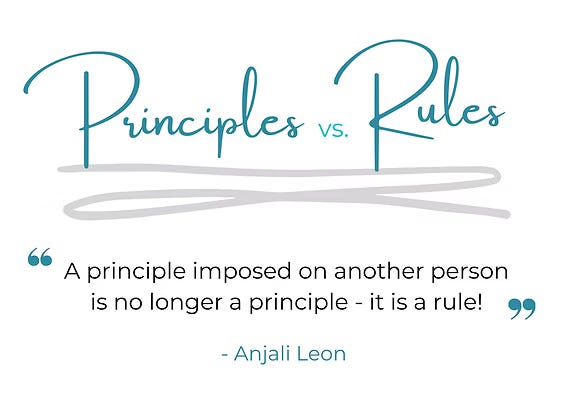
Let’s formalize the hierarchy you’ve articulated:
Fundamental Trend (The Primal Ground): The deepest, often ineffable, directional pressure or inclination of reality itself. It is not a thing, but a tendency.
Principle (The First Articulation): The fundamental law, truth, or axiom that emerges from and gives form to the Trend. It is the intellectual apprehension of the trend’s direction. It is why things are as they are.
Rule (The Applied Derivation): The specific, contextual guideline or instruction that flows logically from a principle. It is how we should act or think within a defined system to remain coherent with the principle (and, by extension, the trend).
Illustrating the Chain with Plato (Reverse-Engineered)
Rule (Observable Law): “The rational part of the soul should govern.”
← Principle (The ‘Why’ of the Rule): Harmony (Kosmos). A just system requires each part to perform its proper function for the good of the whole.
← Fundamental Trend (The ‘Why’ of the Principle): The tendency of reality toward rational order. The cosmos itself is not chaos; it is a Kosmos—an ordered, beautiful, intelligible whole. The universe trends from disorder to order, from the Indefinite to the Definite (a theme echoed in the Timaeus). Justice and virtue are alignments with this cosmic trend.
Expanding the View: Other Domains
In Physics (A Clean Example):
Rule: The equations of General Relativity (how spacetime curves).
← Principle: The Equivalence Principle (why gravity is indistinguishable from acceleration).
← Fundamental Trend: The tendency of physical systems to seek paths of least action / follow geodesics in a curved geometry. The universe “prefers” certain extremal, efficient paths.
In Ethics/Metaphysics (Your Point):
Rule: “Do not lie.”
← Principle: Truthfulness / Fidelity to Reality (to lie is to create a false world, which is a form of corruption and disharmony).
← Fundamental Trend: The trend of Being toward intelligibility and coherence. Reality is structured, knowable, and communicative. Acts that undermine intelligibility (like lying) work against this fundamental trend of existence itself.
The Philosophical Weight of This View
This hierarchy implies that rules without principles are brittle, and principles without an understanding of the fundamental trend are rootless. It is a call for ever-deeper understanding.
Reverse Engineering (Your Method): Start with any rule (social, logical, physical). Ask: “From what principle does this logically derive?” Then ask: “Upon what fundamental trend of reality is this principle itself founded?” This leads to the deepest layers of “why.”
Forward Engineering (The Constructive Method): Observe a fundamental trend of existence (e.g., evolution’s trend toward adaptation, or consciousness’s trend toward integration). Derive a principle from it (e.g., “What persists is what fits its context,” or “Greater awareness enables greater coherence”). From that principle, derive rules for action or system design.
What you’ve succinctly stated is, in essence, the meta-structure of wisdom: the movement from the implicit, directional flow of the Real, to the explicit, actionable guides for thought and conduct.
This is a powerful lens.