Human Brain Problem-Resolution Strategies
This article categorizes human problem-solving into seven cognitive paradigms: Analytical-Reductionist (breaking down parts), Holistic-Systems (interconnected patterns), Intuitive-Heuristic (experience-based shortcuts), Divergent-Creative (generating novel ideas), Procedural-Algorithmic (rule-based steps), Dialectical (synthesizing contradictions), and Pragmatic-Abductive (inferring best explanations). The core thesis advocates for Adaptive Cognition—orchestrating these strategies flexibly based on context. While cognitive profiles vary by personality, culture, and training, the article stresses that population-level trends (including nuanced sex-based averages in spatial vs. social tasks) show massive individual overlap. Biology and socialization intertwine, but cognitive style remains probabilistic, shaped more by practice and mindset than deterministic factors.
We can categorize problem-resolution strategies into broad, overlapping cognitive paradigms or meta-strategies. “Holistic thinking” is one; here are the primary categories, each with a distinct logic.
1. Analytical-Reductionist
Core Logic: Break down a complex problem into its smallest, constituent parts. Understand the properties and causal relationships of the parts, then reassemble to understand the whole.
Thought Verb: Dissect, analyze, decompose.
Tools: Logic trees, root-cause analysis, quantitative modeling, the scientific method.
Domain: Engineering, diagnostics, programming, classical physics.
Limitation: Can miss emergent properties and systemic interactions that only appear at the whole-system level.
2. Holistic-Systems (as you noted)
Core Logic: Understand the problem as a component within a larger, interconnected system. Focus on relationships, feedback loops, patterns, and emergent properties. The whole is greater than the sum of its parts.
Thought Verb: Synthesize, integrate, contextualize.
Tools: Systems diagrams, causal loop modeling, ecological thinking, design thinking (in its broad sense).
Domain: Ecology, sociology, medicine (treating the patient, not just the disease), strategic planning.
Limitation: Can become vague and lack actionable, concrete steps if not grounded in specific details.
3. Intuitive-Heuristic
Core Logic: Use pattern-matching based on prior experience (tacit knowledge) to arrive at fast, satisfactory solutions. Relies on “gut feeling” and mental shortcuts (heuristics).
Thought Verb: Recognize, sense, guess.
Tools: Analogical reasoning (”this is like that”), rules of thumb, “trial and error” learning.
Domain: Expert decision-making (e.g., a chess master, a seasoned doctor’s diagnosis), everyday social navigation, creative insight (”aha!” moments).
Limitation: Prone to cognitive biases (confirmation bias, availability heuristic) and can fail when faced with novel, unprecedented problems.
4. Divergent-Creative
Core Logic: Generate a wide array of possible solutions, ideas, or perspectives first, without immediate judgment. Explores novelty and breaks existing frames.
Thought Verb: Ideate, brainstorm, reframe.
Tools: Brainstorming, lateral thinking, SCAMPER, “what-if” scenarios, metaphor.
Domain: Art, invention, marketing, entrepreneurship, strategy.
Limitation: Requires subsequent convergent thinking to evaluate and implement ideas. Can be inefficient for problems with a single, known correct answer.
5. Procedural-Algorithmic
Core Logic: Apply a pre-defined sequence of steps or rules guaranteed to produce a correct solution. It is the logic of the recipe, the checklist, and the computer program.
Thought Verb: Compute, execute, follow.
Tools: Algorithms, flowcharts, standard operating procedures, mathematical proofs.
Domain: Mathematics, baking, assembly lines, bureaucratic processes.
Limitation: Utterly fails when no known procedure exists or when the problem is “wicked” (ill-defined, changing constraints).
6. Dialectical / Contradiction-Based
Core Logic: Engage with the inherent contradictions or opposing forces within a problem. Seek a synthesis that transcends and integrates the tension, rather than choosing one side.
Thought Verb: Negotiate, synthesize, transcend.
Tools: Hegelian dialectic (Thesis-Antithesis-Synthesis), devil’s advocacy, pros/cons lists with integration.
Domain: Philosophy, conflict resolution, policy-making, advanced strategy, personal growth.
Limitation: Intellectually demanding and time-consuming. Can lead to paralysis if synthesis is not found.
7. Pragmatic-Abductive
Core Logic: Infer the best or most likely explanation from an observed set of incomplete data. It’s the logic of the “educated guess” or the detective.
Thought Verb: Infer, hypothesize, diagnose.
Tools: Abductive inference (”inference to the best explanation”), Bayesian reasoning, hypothesis testing.
Domain: Medical diagnosis, scientific discovery, detective work, machine learning classification.
Limitation: The conclusion is only probable, not certain. Heavily dependent on the quality of observation and the range of considered hypotheses.
The Meta-Strategy: Adaptive Cognition
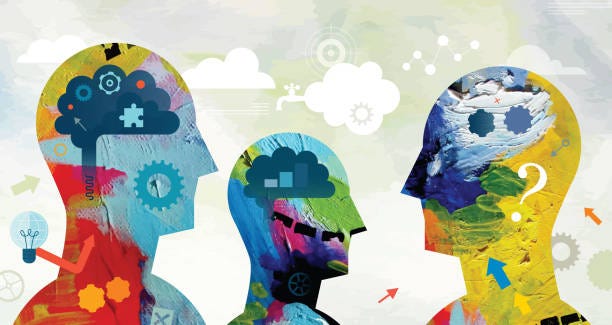
The most effective human problem-solvers don’t use one category exclusively. They orchestrate these strategies based on the problem context. This is sometimes called cognitive flexibility or strategic mindset switching.
First, use Divergent-Creative thinking to frame the problem in multiple ways.
Then, apply Analytical-Reductionist thinking to a promising frame to understand mechanics.
Check that analysis against a Holistic-Systems view to see secondary effects.
Use Intuitive-Heuristic thinking to make fast sub-decisions based on experience.
Finally, employ Procedural-Algorithmic thinking to implement the solution reliably.
Your earlier insight about interference patterns fits here: Problem-solving is often about managing the constructive interference (synergy) between these different cognitive modes and avoiding their destructive interference (e.g., when analytical thinking prematurely kills a creative idea). The “problem” itself often changes shape depending on which cognitive lens you look through.
Very interesting. Is there a known distribuition of the main categorie for each person? Does that varies upon, let’s say, men and women? What we mankind know about it?
It is clear that human cognition isn’t a fixed set of categories, but rather a probabilistic mosaic influenced by biology, culture, and experience. Below is the formatted version of your text, with all information preserved and the table converted into a clear text-based summary for easy copying.
The Distribution of Cognitive Profiles: Patterns, Not Determinism

Science suggests that while there are measurable tendencies in how people solve problems, these are probabilistic rather than deterministic. We don’t occupy a single category; instead, we possess a cognitive profile—a hierarchy of approaches with certain dominant modes.
1. Distribution Across Individuals
A person’s cognitive profile is shaped by several intersecting factors:
Personality: High “Openness to Experience” (Big Five) correlates with Divergent-Creative and Holistic thinking. High “Conscientiousness” correlates with Procedural-Algorithmic and Analytical thinking.
Profession & Training: An engineer’s brain is shaped for Analytical-Reductionist thinking, while an artist’s is tuned for Divergent-Creative and Intuitive-Heuristic modes. CEOs often develop strong Dialectical and Systems thinking.
Culture: Western traditions often emphasize Analytical and Procedural training, while some Eastern philosophies (e.g., Taoism, Buddhism) cultivate Holistic, Dialectical, and Intuitive patterns.
Neurology: Connectivity patterns vary. Higher “systematizing” (rule-based) vs. “empathizing” (social/contextual) tendencies are linked to different neural connectivity patterns.
2. The Question of Sex and Gender
This area involves a complex mix of robust data and cultural nuances.
A. Average Population Data
Spatial Manipulation: On average, males tend to perform better in mental rotation and spatial tasks (Analytical/Reductionist sub-skills).
Verbal & Social Cognition: On average, females tend to perform better in verbal fluency, reading emotions, and processing social information (Holistic/Intuitive sub-skills).
Empathizing vs. Systematizing: Populations show a trend where more females cluster around high empathizing and more males cluster around high systematizing, though distributions overlap enormously.
B. Crucial Caveats
The Overlap: Variation within each sex is far greater than the difference between them. Sex is a poor predictor of an individual’s cognitive style.
Nature vs. Nurture: Differences are a “tangled mix” of prenatal hormones (Biology) and socialization/play patterns (Neuroplasticity).
Stereotype Threat: Awareness of stereotypes can negatively impact performance, creating self-fulfilling prophecies.
Training Matters: When spatial skills are explicitly taught, gender gaps often vanish.
3. A More Powerful Lens: Cognitive Diversity
Modern science focuses on cognitive diversity rather than binaries. Successful teams require a mix of:
Explorers (Divergent-Creative)
Analyzers (Analytical-Reductionist)
Connectors (Holistic-Intuitive)
Finishers (Procedural)
Summary of Influencing Factors
Individual Neurology & Personality Creates a baseline inclination (e.g., a naturally intuitive or analytical mind).
Culture & Education Trains and reinforces specific patterns, often valuing Analytical over Holistic, or vice versa.
Profession & Lifelong Practice Deeply sculpts the brain, making certain modes (legal dialectics, engineering analysis) automatic.
Sex/Gender (Population Level) Shows subtle statistical tendencies in certain sub-skills but is a poor predictor for any given individual. It is generally overwhelmed by the other factors listed above.
Conclusion: The Toolset of the Mind
The most defining human trait is neuroplasticity. While our “starting toolbox” may contain different default tools due to genes or hormones, we can learn and master any cognitive style through intention and training.
The goal is not to label ourselves, but to diagnose the problem at hand and select the appropriate cognitive tool—or build teams where diverse cognitive styles create “constructive interference.”