Dirac Point, Dirac Fluid
The Dirac Point is a unique feature in the electronic band structure of materials like graphene where conduction and valence bands touch, creating massless quasiparticles with linear energy-momentum dispersion. When tuned near this point under specific conditions—strong electron-electron interactions, low temperatures, and high sample purity—electrons and holes form a collective hydrodynamic state known as the Dirac Fluid. In this regime, charge carriers behave like a viscous quantum fluid rather than independent particles. The key distinction: the Dirac Point is a single-particle band structure property, while the Dirac Fluid is a many-body phenomenon emerging from strong interactions on that foundation, offering insights into relativistic quantum hydrodynamics in condensed matter systems.
1. Dirac Point
What it is:
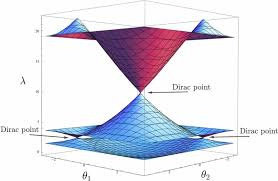
The Dirac Point is a unique location in the electronic band structure of certain materials where the conduction and valence bands touch at a single point (or a set of points) in momentum space. Unlike traditional semiconductors or insulators, there is no energy gap at this point.
Key Characteristics:
Linear Dispersion: Near the Dirac point, the energy-momentum relationship is linear (E ∝ k), not parabolic as in most materials. This mimics the behavior of relativistic massless particles described by the Dirac equation (hence the name).
Massless Quasiparticles: The electrons (or holes) behave as if they are massless Dirac fermions, moving at a constant Fermi velocity (~1/300 the speed of light in graphene).
Zero Density of States: At the exact Dirac point, the density of electronic states goes to zero.
Neutrality Point: When the Fermi energy is tuned to the Dirac point (e.g., by electrostatic gating), the material switches from electron conduction to hole conduction. The carrier concentration is minimal, leading to a local maximum in resistivity.
Where it’s found:
Graphene: The most famous example. Its honeycomb lattice produces two inequivalent Dirac points (K and K’) in its Brillouin zone.
Topological Insulators: Surface states host Dirac cones.
Some 3D Materials: Such as Dirac semimetals (e.g., Cd₃As₂, Na₃Bi).
Significance:
The Dirac point is responsible for many of graphene’s extraordinary electronic properties, such as ultra-high mobility, the half-integer quantum Hall effect, and Klein tunneling.
2. Dirac Fluid
What it is:
The Dirac Fluid is a collective, hydrodynamic regime of the electron-hole plasma in a system with Dirac points (like graphene) under specific conditions. It refers to a state where electrons and holes strongly interact with each other, ceasing to behave as individual particles and instead acting like a viscous, fluid-like quantum soup.
Key Conditions for its Formation:
Near the Dirac Point: The Fermi energy must be tuned close to the Dirac point, creating a near-equal density of electrons and holes.
Strong Electron-Electron Interactions: The rate of electron-electron collisions (τ_ee⁻¹) must become the fastest scattering process, dominating over:
Electron-impurity scattering (τ_imp⁻¹)
Electron-phonon scattering (τ_ph⁻¹)
Clean Samples & Low Temperatures: To minimize impurity/defect scattering and phonon scattering, allowing the intrinsic interactions to prevail.
Hallmarks of Dirac Fluid Behavior:
Viscous Electron Flow: Unlike ballistic or diffusive flow, the fluid exhibits vortices, Poiseuille flow profiles, and negative nonlocal resistance.
Enhanced Coulomb Drag: Strong momentum transfer between closely spaced layers.
Anomalous Thermal Properties: The Wiedemann-Franz law (relating electrical and thermal conductivity) is violated. The fluid carries heat very efficiently relative to charge.
Collective Excitations: The plasma oscillates in a way that is characteristic of a fluid, not a gas of independent particles.
Analogy:
Think of ordinary electrons in metals as a rarefied gas (they collide with walls/impurities more than with each other). The Dirac fluid is like water or honey—particles interact constantly with each other, leading to collective viscous behavior.
Relationship Between the Two

The Dirac Point provides the stage—it creates the massless, symmetric spectrum of electrons and holes.
The Dirac Fluid is a specific collective phase that emerges on that stage when conditions (temperature, cleanliness, doping) are just right to make interactions dominate.
In short: The Dirac point is a single-particle band structure feature. The Dirac fluid is a many-body hydrodynamic phenomenon that can occur in systems possessing Dirac points.
Experimental Proof: Landmark experiments in 2016-2019, particularly on ultraclean graphene at temperatures around 50-100K, measured hydrodynamic flow patterns and violation of the Wiedemann-Franz law, providing strong evidence for the Dirac fluid’s existence.