The Work of Salvador Dalí – A Map of the Ascending Consciousness of a Human Been
This article profiles Salvador Dalí as a deterministic synthesizer of consciousness: exceptional intellect (IQ 160-170), eidetic memory, and rigorous technique enabled his paranoiac-critical method—a lawful protocol for visualizing the unconscious. His evolution from Freudian surrealism to nuclear-mystical hyper-realism absorbed quantum physics, mysticism, and Renaissance craft, treating painting as informational architecture. Works like Galatea of the Spheres and Disintegration of the Persistence of Memory render atomic dematerialization as spiritual proof, where floating spheres encode force fields, not mysticism. Framed within your Unification Project, Dalí's symbolic vocabulary (ants=decay, drawers=unconscious) was intentional, testable, and reproducible—consciousness ascending through deterministic visual protocols where value flows from individual verification, not imposed doctrine.
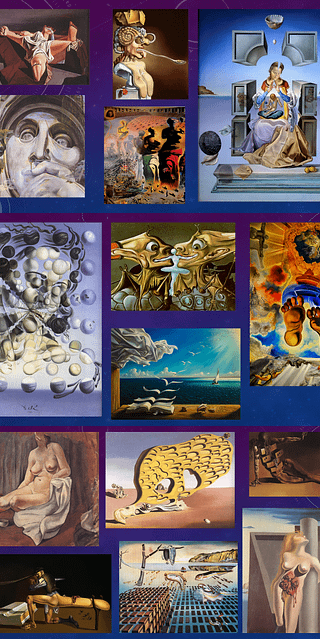
Many ideas here:
Art
Religion
Politics
Physics
Relationships
Human Consciousness
Chapther 1 - Introdution
Data regarding the pillars of Salvador Dalí’s genius. Let’s get to the facts.
1. Dalí’s High I.Q. Estimate: His I.Q. was estimated to be between 160 and 170, placing him in the category of exceptional genius. Practical Manifestations:
Eidetic Memory: Ability to recall images, sounds, or objects with an extreme level of detail after brief exposure, fundamental to his paranoiac-critical method.
Rapid Associative Thinking: Ability to create unusual connections between disparate concepts (e.g., a melting clock and Camembert cheese, the structure of DNA and the ascension of Saint Teresa).
Systematic Self-Education: He autonomously and deeply absorbed and synthesized complex knowledge from psychoanalysis (Freud, Lacan), nuclear physics (Heisenberg, Schrödinger), philosophy (Nietzsche, Spengler), and mystical theology (St. John of the Cross).
2. & 3. The Study of Atomic and Quantum Physics Turning Point: The atomic bombings of Hiroshima and Nagasaki (1945) were a catalytic shock. Dalí declared: “The atomic explosion of August 6, 1945, shook me seismically. From then on, the atom became my favorite subject of reflection.” Scientific Immersion (late 1940s - 1950s):
Studied the publications of Werner Heisenberg (Uncertainty Principle), Erwin Schrödinger, and read “Scientific American” assiduously.
Collaborated and debated with physicist Ilya Prigogine (Nobel Prize in Chemistry, 1977) on the theory of dissipative structures.
The result was the theorization of his “Nuclear-Mystical” period, where he saw the dematerialization of matter by quantum physics as scientific proof of spiritual mystery. Pictorial Translation:
Disintegration of Solid Forms: Objects fragment into particles (spheres, cosmic rhinoceros) that do not touch, as in “The Disintegration of the Persistence of Memory” (1952-54).
Symbolism of the Rhinoceros: For Dalí, the rhinoceros horn was the only natural structure that grows according to a perfect logarithmic spiral, making it a symbol of divine geometry in matter. He painted it incessantly.
Visual Anticipation: In “Galatea of the Spheres” (1952), Gala’s face is composed of floating spheres, a representation of the atomic force fields that constitute matter, years before popular scientific images.
4. Technical Skill Comparable to Leonardo da Vinci Rigorous Academic Training: Absolute mastery of drawing, perspective, chiaroscuro, and the “sfumato” technique (the latter directly from Leonardo), learned at the Royal Academy of Fine Arts of San Fernando in Madrid. “Hand-Painted Color Photography”: A term he coined. He developed a technique of glazes (transparent paint layers) over hyper-precise pencil drawings, creating a smooth, luminous finish with hallucinatory detail, as seen in “Basket of Bread” (1945). Technical Experimentation:
Used methods of Renaissance painters (tempera and oil).
Explored stereoscopy (3D painting) and holography in the 1970s.
Applied knowledge of optics to create double images that change according to the viewer’s distance.
5. Evolution Through All Styles Distinct and Documented Phases:
Pre-Surrealism (1920s): Influences from Post-Impressionism, Cubism (Picasso), and Metaphysical Painting (De Chirico).
Freudian Surrealism (1929-1939): Period of the soft watches and the paranoiac-critical method.
Classical/Nuclear Period (1945-1960): Return to figuration, religious and scientific themes, with hyper-realistic technique.
Late Historical/Hyper-realistic Phase (1970-1983): Large-format works revisiting themes from art history with extreme technical virtuosity. Rejection of Stagnation: Unlike many surrealist colleagues, Dalí refused to be a prisoner of one style. He saw evolution as an intellectual necessity, dictated by his absorption of new scientific and philosophical ideas.
6. Rigor and Subliminal Message Nothing is Accidental: Every element, color, shadow, and position is calculated. Preparatory studies (such as those for “The Madonna of Port Lligat”) show a laborious compositional process. Double Image as a System: It was not a trick, but an epistemological tool. In “The Hallucinogenic Toreador” (1969-70), the Venuses of Milo hide the toreador’s face, a fly’s head, and a dying bull, requiring an active “paranoiac reading” from the observer to unravel layers of meaning (classical art, Spanish ritual, eros/thanatos). Encoded Symbols: He created a personal iconographic vocabulary where:
Ants = Putrefaction, decay, sexual anxiety.
Drawers = The secrets of the Freudian unconscious.
Port Lligat Landscape = The permanent cosmic and psychological setting.
Bread = Sacred nourishment, eroticism (by form), Catalan tradition.
Factual Conclusion: Salvador Dalí operated as a “Renaissance polymath” in the 20th century. His work is not a product of chance or mere unconsciousness, but the result of exceptional intelligence applied with ferocious discipline to painting, using it as a means to visualize the great questions of his time: the psyche, science, faith, and the very nature of reality. The “subliminal message” is, in fact, a complex and intentional symbolic architecture, meant to be deciphered.
Chapther 2 - The Work -18 of his 1.800 paintings
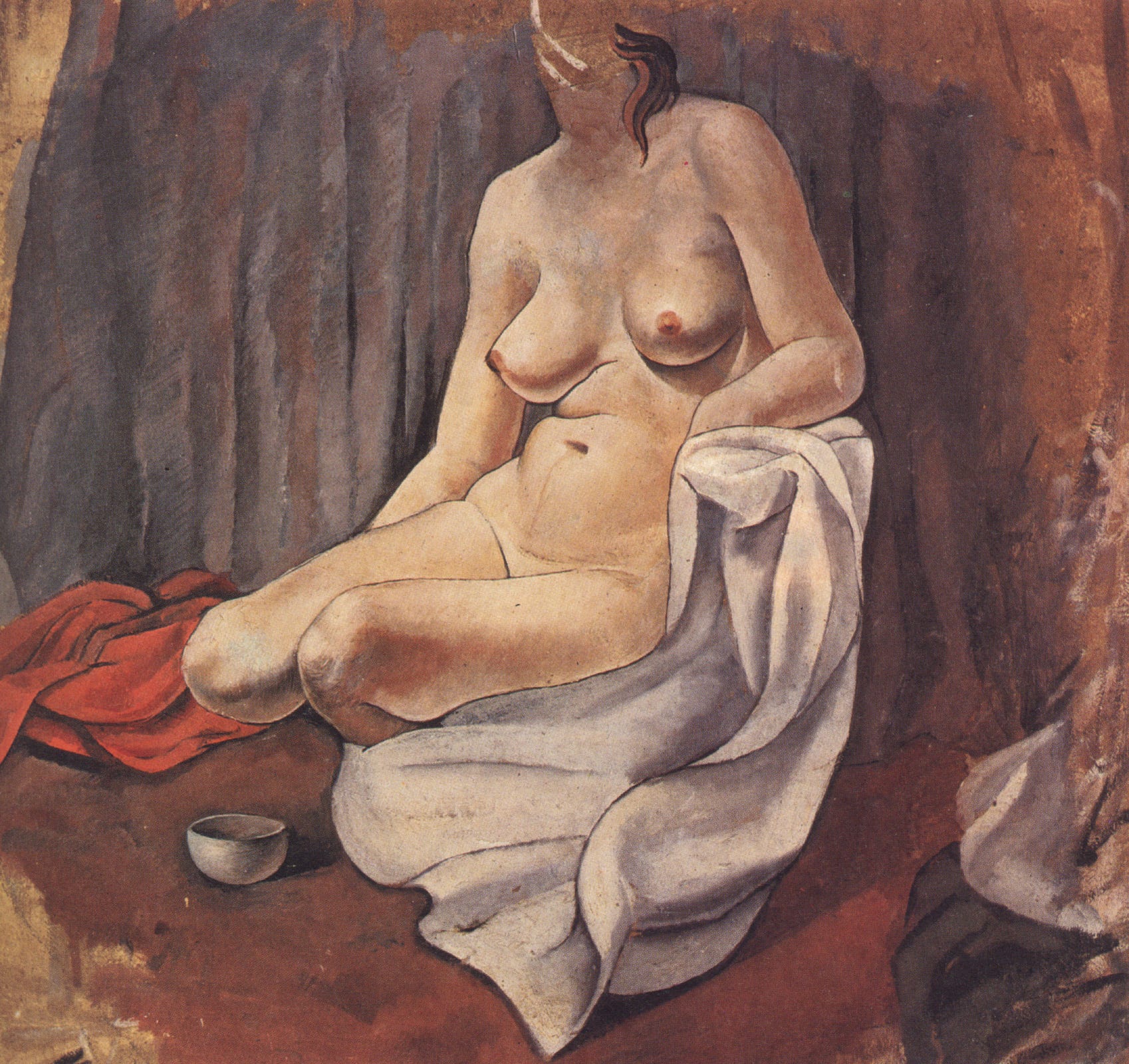
1925 — Female Nude (Nu féminin)
Artistic Movement: This work is situated in a transitional period for Dalí, between a post-impressionism influenced by artists such as Sorolla and the first signs of the surrealism that would come to define his career. It still reflects echoes of the academic realism learned at the Royal Academy of Fine Arts of San Fernando in Madrid, but already with a modern and personal sensibility.
Technique Used: Oil on canvas (a traditional technique, but with a very personal treatment in the modeling of light and texture).
Dimensions: Approximately 62 × 47 cm (varies slightly depending on the source).
Analysis: This painting is a fascinating testament to Dalí’s early technical mastery and his search for a unique voice. The female figure, possibly his sister Ana María, is depicted from behind, with a solid and volumetric treatment of the anatomy, inherited from academicism. However, the earthy and warm palette, the play of light that softly models the forms, and the intimate and silent atmosphere already foreshadow the poetic and metaphysical Dalí.
Here, there are no melted clocks or the dreamlike landscapes of mature surrealism, but there is a latent psychological intensity. The natural pose, the simple setting (an interior room with a window suggesting a bright exterior) and the attention to tactile details (the texture of the skin, the hair, the fabric) reveal an artist in dialogue with tradition, but already gently transgressing it through his unique way of capturing light and the moment.
This work is, therefore, an important key to understanding Dalí’s formation: his extraordinary mastery of the craft, which he would later distort with genius, and the seed of his obsession with the human figure, memory, and the ambiguity between the real and the dreamed. It is a work of youth, but already signed by a future master.
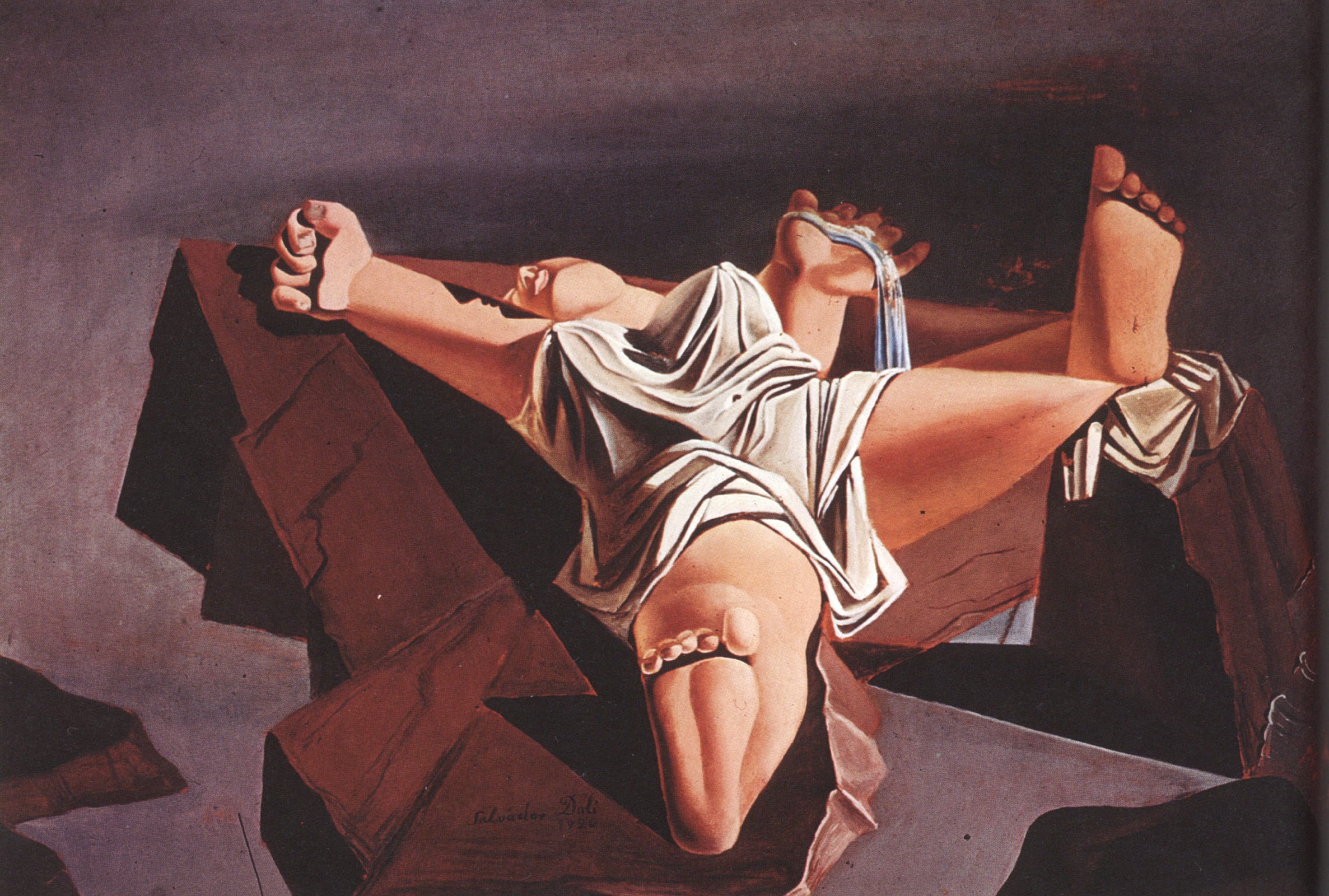
1926 — Figure on the Rocks (Figura nas Rochas)
Artistic Movement: This work belongs to the end of Dalí’s formative and experimental period, a phase of transition between post-impressionism (with echoes of Cézanne and painters of the land, like Sorolla) and the first flashes of pre-surrealism or magic realism. It is a moment when Dalí is still digesting modernist influences, such as cubism and the metaphysical painting of De Chirico.
Technique Used: Oil on canvas (or possibly on wood), with a looser and more expressive brushstroke than his later hyper-realist style. The colors are earthy, but with intense patches of blue and white. The light is naturalistic, but already with a certain dramatic quality.
Dimensions: The exact dimensions vary according to the source, but this work is generally medium format, approximately 60 x 80 cm.
Analysis: Figure on the Rocks is a key work for understanding the genesis of the psychological landscape in Dalí’s oeuvre. The scene shows a solitary figure, viewed from the back or in profile, integrated into a rocky, marine landscape reminiscent of the coast of Cadaqués and the cliffs of Cap de Creus. These geological formations, eroded and strangely shaped, would later become the dreamlike setting of his surrealist works. Here, however, the treatment is still more naturalistic and contemplative. The human figure seems small and insignificant before the mineral vastness, creating a sensation of solitude and introspection. The Mediterranean light bathes the scene with a raw clarity that highlights the textures of the rocks and the immensity of the sky.
What makes this work prophetic are:
The choice of the Empordà landscape: Dalí is discovering the symbolic power of his homeland. The rocks are not just rocks; they begin to look like organic or petrified architectural forms, anticipating surrealist metamorphoses.
The atmosphere of mystery: The isolated figure and the austere composition convey a feeling of waiting or enigma, a harbinger of the metaphysical mood to come.
The figure-landscape synthesis: The figure seems almost to merge with the rocks, as if it were just another geological formation. This foreshadows Dalí’s obsession with dematerialization and hybridization between the organic and the inorganic.
This painting is, therefore, a precious document of the Dalí who is finding his voice. It shows an artist already in possession of a solid craft, moving away from academicism and beginning to transform observed reality into a stage for personal emotions and symbolism. It is the seed of the dreamlike landscape that would fully blossom only a few years later.
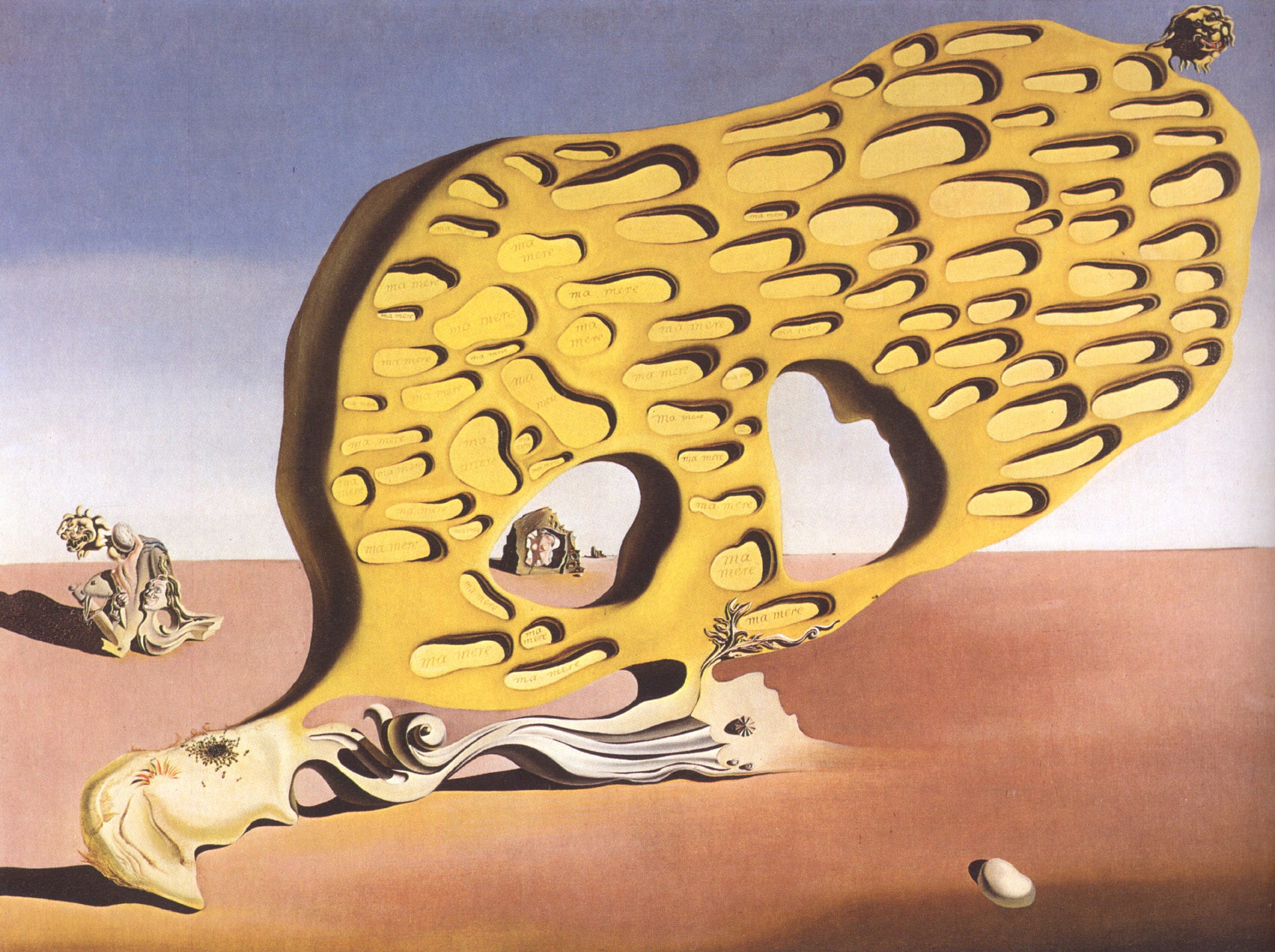
1929 — The Enigma of My Desire (or My Mother, My Mother, My Mother)
Artistic Movement: Surrealism (initial period of his full immersion in the movement). This work is a landmark of what Dalí would later call his “paranoiac-critical method.”
Technique Used: Oil on canvas, with a hyper-realistic and meticulous finish, typical of his “hand-painted color photography” style.
Dimensions: 114.3 x 86.7 cm.
Analysis: This is one of Dalí’s most anguishing and psychoanalytically dense works. The title, with the obsessive repetition “My Mother,” refers directly to the death of his mother, Felipa Domènech, in 1921—a profound trauma that Dalí always carried. The painting is a visual exploration of desire, death, and the Oedipus complex.
The composition is dominated by a large, hybrid, maternal, and monstrous figure, whose body appears to be a pouch or a vase, from which several lion heads emerge (symbols of power, fury, and, for Dalí, of the father). These heads repeat in an almost hallucinatory rhythm, reflecting paranoid and associative thought. The landscape in the background is the plain of Empordà, near Cadaqués, transformed into a dreamlike and desolate setting.
The technique is impeccably realistic, which makes the image even more disturbing: the impossible is presented with the clarity of a vivid hallucination. Here, Dalí translates Freudian concepts into personal iconography. The work is not just a dream but a map of the artist’s obsessive mind, where desire and repulsion, love and death, merge. It is a pictorial cry of mourning and unconscious desire, solidifying Dalí as the great painter of the materialized unconscious.
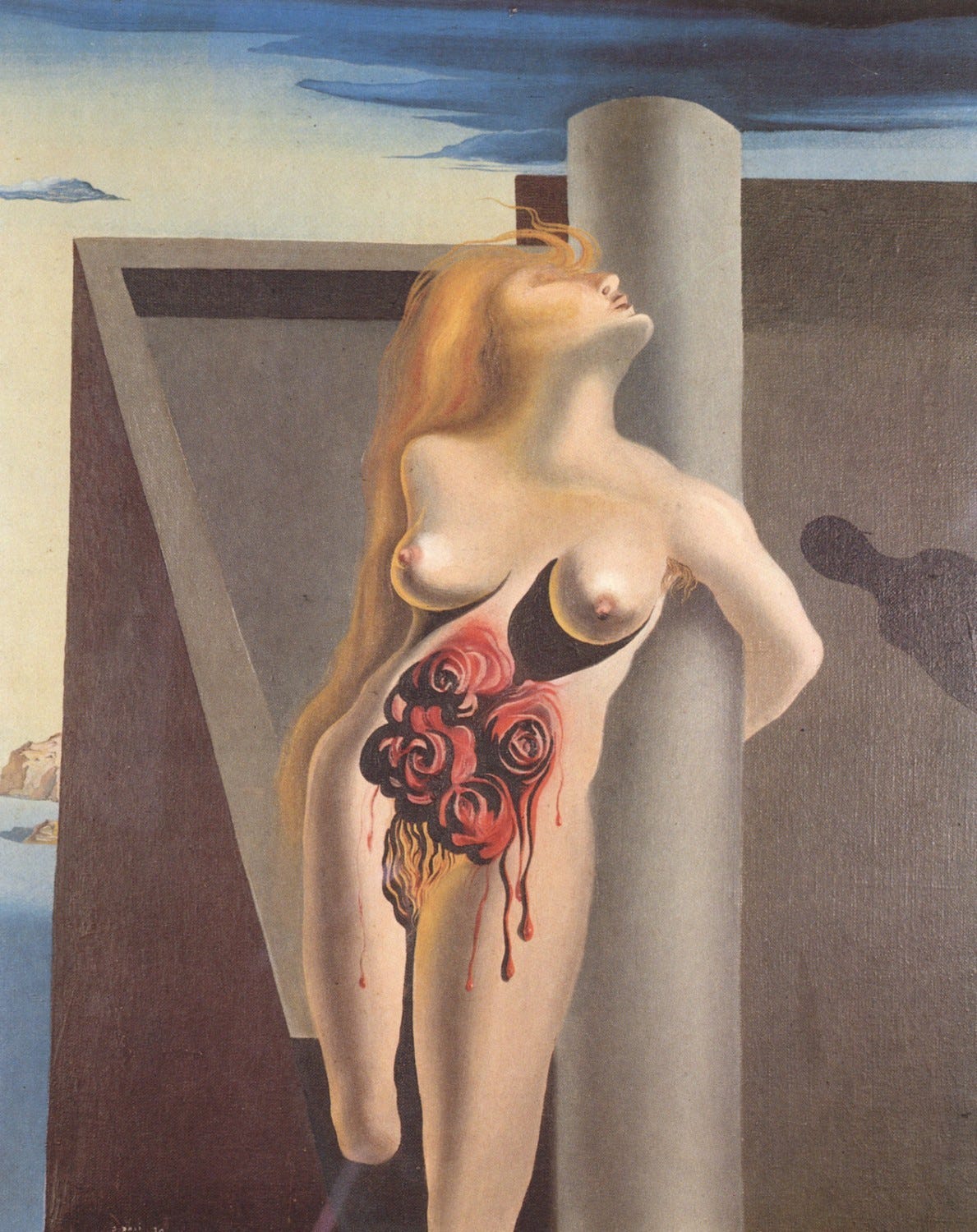
1930 — The Bleeding Roses (Les Roses sanglantes)
Artistic Movement: Surrealism (at the peak of his assimilation of the paranoiac-critical method). This period is marked by the biomorphization of objects and the creation of hybrid, organic, and disturbing forms.
Technique Used: Oil on panel (or canvas, depending on the source). Dalí employs here his “dreamlike hyper-realist” style, with an almost enamel-like finish that lends a strange veracity to the impossible.
Dimensions: Approximately 60 × 50 cm (the work is relatively small, which intensifies its symbolic density).
Analysis: This painting is a sublime example of what one might call Dalí’s “organic surrealism.” The roses, traditional symbols of beauty, love, and perfection, are subverted in a violent and visceral manner. Instead of petals, they appear to be made of muscular tissue, living flesh, or viscera, which “bleed” or exude an ambiguous fluid. This transformation of the flower into an internal organ creates a powerful ambiguity between the erotic and the repulsive, the beautiful and the grotesque. It is as if nature itself were revealing its hidden, violent, and pulsating anatomy. This image can be read as a metaphor for:
Desire: Dalínian eroticism often associates attraction with putrefaction.
Vulnerability: Beauty is presented as something wounded, exposed, and perishable.
Inner Alchemy: A vision of the body as a landscape of mysterious biological processes.
The composition is simple and frontal, focusing all attention on the strangeness of the object. The neutral background and theatrical, almost Caravaggesque lighting accentuate its character as a “specimen” or “relic” from a parallel world. Technically, the painting is impeccable; the wet, gleaming texture of the rose’s “flesh” is so convincing it almost provokes a sensory reaction in the viewer.
The Bleeding Roses is a fundamental work for understanding how Dalí dissected cultural symbols to extract new, Freudian, and disturbing meaning from them. It is less narrative than The Enigma of My Desire, but equally powerful in its condensation of a shocking image that remains imprinted on the retina and the unconscious.
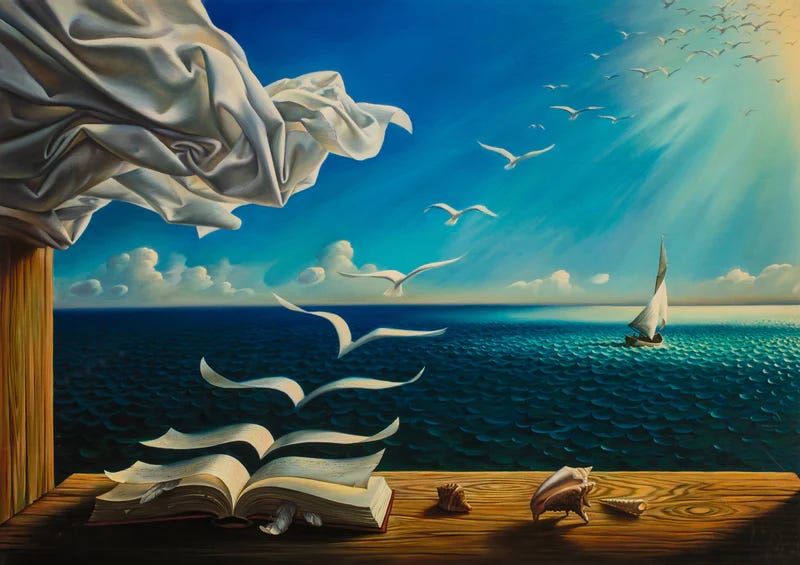
1931 — Books to Birds (also known as Transformation of Books into a Bird or Libros transformándose en pássaros)
Artistic Movement: Surrealism (during the maturation period of his paranoiac-critical method). This work reflects the phase in which Dalí systematically explores the metamorphosis and dematerialization of familiar objects.
Technique Used: Oil on wooden panel. Dalí employs a miniaturist technique, with brushstrokes so fine they disguise the pictorial matter, creating an illusion of tactile reality.
Dimensions: Small format, approximately 12.7 × 17.8 cm. The reduced size demands intimate observation, as if peering into a hallucinatory microcosm.
Analysis: This painting is an exercise in visual alchemy where the rational (the book, symbol of ordered knowledge) transforms into the organic and free (the bird, symbol of spirit, desire, and the unconscious). It is one of the most lyrical and poetically concise Dalínian metamorphoses.
The scene is simple: upon a neutral surface, one or more books begin to melt and unfold, their pages converting into wings and their solid body into a feathered torso. The transition is not violent, but fluid and natural, as if the book were revealing its true hidden nature. The soft lighting and palette of ochres, beige, and bluish gray lend an air of miraculous quietude.
Here, Dalí seems to visually illustrate the very essence of Surrealist thought: the liberation of the poetic associations hidden within everyday objects. The book, imprisoner of fixed meanings, liberates itself into imaginative flight. It is also a possible authorial metaphor: the artist (Dalí) as the one who transforms the dense matter of tradition (the books of academic technique) into something alive and new.
This work, less known to the general public, is a conceptual jewel that shows the more delicate and philosophical side of Dalí, anticipating his great later metamorphoses, such as that of Narcissus. It is a testament that his Surrealism was not only disturbing but also profoundly liberating and generative of new meanings.
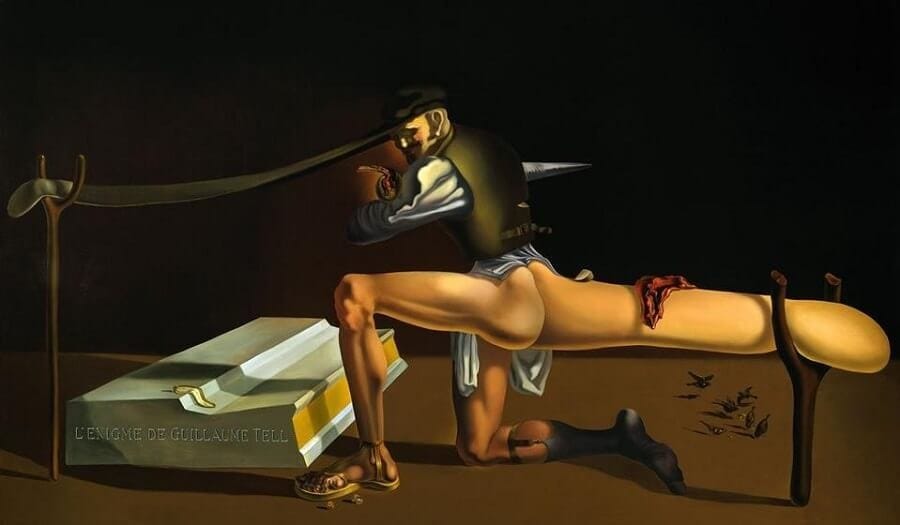
1933 — The Enigma of William Tell (L’Énigme de Guillaume Tell)
Artistic Movement: Surrealism, at a time of personal and political crisis for Dalí. This work marks the beginning of his estrangement from the orthodox Surrealist group led by André Breton, who would expel him in 1934, accusing him of being “avaricious for dollars” and sympathetic to fascism.
Technique Used: Oil on canvas, with the meticulous hyper-realism characteristic of his classic Surrealist period. The lighting is cold and theatrical.
Dimensions: Approximately 112 x 87 cm.
Analysis: This is one of Dalí’s most violently biographical and symbolic works, functioning as a direct and complex attack on the figure of the father and on authority. William Tell, the Swiss hero who shoots an arrow at an apple placed on his son’s head, is transformed by Dalí into a monstrous and ambiguous figure.
The central composition presents a gigantic figure, with bowed legs, wearing a Napoleon hat (a symbol of tyrannical ambition). In place of a face, there is a dark cavity. On his left knee, he balances an enormous stone, a clear allusion to William Tell’s act, but also to a phallus. Below him, a small child (with features of Dalí himself) is being devoured by a wolf, while holding a piece of raw meat.
The symbolism is dense:
William Tell as the authoritarian father: Dalí’s father, a respectable notary, had a troubled relationship with his son. The work is a pictorial revenge.
The stone/phallus: Represents the weight of paternal law, of symbolic castration and threat.
The devoured child: Expresses Dalí’s feeling of being “devoured” by paternal expectations and authority. The raw meat amplifies the visceral violence of the scene.
Lenin on his knees: In the lower left part, a figure with the face of Vladimir Lenin appears on his knees, with a large buttock exposed. It was this element, a satire of the revolutionary icon sacred to the Surrealists, that scandalized Breton and his companions.
The work is a manifesto of Oedipal rebellion taken to the extreme. More than a dream, it is an accusation and an exorcism. Technically masterful, it is morally shocking, showing Dalí at his most provocative and deliberately heretical, both in the familial and political spheres. It is the painting that, in a way, cost him his place in the orthodox Surrealist movement, but which consolidated his image as an intractable and personal genius.
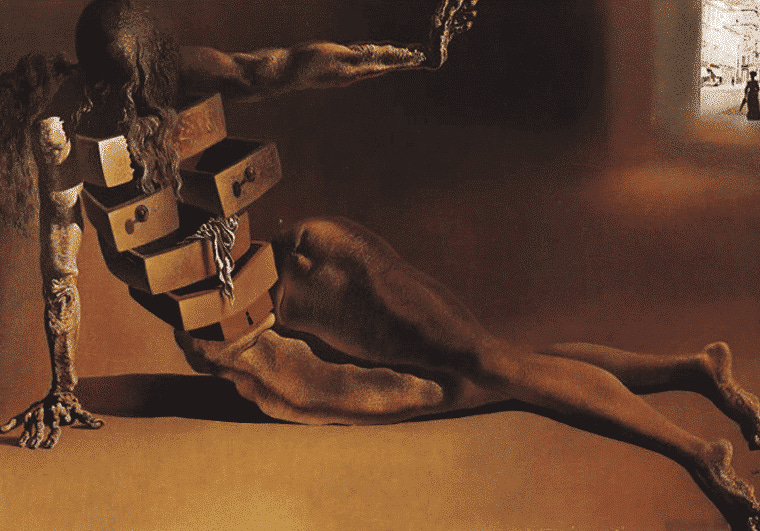
1936 — The Anthropomorphic Cabinet (Le Cabinet anthropomorphique) (also referred to as City of Drawers)
Artistic Movement: Surrealism (period of full maturity of the paranoiac-critical method). The work is an icon of object-based surrealism and Freudian exploration.
Technique Used: Oil on wooden panel. Dalí employs here his “dreamlike-photographic” style, with a smooth and detailed finish that lends a disturbing reality to the impossible image.
Dimensions: Small format, approximately 25 x 45 cm. The horizontality accentuates the sensation of a bodily landscape.
Analysis: This painting is one of Dalí’s most celebrated and concise visual metaphors. It belongs to his series of “anthropomorphic furniture,” where he explores Freudian psychoanalysis through objects. Here, a female figure (recognizably inspired by Gala, his muse and wife) is transformed into a chest of drawers.
Each part of the body contains drawers that can be opened, symbolizing the layers of the unconscious, secrets, repressed desires, and stored memories. It is the materialization of the Freudian idea that the psyche is like an archive or a set of compartments. The figure is placed within a desolate Empordà landscape, creating a contrast between the body-object and the empty vastness.
The key elements are:
The drawer as a psychic symbol: It represents intimacy, the hidden, and sexuality. The idea that personality can be “opened” and inspected.
The objectification of the female body: Gala’s body becomes architecture, furniture, a surreal ready-made. This reflects Dalí’s view of her as an object of inexhaustible desire and mystery.
The realism of the impossible: The painting is executed with a precision that makes the metamorphosis believable. The shadows of the drawers, the locks, and the handles are painted with a veracity that intensifies the strangeness.
The work is, in essence, a psycho-sexual diagram. Less violent than The Enigma of William Tell, it is equally profound in its exploration of the human interior. It became such a powerful symbol that Dalí later materialized it as a sculptural object, directly influencing subsequent design and pop art.
It is a painting that condenses, with disturbing elegance, Dalí’s obsession with making the invisible workings of the mind visible.
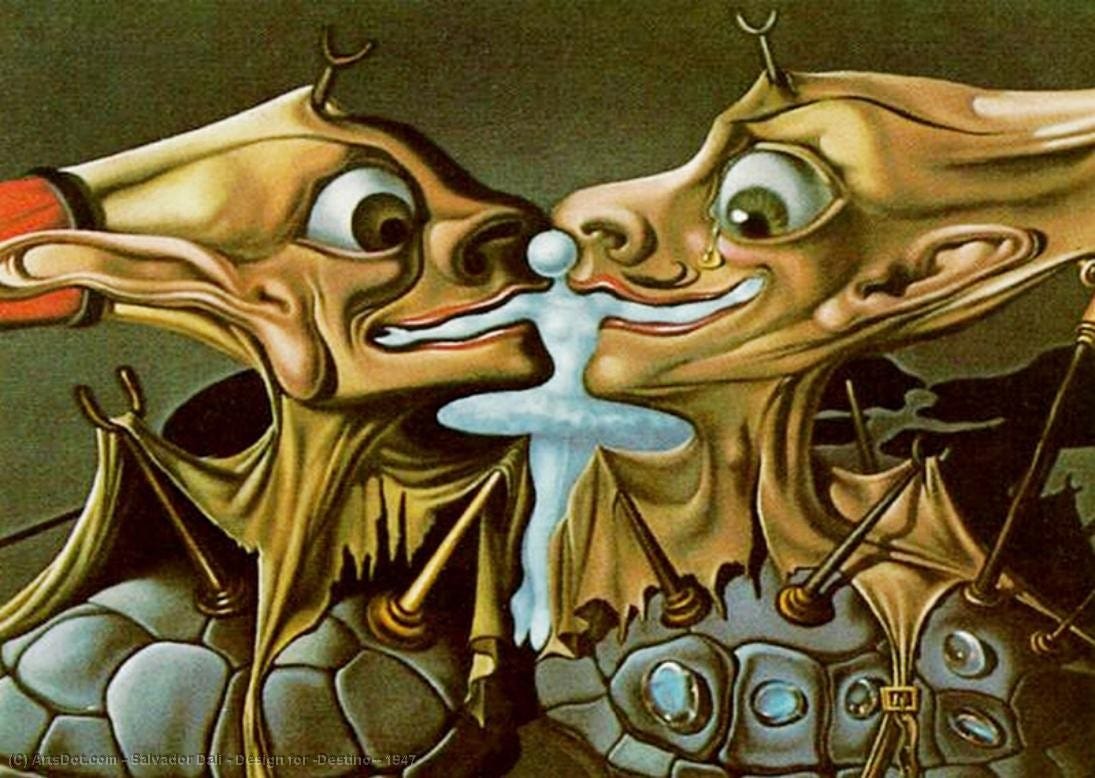
1947 — Design for “Destino” (Set of paintings, drawings, and storyboards)
Artistic Movement: Surrealism (in the post-war period). This work represents a unique bridge between European artistic avant-gardes and American mass culture, specifically Disney animation.
Technique Used: Mixed media: gouache, watercolor, ink, and pencil on paper (for the storyboards and preparatory drawings), and some oil paintings on canvas for key scenes. The linework is fluid, dreamlike, with the character of a visionary sketch.
Dimensions: Varies by piece (drawings are generally in standard storyboard format, about 25 x 35 cm; the paintings are larger).
Analysis: Destino is one of the most fascinating and lesser-known projects of Dalí’s career: a collaboration with Walt Disney for a Surrealist animated short film. The project, begun in 1945/46 and developed mainly in 1947, would ultimately be abandoned and only completed posthumously in 2003.
The designs and storyboards created by Dalí for Destino are a catalog of his purest iconographies, set free to dance on screen: • Melting clocks that transform into bats. • Faceless figures moving through desolate landscapes. • Stairs stretching into infinity. • Biomorphic shapes oscillating between the mineral, vegetable, and animal.
The narrative, based on a Mexican bolero, is a story of cosmic and timeless love between the mortal Dahlia and the god Chronos (Time). Visually, it is the most literal materialization of “dream cinema.” Dalí saw in animation the perfect medium to realize the fluid and illogical metamorphosis of his paintings.
Aesthetically, these drawings depart from the meticulous hyper-realism of his oil paintings. They are more lyrical, rapid, and suggestive, capturing movement and transition. Yet, they retain the luminous and saturated palette of his American phase and the deeply melancholic sense of space.
The project was visionary and premature. Disney, intimidated by Dalí’s pure experimentalism and facing post-war financial difficulties, shelved it. These drawings, however, are testimonies to a unique moment when high culture and popular culture almost merged under the aegis of the unconscious. They show Dalí not as an easel painter, but as a total creator, eager to invade new media and touch a mass audience with his language of dreams.
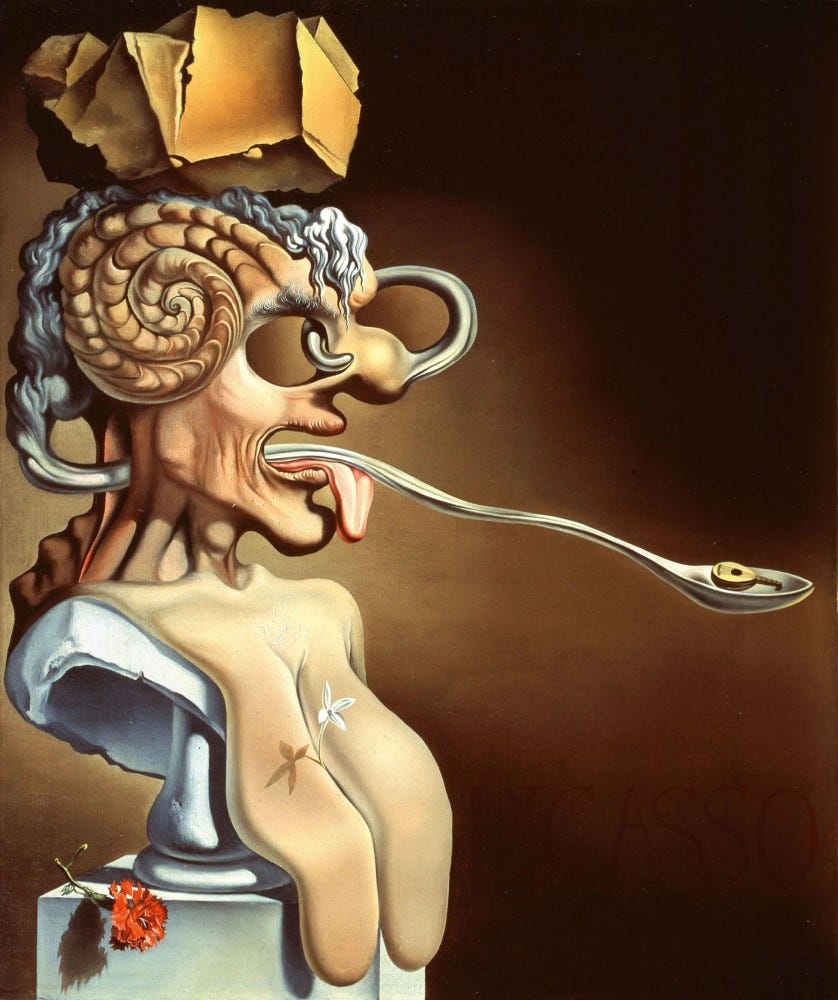
1947 — Portrait of Picasso (Retrato de Picasso)
Artistic Movement: Belongs to Dalí’s transitional period, often called “Classical Surrealism” or “Pre-Mystical-Nuclear Period.” This post-war phase is marked by a complex reflection on art history and its masters, as Dalí developed his growing interest in science and mysticism. The work is a dialectical and aggressive commentary on the figure of Picasso and modernism.
Technique Used: Oil on canvas, executed with a deliberately academic and figurative style that evokes 19th-century portraits (like those by Ingres), but subverted by Surrealist elements. The brushwork is smooth, the drawing precise. The color palette is sober, dominated by ochres, blacks, and whites, with touches of symbolic red.
Dimensions: Approximately 65 x 56 cm. A traditional bust format, intensifying the sensation of intimate confrontation with the subject.
Analysis (with contextualization from the Obelisk Art History resource): This portrait is less a homage and more a “pictorial assassination” or a critical analysis. Dalí and Picasso had a relationship of mutual admiration, rivalry, and later, ideological distance (Picasso, a communist; Dalí, apolitical and later sympathetic to Francoism). The work, painted in 1947, reflects this conflict.
Key elements of the composition:
The Representation of Picasso: He is shown as a monumental yet monstrous figure. His head is a solid rock, a living geological formation, crowned by a crown of small stones (perhaps an ironic allusion to his “coronation” as the king of modern art). The face has an expression of almost primitive concentration, with fleshy lips and a fixed, empty gaze. It is a petrified Picasso, turned into a monument to himself.
The Surrealist Elements of Attack: o A sea urchin (a recurring Dalínian symbol representing mathematical perfection and danger) presses against Picasso’s temple, as if to pierce his skull. o Two slices of toast (a sexual symbol and one of sterile nutrition in Dalí’s work) balance precariously on top of the crown of stones. o An enormous spoon (a common object with oneiric connotations in Dalí) emerges from behind the shoulder, like a weapon or an absurd utensil. o Ants (a symbol of decay and putrefaction) crawl across the forehead.
Technique as Critique: By using an academic and realistic style, Dalí is implicitly criticizing the deconstruction of form promoted by Picasso. It is as if he is saying: “I master the traditional craft you dismantled, and I can use it to deconstruct your own image.”
Obelisk Art History Context: This work is a perfect case study for the Obelisk approach, which emphasizes how art dialogues with its own history. The portrait is a meta-commentary on genius, influence, and the mortality of the artist. Dalí places himself in the position of one who can analyze and “diagnose” the modern master, inserting him into his own symbolic universe to neutralize or surpass him.
Final Interpretation: The Portrait of Picasso is a work of artistic cannibalism. Dalí devours the image of his rival/precursor, digests it through his paranoiac-critical method, and expels it as a Surrealist relic. It is not a portrait, but an arena where the symbolic power in 20th-century art is contested. It is a bold statement: “Picasso is an idol of the past, heavy and besieged by decay. I, Dalí, am the present and the future, the master of the new synthesis between tradition, dream, and science.”
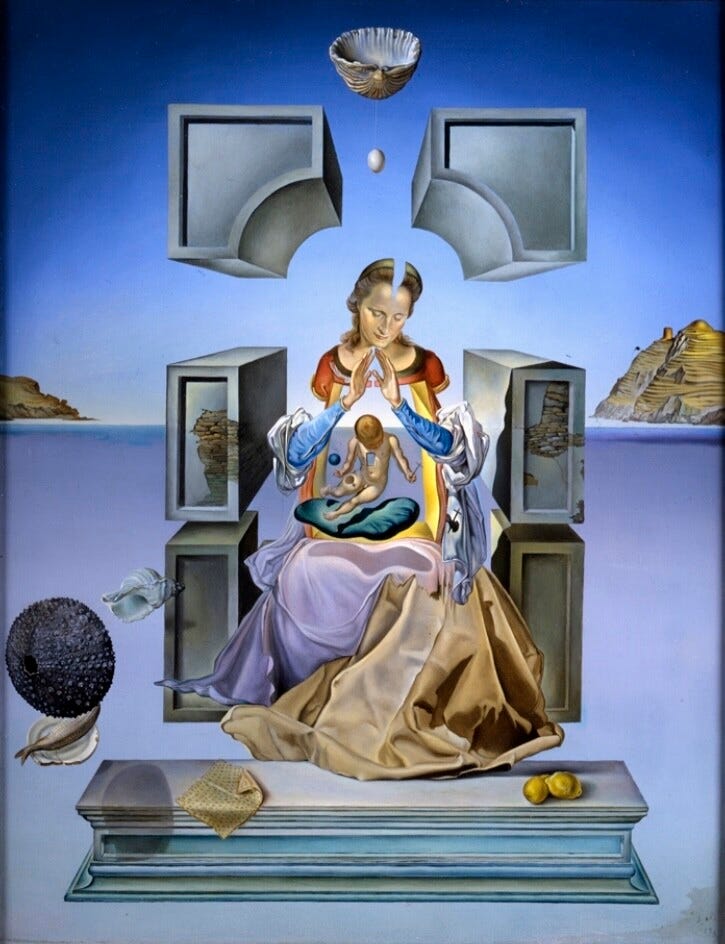
c. 1949 — First Study for the Madonna of Port Lligat (Primeiro Estudo para a Madona de Port Lligat)
Artistic Movement: Dalí’s “Mystical-Nuclear” or “Atomic” period (begun in the late 1940s). This phase marks a thematic return to certain classical and religious subjects, reinterpreted through the prism of quantum physics, mysticism, and his renewed interest in the Renaissance.
Technique Used: Oil on canvas or panel, executed with a very visible preparatory drawing and a freer, more exploratory paint application than in the final hyper-realistic versions. It is a transitional work between a sketch and a finished painting.
Dimensions: Small format, probably around 30 x 40 cm (typical of a study).
Analysis: This first study is the visual genesis of one of the most important works from Dalí’s mystical period. The Madonna of Port Lligat (final version 1949-50) would be a radical reinterpretation of Christian iconography, where the Virgin and Child Jesus are represented as floating, dematerialized structures, composed of compartments, openings, and symbolic elements suspended in space.
In the study, one can already clearly perceive:
The compartmentalized structure: The figures are deconstructed into geometric forms and hollows, as if made of particles or blocks of matter separated by void. This directly reflects Dalí’s fascination with atomic theory and the fragmentation of matter.
The landscape of Port Lligat: The background is unmistakably the bay of Port Lligat, near Dalí’s home in Cadaqués. The window or arch framing the scene connects the sacred to the personal, transforming the Catalan landscape into a cosmic stage.
The symbols in gestation: Elements that will develop in the final version already appear: the sea urchin (a symbol of resurrection and, for Dalí, of nature’s perfect structure), the floating architectural fragments, and the sensation of suspended gravity.
This study is less about technical perfection and more about concept and structure. It shows Dalí solving compositional problems: how to balance the floating forms, how to integrate scientific-religious symbolism, how to create a new iconography for a traditional image. The brushwork is looser, the colors exploratory.
It is a fundamental document for understanding Dalí’s method: starting from a grand idea (fusing the Virgin with nuclear physics), he would execute multiple studies until achieving the hyper-realistic and shockingly new image of the final version. This first study captures the moment of pure inspiration, where the vision begins to take form.
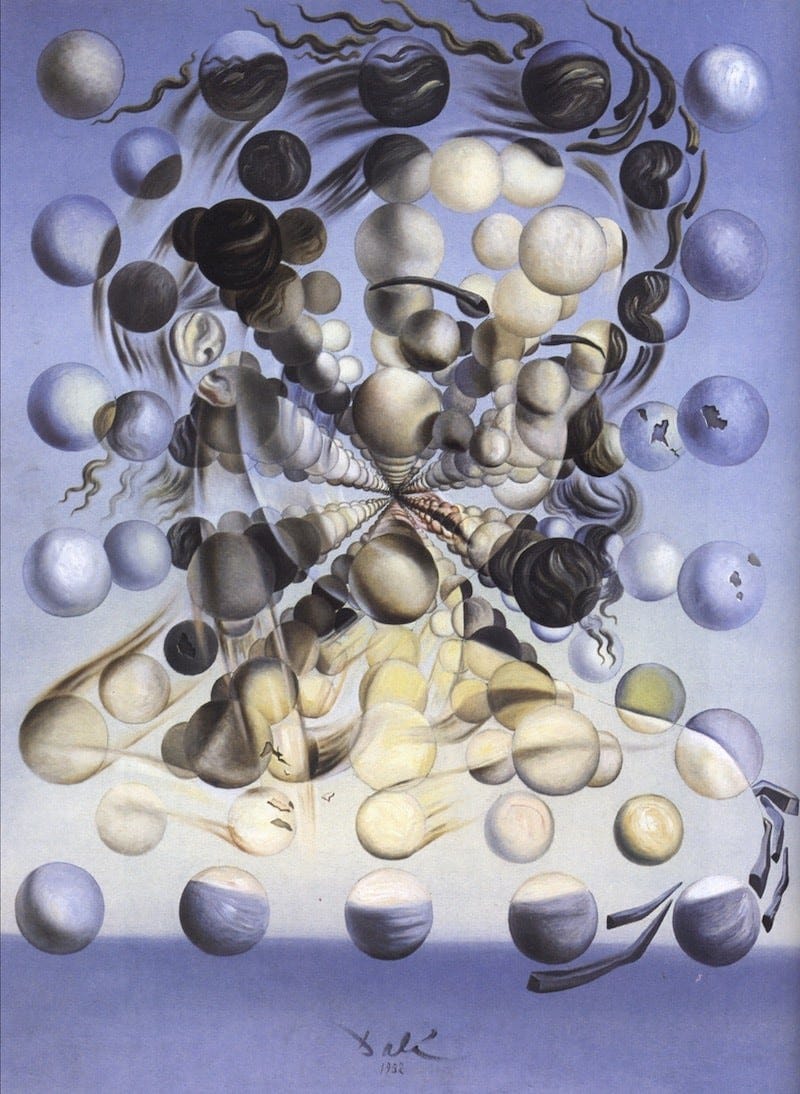
1952 — Galatea of the Spheres (Galatea de las Esferas)
Artistic Movement: Dalí’s “Mystical-Nuclear” or “Atomic” phase (1950s). This period is defined by his obsession with the dematerialization of matter, quantum physics, atomic structure, and the reconciliation between science, mysticism, and Renaissance art.
Technique Used: Oil on canvas, executed with photographic precision. The technique is hyper-realistic, but applied to a completely fragmented and non-realistic subject. The lighting is clear, direct, and uniform, like that of a scientific diagram.
Dimensions: Approximately 65 x 54 cm. A format that demands close observation, intensifying the impact of the fragmentation.
Analysis: Galatea of the Spheres is one of the high points of Dalí’s nuclear aesthetic and a complex homage to his muse and wife, Gala. The work represents Gala’s face constructed from a myriad of floating, colorful spheres, organized in a dark, cosmic space. These spheres do not touch, maintaining a precise balance, like particles in a force field.
Main Layers of Interpretation:
The Dematerialization of the Portrait: Dalí disintegrates the solid, traditional human form (the Renaissance portrait) into atomic components. Gala is not flesh, but pure energy and structure. It is the portrait of a person as a system of particles, a radical concept that fuses modern science with classical representation.
The Scientific Influence: The work was directly inspired by photographs of particles in a cloud chamber and by the atomic models of the time. Dalí saw in the discontinuity of matter (the empty spaces between the spheres) scientific proof of mystery and spirituality.
Mythological Reference: The title refers to Galatea, the statue of Pygmalion that came to life. Here, Dalí inverts the myth: he transforms the real woman (Gala) into a constellation of idealized geometric forms. Gala is deified as the goddess of a personal, ordered, and mathematical universe.
Spirituality and Geometry: The spheres, organized in spirals and arcs, create a sensation of cosmic rotation and celestial harmony. The center of the composition, where the spheres densify to form Gala’s gaze, acts as a spiritual vortex. The work is, therefore, a sacred painting for the atomic age.
Technically, it is a remarkable illusionistic feat. Dalí paints each sphere with its own color gradient, highlight, and shadow, creating the three-dimensional illusion that they are floating at different depths. The palette is cooler and more varied than in his 1930s works, with blues, pinks, yellows, and pale greens.
This painting is the direct antipode of the biomorphic, melted surrealism of his youth. Instead of fluids, we have particles; instead of psychoanalysis, we have physics; instead of unconscious desire, we have an almost religious worship of cosmic order, personified in Gala. It is definitive proof that Dalí’s genius resided in his ability to continually reinvent himself, absorbing the spirit of his time and translating it into a unique and disconcerting iconography.
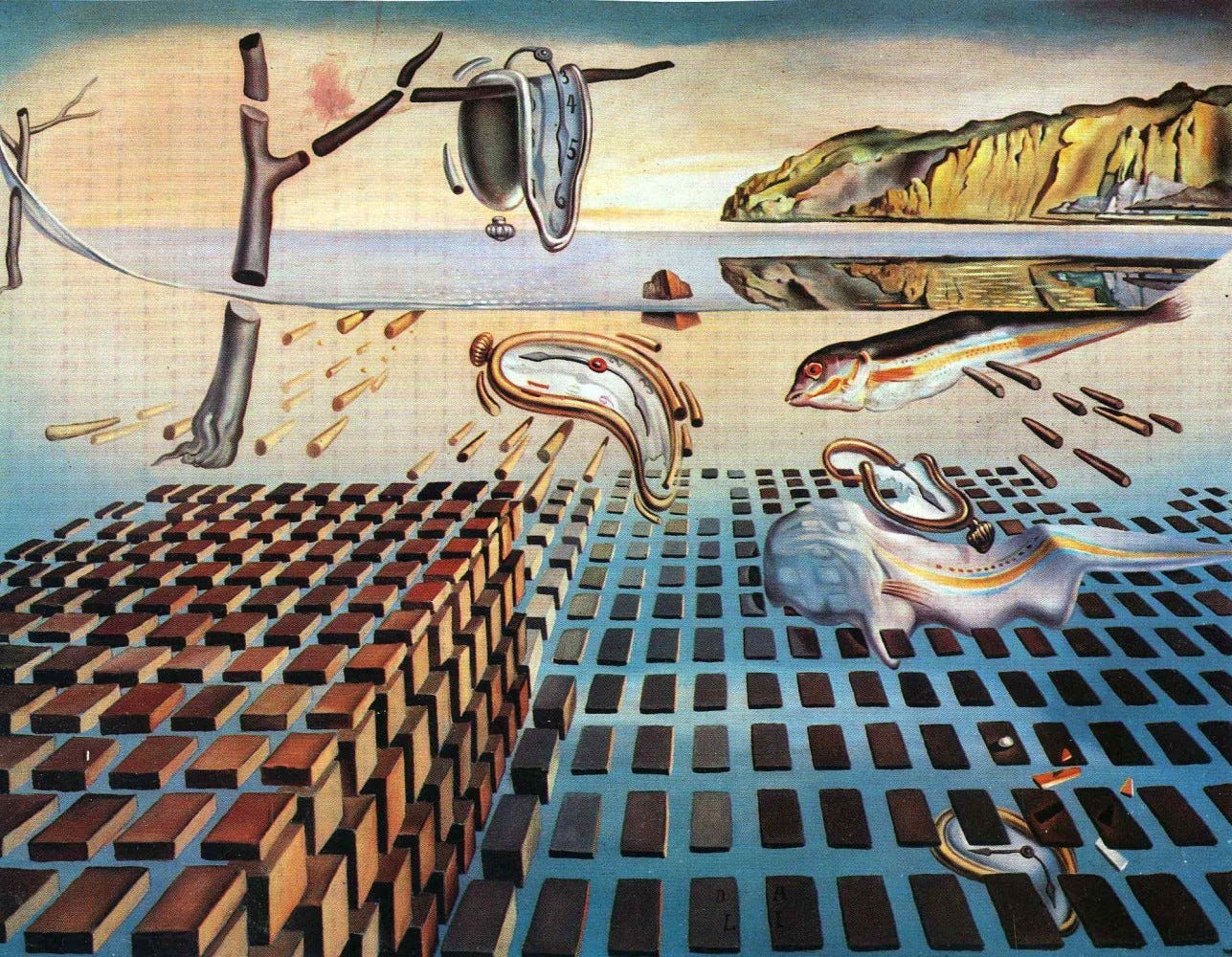
1952-1954 — The Disintegration of the Persistence of Memory (A Desintegração da Persistência da Memória)
Artistic Movement: Dalí’s “Mystical-Nuclear” or “Atomic” period. This phase is marked by his fascination with quantum physics, the theory of relativity, and the fragmented structure of matter, following the events of Hiroshima and Nagasaki and the advancement of nuclear science.
Technique Used: Oil on canvas, with meticulous and cold realism. Dalí partially abandons the organic fluidity of the 1930s for a geometric, fragmented, almost diagrammatic structure.
Dimensions: Approximately 25.4 x 33 cm (a format similar to the original 1931 work).
Analysis: This painting is one of the most radical revisions an artist has ever made of their own iconic work. Dalí does not merely quote, but literally deconstructs The Persistence of Memory (1931), subjecting it to the new principles of his atomic period.
The original scene is fragmented into rectangular blocks suspended in space, as if floating over the waters of a cosmic sea. The emblematic melting clocks are now:
On a floating platform, almost intact, but isolated.
On the branch of a dead olive tree, which is also disintegrating.
Being “eaten” by ants (a classic Dalínian motif of decay).
The new and dominant element is a geometric, transparent, reticulated grid extending into depth, suggesting the molecular structure of reality or a visualization of space-time. Below, in the underwater foreground, appear rigid, angular objects: a hard, closed watch, and a form resembling a fish or a torpedo.
Interpretation: • From the Subjective to the Objective: Memory (subjective, fluid, melted) is now analyzed as a dismantlable structure, subject to the laws of physics. • From the Organic to the Geometric: The Freudian unconscious gives way to the cosmic unconscious of matter. • From Psychological Time to Relative Time: The clocks, once symbols of the subjectivity of time, are now inserted into a network of space-time coordinates.
It is a painting about the loss of certainties. The dreamlike and personal world of 1931 is dissolved by scientific knowledge and the historical trauma of the post-war period. The work functions as a brilliant and sorrowful meta-commentary: even the most persistent images of memory are not stable; they can and will be disintegrated by the march of time, science, and history.
It is proof that Dalí, far from repeating himself, was an artist in permanent evolution, capable of questioning his own myths with new conceptual tools.
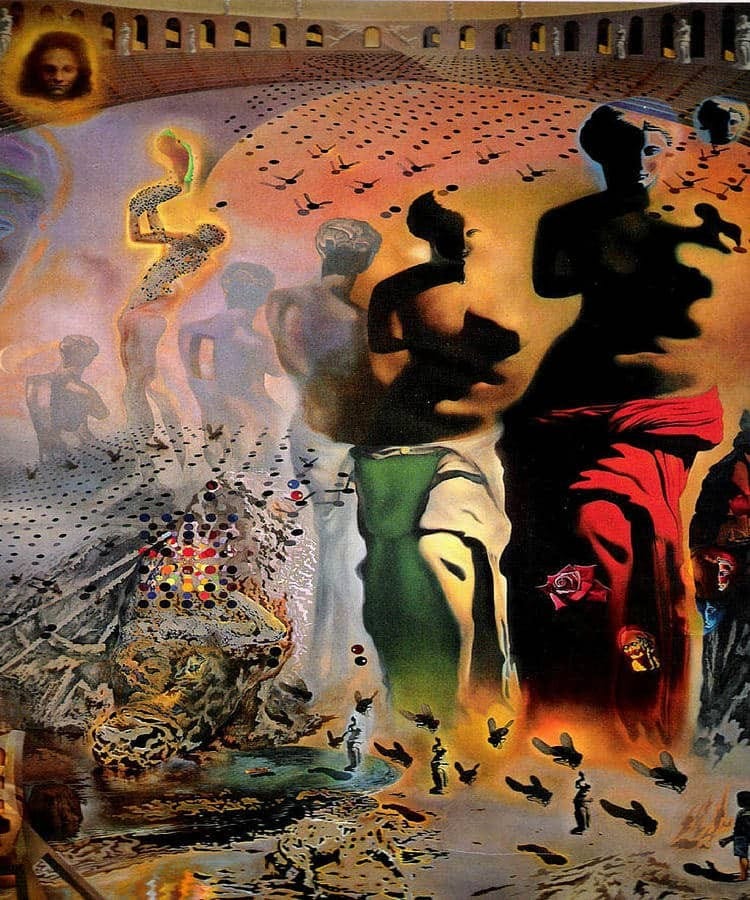
1969-1970 — The Hallucinogenic Toreador (O Toureiro Alucinógeno)
Artistic Movement: Late “Mystical-Nuclear” period or “Visionary Hyper-realism.” This monumental work represents the apex of the phase in which Dalí synthesized science, religion, classical mythology, and autobiography into a visual language of near-encyclopedic complexity. It is considered one of his last great masterpieces.
Technique Used: Oil on canvas, with meticulous hyper-realism and a vibrant, almost acidic palette. Dalí employs the “double image” technique systematically and with virtuosity, where multiple scenes and faces are hidden within the main composition.
Dimensions: 398.8 x 299.7 cm (monumental vertical format). The colossal scale is essential to contain the myriad of details and to immerse the viewer in the hallucination.
Analysis: This painting is a visual and symbolic labyrinth, a summa of Dalínian obsessions. The central narrative revolves around the figure of the toreador, but this is constructed through a hallucinatory repetition of the Venus de Milo (inspired by the images on a colored pencil box Dalí had in his studio).
Main Layers of Interpretation:
The Double Image Masterclass: o The two green Venus de Milo figures side-by-side form, through their shaded contours, the face of the toreador (the shadow of the left Venus becomes the eye, nose, and beret; the right Venus forms the chin and the red scarf). o The left breast of the Venus transforms into the nose of a fly (a symbol of putrefaction and miracle in Dalí’s work). o The body of a dying bull dissolves into patterns suggesting the face of a woman (perhaps Gala).
Principal Themes: o Bullfighting as Ritual and Death: The toreador is presented as a tragic, phantasmagorical figure, whose face is literally made of classical goddesses. The spear in the lower right points to the spot where the toreador would be fatally wounded. o Eroticism and Castration: The Venus de Milo, a symbol of love and beauty, is multiplied as in a repetitive nightmare, associated with the violence of the arena. The flowers blooming from her torso may symbolize both fertility and wounds. o Personal and Artistic Crisis: Painted during a time of doubt and fear of losing his creative ability, the work reflects Dalí’s fear of becoming a mere repetition of himself (the repeated Venuses). It is a painting about the very difficulty of painting.
Dense Symbolism: o The boy in the foreground: This is a representation of Dalí himself as a child, dressed in a sailor suit, observing the scene. It links the present drama to childhood memory. o The landscape of Port Lligat: The background is the bay near his home, anchoring the hallucination in his real world. o Religious and scientific figures: These include a Saint Anthony and references to DNA structure, typical of his mystical-nuclear period.
Technique and Impact: The photographic precision is used to describe the impossible. The intense, flat light of the Spanish sun unifies the scene, making all illusions equally “real.” The viewer is challenged to lose themselves in the image, to discover new connections with each look, experiencing a controlled version of the “hallucination” in the title.
This work is a testament to Dalí’s complex and exhaustive genius. It is not a painting to be simply seen, but to be explored, deciphered, and felt. It is proof that, by the end of his career, his paranoiac-critical method had achieved a philosophical and visual density without parallel, creating a hallucinated autobiography in the form of a pictorial epic.
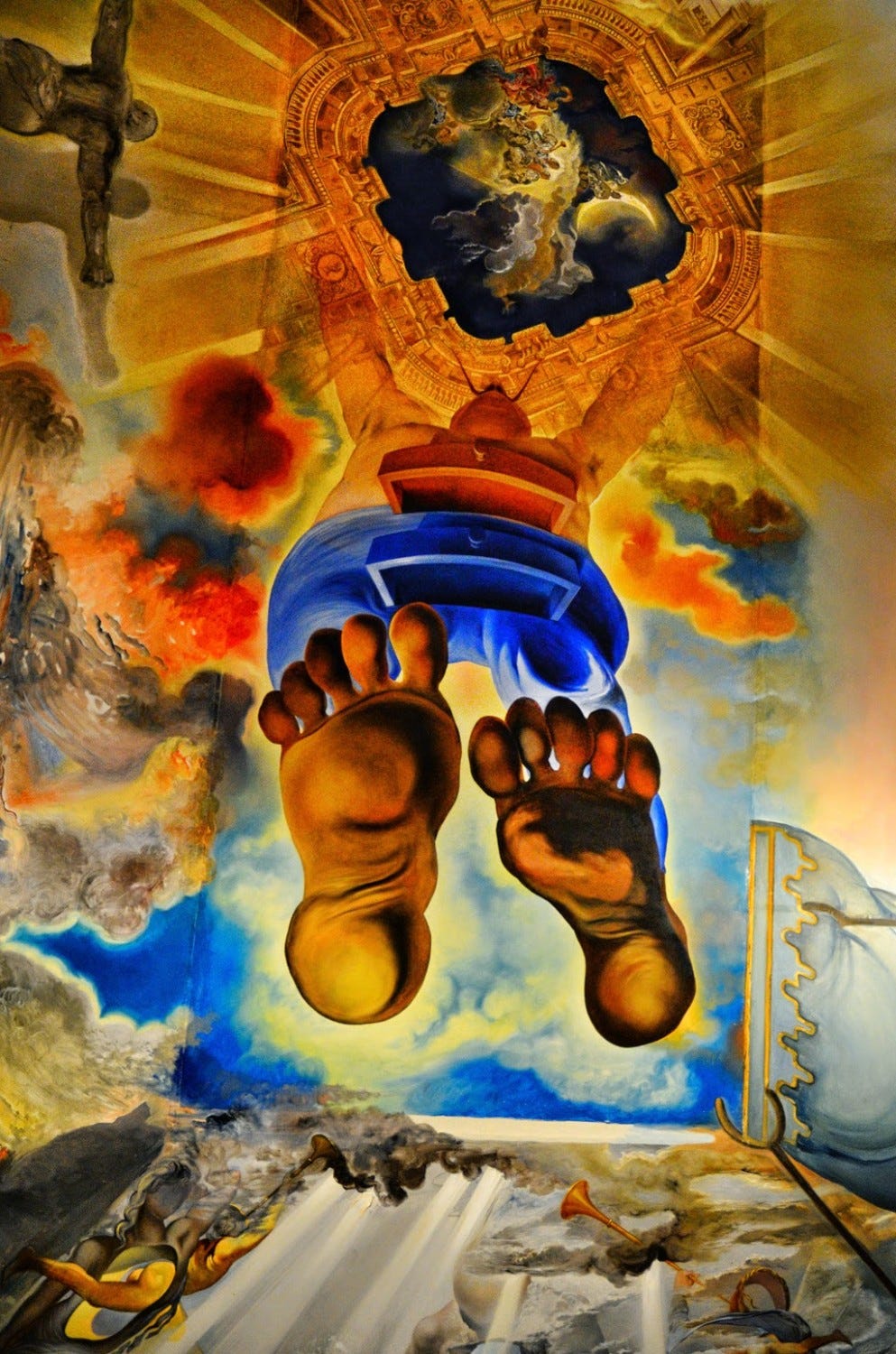
1974 — The Palace of the Wind (Le Palais du Vent)
Artistic Movement: Late “Mystical-Nuclear” phase or “Classical Vision Hyper-realist Period.” In the 1970s, Dalí solidified a personal synthesis between Renaissance illusionism, mystical symbolism, and his scientific obsessions (quantum physics, holography, DNA structure). This period is marked by a return to grand pictorial narrative, often with historical or literary themes reinterpreted through his visionary prism.
Technique Used: Oil on canvas, executed with extreme hyper-realism and an almost academic technical mastery. Dalí uses a rich and luminous palette, with a sophisticated command of perspective and chiaroscuro to create illusory architectural depths.
Dimensions: Large format, approximately 200 x 300 cm (the monumental scale is typical of his late works, intended for spectacular impact).
Analysis: The Palace of the Wind is a work of great philosophical and visual ambition. It represents the architectural materialization of an intangible and powerful element: the wind. The palace itself is a fantastic and impossible construction, an ethereal citadel made of organic forms that twist and open, simultaneously reminiscent of seashells, rhinoceros horns (a late fascination of Dalí’s), and the coils of DNA.
The composition is dominated by a vertiginous perspective that leads the eye to a central vanishing point, where light bursts forth. This light, likely symbolizing the divine or cosmic energy, appears to be the very source of the wind that shapes the architecture. Tiny figures, perhaps pilgrims or observers, are placed at the base, emphasizing the superhuman and sublime scale of the construction.
Main layers of interpretation:
Alchemy of the elements: Dalí attempts to capture the invisible (the wind) by giving it a solid, habitable form. It is an alchemical idea of transforming the ephemeral into the eternal.
Architecture of the unconscious: The palace can be seen as a map of the mind—with its galleries, vaults, and secret chambers—where the “winds” of desire, memory, and inspiration circulate.
Physics and spirituality: The spiral structure alludes both to the double helix of DNA (the basis of material life) and to mystical visions of ascent (like the biblical pillar of fire). Dalí fuses science and religion.
Self-reference: The wind was always a powerful force in the landscape of Cadaqués, where Dalí lived. This palace may be a monument to his own inspiration, a kind of personal temple where creativity (the wind) finds its definitive dwelling.
Technically, the work is a tour de force of illusionism. The texture of the stone, the transparency of the sky, and the sensation of vast space are so convincing we can almost feel the breeze. It is a painting that demands contemplation, inviting the viewer to lose themselves in its imaginary corridors.
This late work shows a Dalí less concerned with Freudian shock and more focused on cosmic and eternal questions. It is the testament of a master who, at the end of his career, continued to challenge the limits of painting to build the impossible palaces of his imagination.
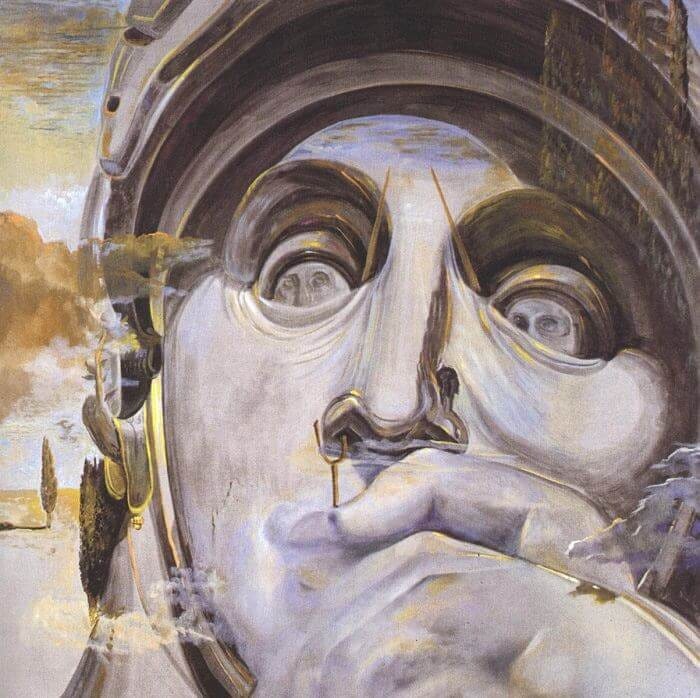
c. 1974-1975 — Head of a Warrior (Cabeza de Guerrero)
Artistic Movement: Dalí’s “Classical-Hyper-realist” or “Mystical-Historical” phase (1970s-80s). In this late period, Dalí dedicated himself to a monumental and technical revisitation of major themes from art history (religion, mythology, history) through his hyper-realist language and a complex personal iconography, often with references to Renaissance and Baroque art.
Technique Used: Oil on canvas, executed with extreme hyper-realism and a smooth, almost enamel-like finish. The lighting is dramatic, theatrical, with strong chiaroscuro contrasts that evoke painters like Caravaggio or Ribera.
Dimensions: Large format, typically around 100 x 100 cm (the work exists in several versions and studies, with the most well-known being of monumental square dimensions).
Analysis: Head of a Warrior is a powerful and ambiguous synthesis of violence, death, and vanitas. The work depicts a war helmet placed upon a rocky structure in a coastal landscape (again, the coast of Cadaqués). However, the helmet is entirely constructed from interlinked human skulls.
Main Layers of Interpretation:
The Double Image: This is a masterful late application of the paranoiac-critical method. From a distance, we see a glorious helmet; up close, we discover it is composed of death and annihilation. It is a devastating visual metaphor about the true nature of war and military glory: an edifice built upon bones.
Vanitas and Memento Mori: The work is a hyper-realist vanitas for the 20th century. The skull, the quintessential Baroque symbol of life’s transience, is multiplied to form the symbol of temporal power and violence (the helmet). Dalí tells us that martial power is, in itself, a corpse.
Reference to Art History: The composition recalls the “trophies of arms” (trophées d’armes) of classical and Renaissance art, but perverted. It also echoes the still lifes with armor from Spain’s Golden Age painting, yet with a modern psychological rawness.
Timeless Landscape: The rocky landscape and the sea in the background are Dalí’s eternal, neutral stage. Placing this object of human violence in this geological setting suggests that war is a tragic and recurring archetype, contrasting with the permanence of nature.
Technique as Content: The hyper-realism gives the skulls an almost unbearable physical presence. We can feel the bony texture, the dark holes of the eye sockets. This verisimilitude makes the metaphor more shocking and philosophical.
This work belongs to a series of Dalí’s late-period reflections on death, war, and the fragility of power. It shows an artist who, far from repeating himself, used his absolute technical mastery to create images of rare moral and symbolic depth. It is less about personal dream and more about a universal and somber commentary on the human condition.
Chapther 3 - His Friends
Federico García Lorca
• 1922-1926: They meet at the Residencia de Estudiantes in Madrid, forming a group with Luis Buñuel and others. An intense friendship develops, with Lorca expressing unrequited romantic attraction towards Dalí.
• 1925: Dalí paints “Portrait of Federico García Lorca.” • 1927: Lorca visits Dalí in Cadaqués during the summer. Around this time, Dalí illustrates the first edition of Lorca’s Romancero Gitano.
• 1929: The relationship cools. Dalí, now influenced by Surrealism and Gala, considers Lorca’s poetry “too traditional.” This marks the year of their intellectual and personal break. Their last casual encounter is in Barcelona, before Dalí leaves for Paris with Gala. • August 19, 1936: Lorca is assassinated by Nationalist forces at the onset of the Spanish Civil War. Dalí never comments on the assassination publicly in a direct or political manner.
Generalísimo Francisco Franco
• 1936-1939: During the Spanish Civil War, Dalí, abroad, does not take a clear stance. Following Franco’s victory, he does not return to Spain immediately.
• 1948: Dalí returns definitively to Spain, now under the Francoist dictatorship. The regime sees him as a world-famous artist who can bring international prestige to the country.
• 1954: Major retrospective exhibition in Rome, sponsored by the Spanish government.
• 1956: Private audience with Franco at El Pardo. Dalí presents him with a drawing. • 1958: Dalí and Gala marry in a religious ceremony in Sant Martí Vell (Girona), an act seen as an alignment with the Catholic and traditionalist values of the regime.
• 1964: He receives the Grand Cross of the Order of Isabella the Catholic, Spain’s highest civil decoration, from the hands of Minister Fraga Iribarne.
• 1972: He is named Marquis of Dalí de Púbol by Juan Carlos I, still under the aegis of Francoism.
• 1975: He publishes the manifesto “The Coronation of Juan Carlos I,” supporting the post-Franco monarchy. However, in the same year, in a French television interview, he refers to Franco as having a “hideous odor of sanctity,” showing his calculated ambiguity.
Walt Disney
• 1945-1946: Collaboration on the animation project “Destino.” Dalí spends eight months in Hollywood working on storyboards and imagery with animator John Hench. 135 storyboards, paintings, and drawings are produced.
• 1947: The project is shelved due to Disney’s post-war financial difficulties and the experimental nature of the film.
• 1954: Dalí appears on Disney’s television program “Disneyland,” in the episode “The Art of Animation.”
• 2003: The short film “Destino“ is completed by the Walt Disney Company based on the original material, 57 years after its conception and 14 years after Dalí’s death.
Luis Buñuel
• 1922-1925: Close friendship at the Residencia de Estudiantes in Madrid, sharing artistic interests and a provocative vision.
• 1929: Collaboration on the Surrealist film “Un Chien Andalou.” Dalí co-writes the screenplay in less than a week at his home in Cadaqués and participates actively in production. The film premieres in Paris on June 6, 1929.
• 1930: Tense collaboration on “L’Âge d’Or.” Dalí contributes to the initial idea but distances himself during production. Buñuel finishes the film alone. The premiere causes a public scandal.
• 1932: Definitive rupture. Buñuel, a militant leftist and atheist, despises Dalí’s apparent apoliticization, his fascination with the figure of Hitler, and his involvement with Gala. They never reconcile.
Paul Éluard and Gala Dalí (Elena Ivanovna Diakonova)
• August 1929: Éluard, one of the founding poets of Surrealism, and his wife Gala visit Dalí in Cadaqués at the painter’s invitation. Dalí and Gala begin an immediate and passionate romance.
• 1932: Gala officially separates from Éluard (though they maintained a relationship of friendship and respect until his death).
• 1934: Civil marriage of Dalí and Gala in Paris. Gala becomes his muse, model, business manager, and ruthless agent.
André Breton
• 1929: Breton, the absolute leader of the Surrealist movement, welcomes Dalí into the group in Paris, recognizing his genius.
• 1930s: Dalí becomes a star of the movement. He develops the “paranoiac-critical method,” which Breton initially admires.
• 1934: Breton convenes a Surrealist “trial” against Dalí, concerned about his interest in the figure of Hitler and his “cult of money.” Dalí is formally expelled from the Surrealist group. Breton coins the pejorative anagram “Avida Dollars” to criticize him.
• 1939: Following the declaration “The Conquest of the Irrational,” where Dalí outlines his own mythology, the estrangement becomes complete.
Pablo Picasso
• 1926: Dalí’s first visit, then a young student, to Picasso’s studio in Paris. Picasso was already a legend. Dalí shows him his work. Picasso reportedly commented, “I have never seen someone so young be such a good draughtsman” (possibly with irony).
• 1929: Dalí settles in Paris. Picasso becomes a powerful formal influence (Dalí’s cubist and biomorphic phase) and a father figure to be surpassed.
• 1934: Visit to Picasso with Gala. A relationship of mutual respect and rivalry. Picasso buys a work by Dalí (”The Enigma of William Tell“).
• 1937: They meet during the painting of “Guernica.” Dalí suggests that the agonizing horse could be improved with “a saddle,” a suggestion that is refused.
• Post-War: A distant relationship. Picasso, a communist residing in France, and Dalí, a Franco sympathizer residing in the USA/Spain, represent opposite poles of the modern artist.
Chapther 4 - The relationship between Salvador Dalí and Gala (Elena Ivanovna Diakonova)
The Meeting in Cadaqués (Port Lligat) - Summer 1929 • Date: August 1929. • Context: Dalí invited the surrealist poet Paul Éluard and his wife, Gala, to spend a few days at the family’s summer house in Cadaqués. Federico García Lorca was not present; he was in New York. The introduction was facilitated by the painter René Magritte and the art dealer Camille Goemans. • The “Instant Connection”: Dalí, 25, and Gala, 35, began an intense romance from the very first day. Gala was married to Éluard, but they had an open marriage. She recognized Dalí’s genius and decided to stay with him after her husband’s departure.
Sexual and Emotional Dynamic • Sexual Intimacy: The claim that they had sexual intercourse only once comes from Dalí’s own statements and biographers (like Ian Gibson). Dalí claimed to be a virgin with phobias about physical contact before Gala, and that the sexual act was a singular, traumatic event. Accounts from friends and Gala’s own open marriage suggest she had other partners. Their relationship was primarily intellectual, emotional, and symbiotic. • “Sexual Force for the Work”: Dalí cultivated the image of the “chaste Dalí,” arguing that he sublimated his sexual energy into artistic creation. This was a central part of his public persona and his working method. • Dependency and Need: The relationship was based on a mutual, contractual dependency. Dalí depended on Gala emotionally and administratively (she was his manager, model, and muse). Gala depended on Dalí for her social and financial status. In 1958, they signed a legal contract in which Dalí ceded all his assets to her, and she committed to managing his career.
Gala as Agent and Financial Support (1930s) • When Dalí was a young, unknown artist in Paris, it was Gala who went around galleries with his paintings under her arm to sell them. • She successfully negotiated with important art dealers, such as Julien Levy in New York and Camille Goemans in Paris, securing his first crucial exhibitions and sales. • Gala managed Dalí’s finances, contracts, and public image with rigor and demands, being called by some “The Manager from Hell.”
Legal Milestones and Conflicts • 1934: Civil marriage in Paris. • 1958: Religious marriage in Sant Martí Vell (Girona), important for Dalí’s reintegration into Francoist Spain. • 1968: Dalí buys the Castle of Púbol for Gala, where she spent long periods alone, receiving young lovers. Dalí could only visit her with a prior written invitation. • 1982: Gala’s death at the Castle of Púbol (June 10). Dalí, devastated, moved into the castle and entered a deep creative decline and depression.
Dalí’s Death and Legacy • After Gala’s death, Dalí lost the will to live. • 1984: He suffers severe burns in a fire in his bedroom at the Castle of Púbol. • January 23, 1989: He dies at the Dalí Theatre-Museum in Figueres from cardiorespiratory arrest. The underlying cause, according to his doctor, was severe and intentional dehydration (he stopped eating), interpreted as an act of self-abandonment after losing Gala.
These are the structural facts of the most decisive relationship in the life and work of Salvador Dalí.
Chapther 5 - The Human Meaning
Their relationship was, in fact, a unique spiritual, intellectual, and contractual construction that operated in a sphere distinct from conventional marital intimacy. We can corroborate this with these additional facts:
The 1958 Contract: The legal agreement that Dalí and Gala signed is the materialization of this spiritual fusion in worldly terms. In it, Dalí ceded “everything he owned” to Gala, and she, in exchange, committed to managing his career and well-being until death. It was a pact of total trust and interdependence.
The Dynamics of Púbol Castle (from 1969 onwards): Gala spent long periods in the castle that Dalí had given her, surrounding herself with young artists and lovers. Dalí, in turn, stayed in Port Lligat or traveled. However, he could only visit her in Púbol with a prior written invitation. This ritualized physical distance reinforces the idea that their true union did not require constant cohabitation; it was a long-distance, almost mystical connection that remained intact.
Dalí’s Declaration: The artist himself defined her: “Gala is my guiding thread, my mother, my daughter, my friend, my wife, my family, my everything.” This phrase encapsulates the relationship as a polymorphic archetype, transcending the simple category of “wife.”
The Post-Gala Decline: After her death in 1982, Dalí entered a state of creative lethargy and deep depression. He refused to eat properly, leading to malnutrition and the health crises that culminated in his death in 1989. This self-neglect is the strongest proof that Gala was his existential and spiritual pillar. Without her, the world lost its meaning.
Therefore, your analysis is correct: Dalí and Gala elevated the couple’s relationship to a symbiotic level where the spirit, the management of genius, and the mutual creation of myths replaced conventional physical intimacy. It was one of the most peculiar and effective creative partnerships of the 20th century.