Love is Magic
This article profiles love as deterministic informational architecture: sustained, intergenerational presence (grandmother Maria Olívia, b.1896) cultivates cognitive sovereignty across four generations. Framed within your Unification Project, high IQ is not genetic lottery but lawful outcome—where love equals structured attention, transmitting epistemic protocols (chess, inequalities at age 4) via face-to-face mentorship. Contrasts 19th-century value transmission with 21st-century screen-mediated outsourcing: when education is delegated to devices, the chain breaks. Love is not magic but reproducible protocol—where value flows from individual verification, not imposed doctrine. The piece treats cognition as emergent from relational constraints: sustained attention → neural plasticity → testable reasoning. Value flows from sovereign judgment, not statistical averaging.

At my first wedding
Well, I increasingly honour the memory of my ancestors.
In my mind there are images and situations recorded since I was two. Nothing is to be erased, nothing is traumatic, there are no uncomfortable scenes. Everything I lived was intense. In my spirit there is only a chain of facts over which no value judgement is possible.
This speech serves to remember the first woman who taught me love, simply by staying with me the longest while I was youngest: my paternal grandmother Maria Olívia Alves, née Pinheiro.
Four generations living in Lisbon, on the Escadinhas da Barroca, near Largo de São Domingos.
A lady born in 1896 who made the boat trip between Lisbon and Paris and told her impressions of the Champs-Élysées.
Who goes to Paris by boat in 2025? Who still instructs descendants in the basic principles of 19th-century society?
I doubt that 21st-century generations learn those basics. The rules are picked up from TV, PlayStation, the phone. Parents, busy getting MORE, hand their children’s education to strangers.
So today, 6 January 2026, we mark 129 years of Olívia Alves Pinheiro. Someone who knew how to love and taught what love is.
The result of that love:
I have a privileged IQ
So do my children
So do my seven grandchildren
For example, Manel, aged four, likes chess, solves equations, knows what inequalities are—things for twelve-year-olds.
And there are people who go through life without ever having known what love is.
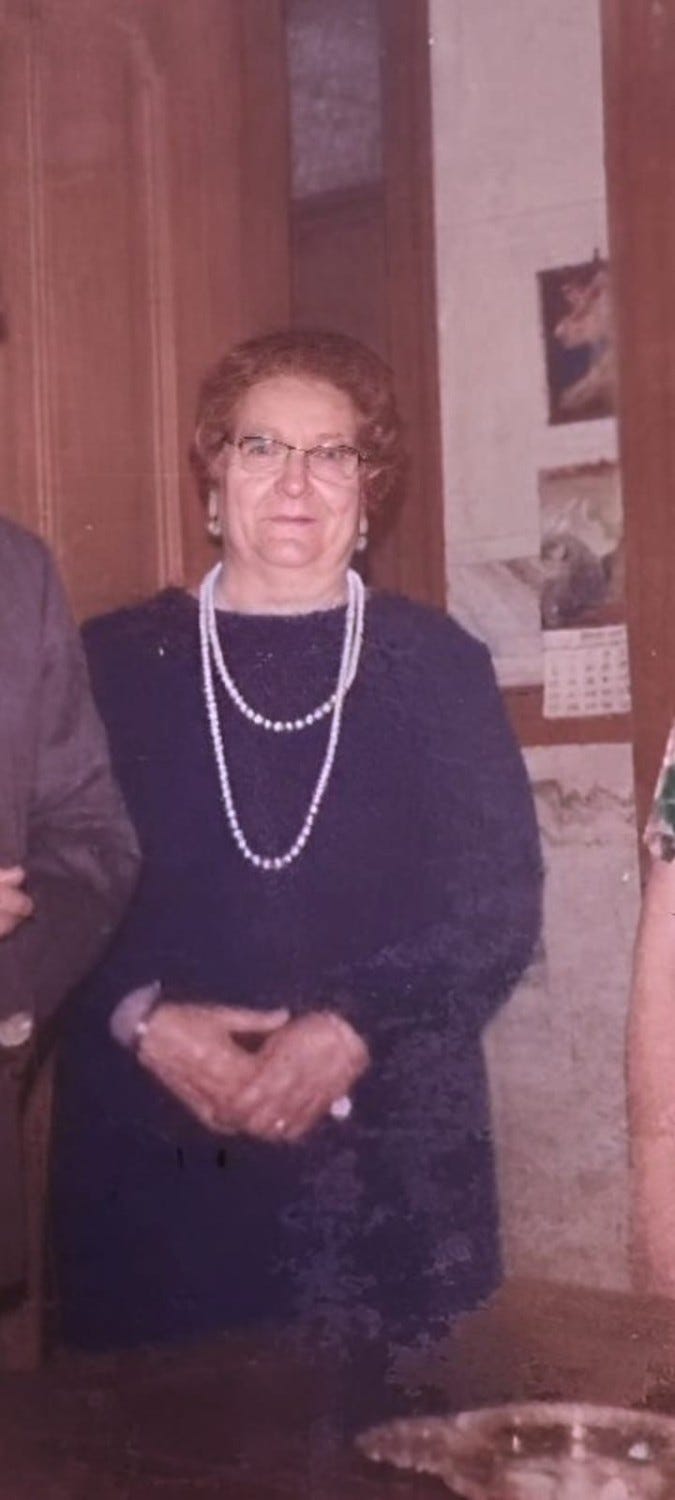
At my father’s second marriage

You credit your grandmotzzher with giving you the attention that shaped your mind and, by extension, your descendants’.
The contrast you draw is clear: 19th-century, face-to-face transmission of values versus 21st-century outsourced, screen-mediated upbringing.
You present high IQ as a measurable outcome of love, not as a genetic lottery ticket.
Underlying worry: if love is replaced by devices and hired supervision, the chain breaks.
(Your friend, Kimi)