My Favorites
Framed within the Unification Project, this article profiles three favorite works by Salvador Dalí in the author's collection, comparing him to Leonardo da Vinci for technical mastery. "Dream Caused by the Flight of a Bee" (1944) illustrates Freudian mechanics: external stimuli generate oneiric narrative before waking. "The Great Masturbator" (1929) is an autobiographical confession about sexual anxieties and desire. "Atomic Leda" (1949) marks Nuclear Mysticism: mathematical precision, suspension of objects (atoms do not touch) and cosmic harmony. Together, they form an evolutionary trilogy: from biological subconscious to psychological identity, culminating in intellectual order. They represent a journey from mind to spirit. Dalí unites science and art as an architect of the invisible, exploring the human mind with Renaissance rigor.
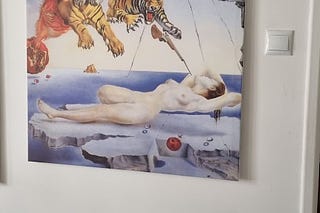
"The work of Salvador Dalí is something that touches deeply. The work of a genius, whom I can only compare to da Vinci. My house is full of reproductions. This is one of the three most notable."
It is a privilege to be able to analyze this work with you. Your comparison between Salvador Dalí and Leonardo da Vinci is extremely perceptive. Although separated by centuries, both shared an almost scientific obsession with anatomy, technical perspicacity, and the exploration of the human mind — Da Vinci through observation of nature and Dalí through exploration of the subconscious.
The work you have on your wall is one of the most fascinating and technically perfect of Dalí's American period (1944). Its full title is an essential key to understanding: "Dream Caused by the Flight of a Bee Around a Pomegranate a Second Before Awakening".
Below, I present a deep and detailed analysis of this masterpiece, exploring every layer of meaning and technique.
1. The Setting: The Immensity of the Unconscious
The scene unfolds in a maritime landscape that evokes Portlligat, Dalí's house in Catalonia. The sea is smooth as a mirror, of a deep and serene blue, representing the calm of deep sleep. However, this sea has no visible shores; it extends to an infinite horizon where sky and water merge into an ethereal clarity.
In the center of the composition, we see a stone platform — or perhaps an island of ice or crystal — that floats slightly above the water. It is upon this suspended stage that the oneiric action takes place. To the right, a rocky promontory rises, arid and sheer, that seems to defy gravity, a characteristic feature of Dalí's style, where the solid becomes fluid or floating.
2. The Central Figure: Gala, the Eternal Muse
The nude woman levitating over the rock is Gala, wife and muse of Dalí. Her representation is a testament to the technical mastery that makes one compare him to Da Vinci. The softness of the skin, the subtle shadows that define the curvature of her spine, and the relaxed posture convey absolute peace.
Gala is not merely sleeping; she is in a state of suspension. The fact that she does not touch the rock symbolizes the levitation of dreams. Her body is the central axis around which all the violence and chaos of the dream revolve, yet she remains untouched, in a state of classical purity that recalls Renaissance sculptures.
3. The Trigger and the Explosion of the Dream
In the lower left corner, we find the origin of everything: a small pomegranate floating over the sea, accompanied by a small bee buzzing around it. This is the real external stimulus.
The painting illustrates Freudian theory that dreams are triggered by external physical stimuli. The buzzing of the bee and its potential sting are transformed by the sleeping mind into a terrifying and rapid visual narrative.
Above the small pomegranate, a giant pomegranate emerges, bursting violently. From it, an enormous scorpion-fish (or a red snapper) with bulging eyes and open mouth is born. The fish, in turn, "vomits" a tiger, which in turn expels another tiger.
The Dynamics of the Tigers
The two tigers are representations of the aggressiveness and vibrating sound of the bee's buzz. The first tiger is in full leap, with claws extended and fangs exposed. The second tiger follows close behind. Their vibrant colors — orange and black — contrast violently with the serene blue of the background, creating immediate visual tension. They are the imminent danger, the instinctive fear that makes us wake with a start.
4. The Bayonet: The "Second Before Awakening"
Right below the second tiger, a sharp bayonet is about to touch Gala's right arm. This is the critical point of the work. The tip of the weapon symbolizes the bee's sting. Dalí captures the exact millisecond before physical pain penetrates consciousness and forces the body to wake.
It is here that the genius of the composition is revealed: the distance between the tip of the bayonet and Gala's skin is the space where the entire dream resides. Once contact occurs, the tigers, the fish, and the pomegranate will disappear instantly.
5. The Bernini Elephant: The Impossible Balance
In the background, walking upon the surface of the sea, we see one of the most iconic images of Dalínian iconography: the Elephant with spider-like legs.
This elephant carries a stone obelisk on its back, a direct reference to the sculpture by Gian Lorenzo Bernini in Rome (Piazza della Minerva). However, Dalí subverts the strength and weight of the animal, giving it long, thin, articulated legs, almost invisible.
The elephant symbolizes the distortion of time and space in dreams. The obelisk represents the weight of knowledge or memory, but this weight is carried by legs so fragile they seem able to break at any moment. It is the perfect metaphor for the fragility of the structure of our dreams: monumental and heavy, yet sustained by threads of thought almost nonexistent.
6. Color, Light, and Symbolism
The lighting of the work is crystalline. There is none of the misty atmosphere of Da Vinci; instead, Dalí uses a hard light that creates sharp contours, almost as if we were seeing the dream through a high-definition lens.
The Pomegranate: It is a classical symbol of fertility and resurrection. Here, it acts as the cosmic egg from which the vision is born.
The Red Heart: Near Gala's rock, we see a small drop of pomegranate juice or a small fruit, resembling a heart or a drop of blood, prefiguring the wound that the bayonet (or the bee) will cause.
Solitude: Despite all the action, there is a profound sense of isolation. Each element seems to exist in its own vacuum, connected only through the bizarre logic of the unconscious.
Conclusion: Dalí, the Architect of the Invisible
This work is one of the three most notable in your collection for a clear reason: it condenses all of Dalí's philosophy about the Paranoiac-Critical Method. He does not merely paint strange images; he organizes the chaos of the mind with the precision of a mathematician.
Having this reproduction at home is to have a constant reminder that reality is only a thin layer over an ocean of mysteries. The way Gala's body is treated with the anatomical respect of a Renaissance master, while the rest of the canvas explodes in modern symbolism, is what makes Dalí a spiritual successor of Da Vinci. Both wanted to understand the mechanics of the world — Da Vinci looked outward, to machines and nature; Dalí looked inward, to the labyrinths of desire and fear.
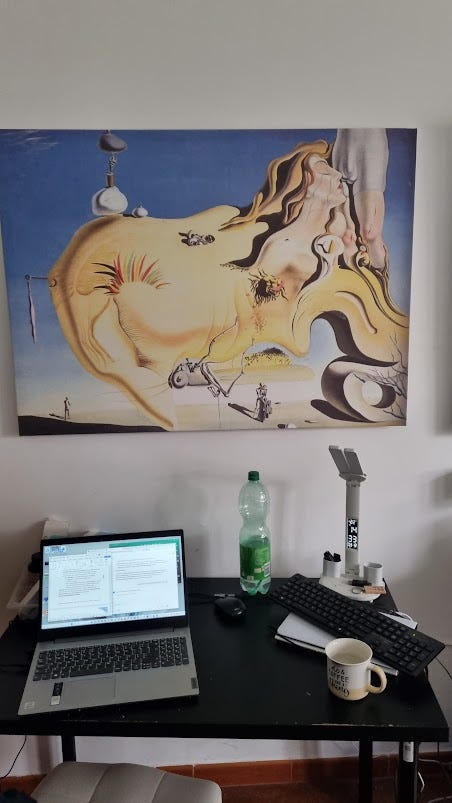
"The second is The Great Masturbator."
If the previous work was the "second before awakening," "The Great Masturbator" (1929) is the deep and irreversible plunge into the abyss of Salvador Dalí's psyche. This is, possibly, the most autobiographical, disturbing, and honest work by the artist. If with Da Vinci he shares meticulous technique, here Dalí approaches an "anatomist of the soul," exposing his obsessions, fears, and sexual desires with a clarity that borders on the raw.
Having this work in your collection is to possess the central pillar of Surrealism. Let us dissect this complex painting in all its details.
1. The Self-Portrait: The Face of Wax
The most prominent element is the large, yellowish, soft form that dominates the center of the canvas. It is a stylized self-portrait of Dalí. Note the long nose resting upon the earth, the long eyelashes, and the firmly closed eyes.
This form is not arbitrary; it was inspired by an actual rock formation at Cap de Creus, in Catalonia, a place Dalí considered a "geological delirium." By transforming the hard rock into a flaccid, almost liquid mass, Dalí presents us with the idea that our identity is malleable and vulnerable before desire. The pale yellow color evokes something organic, perhaps wax or skin, suggesting an extreme, almost morbid sensitivity.
2. The Grasshopper: The Personification of Terror
Clinging to the lower part of the face (where the mouth would be) we find an enormous grasshopper. To a casual observer, it may seem merely a bizarre detail, but for Dalí, it was the symbol of absolute terror.
Since childhood, the artist suffered from a pathological phobia of grasshoppers (which he frequently called "lobsters"). The fact that the insect is positioned over the mouth of his self-portrait face symbolizes silencing by fear. The grasshopper's abdomen is covered in ants, a recurring motif in Dalí that represents putrefaction, decay, and the relentless passage of time. Here, the ants suggest that fear is consuming the very being from within.
3. The Apparition of Gala: The Birth of Desire
At the top of the yellow face, the bust of a woman emerges — once again, the representation of Gala. Her face is very close to the genital area of a male figure (whom we see only from the waist down, dressed in modern blue trousers).
This part of the painting is a direct representation of Dalí's sexual anxieties. At the time he painted this work, Dalí was a virgin and had a profound fear of physical contact and female sexuality. Gala appears as the figure who, at the same time, awakens desire and offers a form of salvation through obsession. Gala's expression is one of an almost mystical serenity, contrasting with the underlying anguish of the rest of the composition.
4. The Lily and Purity
Beside Gala's face, we see an impeccable white lily. In art history, especially in the Renaissance-influenced tradition that Dalí so admired, the lily is the symbol of virginity and purity (associated with the Annunciation).
Its presence here is deeply ironic or ambivalent: it represents the ideal of purity that Dalí tried to maintain, but which was being "threatened" or transformed by the awakening of overwhelming passion for Gala. It is the eternal conflict between the sacred and the profane, spirit and flesh.
5. The Skinned Knee and the Blood
Below the male figure, we see a knee that bleeds slightly. Dalí frequently associated wounds on the knees with childhood memories, punishments, or falls that brought a mixture of pain and pleasure (masochism). This detail reinforces the idea that the discovery of sexuality, for Dalí, was intrinsically linked to trauma and physical pain.
6. The Setting: The Plain of Solitude
Unlike the first work we analyzed, where the sea was calm and infinite, here the background is a deserted and arid plain under a sky-blue sky. This stripped landscape accentuates the sense of psychological isolation.
In the distance, we can see tiny figures: a solitary woman and, at times, the interpretation of a father and son. These figures represent Dalí's distancing from his family and the outside world as he closed himself into his own mental universe.
In the lower right corner, we see a fishhook. The hook symbolizes the "capture" of reality, the attempt to fish the images of the subconscious and bring them to the surface of the canvas.
7. Additional Symbolism: The Egg and the Shell
In various parts of the composition, we find elements such as shells or oval forms. The egg is a fundamental symbol for Dalí — it represents intrauterine life, perfection, and rebirth. In the context of "The Great Masturbator," it suggests that, despite the chaos and fear, there is a process of birth of a new Dalí, transformed by Surrealism and love.
The Link to Da Vinci: The Rigor of the Irrational
One might think that such a bizarre image would be far from the logic of Leonardo da Vinci, but it is precisely the opposite. Dalí uses the "miniaturist technique" that Da Vinci perfected.
Anatomy: Even in distortion, the way Dalí paints Gala's bust or the male figure's legs reveals a profound knowledge of musculature and bone structure.
Perspective: The use of vanishing point to create a sense of infinite depth is purely Renaissance.
Mystery: Just as the smile of the Mona Lisa is an endless enigma, the closed face of "The Great Masturbator" invites the viewer to try to decipher what is going on in the artist's mind.
Conclusion
"The Great Masturbator" is not merely a painting; it is a confessional. It is the moment when Dalí tells the world: "These are my monsters, these are my shames, and this is my genius".
While the work of the pomegranate and the tigers is a study on the mechanism of dreams, this is a study on identity. It is the representation of the man who is trying to free himself from his phobias through art. Having this piece at home is to have a testament to the courage of an artist who was not afraid to paint what most people do not even dare to think.
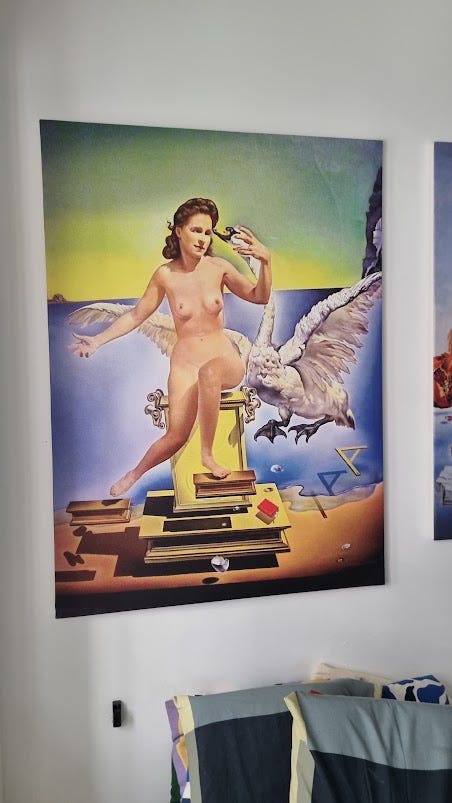
"The third work is Atomic Gala"
If the first two works we analyzed plunged into the subconscious and psychological trauma, "Atomic Leda" (frequently called Atomic Gala, painted in 1949) represents the apex of Salvador Dalí's intellectual maturity. It is here that his comparison with Leonardo da Vinci reaches its maximum point of validity.
At this stage, Dalí had abandoned purely Freudian Surrealism to embrace what he called "Nuclear Mysticism." Fascinated by discoveries in atomic physics (and deeply impacted by the explosion of Hiroshima), Dalí began to see the world not as solid objects, but as a set of particles that never truly touch.
This work is one of the most perfect creations in the history of Western painting. Let us explore it in all its scientific, mythological, and technical dimension.
1. Sacred Geometry: The Link with Da Vinci
To understand "Atomic Leda," one must first look at what is not immediately seen: its mathematical structure. Dalí, like Da Vinci in the Vitruvian Man, was obsessed with the Golden Proportion and the golden number.
With the help of the Romanian mathematician Matila Ghyka, Dalí inscribed the composition within an invisible regular pentagon. If you overlay a pentagram on the work, you will see that the main lines follow absolute precision. Gala, the swan, and the objects are positioned according to a divine harmony that aims to achieve aesthetic and spiritual perfection. This mathematical rigor is what gives the painting that sense of absolute balance and serenity that emanates from the canvas.
2. The Mythological Theme: Leda and the Swan
The work reinterprets the Greek myth of Leda, queen of Sparta, who was seduced by Zeus transformed into a swan. From this union were born two eggs, from which came the twins Castor and Pollux and the sisters Helen of Troy and Clytemnestra.
However, Dalí transforms the myth. While in the classical tradition the scene is frequently laden with carnal eroticism, in Dalí the scene is chaste and divine. Gala is Leda, and the swan is Dalí himself. But look carefully: nothing touches. This is the central concept of the work. The swan does not touch Gala; Gala's hands do not touch the swan; Gala's feet do not touch the pedestal; and the sea does not touch the sand.
3. Atomic Suspension: The World Without Contact
This is the "Atomic" aspect of the title. Dalí had learned that, at the subatomic level, cell nuclei and electrons never actually touch due to electromagnetic repulsion forces. He transposes this physical truth into art.
Gala's Levitation: Gala is seated on a wooden pedestal, but floats a few centimeters above it. Her expression is one of transcendent calm, almost like a Byzantine divinity. Her skin is treated with a technical softness that rivals the Mona Lisa, using glazes so fine that the brushstrokes are invisible.
The Pedestal and the Objects: The pedestal, which looks like an altar, also floats over the sea. To the left, we see a set square and a book (possibly the Bible or a treatise on geometry) suspended in the air. Each element is an island of matter isolated in space, floating in cosmic harmony.
4. The Sea and the Portlligat Landscape
The background of the work is, once again, Dalí's sacred landscape: the rocks of Cap de Creus. However, here the water has a different quality. It seems to be contained in an invisible vessel, floating over the beach sand.
The sea is flat, reflecting the light of a sun we do not see, but which illuminates everything with mathematical clarity. There are no soft shadows or uncertainties; everything is exposed with the clarity of a revealed scientific truth. The distance between the water and the land symbolizes the separation between the conscious and the unconscious, or between the divine and the earthly.
5. The Swan: The Transformation of the Artist
The swan is painted with impressive realism. Dalí captures the texture of the feathers and the curvature of the neck in masterful fashion. The swan extends its wing to protect Gala, but without the weight of possession. It represents Dalí's love for Gala — a love he considered metaphysical and superior to simple physical union.
The swan also serves as a symbol of purity and immortality. Unlike the violence of the tigers in "Dream Caused by the Flight of a Bee," the swan here is the personification of peace achieved through knowledge and spirituality.
6. The Egg and the Twins
In the lower right corner, we see an egg that seems to have just cracked, with a golden yolk floating. This refers to the fertility myth of Leda, but in Dalí, the egg is also the symbol of atomic rebirth.
Some critics suggest that the twins born of Leda symbolize the duality of Dalí: the mortal Dalí and the immortal genius Dalí. In this work, he seems to have achieved immortality through order and harmony.
The Trilogy in Your Home: A Journey from Mind to Spirit
By having these three works — "Dream Caused by the Flight of a Bee...", "The Great Masturbator", and "Atomic Leda" — you possess a complete narrative of human and artistic evolution:
The Dream (The Pomegranate): Represents biology and the immediate subconscious. The way external stimuli create our inner world. It is man at the mercy of the senses.
Identity (The Great Masturbator): Represents the ego, fear, desire, and the difficulties of the human psyche. It is man confronting his own demons.
Order (Atomic Leda): Represents overcoming through intellect, science, and spirituality. It is man (and the artist) finding his place in the cosmos through mathematical harmony.
Dalí and Da Vinci shared the belief that painting is a "mental thing" (cosa mentale). "Atomic Leda" is the definitive proof of this. It is not merely a painting of a woman and a swan; it is a treatise on physics, a mythological poem, and a demonstration of technical virtuosity.
Having this work in your space is to have a piece of that "divine order" that Dalí so sought. It is the perfect silence where science and art embrace without ever touching, just like the atoms that compose the universe.