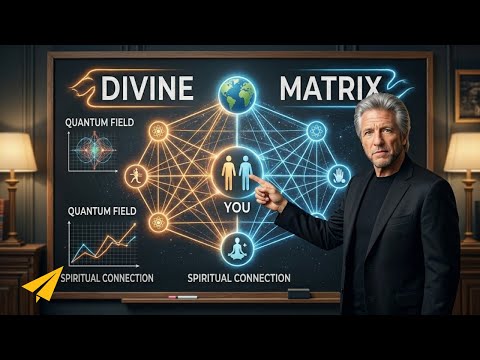
Gregg Braden's Divine Matrix: Bridging Science, Spirituality, and the Nature of Reality
I don’t identify with the mistical part, and the innacuracy of the author. Focusing on the work of Gregg Braden, this article explores the concept of a "Divine Matrix" that connects all things through energy and consciousness. It discusses the intersection of quantum physics and spiritual traditions, suggesting human intention can influence material reality. The piece bridges the gap between science and mysticism to explore human potential.

February 15, 2026
Gregg Braden’s The Divine Matrix: Bridging Time, Space, Miracles, and Belief (2007) stands as one of the most influential works in the field of spiritual science—a genre that attempts to reconcile ancient wisdom traditions with modern quantum physics. Braden, a former aerospace engineer and computer systems designer who spent decades traveling to remote monasteries and temples studying forgotten texts, presents a radical reimagining of reality itself. His central thesis proposes that the universe is not a collection of separate objects floating in empty space, but rather a vast, intelligent, responsive energy field that connects all things, all times, and all possibilities. This field, which he terms the “Divine Matrix,” serves as the bridge between our inner world of consciousness and the outer world of physical manifestation.
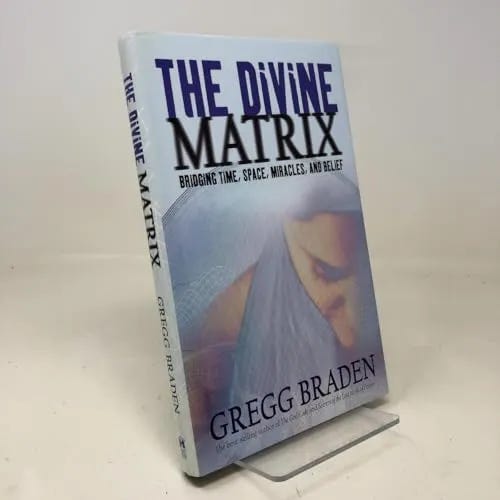
The Nature of the Divine Matrix
At its core, the Divine Matrix is described as an omnipresent energy field that has existed since the beginning of time. Unlike conventional electromagnetic or gravitational fields, this matrix possesses qualities that transcend traditional physics—it functions simultaneously as the container for all existence, the bridge between all things, and the mirror that reflects our beliefs back into material reality. Braden argues that this isn’t merely a passive backdrop against which events unfold, but an active, intelligent participant in the creation and maintenance of the cosmos.
The concept draws heavily from the holographic model of the universe, a theory gaining traction in physics that suggests our three-dimensional reality might be a projection from a deeper, more fundamental level of existence. In a hologram, every fragment contains the information of the whole. If you cut a holographic image in half, each half still contains the entire picture, just with less detail. Apply this principle to the universe, and you arrive at a staggering implication: every human being, every atom, every particle contains within it the information of the entire cosmos. You are not merely in the universe; the universe is in you. This holographic nature explains how distant events can influence local ones, how consciousness can affect matter, and how prayer or intention might work across vast distances.
Braden supports these claims by citing three crucial experiments that he believes demonstrate the existence and properties of this interconnected field. The first involves research by Peter Gariaev at the Russian Academy of Sciences, who discovered that human DNA appears to influence the behavior of photons—particles of light—even when separated by physical barriers. When DNA was placed in a vacuum tube, photons that normally scattered randomly instead organized themselves into patterns that followed the DNA’s structure. Remarkably, when the DNA was removed, the photons maintained their organized patterns for some time, suggesting that the DNA had left an imprint on the field itself, or that the field was “informed” by the DNA’s presence.
The second experiment, conducted by Cleve Backster and later replicated by the U.S. Army, examined the relationship between human emotions and DNA across distance. Researchers collected DNA samples from volunteers, transported them to locations hundreds of feet away, then showed the donors emotionally provocative images—some pleasant, some disturbing. The donors exhibited expected emotional responses, but surprisingly, their isolated DNA samples showed simultaneous electrical responses that matched the donors’ emotional states. The DNA appeared to “know” what its donor was experiencing, instantaneously, without any conventional physical connection. This nonlocal correlation suggests that the separation we perceive between objects in space is an illusion—that at a deeper level, all things remain connected through the matrix.
The third line of evidence comes from the HeartMath Institute’s research on how human emotions affect DNA structure. In these studies, participants trained themselves to generate specific heart-centered emotions—particularly appreciation, love, and compassion—while samples of their DNA were held in a separate room. The researchers found that these emotional states produced measurable changes in the DNA’s molecular structure, causing the strands to wind or unwind depending on the nature of the emotion being felt. Negative emotions like anger or frustration caused the DNA to tighten, while positive emotions caused it to relax and elongate. This suggests that our feelings don’t merely reflect our reality—they actively shape it at the most fundamental biological level.
Twenty Keys to Understanding Reality
To help readers grasp the full implications of the Divine Matrix, Braden outlines twenty “Keys”—principles that describe how this field operates and how humans can work with it. These keys form a practical philosophy for reality creation that moves beyond wishful thinking into what Braden considers scientifically-grounded practice.
The first key establishes the matrix’s existence as a container that holds all creation. Subsequent keys explore its holographic nature (where every part contains the whole), its responsiveness to human belief and emotion, and its transcendence of linear time. Particularly significant is Braden’s assertion that the matrix doesn’t distinguish between past, present, and future—it exists in an eternal “now” where changes made in the present ripple forward and backward through time. This explains how healing work or consciousness shifts can affect not just future outcomes but past traumas and ancestral patterns.
Other keys address the mirror-like quality of the matrix: it reflects our beliefs about reality rather than some “objective” truth independent of observation. This aligns with the observer effect in quantum physics, where the act of measurement determines the state of a quantum system. Braden extends this principle to everyday life, suggesting that our relationships, careers, health, and world events are all reflections of our deepest, most emotionally-charged beliefs. The matrix doesn’t judge these beliefs as good or bad; it simply responds to the energetic signature they create.
The language of the matrix, according to Braden, is emotion. While we often try to change our reality through positive thinking or verbal affirmations, he argues that these mental constructs are secondary to the feeling states we generate. The matrix responds to the electromagnetic and quantum signatures produced by our hearts and bodies when we feel gratitude, love, fear, or anger. This is why someone can repeat affirmations endlessly without results—their words say one thing, but their emotional state (their true broadcast to the matrix) says another. Genuine change requires aligning thought, word, and feeling into a coherent signal.
The Science-Spirituality Bridge
What distinguishes The Divine Matrix from many New Age texts is Braden’s deliberate grounding in scientific terminology and research. He doesn’t ask readers to accept these ideas on faith alone; instead, he constructs arguments drawing from quantum entanglement theory, nonlocality, the zero-point field, and string theory. He traces the historical development of physics from Newton’s mechanistic universe through Einstein’s relativity to the current frontier where physicists confront the role of consciousness in reality.
Braden points to quantum entanglement—the phenomenon where paired particles remain instantaneously connected regardless of spatial separation—as physical evidence for the matrix’s existence. When two particles become entangled, measuring the state of one immediately determines the state of the other, faster than light could travel between them. Einstein famously derided this as “spooky action at a distance,” but experiments have repeatedly confirmed it. For Braden, entanglement proves that at the quantum level, separation is an illusion. The universe is an unbroken wholeness where information transfers instantaneously across any distance.
He also discusses the zero-point field—the quantum vacuum that physicists once considered empty space but now recognize as a seething ocean of energy. This field contains more energy in a cubic centimeter than all the matter in the universe, yet it remains invisible and undetectable through ordinary means. Braden identifies this zero-point field as the scientific correlate to the ancient spiritual concept of the “void” or “ether”—the invisible substrate from which all manifestation arises. The Divine Matrix, in his view, is essentially the conscious, intelligent aspect of this field, responsive to life and meaning.
However, critics and reviewers have noted that while Braden presents himself as a “man of science,” his interpretations often go beyond what mainstream physics would endorse. The experiments he cites—particularly the DNA studies—have not been consistently replicated in peer-reviewed settings, and some scientists argue that his conclusions exceed the data. Nevertheless, Braden’s background as an engineer and his methodical presentation style lend his work an authority that resonates with readers who might otherwise dismiss spiritual concepts as unscientific.
Practical Applications: Living as a Conscious Creator
The latter half of The Divine Matrix moves from theory to practice, offering readers methods to apply these principles in their lives. Braden emphasizes that understanding the matrix isn’t merely an intellectual exercise—it’s a call to responsibility. If our beliefs and emotions create our reality, then we are all, consciously or unconsciously, constantly creating our personal and collective world.
He introduces what he calls the “Lost Mode of Prayer,” based on his study of ancient texts and indigenous traditions. Unlike petitionary prayer (asking a distant deity for help) or affirmations (trying to convince oneself of a new reality), this mode involves feeling the emotion of the wish fulfilled, as if the desired outcome has already happened. By generating the feeling-state of health, abundance, or peace in the present moment, we broadcast that signature to the matrix, which responds by organizing circumstances to match. The key is to feel the gratitude, joy, or relief now—not as a future possibility, but as a present reality.
Braden also addresses the challenge of collective creation. If individuals create their personal realities, what happens when billions of people with conflicting beliefs share the same planet? He suggests that collective reality emerges from the dominant emotional and belief patterns of the group. This explains why certain historical periods are characterized by war, while others experience relative peace—it reflects the collective consciousness of humanity at that time. Importantly, he notes that a small percentage of a population practicing coherent, heart-centered consciousness can influence the entire group, a finding supported by research on the “Maharishi Effect” where group meditation reduced crime rates in cities.
The implications for social change are profound. Braden argues that we cannot create peace through anger, or abundance through scarcity-consciousness. The matrix reflects what we embody, not what we oppose. Attempting to fight against violence, for instance, often reinforces the energetic pattern of violence itself. Instead, he advocates for “being the change” in the most literal sense—cultivating inner peace, compassion, and gratitude as the most effective means to transform outer conditions.
Critical Reception and Contemporary Relevance
Since its publication in 2007, The Divine Matrix has garnered both passionate followers and skeptical critics. Reviewers praise Braden’s ability to explain complex concepts in accessible language, his integration of diverse spiritual traditions, and the empowerment his philosophy offers. Many readers report that the book fundamentally shifted their understanding of their role in the universe, helping them move from victimhood to active creation.
Critics, however, question the scientific validity of some claims. The DNA experiments, while intriguing, lack the rigorous replication that would establish them as accepted science. Some physicists argue that Braden conflates quantum effects—which operate at microscopic scales—with macroscopic reality, where classical physics dominates. The “quantum mysticism” approach of using scientific terminology to support spiritual conclusions remains controversial in both scientific and theological circles.
Yet the book’s enduring popularity suggests it fills a genuine need in contemporary culture. As quantum physics continues to reveal a universe far stranger and more interconnected than classical models suggested, many people seek frameworks that honor both scientific discovery and spiritual experience. Braden’s work offers one such framework, proposing that the divide between science and spirituality is artificial—a limitation of our current understanding rather than a fundamental truth about reality.
In recent years, concepts from The Divine Matrix have gained renewed attention as discussions about consciousness, the observer effect, and the hard problem of consciousness in science have intensified. While mainstream physics hasn’t embraced Braden’s specific terminology, the questions he raises—about the relationship between mind and matter, the nature of time, and the interconnectedness of all things—remain at the cutting edge of scientific inquiry.
Conclusion
Gregg Braden’s The Divine Matrix presents a vision of reality where consciousness is primary, connection is fundamental, and human beings possess far greater creative power than conventional wisdom acknowledges. Whether approached as a scientific hypothesis, a spiritual teaching, or a practical self-help system, the work challenges readers to reconsider their assumptions about who they are and what they can become.
The matrix, as Braden describes it, is not a distant abstraction but the immediate context of our lives right now. Every thought, every feeling, every belief is a signal broadcast into this field, contributing to the collective dream we call reality. Understanding this doesn’t just change how we see the world—it changes our relationship to it, transforming us from passive observers into active participants in the ongoing creation of existence.
In an age of global challenges that seem to exceed our capacity to solve them, Braden’s message offers both a warning and a promise: the reality we experience is the reality we create. If we continue to generate fear, division, and scarcity, the matrix will reflect these patterns back to us. But if we can learn to generate love, connection, and abundance—truly feel these states in our hearts—we might discover that the universe is far more magical, responsive, and benevolent than we ever imagined. The Divine Matrix, in this view, is not just a theory about the nature of reality, but an invitation to participate consciously in the miracle of creation itself.
The Twenty Keys of Conscious Creation
Following the experimental evidence, Braden devotes significant portions of the book to twenty specific “Keys of Conscious Creation.” These are not vague suggestions but precise principles that form an operating manual for the matrix. Here are the specific keys with their detailed implications:
Key 1: The Divine Matrix is the container that holds the universe, the bridge between all things, and the mirror that shows us what we have created.
This establishes the triple function of the matrix: it contains all manifestation (container), connects all points in space and time (bridge), and reflects our internal state externally (mirror). Braden emphasizes that these are not metaphors but functional descriptions of how the field operates.
Key 2: Everything in our world is connected to everything else.
This follows from the holographic principle. Every particle, every atom, every cell contains information about the whole. Changes in one location affect the entire field instantaneously.
Key 3: To tap the force of the universe itself, we must see ourselves as part of the world rather than separate from it.
Braden identifies the perception of separation as the primary obstacle to accessing matrix power. The shift from “I am in the universe” to “the universe is in me“ is not philosophical but practical—it changes how we interact with the field.
Key 4: Once something is joined, it is always connected, whether it remains physically linked or not.
This explains the persistence of connections after physical separation—why separated DNA remains linked to its donor, why separated particles remain entangled, why relationships continue to influence us after they’ve ended.
Key 5: The act of focusing our consciousness is an act of creation. Consciousness creates!
Braden replaces the term “observer” with “participator.” In quantum mechanics, observation collapses probability waves into reality. Braden extends this: sustained, emotionally-charged focus doesn’t just observe reality—it selects and stabilizes specific possibilities from the quantum field.
Key 6: We have all the power we need to create all the changes we choose!
This is presented as literal truth based on the experimental evidence. If emotions can change DNA structure across distance, and if we can generate emotions at will, then we possess direct creative power over matter.
Key 7: The focus of our awareness becomes the reality of our world.
Braden distinguishes between casual attention and focused awareness. The matrix responds to the quality and intensity of attention, particularly when combined with emotion.
Key 8: To simply say that we choose a new reality is not enough!
This key addresses the limitation of affirmations and positive thinking. Verbal statements without emotional conviction broadcast mixed signals to the matrix. The field responds to feeling, not language.
Key 9: Feeling is the language that “speaks” to the Divine Matrix. Feel as though your goal is accomplished and your prayer is already answered.
This is the core operational instruction. The specific technique involves generating the feeling-state that would accompany the desired outcome, as if it has already occurred. This is not visualization but embodiment.
Key 10: Not just any feeling will do. The ones that create must be without ego and judgment.
Braden specifies that creative emotions must be “quantum” rather than “Newtonian”—they must arise from the heart’s intelligence rather than the ego’s demands. Feelings of appreciation, gratitude, and compassion are more powerful than desire or wanting because they lack the frequency of lack.
Key 11: We must become in our lives the things that we choose to experience as our world.
This is the principle of coherence. You cannot create abundance while feeling scarcity, or peace while feeling anger. The internal state must match the external goal.
Key 12: We are not bound by the laws of physics as we know them today.
Braden argues that the experiments prove consciousness can override conventional physical constraints. The matrix operates by quantum, not classical, rules.
Key 13: In a holographic “something,” every piece of the something mirrors the whole something.
This establishes the mechanism for instantaneous change. Because every part contains the whole, changing one element changes the entire pattern.
Key 14: The universally connected hologram of consciousness promises that the instant we create our good wishes and prayers, they are already received at their destination.
This addresses the nonlocality of the matrix. There is no transmission time because there is no spatial separation at the matrix level. Prayer is instantaneous because distance is an illusion.
Key 15: Through the hologram of consciousness, a little change in our lives is mirrored everywhere in our world.
Small internal shifts produce large external effects because of the holographic amplification. Changing your heart rhythm pattern affects the global field.
Key 16: The minimum number of people required to “jump-start” a change in consciousness is the square root of 1% of a population.
This is the specific formula for collective change. For a population of 7 billion, the square root of 1% (70 million) is approximately 8,366 people. Braden cites research suggesting that when this threshold of coherent consciousness is reached, the effect spills over to the entire population.
Key 17: The Divine Matrix serves as the mirror in our world of the relationships that we create in our beliefs.
This establishes that external reality reflects internal belief structures. The matrix doesn’t judge beliefs; it reflects them with mathematical precision.
Key 18: The root of our “negative” experiences may be reduced to one of three universal fears (or a combination of them): abandonment, low self-worth, or lack of trust.
Braden identifies these three fears as the source of all limiting beliefs. Healing these core wounds changes the mirror of the matrix.
Key 19: Our true beliefs are mirrored in our most intimate relationships.
This key includes the “Five Ancient Mirrors of Relationship”:
First Mirror: Reflections of the Moment—how others treat us reflects how we treat ourselves in that moment
Second Mirror: Reflections of What We Judge in the Moment—our judgments of others reflect our self-judgments
Third Mirror: Reflections of What We’ve Lost, Given Away, or Had Taken from Us—relationships reflect our unconscious losses
Fourth Mirror: Reflections of Our Dark Night of the Soul—our deepest traumas and wounds
Fifth Mirror: Reflections of Our Greatest Act of Compassion—our capacity for love and service
Key 20: We must become in our lives the very things that we choose to experience in our world.
This completes the circle: the matrix mirrors what we are, not what we want. Being precedes having.

The Lost Mode of Prayer: Specific Technique
Braden doesn’t just theorize; he provides concrete instructions for accessing the matrix. The “Lost Mode of Prayer” (detailed more fully in his subsequent book Secrets of the Lost Mode of Prayer but introduced here) is a specific technique distinct from conventional petitionary prayer. The method involves:
Step 1: Shift from Asking to Feeling Conventional prayer asks for something in the future. The lost mode generates the feeling of the wish fulfilled in the present. If praying for healing, feel the gratitude and relief of being healed now. If praying for peace, feel the peace now.
Step 2: Move from Mind to Heart The technique requires dropping out of mental narrative and into heart-centered feeling. Braden cites HeartMath research showing that the heart’s electromagnetic field is 5,000 times stronger than the brain’s and extends several feet from the body. The heart, not the brain, is the primary interface with the matrix.
Step 3: Generate Specific Feeling States The specific feelings that access the matrix are:
Appreciation (not just gratitude, but active appreciation)
Care and compassion
Love that is unconditional (not romantic or possessive)
Step 4: Sustain the Feeling The feeling must be sustained for a minimum period (Braden suggests several minutes) to allow the electromagnetic signature to stabilize and transmit to the matrix. Brief flashes of feeling are insufficient.
Step 5: Release Attachment to Form The matrix responds to the feeling, not the specific form. If you pray for a specific job with attachment, you limit possibilities. If you generate the feeling of meaningful work and abundance, the matrix can organize circumstances beyond your imagination.
The Mirror Principle in Practice
One of the book’s most detailed sections explores how the matrix functions as a mirror. Braden argues that relationships are the primary feedback mechanism for our beliefs. If you experience repeated patterns in relationships—being abandoned, betrayed, or undervalued—these are not random but precise reflections of internal beliefs.
The mechanism works as follows: Your beliefs generate an electromagnetic signature broadcast into the matrix. The matrix organizes circumstances, encounters, and events to reflect this signature back to you. If you believe you are unworthy of love (low self-worth fear), the matrix arranges for people to treat you as unworthy. This isn’t punishment; it’s the mirror function showing you your internal state so you can change it.
Braden provides specific diagnostic questions to identify the beliefs being mirrored:
What emotion do you feel most often in relationships? (This is your broadcast)
What do you judge most harshly in others? (This is your self-judgment)
What do you repeatedly attract that you don’t want? (This is your unconscious belief)
Scientific Controversies and Specific Criticisms
The book’s detailed claims invite specific scrutiny. The DNA phantom effect, while reported by Gariaev, has not been consistently replicated in mainstream laboratories and is not accepted as established science. Critics note that photon behavior in vacuum tubes is subject to multiple interpretations, and the “phantom” effect may be an artifact of experimental conditions rather than evidence of a persistent field.
The Army DNA experiment has been questioned regarding its methodology and whether it was actually conducted as described. The journal Advances is not a mainstream peer-reviewed publication, and independent verification of the results is lacking.
The HeartMath studies are more documented but remain controversial. While HeartMath Institute publishes its research, critics argue that the effect sizes are small and the mechanisms unclear. The claim that emotions change DNA structure across distance remains extraordinary and requires extraordinary evidence that has not been broadly accepted by the molecular biology community.
Braden’s interpretation of quantum physics has been criticized by physicists who argue that quantum effects at the microscopic scale (coherence, entanglement, superposition) do not scale up to macroscopic biological systems due to decoherence. The warm, wet environment of living cells destroys quantum coherence, making sustained quantum effects in DNA unlikely.