Dr Michael Levin's "Cones Spaces" = Morphospace
“When Levin talks about “cones spaces of our existence in spacetime,” he’s referring to morphogenetic fields and anatomical morphospace—the abstract space of all possible biological shapes and patterns that living systems can occupy”
March 1, 2026
When Levin talks about “cones spaces of our existence in spacetime,” he’s referring to morphogenetic fields and anatomical morphospace—the abstract space of all possible biological shapes and patterns that living systems can occupy
.
Key idea: Biological development isn’t just chemistry—it’s navigation. Cells collectively navigate a high-dimensional space of possible anatomies, solving problems to reach target morphologies (a limb, an eye, a head) .
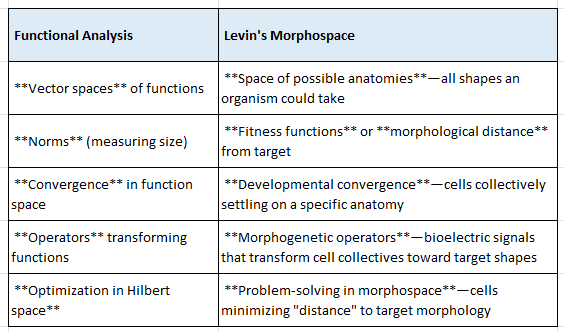
How This Connects to Functional Analysis
The Specific “Cone” Concept
In functional analysis, a cone is a special subset of a vector space where:
If you add two elements, you stay in the cone
If you scale by a positive number, you stay in the cone
It defines a “positive direction” in the space
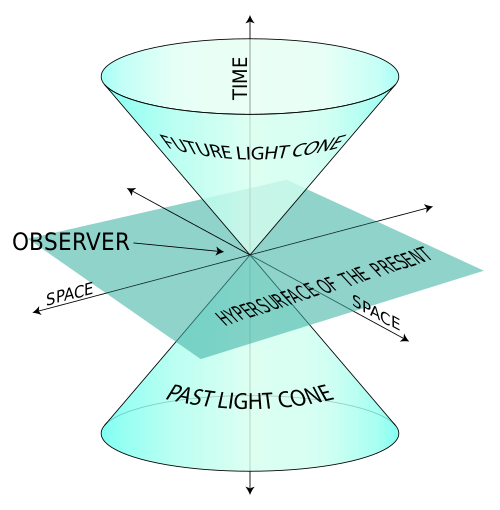
Levin’s analogy: The “cone of possible futures” for a developing organism—the region of morphospace accessible from current state given biological constraints. Cells navigate within this cone toward attractor states (target anatomies)
.
Levin’s Deeper Philosophical Layer
Levin goes further, proposing “Platonic space”—a non-physical latent space containing not just geometric patterns but patterns of mind and cognition that ingress into physical systems
. This resembles:
Function spaces (infinite-dimensional)
Manifolds in theoretical physics
Twistor space concepts you asked about earlier
Physical systems (embryos, biobots, even AI) act as pointers or interfaces that allow these patterns to manifest in physical reality
.

The Core Parallel
Both functional analysis spaces and Levin’s morphospace share:
Infinite dimensionality: The space of possible biological forms is vast, just as function spaces are infinite-dimensional
Navigation/optimization: Cells find paths through morphospace; functions converge to solutions in analysis
Attractors: Target anatomies are attractor states in morphospace, like convergence points in function spaces
Non-locality: Information distributed across the whole system guides local behavior—paralleling how functional analysis handles global properties of functions

Simple Summary
Levin’s “cones spaces” are biological possibility spaces—the arenas where development, regeneration, and evolution operate. Functional analysis provides the mathematical language to describe such spaces rigorously. Both deal with high-dimensional spaces of possibilities, whether those possibilities are functions (analysis) or anatomies (biology). The “cone” represents the forward-looking region of what’s achievable from a given starting point—constrained, navigable, and shaped by the geometry of the space itself.