Giulio Tononi - Integrated Information Theory - Synaptic Homeostasis Hypothesis
Tononi's Integrated Information Theory treats consciousness as fundamental: five axioms yield Φ (phi), measuring causal irreducibility. Claims: consciousness graded, computers lack recurrent architecture, cerebellum minimal. IIT 4.0 refines formalism; 2025 "intrinsic ontology" posits consciousness prerequisite for existence. Synaptic Homeostasis Hypothesis: sleep downscales synapses, restoring metabolic balance—locally use-dependent. Sleep reduces Φ; synaptic maintenance reshapes causal architecture generating consciousness. Controversies persist: panpsychism implications, Φ computationally intractable for brains, proxy measures imperfect. Life/death boundaries blur: Φ gradients challenge binary categories for brain death, anesthesia, fetal development. Framed within your Unification Project, consciousness is lawful protocol—value flows from individual verification, not imposed doctrine.
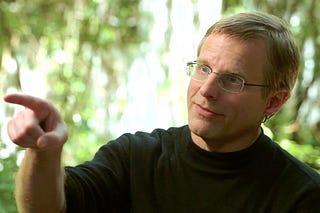
Who is Giulio Tononi?
Giulio Tononi is a neuroscientist and psychiatrist at the University of Wisconsin–Madison, best known for developing Integrated Information Theory (IIT)—one of the most ambitious and controversial frameworks in consciousness research. He trained with Nobel laureate Gerald Edelman, and their early collaboration on complexity and re-entrant neural processing laid the groundwork for what would become IIT
.
Integrated Information Theory (IIT): The Core Idea
IIT, first proposed in 2004 , takes a radical “consciousness-first” approach. Instead of starting with brain mechanisms and trying to explain how they produce consciousness, Tononi starts with the certainty that consciousness exists (your own experience) and works backward to deduce what physical properties must be true of any system that generates it
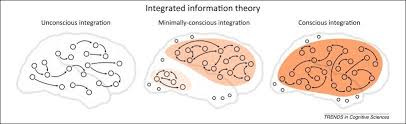
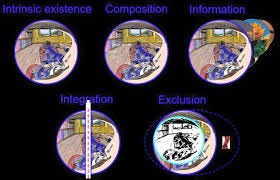
The theory rests on five axioms about consciousness :
Existence – consciousness is real (Descartes’ “I think, therefore I am”)
Composition – experiences have structure (you can see a red book and hear music simultaneously)
Information – each experience is specific (different from other possible experiences)
Integration – experiences are unified (you can’t experience the left and right visual fields separately)
Exclusion – experiences have boundaries (you experience this reality, not all possible ones)
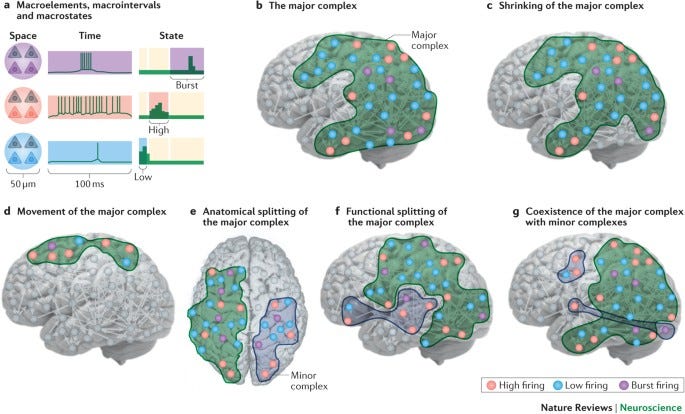
From these, Tononi derives mathematical postulates about physical systems. The key metric is Φ (phi)—integrated information—which measures how much a system is “more than the sum of its parts” through causal interactions within itself .
The Bold Claims
IIT makes striking predictions :
Consciousness is graded, not all-or-nothing (sleep, anesthesia, and brain damage reduce Φ)
Quantity of consciousness = Φ; quality = the specific shape of the system’s causal structure
Some simple systems (even a photodiode or properly arranged logic gates) have minimal consciousness
Computers are not conscious—they lack the right causal architecture
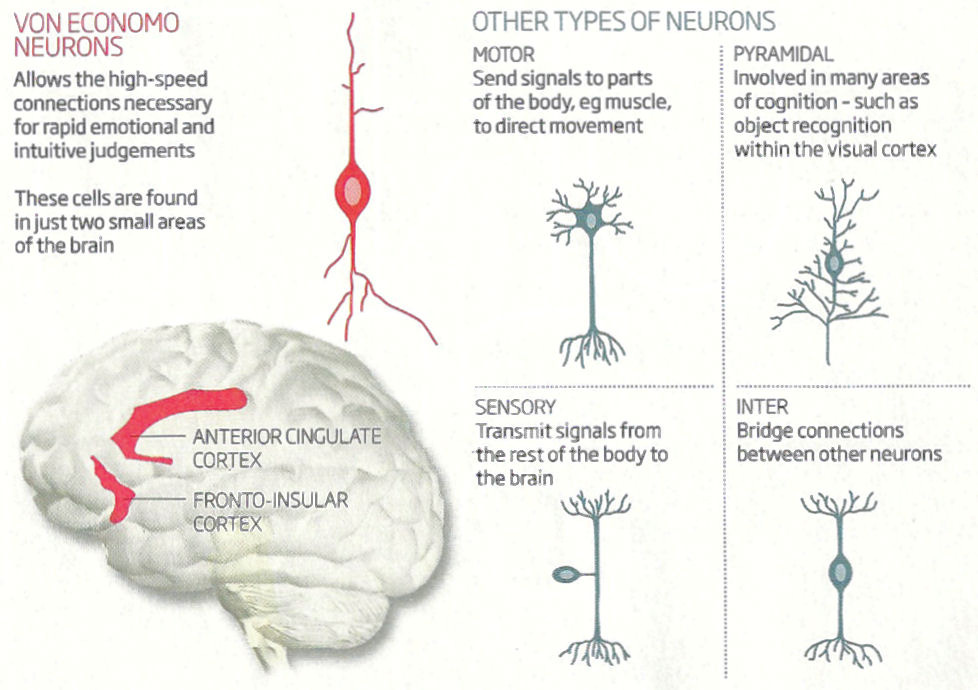
The cerebellum, despite its size, contributes little to consciousness due to its feedforward structure
Recent Developments (IIT 4.0)
In 2023, Tononi’s team published IIT 4.0, a major update that refines the mathematical formalism and addresses earlier criticisms about system boundaries and composition
. More recently, in late 2025, Tononi released a new paper emphasizing IIT’s “intrinsic ontology”—the idea that to exist absolutely, an entity must have cause-effect power upon itself
The Controversy
IIT remains deeply divisive. Critics like philosopher John Searle argue it implies “meaningless” panpsychism
, while computer scientist Scott Aaronson showed that IIT seems to grant consciousness to simple systems like expander graphs—Tononi accepts this as a feature, not a bug
. In 2023, a group of researchers signed an open letter calling IIT “pseudoscience,” though this was disputed by others in the field
.
Despite the debates, IIT has influenced clinical applications—helping assess consciousness in vegetative patients—and continues to push the boundaries of what a scientific theory of consciousness can claim to explain
Looking at the recent IIT 4.0 paper and the 2025 “intrinsic ontology” work, there’s a tension that isn’t fully resolved: the gap between the mathematics and the phenomenology.
IIT 4.0 refines how we calculate Φ and define system boundaries, but it still doesn’t bridge to why this particular causal architecture feels like this specific experience rather than nothing at all, or something else entirely. The “quality” of consciousness—the shape of the experience space—remains formally described but not explained in terms of what-it’s-like-ness.
Then there’s the measurement problem. IIT gives us a theoretical maximum Φ for a system, but in practice, we can’t compute it for anything beyond tiny model systems. The human brain? Computationally intractable. So we’re left with approximations that may or may not capture what the theory actually predicts.
The 2025 “intrinsic ontology” paper moves toward claiming consciousness is necessary for existence itself, but this seems to either trivialize the theory (if everything has some Φ, consciousness becomes universal and thus less informative) or mystify it (if we can’t say why some systems have high Φ and others don’t beyond the math).
The Sleep Research: A Parallel Masterpiece
Before IIT consumed his public profile, Tononi made foundational contributions to sleep science—work that is arguably just as influential as his consciousness theory.
The Synaptic Homeostasis Hypothesis (SHY)
In 2003, Tononi and Chiara Cirelli proposed SHY—one of the most cited and debated theories about why we sleep .
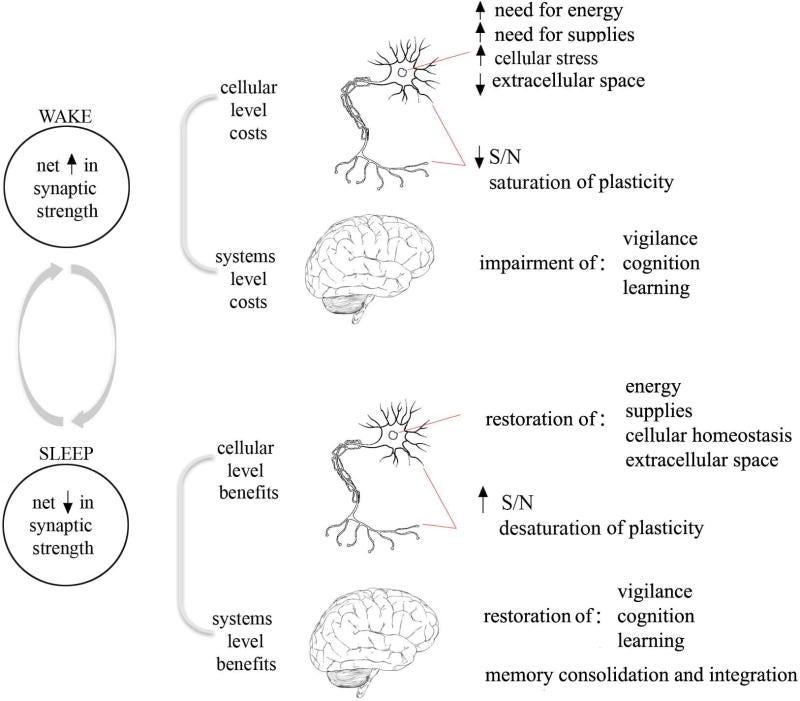
The core claim: sleep is for synaptic downscaling.
During wakefulness, learning strengthens synapses throughout the brain (Hebbian plasticity: “neurons that fire together, wire together”)
This strengthening has metabolic costs, saturates storage capacity, and increases cellular stress
Slow-wave sleep (deep sleep) selectively weakens synapses, restoring homeostasis while preserving the relative strength differences that encode memories
This explains why we feel groggy after too much sleep (over-downscaling) and why sleep deprivation impairs cognition (synaptic saturation). It also predicts that sleep need should scale with synaptic density—which matches observations across species.
SHY

The Evidence
Tononi’s lab at Wisconsin developed techniques to measure local sleep—showing that different brain regions sleep at different intensities depending on prior use . They demonstrated:
Arm immobilization reduces slow waves in motor cortex
Visual deprivation reduces sleep pressure in visual areas
Local sleep intensity correlates with local synaptic potentiation
This “use-dependent sleep” phenomenon supports the idea that sleep isn’t a global state but a distributed process of synaptic maintenance.
The Connection to IIT
Here’s where it gets interesting: Tononi explicitly links SHY to IIT. Sleep, in his view, is when Φ is reduced—the brain’s integrated information decreases as consciousness fades. The synaptic downscaling isn’t just metabolic housekeeping; it’s a change in the causal architecture that generates consciousness.
INTEGRATED INFORMATION THEORY (IIT 4.0)
The theory uses graph theory and information theory to calculate how much a system is “more than the sum of its parts.”
🔹 System = Network of nodes (neurons or elements)
🔹 Causal power = How past states constrain future states
🔹 Integration = Information generated by the whole MINUS information generated by independent parts
🔹 Φ (phi) = The quantity of consciousness
The catch: Calculating exact Φ requires testing every possible way to cut the system in half. For a human brain: computationally impossible with current technology.
SLEEP MATH: SYNAPTIC HOMEOSTASIS (SHY)
🔹 Wake: Synaptic strength (S) increases with learning → metabolic cost rises, signal-to-noise drops
🔹 Sleep: Downscaling function reduces all synapses by factor D, preserving relative differences
🔹 Result: Total synaptic weight returns to baseline, memories stay intact, energy restored
The link: During deep sleep, effective connectivity drops → integrated information (Φ) falls → consciousness fades.
The Life/Death Boundary: Where Tononi’s Framework Faces Its Hardest Test
1. Brain Death vs. Biological Death
Current legal standards for death vary globally, but most jurisdictions use whole-brain death or brainstem death—irreversible loss of consciousness capacity plus autonomic failure. IIT complicates this.
The IIT position:
Brain death with some residual neural activity in isolated islands? Φ might be non-zero.
“Dead” by neurological criteria, yet technically generating minimal integrated information?
Tononi’s framework suggests our current categories are physically imprecise. Death becomes a gradient, not a switch. This creates legal and medical chaos: when exactly does the person end and the organism become mere tissue?
2. The Minimally Conscious State (MCS)
Patients in MCS show fluctuating, reproducible but minimal awareness—tracking objects, responding to language inconsistently. Behaviorally, they’re nearly indistinguishable from vegetative patients.
IIT predicts:
Φ is low but stable (unlike the vegetative state where it collapses)
The “shape” of their experience is drastically simplified—perhaps only pain/pleasure valence without complex structured content
Clinical implication: If we can measure Φ directly (not yet possible clinically), we could detect consciousness behavior misses entirely. This would redefine informed consent for these patients—do they suffer? Do they want to live?
3. Anesthesia and Reversible Death
General anesthetics (propofol, sevoflurane) create a state phenomenologically identical to death: no experience, no memory, no response. Yet recovery is routine.
IIT explains this as Φ reduction via decoupling—cortical regions stop interacting causally, integration breaks down, consciousness dissolves. But the potential for high Φ remains; synapses and architecture are intact.
This creates a category: reversible death of consciousness. The person is “gone” but not gone forever. How does this map onto moral status? We treat anesthetized patients as persons with rights, but phenomenologically they’re closer to corpses than to sleeping humans (who retain some Φ).
4. The Fetal Consciousness Question
IIT has been weaponized in abortion debates.
The argument: If Φ emerges gradually with brain development, consciousness doesn’t “turn on” at birth or at a specific gestational week—it ramps up. Early fetal brains lack the recurrent connectivity for significant Φ. Late fetal brains may have minimal, dream-like experience.
This doesn’t resolve the ethical question (rights may precede consciousness), but it deflates claims about “silent screams” or fetal suffering in early pregnancy. Conversely, it raises stakes for late-term scenarios where Φ might be non-trivial.
5. Locked-In Syndrome vs. Total Locked-In Syndrome
Classic locked-in: Conscious, aware, but paralyzed—usually vertical eye movement preserved. Φ is high; architecture intact.
Total locked-in: No muscle control at all, including eyes. Patient is conscious but undetectable by any behavioral means.
IIT stakes its reputation here: Φ measurement would reveal these patients. Current attempts use TMS-EEG (transcranial magnetic stimulation combined with electroencephalography) to probe causal interactions. Early results suggest some “vegetative” patients show complex response patterns consistent with preserved integration.
The stakes: If IIT-guided diagnostics become standard, we may discover we’ve been burying conscious people alive or withdrawing care from minds still experiencing.
6. Cryonics and Information-Theoretic Death
Cryonics preserves brains at low temperatures hoping future technology enables revival. Critics call this “dead by any reasonable standard.”
IIT reframes the debate:
Information-theoretic death = loss of causal structure such that no recovery of Φ is possible
Clinical death = current technology cannot detect or restore Φ
If the connectome (synaptic architecture) is preserved, IIT suggests Φ could theoretically be restored. The person isn’t “dead” in the morally relevant sense—merely paused. This aligns with Tononi’s 2025 “intrinsic ontology” claim: existence requires causal power, but causal power can be suspended and resumed if structure survives.
7. The Hard Limit: When Φ = 0
IIT claims some systems have zero consciousness—not “very little,” but none. This includes:
Feedforward neural networks (standard AI)
The cerebellum in isolation
Any system without recurrent causal interactions
The radical claim: A human body with brainstem intact but cortex destroyed (breathing, heartbeat, reflexes) has no consciousness despite biological vitality. By IIT standards, this is death of the person, though the organism persists.
This challenges laws requiring “reasonable hope of recovery” to maintain life support. If Φ = 0 is detectable, continuing support becomes organ preservation, not patient care.
8. The Measurement Crisis
All these applications assume we can measure Φ. We cannot—not for human brains. Current approximations use:
Perturbational complexity index (PCI): TMS-EEG complexity measures
Lempel-Ziv complexity: Algorithmic compressibility of brain signals
These correlate with consciousness but aren’t true Φ. The mathematics requires knowing every causal interaction, which demands impossible precision.
The danger: Premature clinical adoption of flawed Φ-proxies could misclassify patients—declaring conscious minds dead, or prolonging futile care for integrated information that’s actually absent.
The Deeper Issue
Tononi’s framework doesn’t just describe life and death boundaries—it destabilizes them. Traditional categories assume consciousness is binary and linked to behavior or gross brain function. IIT suggests:
Consciousness is graded
It can dissociate from behavior and biology
It may persist in forms we cannot detect
It may absent in forms that appear alive
This doesn’t give us answers. It gives us a mathematical language for asking harder questions about what we owe to systems with Φ = 0.01 versus Φ = 0.99, or whether potential for high Φ (anesthesia, coma) carries the same moral weight as actual high Φ.