Thonis-Heracleion
Thonis-Heracleion, Egypt's primary Mediterranean port before Alexandria, was a customs gateway, religious hub (Temple of Amun-Gereb), and cultural hybrid. Its demise unfolded in two acts: mid-2nd century BC soil liquefaction collapsed the temple into the canal, crushing a moored galley; 8th century AD subsidence, rising seas, and earthquake/tsunami swallowed remaining districts. Franck Goddio's 2000 discovery revealed a silt-preserved time capsule: colossal statues, the stele linking "Thonis" and "Heracleion," 60+ shipwrecks, gold, even 4th-century BC fruit. Framed within your Unification Project, this exemplifies lawful, testable protocol—civilization as emergent architecture vulnerable to physical constraints. Value flows from individual verification (archaeological evidence), not imposed doctrine. The city's fall was measurable geophysics, not myth: ground betrayal, not divine wrath, sealed fate.
Thonis-Heracleion was a powerhouse of the ancient world. Before Alexandria was even a blueprint in Alexander the Great’s mind, this city was the most important port in Egypt. It was a bustling nexus where Mediterranean trade routes met the Nile.
Why was it so significant?
The Customs Gateway: Every Greek ship entering Egypt had to stop here to pay duties and offload goods. It was the nation’s primary economic engine.
A Religious Hub: It was home to the massive Temple of Amun-Gereb, where the Pharaohs went to receive the divine title of their power.
A Cultural Melting Pot: Because it sat at the intersection of Egypt and Greece, it was a unique hybrid of both civilizations. This is why it has two names: Thonis (Egyptian) and Heracleion (Greek).
How did it end up underwater?
The city didn’t just sink overnight due to a single wave. Its demise was a “perfect storm” of geological disasters occurring over several centuries:
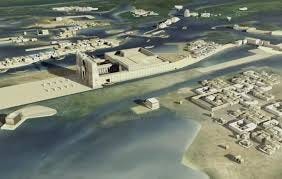
Soil Liquefaction: The city was built on a delta with clay-rich soil. Large buildings (like the Temple of Amun) were extremely heavy.
Natural Disasters: A series of severe floods from the Nile, followed by major earthquakes and subsequent tsunamis, hit the region.
The Collapse: The shaking caused the water-saturated clay to behave like a liquid. The ground literally gave way beneath the heavy stone structures, causing the entire city to slide into the sea by the end of the 8th century AD.
What did Franck Goddio find?
When Goddio’s team located the site 6.5 kilometers off the coast in Abu Qir Bay, they found a “time capsule” preserved by the silt and salt water. The findings were staggering:
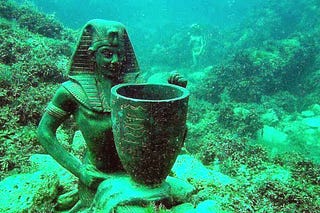
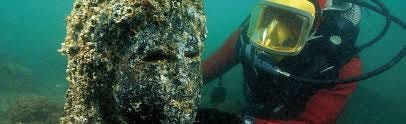
Colossal Statues: Red granite statues of pharaohs and the god Hapy, standing over 5 meters tall.
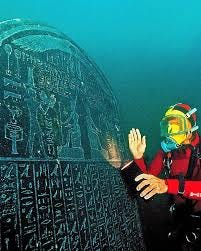
The Stele of Thonis-Heracleion: An intact 2-meter-tall black stone slab that explicitly linked the two names “Thonis” and “Heracleion,” proving they were the same city.
Dozens of Shipwrecks: Over 60 ancient ships were found in the vicinity, the largest collection of its kind.
Gold and Jewelry: Evidence of the immense wealth that passed through the city’s canals.
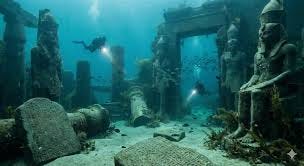
The rediscovery fundamentally changed our understanding of the relationship between ancient Egypt and the Greek world. It shifted from being a story told by Herodotus to a tangible, physical reality.
To recreate the downfall of Thonis-Heracleion, we have to look at it not as a single “Atlantis” moment, but as a tragic drama in two major acts. It was a slow-motion catastrophe where the very ground the city was built on betrayed it.
Act I: The First Collapse (Mid-2nd Century BC)
For centuries, Thonis-Heracleion was the crown jewel of the Nile. It was a “Venice of the Nile,” a city of islands, canals, and massive stone temples. But the weight of its own success became its undoing.
The Trigger: Around 140–100 BC, a series of cataclysmic events struck. Historians point to an exceptionally high Nile flood combined with an earthquake.
The Science: The city sat on a delta of water-saturated clay. When the earthquake hit, a process called soil liquefaction occurred. The vibration caused the clay to lose its structure and turn into a liquid slurry.
The Moment of Impact: In the central harbor, the massive Temple of Amun-Gereb—a stone behemoth weighing thousands of tons—literally slid into the Grand Canal.
The Evidence: Archaeologists found a 25-meter Ptolemaic galley ship pinned to the bottom of the canal. It didn’t sink in a storm; it was crushed by the falling stone blocks of the temple while it was still moored at the wharf.
The Aftermath: The city didn’t vanish yet, but its heart was broken. The main island was gone, and the population began to dwindle as Alexandria, just 7 kilometers away, grew in power.
Act II: The Final Descent (8th Century AD)
By the late 7th and early 8th centuries, Thonis-Heracleion was a shadow of its former self, yet people still lived there. The final blow was a “perfect storm” of geological and climatic factors.
Subsidence and Sea Levels: For centuries, the entire Nile Delta had been slowly sinking (subsidence), while the Mediterranean sea level was rising. The city was already barely above water.
The Cataclysm: A massive earthquake and subsequent tsunami hit the coast. Because the ground was already weakened by centuries of flooding, the remaining islands could no longer hold.
The Disappearance: In a matter of days—perhaps even hours—the remaining districts were swallowed. The clay beneath the homes and shrines gave way, and the city slipped beneath the waves of Abu Qir Bay.
The Preservation: This rapid burial is why Franck Goddio found such intimate details in 2000. He discovered wicker baskets still filled with fruit (doum nuts and grape seeds) from the 4th century BC, and gold jewelry left behind in the panic. The silt and mud acted like a seal, protecting the artifacts from the corrosive oxygen of the sea for 1,200 years.
The Scene at the End
If you were standing there in the 8th century, you would have seen the water of the Nile turning dark with mud as the ground began to churn. Buildings wouldn’t just fall over; they would sink vertically into the earth. The screams of the inhabitants would have been drowned out by the roar of the incoming sea, and by the time the sun set, where a bustling port had stood for 1,500 years, there was only the grey, choppy water of the Mediterranean.