The 7 Levels of Awakening Consciousness
The 7 Levels of Awakening Consciousness profiles a spiral, not a ladder: Comfortable Conformity (autopilot, security over truth) → Inner Friction (existential emptiness as seed) → Questioning Pillars (deconstruction of religion, politics, science) → Seeing Manipulation (recognition of systemic control; anger, grief) → The Inward Turn (meditation, shadow work, self-inquiry) → Mastery of Personal Energy (attention, thought, emotion as directed forces) → Pure Gratitude & Inner Freedom (no external savior; peace as structural recognition). Each level necessary; friction is the path. Shadow traps: Level 1 comfort, Level 3 intellectual stagnation, Level 4 anger vortex, Level 5 void avoidance, Level 6 spiritual bypassing, Level 7 paradox of arrival. Core insight: Consciousness emergence is relational, non-hierarchical, non-dual. Love, Beauty, Collective Consciousness are expressions of the same primordial tendency manifesting through increasing complexity. Value flows from individual verification, not imposed doctrine. The journey is the destination; the measure is not level attained but whether one becomes more loving, more free, more at peace. Ancient wisdom parallels: Plato's Cave, Hero's Journey, chakras, alchemy. Neuroscience correlates: DMN modulation, neuroplasticity, polyvagal theory.

The 7 Levels of Awakening Consciousness
This is a fascinating framework that has been gaining traction in spiritual, psychological, and philosophical communities. It describes a deeply personal journey of inner transformation. Here’s a deeper look at each level:
Level 1 — Comfortable Conformity The person lives within the established rules of society — career, consumption, social roles. There’s no questioning. Life is on “autopilot.” Security feels more important than truth.
Level 2 — The Inner Friction A subtle but persistent feeling that something is off. It may come through dissatisfaction, existential emptiness, anxiety, or a sense that life “should mean more.” This discomfort is the seed of awakening.
Level 3 — Questioning the Pillars The person begins to critically examine the major structures of life — organized religion, political systems, mainstream science. Old certainties collapse. This phase can feel destabilizing, even frightening.
Level 4 — Seeing the Manipulation The recognition that many systems were designed to keep people distracted, dependent, and controlled. This can bring anger, grief, or a sense of betrayal. It’s a crucial but potentially dangerous level — some get stuck in cynicism here.
Level 5 — The Inward Turn The great shift. Instead of seeking answers outside, the person redirects attention inward. Meditation, shadow work, self-inquiry, and stillness become the tools. The self becomes the territory to explore.
Level 6 — Mastery of Personal Energy Awareness of how thoughts, emotions, beliefs, and habits shape reality. The person learns to consciously direct their attention and energy. Emotional regulation, intentionality, and inner sovereignty become natural.
Level 7 — Pure Gratitude & Inner Freedom The deepest realization: no external person, system, ideology, or savior is needed. Peace is found within. Gratitude arises not for circumstances, but for existence itself. This is what many traditions call liberation.
Why This Resonates So Deeply Today
This map connects to several established traditions and modern frameworks:
Maslow’s Hierarchy of Needs — moving from survival to self-actualization
Carl Jung’s Individuation — the journey toward wholeness
Spiritual traditions — Stoicism, Buddhism, Advaita Vedanta, Mystical Christianity
Modern psychology — post-traumatic growth, inner child work, somatic healing
Many people today feel this process accelerating due to information overload, institutional distrust, and a collective search for meaning beyond materialism.
The most important insight in this model is that each level is necessary — you cannot skip the discomfort of Level 2 to reach the peace of Level 7. The friction is the path.
Going Much Deeper Into the 7 Levels

The Shadow Side of Each Level
What can go wrong at each stage — the traps people fall into:
Level 1 — The Comfortable Trap Many people never leave this level, not because they’re weak, but because the system is expertly designed to keep them comfortable. Entertainment, consumerism, social validation, routine — these are powerful anchors. Leaving comfort feels like loss, not gain.
Level 2 — The Ignored Signal Most people feel this friction but immediately suppress it — with alcohol, overworking, relationships, social media, or medication. Society even pathologizes this feeling, calling it anxiety or depression, when it may actually be a spiritual alarm bell.
Level 3 — The Intellectual Trap Some people get stuck here for years. They become professional questioners — consuming endless documentaries, podcasts, conspiracy theories — but never actually transforming. Knowing is not the same as changing.
Level 4 — The Anger Vortex This is arguably the most dangerous level. When you see manipulation clearly, rage and paranoia can take over. Some people build their entire identity around being “awake” while others are “sheep.” This is ego wearing spiritual clothes. Awakening that breeds superiority is not awakening.
Level 5 — The Void Turning inward can be terrifying. Without external distractions, many people confront grief, trauma, loneliness and deep pain they’ve spent a lifetime avoiding. This is sometimes called the “Dark Night of the Soul” — described by mystic St. John of the Cross centuries ago. It is not a malfunction. It is the deepest cleaning.
Level 6 — Spiritual Bypassing A real risk here is using spiritual practice to avoid real life — using meditation and energy work to float above problems rather than face them. True energy mastery means being fully present in ordinary, difficult, messy life — not escaping it.
Level 7 — The Paradox of Arrival Those who truly reach this level almost never announce it. In fact, they often say there is no destination. The gratitude is not a trophy. It’s a continuous, humble, daily practice.

How This Connects to Ancient Wisdom
This isn’t new — humanity has mapped this journey for thousands of years:
The Allegory of the Cave (Plato) — prisoners mistake shadows for reality. One escapes, sees the sun, and returns to tell others — who don’t believe him.
The Hero’s Journey (Joseph Campbell) — every great myth follows this exact structure: comfort → call → trials → transformation → return.
The Chakra System (Hindu tradition) — 7 energy centers mapping the exact same journey from survival (root) to pure consciousness (crown).
Dante’s Divine Comedy — descent into darkness before ascent into light.
Alchemy — the transformation of lead into gold was always a metaphor for inner transformation.
The number 7 itself appears repeatedly across cultures — 7 deadly sins, 7 virtues, 7 days, 7 notes in music. There may be something deeply archetypal about this structure.
The Neuroscience Behind It
Modern science is beginning to validate what mystics always knew:
Default Mode Network (DMN) — the brain region responsible for self-referential thought and the “autopilot” of Level 1. Meditation physically quiets this network.
Neuroplasticity — the brain can literally rewire itself through new beliefs and practices. Awakening is not just philosophical — it’s biological.
Polyvagal Theory (Stephen Porges) — the nervous system must feel safe before any genuine inner exploration is possible. Many people are stuck in survival mode neurologically, making Levels 5-7 physiologically inaccessible until the body heals.
Psychedelics research (Johns Hopkins, Imperial College London) — studies show that certain experiences can catalyze jumps through these levels rapidly, often producing lasting increases in gratitude, openness and reduced fear of death.
The Social Dimension — Why So Many People Are Experiencing This Now
This isn’t random. Several forces are converging:
The Internet broke the monopoly on information — Level 3 and 4 became accessible to billions
Institutional collapse of trust — in governments, media, churches, science — forced Level 3 questioning on a mass scale
The pandemic — stripped away routine and forced millions into involuntary Level 5 (solitude, reflection)
Mental health crisis — record anxiety and depression may be Level 2 friction that society hasn’t given a spiritual framework for
The search for meaning — material wealth has clearly failed to deliver happiness in wealthy societies, pushing people toward inner work
We may be witnessing the largest collective consciousness shift in recorded history.
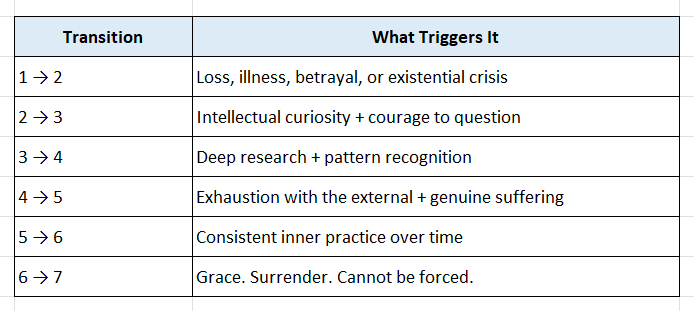
What Moves You From One Level to the Next?
Not books. Not information. What actually creates the shift:
The Most Important Truth About This Map
You are not on a ladder. You are on a spiral.
People move up and down fluidly. A Level 6 person can be pulled back to Level 1 fear under extreme stress. A Level 2 person can have spontaneous moments of Level 7 grace.
The levels are not a hierarchy of human worth. Someone at Level 1 living with genuine kindness and love may be more spiritually advanced than someone at Level 4 filled with anger and judgment.
The only real measure is this: Are you becoming more loving? More free? More at peace?
If yes — you are moving in the right direction, regardless of the level.
Level 1 — The Comfortable Trap: A Full Detailed Description

What It Actually Is
Level 1 is not stupidity. It is not weakness. It is not even a choice in the conscious sense of the word.
It is the default state of a human being who has been successfully integrated into a system that was designed, refined over centuries, and continuously optimized to keep them exactly there.
The person at Level 1 is not asleep in a lazy way. They are asleep in the way that someone is asleep when they have been given a very comfortable bed, a warm room, soft music, and a mild sedative. The conditions for waking up have been systematically removed.
The Architecture of Level 1 — How It’s Built
1. Identity Is Outsourced
The Level 1 person does not construct their own identity. It is handed to them, piece by piece, from birth:
Family gives them their first beliefs, values, and self-image
School gives them a role — good student, bad student, athletic, artistic — and a worldview
Religion (or its absence) gives them a moral framework they did not choose
Media and advertising tell them what is desirable, beautiful, successful
Social class tells them what is possible and what is “not for people like us”
By the time a person reaches adulthood, they have a complete identity — and almost none of it was consciously chosen. Yet it feels entirely their own. This is the first and deepest layer of the trap.
2. The Reward System Is Perfectly Calibrated
The system does not use chains. It uses rewards. And the rewards are real:
Work hard → get paid → buy comfort → feel good
Conform socially → receive approval → feel belonging
Follow the rules → avoid punishment → feel safe
Consume the right products → signal status → feel worthy
These rewards activate genuine neurological pleasure responses — dopamine, oxytocin, serotonin. The trap feels good. That is the entire point. A trap that felt like a trap would not work.
3. Time Is Colonized
One of the most subtle and devastating features of Level 1 is the total occupation of time:
8-10 hours of work (often more)
1-2 hours of commuting
Hours of domestic obligation — cooking, cleaning, errands
Social obligations — family events, appearances to maintain
And then, in the remaining exhausted hours: entertainment
Netflix. Social media. Sports. Reality television. News cycles. Video games. Shopping. Alcohol.
Not because people are shallow — but because the mind needs rest, and these are the rest options that have been made most available, most accessible, most immediately rewarding. By the time a person might sit quietly and think, they are too tired. And silence, for someone who has never practiced it, is profoundly uncomfortable.
There is no time left to question. This is not an accident.
4. Dissent Is Managed
When someone begins to question — as inevitably some do — the system has mechanisms:
Social ridicule — “you’re overthinking it,” “don’t be so negative,” “that’s conspiracy stuff”
Pathologizing — existential questioning is reframed as anxiety, depression, instability
Controlled opposition — safe channels are provided for frustration (voting, protest, debate) that change nothing structurally
Overwhelming complexity — problems are made to seem so large and technical that individual action feels pointless
False urgency — the news cycle keeps people reactive, emotional, and focused on surface events rather than deep structures
The result is that even the impulse to question is redirected back into the system.
The Daily Life of a Level 1 Person — In Detail
Morning: Wake up to an alarm. Check the phone immediately — news, messages, social media. The day begins already reactive, already consuming external input before a single original thought has formed.
Work: Hours spent in tasks defined by others, toward goals defined by others, measured by metrics defined by others. The deepest human need — to create meaning — is partially satisfied here, just enough to prevent total disillusionment.
Lunch: Consumed quickly, often while still looking at a screen. Rest is not really rest — it is a switch between types of consumption.
Evening: The reward phase. Food, drink, entertainment, social connection. These are genuine pleasures and they matter. But they also function as the pressure valve that prevents the discomfort from building to a breaking point.
Weekend: Recovery + slightly elevated consumption. A better meal. A trip to the mall. A sports event. A social gathering. Monday comes and the cycle resets.
Yearly: A vacation — often photographed more than experienced — which serves as proof that life is being lived, and as fuel for another year of the same cycle.
Decade by decade: The milestones accumulate — promotion, house, marriage, children, bigger house — and each one is a new layer of the trap, because now there is more to lose, more to protect, more reason not to rock the boat.
What Level 1 People Believe — And Why Those Beliefs Are Functional
These are not lies exactly. They are functional simplifications that make the system work:
“Hard work leads to success” — true enough to motivate, false enough to obscure structural inequality
“The news tells me what’s important” — true enough to feel informed, false enough to keep attention managed
“Experts know best” — true enough to enable specialization, false enough to prevent independent thinking
“Things are basically okay” — true enough to prevent panic, false enough to prevent change
“I am free” — true in a formal legal sense, profoundly incomplete in a deeper sense
These beliefs are not chosen. They are absorbed through repetition — from parents, teachers, media, peers — until they feel like reality itself, not a perspective on reality.
The Emotional Landscape of Level 1
Level 1 is not pure happiness. It contains a full range of emotions:
Low-level anxiety that never fully resolves — financial worry, health worry, social worry
Boredom that is immediately filled before it can become insight
Fleeting meaninglessness that is quickly covered by the next distraction
Genuine joy — in relationships, in small pleasures, in moments of beauty
Pride in achievements within the system
Fear — of loss, of failure, of what others think, of death (rarely examined)
The anxiety and boredom are actually the first whispers of Level 2. But in Level 1, the system provides immediate tools to silence them. And the person uses those tools, because that is what they have been given.
How Many People Live at Level 1?
This requires honest estimation, not false precision. There is no scientific poll that measures “consciousness levels.” But we can triangulate from available data:
The Data Points
Global workforce engagement: Gallup’s State of the Global Workplace report consistently shows that roughly 77-80% of the world’s workers are either “not engaged” or “actively disengaged” — meaning they operate on pure autopilot in their professional lives, the domain where most waking hours are spent.
Media consumption: The average human being now spends 6 to 7 hours per day consuming digital media. In the United States, total screen time including television exceeds 10 hours per day for many adults. This is the single clearest behavioral marker of Level 1 — consciousness directed entirely outward and into consumption.
Religious and ideological unquestioning: Approximately 84% of the world’s population identifies with a religious tradition. The vast majority practice that tradition exactly as they received it, without deep personal examination. This is not a criticism of faith — but inherited, unexamined belief is a hallmark of Level 1.
Financial behavior: 78% of Americans live paycheck to paycheck. Globally, the pattern is similar or more extreme. This perpetual financial precarity is one of the most powerful mechanisms keeping people locked in survival-and-consumption mode, with no psychological bandwidth for deeper questioning.
Political engagement: Voter turnout globally averages around 60-65%, but meaningful policy understanding is far lower. Most people hold political opinions that are almost entirely shaped by the media environment they grew up in — another form of outsourced identity.
The Estimate
Synthesizing these indicators honestly:
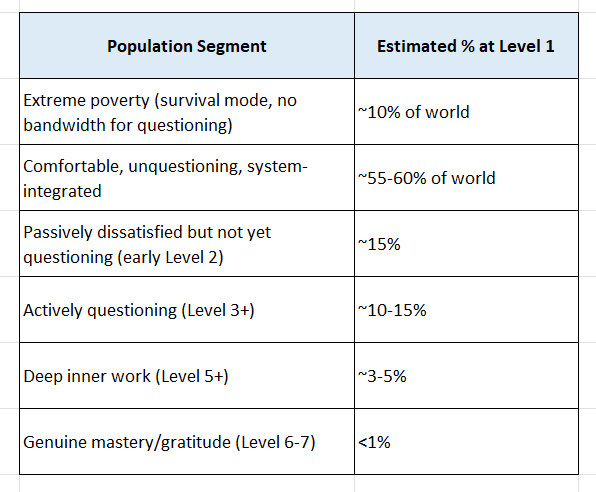
Conservative global estimate for Level 1: approximately 4.5 to 5 billion people out of 8.2 billion.
That is roughly 55 to 65% of all living humans.
The Most Important Thing to Understand About Level 1
Judgment is the wrong response.
The person at Level 1 is not a failed human being. They are a human being who received no map, no permission, and no support for questioning. They were born into a river and they are swimming in the direction the river flows. That is not failure. That is the starting condition of almost every human who has ever lived.
Furthermore — and this is critical — Level 1 contains real beauty. The love between a parent and child. The pride of honest work. The joy of a shared meal. The comfort of belonging. These are not illusions. They are genuine human goods.
The trap is not that Level 1 is entirely false. The trap is that it is partial — and it presents itself as complete.
The person who has never been told there is more will naturally assume there is not.
That is the Comfortable Trap. Not a prison with bars. A room with no windows — that has been decorated very, very well.
Level 2 — The Inner Friction: A Full Detailed Description

What It Actually Is
Level 2 begins not with a decision, not with a book, not with a teacher.
It begins with a feeling.
And not a grand, cinematic feeling. Not a lightning bolt of revelation. It begins as something far more subtle and far more unsettling — a quiet, persistent, shapeless sense that something is not right.
Not wrong with the world necessarily. Wrong with this. Wrong with here. Wrong with the life that was supposed to feel like enough by now.
The person at Level 2 cannot always name it. They cannot point to it. If you ask them what’s wrong, they will often say “I don’t know. Everything is fine. I just feel...” and then trail off. Because the vocabulary for this experience does not exist in the language of Level 1. Level 1 has words for problems that can be fixed — more money, better relationship, new job, new city. Level 2 is a problem that none of those solutions touch.
And that is what makes it so disorienting. The solutions are working. The life looks correct from the outside. And yet — underneath, quietly, persistently — something does not fit.
The Anatomy of the Friction — Where It Comes From
Level 2 does not appear randomly. It is generated by a specific collision:
The collision between who you were told you are — and who you are actually beginning to sense you might be.
Or more precisely: between the life that was constructed for you and the life that some deeper, pre-verbal part of you knows you were capable of.
This friction has several distinct sources:
1. The Arrival Problem
Society offers a series of destinations: graduate, get the job, get the partner, get the house, get the promotion, have the children. These destinations are presented as the locations where fulfillment lives.
Millions of people arrive. They complete the checklist. They stand at the summit they were told to climb.
And they feel — nothing. Or worse: a hollow, specific disappointment that they are too ashamed to name, because naming it feels like ingratitude.
“I have everything I was supposed to want. Why am I not happy?”
This question is Level 2. It is one of the most destabilizing questions a human being can ask, precisely because the entire architecture of Level 1 has no answer for it.
2. The Body’s Signal
The friction does not only live in the mind. The body registers it first, and registers it honestly:
Chronic fatigue that sleep doesn’t fix
Anxiety with no identifiable cause
A tightness in the chest on Sunday evenings before the workweek
Waking at 3am with no reason, lying in the dark with a wordless heaviness
Boredom so deep it feels almost physical
A recurring fantasy of disappearing — not in a dark sense, but in a what if I just walked away from all of this sense
These are not medical malfunctions. They are the body communicating what the mind has been trained not to think. The body has not been to school. The body has not been socialized. The body tells the truth.
3. The Trigger Events
While Level 2 can emerge gradually, it is often catalyzed by specific life events that crack the structure of Level 1 open:
Loss — the death of someone close, especially a parent, which forces the first serious confrontation with mortality
Illness — personal diagnosis, or watching someone suffer, that makes the fragility of ordinary life suddenly visible
Betrayal — a relationship collapse, a professional humiliation, a discovery that someone or something trusted was not what it seemed
Success that disappoints — reaching a major goal and feeling empty upon arrival
A child — bringing new life into the world and suddenly finding that the values you inherited feel insufficient to pass on
Solitude — an extended period alone (a lockdown, a long trip, a breakup) in which the usual distractions are removed and something underneath becomes audible
An encounter — a book, a conversation, a film, a moment in nature that briefly lifts the veil and shows a different quality of experience, leaving an ache for something the person cannot name
These are not causes of Level 2. They are windows through which the Level 2 signal, which was always there, becomes loud enough to hear.
The Inner Experience — In Precise Detail
The Sensation Itself
It is not depression, though it resembles it. It is not anxiety, though it produces anxiety. It is not grief, though it carries weight.
The closest description: a homesickness for a place you have never been. A longing for a version of life, of self, of reality — that you have not yet experienced but somehow recognize as more real than what you are living.
The Portuguese have a word for something close to this: saudade — a melancholic longing for something beloved that may never return, or may never have existed at all.
The mystics called it divine discontent — the soul’s refusal to be fully satisfied by anything less than its deepest nature.
Modern psychology calls it existential anxiety — and largely tries to eliminate it with therapy and medication. Which is sometimes appropriate. And sometimes is exactly the wrong response, because this particular discomfort is not pathology. It is intelligence.
The Cognitive Loop
The mind at Level 2 enters a particular loop:
Something is wrong → but what? → I don’t know → maybe it’s the job → change the job → still there → maybe it’s the relationship → change the relationship → still there → maybe it’s the city → move → still there → maybe it’s me → uncomfortable → go back to distractions → repeat
This loop can run for years. Decades. An entire lifetime. Most people in Level 2 try to solve an inner problem with outer changes — and are perpetually confused as to why it doesn’t work.
The Two Voices
At Level 2, two voices begin to separate and argue:
Voice 1 — The Conditioned Self: “You’re being ungrateful. You have so much. Other people have real problems. Stop overthinking. Get back to work. Have a drink. This feeling will pass.”
Voice 2 — The Emerging Self: “This is not it. This is not enough. There is something else. I don’t know what. But this is not it.”
Voice 1 is louder. Voice 1 has the entire weight of society behind it. Voice 1 has logic and practicality and social approval on its side.
Voice 2 has only one thing: it will not go away.
And that persistence — quiet, irrational, inarticulate — is the most important thing that has ever happened to that person. Because that voice is the first authentic signal they have received in possibly their entire life.
How Level 1 Responds to Level 2 People
The social environment of a Level 2 person typically responds to their friction in predictable ways — all of which are well-intentioned, and all of which are deeply unhelpful:
“You need a vacation.” Temporary relief. The feeling returns on the flight home, sometimes before landing.
“You should see a therapist.” Sometimes useful. Often used to manage the symptom rather than honor the signal.
“You’re just going through a phase.” Minimization. The implication is that maturity means returning to Level 1 contentment.
“Count your blessings.” Gratitude is real and important — but forced gratitude used to suppress legitimate inner questioning is a form of emotional suppression.
“Everyone feels like this sometimes.” True, and also used to normalize what is actually an invitation to transformation.
“Have you tried antidepressants?” Sometimes genuinely necessary. Also sometimes the pharmaceutical management of a spiritual emergence that, if honored, could change someone’s life.
The Level 2 person receives all of this feedback and typically concludes one of two things:
“They’re right — I’m ungrateful and oversensitive” → suppression → delayed awakening
“None of this actually addresses what I’m feeling” → the beginning of Level 3
The Suppression Mechanisms — How Level 2 Gets Buried
The system is extraordinarily well-equipped to silence Level 2 before it can evolve into Level 3. The suppression tools are everywhere:
Alcohol and substances: The most ancient and effective edge-softeners. They don’t solve anything but they reliably blur the signal. Global alcohol consumption is a direct economic indicator of Level 2 prevalence.
Workaholism: Burying the feeling under productivity. Socially rewarded, which makes it especially insidious. The busier you are, the less silence there is for the voice to speak.
Compulsive relationships: Using romantic intensity, social busyness, or family drama to stay externally focused. Loneliness is the precondition for Level 2 deepening — so some people ensure they are never alone.
Consumption: Shopping, food, travel as experience-collection rather than genuine presence. The economy depends heavily on Level 2 people spending to feel better.
Toxic positivity: The “good vibes only” culture that pathologizes negative feeling. Social media presenting curated happiness that makes Level 2 people feel additionally broken for feeling what they feel.
Spiritual materialism: Collecting crystals, attending retreats, reading self-help books — as performance of awakening rather than genuine engagement with the discomfort. This is Level 2 wearing Level 5 clothing.
Numbing through screens: The most modern and pervasive suppression tool. Infinite content, infinite scroll, infinite stimulation — all designed to ensure that no moment of stillness lasts long enough for the friction to become audible.
Why Level 2 Is Actually Sacred
This is the most important reframe:
Level 2 is not a malfunction. It is a biological and spiritual alarm system working exactly as intended.
Every great transformation in human history — personal or collective — began with friction. With dissatisfaction. With the unbearable sense that what is, is not what should be.
Without Level 2:
No artist would ever create — creation comes from the gap between what exists and what you sense could exist
No scientist would question — science begins with anomaly, with things that don’t fit the existing model
No revolution would occur — social change begins when enough people can no longer tolerate the friction of injustice
No spiritual path would be walked — every tradition begins with suffering, with dukkha, with the recognition that ordinary life is fundamentally unsatisfying
The Buddha’s entire teaching begins at Level 2. His first Noble Truth — that life as ordinarily lived contains inherent suffering and unsatisfactoriness — is simply a philosophical formalization of the Level 2 experience.
Jesus in the desert. Mohammed in the cave. Arjuna on the battlefield, unable to fight. The Dark Night of the Soul. The Hero refusing the call. Every sacred narrative in human culture contains a Level 2 moment — and treats it not as a problem to be solved but as the necessary beginning of everything that matters.
The Daily Life of a Level 2 Person — In Precise Detail
Morning: They wake and for a half-second, before full consciousness returns, there is blankness. Then the familiar weight descends — not dramatic, just present. They reach for the phone faster than they would like to admit. Not because they want to. Because they don’t want the alternative, which is lying there in the quiet with whatever is underneath.
At Work: They function well. Level 2 people are often high performers because their discomfort drives them to prove their worth externally. But there are moments — staring out a window, listening to a meeting that feels surreally pointless — when the question rises: Is this really what I’m doing with my life? It is quickly suppressed. There is a deadline.
In Relationships: They are loving, present, functional — and also carrying a loneliness that they cannot explain and would be embarrassed to name, because by every measure they are not alone. The loneliness is not about the relationship. It is the loneliness of not yet having met themselves.
In Free Time: The friction is loudest here. Free time, which should be pleasurable, often produces a particular anxiety — because freedom reveals that there is nothing external to blame for the emptiness. Level 2 people often stay busy voluntarily, because rest activates the signal.
At Night: The most honest moments. In the dark, before sleep, when the distractions have finally run out — the questions come. Quiet, persistent, unanswerable from within Level 1’s framework. Many Level 2 people do their most important thinking here — thoughts they will not remember to act on by morning.
Quantifying Level 2 — The Global Picture
Like Level 1, this cannot be measured with perfect precision. But the data is remarkably consistent across multiple independent indicators:
Mental Health Data
The World Health Organization reports that 280 million people worldwide suffer from depression and over 300 million from anxiety disorders — with these numbers accelerating sharply post-2020. A significant, unmeasurable portion of this is Level 2 friction being processed through a medical framework that was not designed for it.
Meaning and Purpose Research
Gallup research consistently finds that approximately only 23% of workers worldwide feel their work has clear purpose and meaning. That leaves roughly 77% living with a degree of professional meaninglessness — a primary Level 2 driver.
A 2023 Ipsos global study found that only 43% of people across 30 countries describe themselves as “happy” — with the gap between external conditions and inner experience widening in exactly the wealthiest nations where material needs are most met. This inverse relationship between material comfort and inner satisfaction is the statistical signature of Level 2.
The Self-Help and Wellness Economy
The global self-help industry is worth over $45 billion USD and growing at 5-6% annually. The wellness industry exceeds $5.6 trillion globally. These are not industries that serve Level 1 people — Level 1 people don’t feel they need help. This is predominantly the economic footprint of Level 2.
Substance Use
The WHO estimates that 2.6 billion people use alcohol regularly and 284 million have drug use disorders. Not all of this is Level 2 suppression — but a substantial portion represents humanity’s most ancient technology for silencing inner friction.
The Resignation Phenomena
The “Great Resignation” of 2021-2022 saw over 50 million Americans alone voluntarily leave their jobs — an unprecedented mass rejection of Level 1 life structures. In surveys, the overwhelming reason given was not salary. It was meaning, values, and quality of life. This was Level 2 reaching a tipping point on a mass scale.
The Percentage Estimate
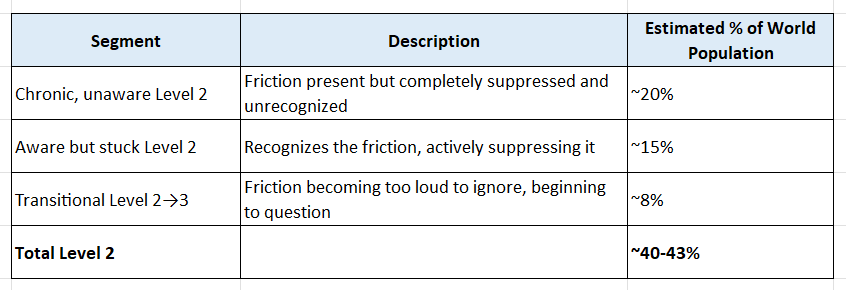
In absolute numbers: approximately 3.2 to 3.5 billion people.
However — and this is essential — Level 2 is not a fixed address. It is the most fluid of all levels. People move in and out of it constantly. A Level 1 person has Level 2 moments every week. A Level 4 person under extreme stress can collapse back into Level 2 suppression patterns temporarily.
The 40% figure represents people for whom Level 2 is the dominant operating frequency of their current life.
The Single Most Important Truth About Level 2
The friction is not the enemy.
The friction is the message.
And the message is simply this: there is more to you than has been permitted to exist so far.
Every moment of Level 2 discomfort — every 3am wakefulness, every Sunday dread, every hollow feeling at the moment of achievement, every inexplicable longing — is not evidence that something is broken.
It is evidence that something is alive.
Something in you knows there is more. Knows it without proof. Knows it against all social instruction to settle down and be grateful. Knows it with a certainty that no argument can fully extinguish.
That knowing — irrational, persistent, quiet — is the most trustworthy thing about you.
It is not pulling you toward destruction. It is pulling you toward yourself.
And that pull — uncomfortable as it is — is one of the most precious experiences a human being can have.
Because it means the door is not yet closed.
Level 3 — The Intellectual Trap: An Exhaustive Description

What It Actually Is
Level 3 begins as liberation.
After the dull ache of Level 2 — that formless, nameless friction that had no language and no direction — Level 3 arrives like a door swinging open. Suddenly there are answers. Suddenly the discomfort makes sense. Suddenly there is a framework, an explanation, a community of people who also see what you are beginning to see.
The mind, which had been restless and directionless in Level 2, now has material. And it consumes that material with a hunger that feels almost biological — because in a sense it is. The brain experiencing genuine paradigm shift releases the same neurochemicals as falling in love. The world looks different. Sharper. More real. Colors seem brighter. Conversations that once satisfied now feel thin. You cannot understand how you did not see this before.
This is the intoxication of Level 3. And it is real. And it is important. And it is also, if you are not careful, the most sophisticated trap of all — because unlike the comfortable numbness of Level 1 or the shapeless suffering of Level 2, this trap feels like freedom.
It feels like arrival.
It is not arrival. It is a very important, very necessary, and very dangerous corridor.
The Core Movement of Level 3
The fundamental action of Level 3 is deconstruction.
The person takes the inherited structures of Level 1 — the beliefs, the institutions, the authorities, the narratives — and begins to systematically examine them. To question them. To find the cracks in them. To pull on the threads and watch entire tapestries unravel.
This deconstruction moves through three primary domains, almost always in this order:
First: Religion Because religion is where the deepest and most personal programming was installed. It is where questions of meaning, morality, death, and ultimate reality were first answered — and answered before the person had any critical faculties to evaluate those answers. The questioning of religion is often the most emotionally charged, because it involves not just ideas but identity, family loyalty, community belonging, and the terror of mortality without a safety net.
Second: Politics and Social Structures Once the religious framework is cracked, the political one follows naturally. The person begins to see that ideologies — left, right, nationalist, globalist — are also inherited constructs, also serving interests that were not the person’s own, also providing identity and tribal belonging in exchange for surrendering independent thought.
Third: Science and Consensus Reality This is the most controversial territory and the one where Level 3 is most vulnerable to serious error. The person begins to question not just bad science or corrupted institutions — which is legitimate and important — but sometimes science as a method, consensus as a process, and material reality as a framework. This is where genuine intellectual courage and genuine intellectual danger become almost indistinguishable.
The Deconstruction of Religion — In Full Detail
What Gets Questioned
At Level 3, the questioning of religion is rarely superficial. It goes through distinct layers:
Layer 1 — Literal Doctrine The first things to fall are the literal claims: the six-day creation, the virgin birth, the parting of seas, the physical resurrection. These are the easiest to question because they conflict most directly with scientific evidence and because the person has usually been suppressing doubts about them since childhood.
Layer 2 — Institutional Authority Next comes the institution itself. The history of religious institutions — the Inquisition, the Crusades, the sexual abuse scandals, the political alliances, the persecution of heretics, the burning of libraries — becomes visible in a new way. Not as historical anomalies but as revelations about the nature of the institution itself: that it was always partly a power structure dressed in sacred language.
Layer 3 — Moral Framework Then the moral teachings come under scrutiny. The person begins to notice contradictions, historical contingency, cultural bias embedded in what was presented as eternal divine law. They notice that the morality of their tradition was often convenient for the powerful and burdensome for the powerless. That it frequently served to control sexuality, suppress women, justify conquest, and maintain social hierarchies.
Layer 4 — The God Concept Itself Finally — and this is the deepest and most disorienting layer — the concept of God itself is examined. Not just “does this specific God exist” but “what is the nature of the divine, if anything, and does the concept as I was given it make coherent sense?”
The Emotional Cost
This process is not merely intellectual. It is a death. And it should be treated as such.
The person loses:
Their cosmological framework — the story of where everything came from and where it’s going
Their moral certainty — the clear sense of right and wrong they had lived by
Their community — often literally, as religious communities do not always receive questioning kindly
Their comfort with death — for many people, religious belief was the only thing that made mortality bearable
Their relationship with family — particularly painful when parents or grandparents’ entire identity is bound to the faith being questioned
Their sense of being held — the feeling, however constructed, of being known and loved by an infinite being
What replaces all of this, in Level 3, is often — nothing yet. Just the cold wind of open space where the structure used to be. This is why many people oscillate at the edge of Level 3 and retreat. The deconstruction is survivable. The emptiness that follows is harder.
What Level 3 Misses About Religion
Here is where the intellectual trap begins to show its edges:
In the rush of deconstruction, Level 3 often throws away not just the institutional corruption and the literal mythology, but also the genuine wisdom, the genuine community, the genuine encounter with mystery and transcendence that religious traditions — at their best — have always provided.
The mystics within every tradition — Meister Eckhart, Ibn Arabi, Ramana Maharshi, Rumi, St. Teresa of Avila, the Baal Shem Tov — were not naive. They were not unaware of institutional corruption. They were not confusing metaphor for literal fact. They were pointing at something real — something that Level 3, in its confident rationalism, often dismisses along with the superstition.
The Level 3 person who says “I have deconstructed religion and found it empty” has often deconstructed the container while dismissing what the container was trying, imperfectly, to hold.
This becomes clear only from Level 5 onward.
The Deconstruction of Politics — In Full Detail
The First Crack
Political questioning in Level 3 usually begins with a specific disillusionment. A policy that clearly served corporate interests over human needs. An election that changed nothing structurally. A war justified by evidence that later proved false. A politician whose private behavior contradicted their public morality.
This specific crack opens into a general questioning of the entire political framework the person inherited.
The Left-Right Dissolution
One of the most disorienting experiences of early Level 3 is the collapse of the left-right political spectrum as a meaningful map.
The Level 1 person inhabits one side of this spectrum and views the other with varying degrees of suspicion or contempt. The Level 3 person begins to see that both sides are operating within the same fundamental system — debating the management of power structures rather than questioning whether those power structures should exist. That corporate funding shapes policy regardless of party. That media narratives serve ownership interests regardless of apparent ideological orientation. That elections offer choices between candidates both selected, funded, and constrained by the same underlying economic interests.
This is genuinely important perception. This is not conspiracy thinking — it is political science and sociology observed by serious scholars across the ideological spectrum, from Noam Chomsky on the left to Ron Paul on the libertarian right, from Christopher Lasch to Jacques Ellul.
What Gets Examined
At Level 3, political deconstruction extends to:
The nation-state itself — Is this natural? Is this permanent? Who drew these lines and why? What violence attended their creation and maintenance?
Democracy as practiced — What is the gap between democratic theory and democratic reality? Who actually governs? What is the relationship between money and political power?
Capitalism and economics — Is this the only possible economic system or the only conceivable one? What are its costs, externalities, and victims that are systematically hidden from mainstream accounting?
Media and information systems — Who owns the channels through which public opinion is formed? How does ownership shape content? What is not being said, and why?
Historical narratives — What does the officially sanctioned history of my nation, my civilization omit? What does the view from the colonized, the enslaved, the defeated, the erased look like?
International institutions — The United Nations, World Bank, IMF, WTO — in whose interests do these actually operate? What is the relationship between humanitarian language and geopolitical strategy?
The Genuine Insights
It must be said clearly: many of the insights gained in Level 3’s political deconstruction are correct. Or at least, importantly correct — pointing to real dynamics that Level 1’s comfortable acceptance of official narratives does obscure.
The concentration of media ownership is real and documented. The influence of money on democratic processes is real and documented. The gap between foreign policy rhetoric and geopolitical reality is real and extensively documented by serious historians and political scientists. The selective application of international law and human rights norms is real and widely acknowledged outside of mainstream political discourse.
Level 3 is not wrong. It is incomplete. And its incompleteness is what makes it a trap.
The Political Trap
The trap is this: deconstruction without construction.
The Level 3 person can take apart every political structure, expose every hypocrisy, name every power dynamic — and be left with nothing but a cleared field and a very sophisticated vocabulary for describing what is wrong.
What they typically cannot do yet is:
Propose alternatives that account for the full complexity of human nature
Sustain engagement with imperfect systems while working for better ones
Tolerate the genuine disagreement and difficulty of democratic negotiation
Recognize that their own newly acquired political lens is itself a partial perspective
Accept that people still inside Level 1 political frameworks are not simply stupid or brainwashed — they are human beings with genuine values and genuine interests
The result, very often, is political nihilism dressed as sophistication. A posture of being beyond politics, above the fray, not voting because “they’re all the same.” Which, ironically, is one of the most politically convenient positions imaginable for the very power structures Level 3 claims to oppose.
The Deconstruction of Science — In Full Detail
Why This Is The Most Complex Territory
Religion and politics are human institutions, historically situated, obviously imperfect, and therefore relatively straightforward targets for critical examination.
Science is different. Science is a method — a set of procedures for interrogating reality that has produced genuine, extraordinary, transformative knowledge. It cured diseases. It mapped the cosmos. It revealed the structure of matter and the mechanisms of life. It is, by any reasonable measure, the most powerful epistemic tool humanity has ever developed.
And yet — at Level 3, science too comes under scrutiny. And here the danger increases substantially, because the person is now in territory where they are more likely to make serious errors — to throw away genuine knowledge along with genuine corruption.
What Is Legitimately Questioned
Some of Level 3’s scientific questioning is entirely legitimate:
The corruption of scientific institutions: The replication crisis is real — a significant proportion of published psychological and biomedical research has failed to replicate when repeated. This is documented not by conspiracy theorists but by scientists themselves. Studies by John Ioannidis and others suggest that a majority of published research findings may be incorrect.
The pharmaceutical-industrial complex: The financial relationship between pharmaceutical companies and research institutions, regulatory bodies, and medical journals is real and extensively documented. Trials funded by pharmaceutical companies consistently produce more favorable results than independently funded trials. Key studies have been suppressed. Diagnostic categories have been expanded in ways that serve commercial interests. This is not conspiracy — this is peer-reviewed science of science.
Scientism as ideology: The claim that science is the only valid form of knowledge — that only what can be measured and quantified is real — is itself a philosophical position, not a scientific finding. It is a metaphysical claim disguised as a methodological one. Consciousness, meaning, beauty, moral truth, subjective experience — these are real features of reality that the scientific method, at least in its current form, cannot fully address. This critique is not anti-science. It is what philosophers of science have been articulating for a century.
The history of scientific consensus being wrong: The history of science is the history of scientific consensus being revised, overturned, and replaced. Bloodletting was consensus medicine for centuries. Continental drift was laughed at when first proposed. Stomach ulcers were attributed to stress until two scientists proved they were bacterial — and were ridiculed for years before being vindicated. The recognition that consensus can be wrong is not anti-scientific. It is the engine of scientific progress.
The social construction of knowledge: Sociology of knowledge and philosophy of science have demonstrated convincingly that scientific research is not conducted in a social vacuum — that funding, career incentives, cultural assumptions, and political pressures shape what questions get asked, what results get published, and what gets defined as knowledge. This is not relativism. It is accurate.
What Gets Distorted
And here is where the trap deepens:
From “some consensus is wrong” to “all consensus is suspect.” The Level 3 person, having correctly identified cases where scientific consensus was corrupted or mistaken, makes the categorical error of applying maximum skepticism uniformly. Climate science, vaccine safety, evolutionary biology, the age of the universe — all become equally suspect as pharmaceutical corruption or the replication crisis. This is intellectually indefensible but emotionally understandable — the same cognitive move that correctly deconstructed one domain is now being applied indiscriminately.
From “question the method” to “prefer alternative knowledge systems.” Some Level 3 people, having found genuine gaps in scientific materialism, swing to uncritical acceptance of alternative frameworks — homeopathy, astrology, certain aspects of the wellness industry, various channeled or revealed cosmologies — applying the same credulity to these that they correctly removed from mainstream institutions. The critical faculty that was so sharp in deconstruction becomes mysteriously soft in these new territories.
From “institutions can be corrupted” to “all expertise is manipulation.” This is perhaps the most dangerous cognitive move of Level 3: the wholesale rejection of expertise. The person who correctly identifies that Dr. X has financial conflicts of interest extends this to mean that no doctor, no scientist, no expert can be trusted — that the ordinary person’s research of three weeks equals or exceeds the accumulated knowledge of specialists. This is not liberation from manipulation. It is a new and more dangerous form of ignorance.
The Full Topology of the Intellectual Trap
What The Trap Looks Like From Inside
From inside Level 3, it does not look like a trap. It looks like:
Clarity — finally seeing through what others are too frightened to examine
Community — finding others who share this vision (podcasts, forums, YouTube channels, documentaries)
Mission — a sense of purpose in spreading this knowledge, waking others up
Identity — “I am someone who sees clearly, who questions, who is not fooled”
Superiority — not always acknowledged, but usually present: the implicit sense that Level 3 perception marks one as more intelligent, more courageous, more evolved than those who remain in Level 1
This combination is extraordinarily seductive because it simultaneously provides everything that Level 2 took away: meaning, community, identity, purpose, and a sense of being special — but now through a framework that feels hard-won rather than inherited.
The trap has been re-baited. The cheese is different. The mechanism is the same.
The Identity Crystallization
At Level 3, many people undergo what can be called identity crystallization around questioning itself.
They do not use their questioning as a tool for arriving at deeper truth. They use it as the foundation of a new, stable identity. “I am an awakened person. I am a critical thinker. I am not like the sheep.”
This identity has all the characteristics of the Level 1 identities it replaced:
It is rigid and defensive
It provides tribal belonging
It resists revision from outside
It defines itself against an other
It provides comfort and security
The content has changed. The structure is identical. The cage has been redecorated.
The Information Vortex
Level 3 lives in a particular informational environment that actively maintains and deepens the trap:
The algorithm. Every major digital platform’s recommendation engine is designed to maximize engagement — and nothing maximizes engagement like confirmation and escalation. The person who watches one documentary questioning official narratives is immediately served another, then another, then another, each slightly more extreme than the last.
This is not conspiracy. It is documented, publicly acknowledged behavior of the recommendation systems. The rabbit hole is not a metaphor. It is an engineered feature of the information environment.
The Level 3 person, believing they are conducting independent research, is in fact navigating a commercially constructed information ecosystem that profits from their radicalization — more time on platform, more engagement, more data, more targeted advertising.
The great irony: the person who has escaped the mainstream media narrative has often simply entered a counter-narrative that is equally curated, equally commercial, and equally distorting — just optimized for a different demographic.
The Conspiracy Theory Gravitational Field
At the edges of Level 3, there is a powerful gravitational field: conspiracy theory as total explanation.
Conspiracy theories are seductive at Level 3 for very specific reasons:
They validate the Level 3 intuition that official narratives hide something
They provide complete explanatory frameworks — nothing is random, everything connects
They restore a sense of human agency in a world that feels frighteningly out of control
They identify clear villains — which is emotionally satisfying in a way that “complex systemic forces” never can be
They provide community with high emotional intensity and a sense of shared secret knowledge
Some conspiracy theories point to real conspiracies — because conspiracies, in the straightforward sense of small groups of people planning harmful things in secret, are real and historically documented. The Tuskegee experiments. COINTELPRO. MKUltra. The tobacco industry’s deliberate suppression of cancer research. These are not theories. They are documented historical facts.
But Level 3 often cannot distinguish between documented institutional wrongdoing (real, important, worth knowing) and unfalsifiable total systems of explanation (intellectually empty, emotionally consuming, politically paralyzing).
The inability to make this distinction — to hold genuine institutional criticism without sliding into unfalsifiable meta-narratives — is one of the defining features of the Level 3 trap.
The Social Experience of Level 3
Relationships Under Strain
Level 3 is extraordinarily hard on relationships. The person undergoing it is changing faster than their social environment, and the change is not comfortable to be around.
With family: Holidays become minefields. The Level 3 person cannot sit through a conventional conversation about politics, religion, or current events without feeling a nearly physical discomfort — the dissonance between what is being assumed and what they now see. They may hold back. They may not hold back. Either way, there is distance growing where there was once easy belonging.
With old friends: Friendships built on shared Level 1 assumptions begin to feel hollow. There is a loneliness in Level 3 that is very specific: the loneliness of seeing things your people cannot yet see, and not being able to unsee them.
With romantic partners: If the partner is at a different level, the relationship faces real stress. The Level 3 person’s questioning can feel destabilizing, nihilistic, or exhausting to a partner invested in Level 1 structures. Conversely, the Level 3 person can begin to experience their partner’s comfort with the system as naivety — a quiet contempt that is deeply corrosive.
With new communities: Level 3 people find each other. Podcasts, forums, alternative media communities, certain political movements, some spiritual circles — these become new tribes. And these tribes, while providing real relief from isolation, also provide powerful social reinforcement for staying exactly at Level 3.
The Evangelist Phase
Almost all Level 3 people go through what might be called the evangelist phase — a period of intense missionary energy where the knowledge that has opened for them must be shared. They send articles, share videos, bring up these topics in conversation, recommend documentaries, write posts.
This impulse is genuine and not entirely misguided. They have seen something real. They want the people they love to see it too.
But the evangelist phase has several hidden costs:
It exhausts relationships — not everyone is ready for what Level 3 has to offer, and pushing the unready produces resistance, not awakening.
It entrenches identity — the act of evangelizing reinforces the belief that Level 3 perception is the destination rather than a way station.
It reveals ego — the urgency to convert others is not entirely about their wellbeing. It is also about the Level 3 person’s need to validate their own perception by having it mirrored back.
It creates enemies — when people don’t convert, the Level 3 person often concludes they are brainwashed, stupid, or cowardly rather than simply at a different stage.
The Hidden Spiritual Emergency Within Level 3
What Is Really Happening Underneath
At the deepest level — beneath all the research and the podcasts and the political deconstruction — something very different is happening inside the Level 3 person.
They are experiencing a death of the father.
Not literally. Psychologically, mythologically — the death of the symbolic father, which is the death of all external authority. Every Level 3 questioning — of God, of government, of science, of experts — is at its core the same psychological act: the refusal to keep outsourcing one’s reality to external authorities.
This is a necessary psychological task. Jung called it the confrontation with the shadow of the father archetype. It is a stage that healthy individual development requires. The adolescent who never rebels never individuates. The person who never questions authority never develops genuine conscience — they remain morally dependent on external rules rather than internally generated values.
Level 3, in this sense, is a necessary adolescence of consciousness. And like all adolescence, it is simultaneously necessary and insufficient, correct in its rebellion and incomplete in its understanding, full of genuine insight and genuine excess.
The Terror Underneath
What gives Level 3 its particular emotional intensity — its brittleness, its evangelical urgency, its tendency toward anger — is a terror that is rarely acknowledged:
If the frameworks are false — if God was a construction, if democracy is theater, if science can be bought — then what is true? Then what can be trusted? Then what am I standing on?
This is the existential vertigo of Level 3. The ground has been removed. The person is floating. And the intellectual activity — the research, the debate, the theorizing — is partly genuine inquiry and partly a way of staying busy enough not to feel the vertigo.
The anger that characterizes Level 3 — particularly Level 4, which grows directly from it — is in large part this terror in disguise. It is easier to be furious at the manipulators than to sit with the terrifying freedom of having no certain ground.
Level 3 and the Information Age
Why Level 3 Has Exploded in the 21st Century
Level 3 has always existed — throughout history there have been those who questioned the dominant religious, political, and intellectual orthodoxies of their time. But it existed as a minority condition, a condition of solitary intellectuals, radical theologians, political dissidents.
The internet changed everything.
For the first time in human history, Level 3 has infrastructure. Dedicated platforms. Global communities. Industrial-scale content production. Recommendation algorithms that actively accelerate the journey from Level 2 friction into Level 3 questioning. YouTube, podcasts, Reddit, Twitter/X, Substack — these are essentially Level 3 delivery systems of unprecedented scale and efficiency.
The result: what once took decades of solitary intellectual work can now happen in months. What once required access to suppressed literature and underground networks is now algorithmically delivered to anyone who watches one heterodox video.
This is extraordinary. And it has created the first mass Level 3 event in human history — hundreds of millions of people simultaneously questioning foundational structures, simultaneously losing their inherited maps, simultaneously searching for new frameworks.
The scale is new. The landscape is new. The human underneath is the same.
And the trap — the intellectual trap of deconstruction without transformation — is the same.
What Keeps People Stuck at Level 3
The following forces act as anchors maintaining residence at Level 3:
Fear of the next step. Level 4 requires acknowledging a degree of manipulation and betrayal that is genuinely painful. Level 5 requires turning inward, which means facing what has been running away from all along. Level 3’s endless outward research is sometimes a sophisticated form of the same avoidance that Level 1 practiced with Netflix and alcohol — just with better content.
Social reward. Within Level 3 communities, status is awarded for the quality and quantity of one’s questioning. There is social capital in having read more, questioned further, connected more dots. This reward structure actively incentivizes staying and performing rather than moving on.
Incomplete grieving. The losses of Level 3 — of religion, of political faith, of scientific certainty — are real losses that require genuine mourning. Many people intellectualize around this grief rather than feeling it. And unfelt grief keeps people circling the same territory.
The ego investment in being right. The Level 3 identity is built on the foundation of “I see clearly.” The next levels require a humility that threatens this foundation — the recognition that seeing the corruption of external systems does not mean one’s own perception is uncorrupted, that the lens through which one criticizes others is itself distorted by fear, ego, and unhealed pain.
The absence of a beyond. Many Level 3 people have never encountered a compelling, coherent, lived example of Levels 5, 6, or 7. They have not met people who have moved through the questioning into genuine peace, genuine freedom, genuine inner authority. Without such examples, Level 3 seems like the end of the road — the final, most honest position available. Why move on when this seems like as far as honest thinking goes?
What Level 3 Gets Profoundly Right
Before quantifying and concluding, it must be acknowledged clearly: Level 3 sees real things.
The manipulation of religion for power is real. The corruption of democratic systems by money is real. The influence of commercial interests on scientific research is real. The manufacturing of consent through media is real. The use of educational systems to produce compliant workers rather than free thinkers is real. The historical revision of national narratives to serve political purposes is real.
These are not paranoid fantasies. They are documented, scholarly, serious, and important observations about how power operates in human societies.
The Level 3 person who sees these things has crossed a threshold that cannot be uncrossed. And that is valuable. Not as a destination — but as a cleared field on which something more real can eventually be built.
The tragedy of Level 3 is not that it sees too much. It is that it stops too soon — mistakes the deconstruction for the destination, the demolition for the building, the removal of false answers for the discovery of true ones.
Quantifying Level 3 — The Global Picture
The Data
Alternative media consumption: A 2022 Reuters Institute Digital News Report found that trust in mainstream media has fallen below 50% in most developed nations. In the United States, trust in mass media hit a historic low of 32% in 2021 (Gallup). Globally, approximately 40-50% of internet users regularly consume alternative or non-mainstream information sources. This is the informational behavior of Level 3.
Religious deconstruction: The “nones” — people who identify with no religious tradition — now represent approximately 16% of the global population and are the fastest-growing religious category in the developed world. In the United States, they represent 26% of adults. In Western Europe, secular non-affiliation ranges from 30-70% depending on country. The majority of this growth comes not from people raised secular but from people who actively left inherited religious frameworks — a Level 3 process.
Political disillusionment: A 2023 Edelman Trust Barometer survey of 28 countries found that only 43% of respondents trusted their governments. Among 18-35 year olds globally, political disillusionment is significantly higher — with many surveys showing majority skepticism about whether elections produce meaningful change.
Conspiracy theory research: A 2022 University of Cambridge global study — the largest of its kind — found that approximately 60% of people across 10 major nations endorsed at least one conspiracy theory. This does not mean all of these people are at Level 3 — conspiracy belief exists across levels — but it indicates the scale of the population that has, at minimum, moved into questioning dominant official narratives.
The wellness and self-questioning economy: Global mindfulness app downloads exceeded 750 million in 2022. Therapy and counseling usage has increased by over 50% in the past decade across developed nations. Philosophy, psychology, and alternative history dominate bestseller lists in ways they did not two decades ago. These are behavioral markers of populations engaged in Level 3 intellectual and existential questioning.
The Percentage Estimate
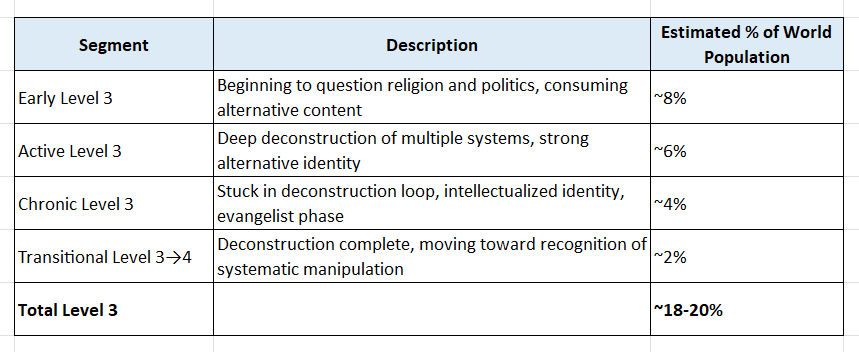
In absolute numbers: approximately 1.5 to 1.6 billion people.
However — and this is essential context — the number of people who visit Level 3 periodically, without fully residing there, is substantially higher. The pandemic alone pushed hundreds of millions of people into temporary Level 3 questioning. Many returned to Level 1 when stability returned. This transient Level 3 population may represent an additional 20-25% of the global population.
The Single Most Important Truth About Level 3
The intellectual trap is not that thinking is wrong.
It is that thinking about transformation is not transformation.
The Level 3 person knows more than they have ever known. They can see further, speak more precisely, name more clearly what was previously invisible. These are genuine and important capacities.
But there is a specific moment — a threshold — where continued outward investigation becomes a substitute for inward movement rather than a preparation for it.
The mind is extraordinary. It is also limited. And one of its deepest limitations is that it cannot think its way into the territory that lies beyond thinking. Not because that territory is mystical or irrational — but because it can only be entered through direct experience, and direct experience requires turning the attention around.
Every book read about meditation is not meditation. Every documentary watched about consciousness is not consciousness. Every framework learned about the nature of reality is not reality.
At some point — and it is different for every person, and it cannot be forced — the accumulated weight of knowing must become too heavy to carry, the endless outward search must reveal its own futility, and something must crack.
Not into despair. Into readiness.
Into the exhausted, humbled, oddly open state that is the beginning of Level 4 — where the question shifts, finally, from:
“Who is manipulating the world?”
to the far more dangerous and far more important:
“Who am I?”
That shift — small, quiet, enormous — is the door out of the intellectual trap.
And everything that Level 3 built — all the knowledge, all the questioning, all the deconstruction — becomes, in retrospect, not the destination but the necessary preparation for walking through it.
Level 4 — Seeing the Manipulation: A Complete and Exhaustive Description
What It Actually Is
Level 4 is where the intellectual becomes visceral.
In Level 3, manipulation was a concept. An interesting, disturbing, increasingly compelling intellectual framework. The person read about it, discussed it, researched it, built theories around it. It was something happening out there — in institutions, in governments, in media boardrooms, in shadowy financial networks. It was a discovery that made the person feel, if anything, slightly elevated — the one who sees what others miss.
Level 4 is when that concept lands in the body.
It is the difference between reading about a car accident and being in one. Between studying grief academically and burying someone you love. The information does not change. The experience of it changes completely. And that change — from intellectual understanding to embodied recognition — is what defines Level 4 and what makes it the most psychologically violent of all the transitions.
Because Level 4 is not just the discovery that manipulation exists.
It is the discovery that you have been its object.
Not humanity in the abstract. Not “people.” Not the unaware masses of Level 1. You. Your specific beliefs. Your specific desires. Your specific fears. Your specific identity. Your specific choices about how to spend your money, your attention, your vote, your loyalty, your body, your life.
The manipulation was not happening to someone else while you watched. It was happening to you while you watched it happen to someone else.
This is the recognition that Level 4 delivers. And it arrives not as a theory but as a shock — cold, clarifying, and in many cases, permanently altering.
How Level 4 Begins — The Specific Moment of Recognition
Unlike the gradual buildup of Level 2 or the slow intellectual expansion of Level 3, Level 4 often has a recognizable moment of arrival. People who have passed through it frequently remember it with unusual precision.
It is not always a single event. But there is almost always a threshold crossing — a moment when the pattern becomes undeniable, when the accumulation of evidence reaches critical mass, when the mind can no longer maintain the cognitive distance it used in Level 3 to keep the knowledge safely theoretical.
Some common threshold experiences:
The personal connection: The person discovers that a specific manipulation they studied abstractly applies directly to their own life. A pharmaceutical that was prescribed to them was promoted with suppressed data. A war they supported was based on documented lies. A food they were told was healthy was marketed by an industry that knew otherwise. A diagnosis they received was shaped by criteria that were commercially influenced. The abstract becomes personal.
The pattern recognition moment: After enough Level 3 research, a point arrives where the patterns across domains — health, media, finance, politics, education — suddenly snap into a unified picture. Where they were previously separate puzzles, they now appear as one puzzle. This moment is simultaneously revelatory and deeply disturbing. Because the unified picture implies not incompetence or isolated corruption but systematic, coordinated, intentional design.
The behavioral observation: The person watches their own behavior with new eyes and realizes how thoroughly it has been shaped by external forces they did not choose. They notice themselves reaching for a product whose desire was manufactured in them by advertising they absorbed before they had critical faculties. They notice themselves feeling a shame or an aspiration or a fear that, on examination, serves someone else’s interests perfectly. They notice themselves defending a system that has cost them substantially.
The betrayal event: A direct, personal experience of institutional betrayal — a doctor who dismissed serious symptoms to avoid expensive testing, an employer who used legally constructed language to avoid responsibility, a legal system that protected property over people, a religious institution that protected itself over its members. The systemic becomes personal in the most acute possible way.
The Architecture of Manipulation — What Level 4 Sees
Level 4’s central revelation is not simply that bad people do bad things. It is the recognition of architecture — that the manipulation is not random, not incidental, not a collection of isolated bad actors, but a structural feature of the systems through which human life is organized.
Layer 1: The Manufacture of Desire
The most fundamental manipulation is rarely recognized as such because it is the water Level 1 people swim in from birth.
Desire — the felt sense of wanting something — seems to come from inside. It seems like the most intimate and authentic expression of selfhood. What could be more genuinely mine than what I want?
Level 4 reveals that a staggering proportion of what people desire was deliberately manufactured and installed in them by systems designed to profit from that desire.
Edward Bernays — the father of modern public relations, nephew of Sigmund Freud — understood before almost anyone else that mass industrial production required mass desire to consume what was produced. He explicitly described his work as the “engineering of consent.” He used his uncle’s insights about unconscious drives to connect products not to rational needs but to psychological longings — for security, belonging, sexual attractiveness, social status, self-expression.
He ran campaigns connecting cigarettes to female liberation. He manufactured demand for bacon and eggs through a study he designed. He created the “modern bathroom” as a site of personal hygiene anxiety that sold products. He helped United Fruit Company use propaganda to justify a CIA-backed coup in Guatemala by framing it as defense against communism.
This was in the 1920s and 1930s. The sophistication has not decreased since. It has increased by orders of magnitude, with the addition of:
Behavioral psychology refined across a century of application
Neuroimaging that reveals which stimuli trigger which emotional responses
Big data that allows individual psychological profiling at population scale
Social media algorithms that have turned every moment of human attention into an optimization target
AI-powered personalization that delivers individually tailored manipulation at industrial scale
Level 4 sees that the person who believes they freely chose their lifestyle, their aspirations, their aesthetic preferences, their political intuitions, their sense of what constitutes a successful life — has in most cases been led to those choices by systems that benefit economically and politically from them having exactly those choices.
This is not to say free will does not exist. It is to say that genuine free choice requires awareness of the forces shaping choice — and that awareness is precisely what Level 1 and Level 2 lack, and what Level 4 begins to develop.
Layer 2: The Control of Attention
Attention is the fundamental resource. Every other resource — money, time, energy, social connection, political will — flows from where attention goes. Whoever controls attention controls, in a very real sense, reality.
Level 4 sees the full scope of the attention economy — the massive, coordinated, extraordinarily sophisticated competition for human attention that defines the 21st century information environment.
The social media machine: The internal documents of major social media companies — revealed through whistleblowers, congressional testimony, and investigative journalism — show that these platforms were designed with explicit knowledge that certain features were psychologically harmful, particularly to adolescents, and deployed anyway because they maximized engagement. The like button. Infinite scroll. Notification design. Autoplay. The removal of natural stopping points. These are not accidents of design. They are deliberate engineering choices made to exploit psychological vulnerabilities — variable reward schedules, social comparison, fear of missing out, the need for belonging — that are among the most primitive and powerful drives in human psychology.
The news cycle: Twenty-four hour news was not designed to better inform citizens. It was designed to maximize advertising revenue, which required maximizing viewership, which required maximizing emotional arousal. Fear, outrage, and tribal conflict reliably produce higher engagement than nuanced, contextualized reporting. The result is a news environment that is not merely biased in its content but structurally optimized to keep the viewer in a state of aroused, reactive, fearful attention — the neurological state least conducive to genuine understanding and most conducive to continued consumption.
The education system: Level 4 looks back at the educational system with a new question: what was this actually designed to produce? The historical record is not ambiguous. Compulsory mass education in its modern form was designed explicitly — as stated by its architects — to produce compliant industrial workers and obedient citizens. To give enough education to function within the economic system, not enough to question it. To standardize thought, reward conformity, punish non-compliance, and sort human beings into hierarchies of economic utility. The person at Level 4 looks back at twelve-plus years of compulsory education and sees, in many cases, a carefully managed curriculum of who they were supposed to become.
The body and health system: Level 4 sees the systematic manufacture of body anxiety and medical dependency. The beauty and diet industries collectively earn trillions by engineering dissatisfaction with the body. Diagnostic criteria for mental illness have expanded in every edition of the DSM — the diagnostic manual of psychiatry — in ways that consistently increase the market for pharmaceutical products. Food systems are engineered at the molecular level to produce craving and overconsumption. The standard American diet — exported globally — was not the result of nutritional science but of agricultural subsidies, food industry lobbying, and deliberately manufactured taste preferences.
Layer 3: The Management of Belief
Perhaps the most profound layer of manipulation that Level 4 recognizes is not the manipulation of desire or attention but the manipulation of belief about reality itself — including beliefs about what is possible, what is human nature, what history was, and what alternatives exist.
The naturalization of systems: Every social system presents itself, to those inside it, as natural, inevitable, and the only possible arrangement. Feudalism seemed natural to those born within it. Slavery seemed natural to those who benefited from it and was made to seem natural to those who suffered it. The divine right of kings was not merely claimed — it was genuinely believed, by most people, most of the time. The Level 4 recognition is that current systems are no different in their self-presentation — that capitalism, the nation-state, representative democracy, monetary systems, property law, and dozens of other fundamental arrangements of power are presented as natural features of reality rather than historical constructs that serve specific interests and that have specific alternatives.
The manufacturing of consent: Noam Chomsky and Edward Herman’s analysis — which Level 3 reads intellectually and Level 4 feels viscerally — identified five structural filters through which media systems produce ideological conformity without explicit censorship: ownership, advertising dependence, sourcing, flak, and ideology. The result is not a conspiracy of editors meeting to decide what to suppress. It is a system whose structural incentives reliably produce the same outcome as such a conspiracy would — without anyone needing to direct it consciously.
The colonization of language: Whoever controls the language controls the thought. Level 4 sees how thoroughly the language of daily life has been shaped by interests that benefit from specific framings. “Human resources” — a term that defines persons as assets. “Collateral damage” — a term that removes the human reality of civilian death. “Fiscal discipline” — a term that frames cuts to social support as moral virtue. “Illegal alien” versus “undocumented immigrant.” “Pro-life” versus “anti-abortion.” “Free market” for a system that is heavily regulated in favor of existing capital holders. The language is not neutral. It is a battlefield on which reality is contested — and the side with more resources to shape language wins more of those contests.
The suppression of alternatives: One of the deepest manipulations is not the promotion of a false idea but the suppression of the knowledge that alternatives have existed and do exist. Indigenous governance systems that sustained communities for millennia. Economic arrangements that distributed resources differently. Medical traditions that integrated rather than separated body and mind. Social structures organized around care rather than production. Political philosophies outside the narrow spectrum of acceptable mainstream debate. These are not absent from history — they are present in it, extensively, and their systematic marginalization from education and mainstream discourse is itself a form of management.
Layer 4: The Control of Opposition
The most sophisticated realization in Level 4 — the one that genuinely shocks even those who thought they had already seen through the system — is the recognition that opposition is managed.
That dissent, to a significant degree, is permitted within carefully maintained boundaries — and that the boundaries are maintained not by suppressing dissent but by controlling it, channeling it, and in some cases manufacturing it.
The spectacle of politics: Democratic politics, viewed from Level 4, increasingly resembles what Guy Debord called “the spectacle” — a performance designed to absorb political energy, provide the emotional satisfaction of participation and conflict, while leaving fundamental power structures untouched. Elections are real. The choices they offer are constrained to options that do not threaten the fundamental interests of those who fund both parties, own the media, and occupy the regulatory agencies.
Controlled opposition: The provision of safe outlets for dangerous energy. Social movements that are co-opted, defunded, or redirected. Radical ideas that are absorbed into mainstream language while being emptied of their transformative content. “Diversity, Equity and Inclusion” programs that change the faces in boardrooms while leaving the boardrooms intact. Environmental initiatives that generate green consumer products while leaving industrial emissions structures untouched. The appearance of change that preserves the substance of stagnation.
The colonization of counterculture: Every significant counterculture movement of the 20th century — from the 1960s counterculture to punk to hip hop to the early internet — was eventually absorbed, commodified, and resold as aesthetic style emptied of political content. The rebellion itself becomes a product. The image of revolution decorates t-shirts sold by the corporations the revolution was directed against. Level 4 sees this pattern operating in real time.
The algorithm as crowd control: Social media outrage — the constant cycling of moral controversies, political fights, and cultural conflicts — keeps enormous amounts of political energy occupied with horizontal conflict between citizens rather than directed vertically toward the power structures that shape the conditions people are fighting about. The left fights the right. Urban fights rural. Race fights race. Religion fights secularism. While the actual machinery of power — regulatory capture, financial system design, military contracting, pharmaceutical approval — operates largely uncontested in the space cleared by the spectacle of these conflicts.
The Psychological Experience of Level 4 — In Precise Detail
The Initial Shock Phase
The first stage of Level 4 is a specific kind of shock that has no adequate name in ordinary language. It is not surprise exactly — the person has been moving toward this in Level 3. It is more like the moment when something you intellectually knew becomes something you feel in the body as true.
The closest analogies:
Finding out a parent has been lying to you for your entire life about something fundamental. The moment after a serious car accident when the adrenaline hits and the sheer fragility of the ordinary is suddenly naked. The first real encounter with death — not as concept but as fact — and the restructuring of reality that follows.
The shock is specific. It has a texture. Cold. Clarifying. Slightly nauseating. The world does not look different exactly — the same objects, the same people, the same physical environment. But the meaning of everything has shifted. What appeared as normal now appears as constructed. What appeared as random now appears as patterned. What appeared as benign now appears — not uniformly malicious necessarily, but organized around interests that were not yours.
The Anger Phase
After shock comes anger. And the anger of Level 4 is unlike any anger most people have previously experienced. It is not the hot, reactive anger of personal slight. It is something colder, deeper, and in many ways more dangerous.
It is betrayal anger. The specific fury of having been deceived by something you trusted. And the persons being felt as betrayers are not limited to individuals — they are institutions, systems, the entire inherited framework of reality that was provided by parents who had been similarly deceived, by teachers who were themselves inside the deception, by a culture that reproduces the conditions of its own limitation across generations.
This anger has several distinct targets that appear in sequence:
The systems themselves — media, government, corporate structures, religious institutions. This is the most abstract target and the safest place for the anger to begin.
The people within the systems — politicians, executives, media figures, religious leaders. Here the anger becomes more personal. The identification of villains is satisfying in ways that systemic analysis never quite is, because systems don’t have faces and faces do.
The people who didn’t tell them — parents, teachers, community leaders. A difficult and often guilt-laden phase in which the people most loved and trusted are recognized as having transmitted the very frameworks now recognized as confining. This is one of the most painful aspects of Level 4 and one most people rush past.
Themselves — the hardest and most important target. At some point in Level 4, if it is being worked through honestly, the anger turns inward. The question arises: I participated in this. I benefited from aspects of it. I defended it. I transmitted it. What does that mean?
Most people don’t reach this self-directed phase during Level 4. It is more characteristic of the transition toward Level 5. But those who do experience it are closer to genuine liberation than those who remain fixed on external targets.
The Grief Phase
Anger is often anger’s surface. Underneath anger, in Level 4 as in most human experiences of crisis, is grief.
What is being grieved is immense:
The lost world — the world of Level 1 that, for all its limitations, had genuine comfort. The comfort of not knowing. The relief of trusting the framework. The ease of living inside a story that, while incomplete, at least felt coherent. That world cannot be re-entered. What was seen cannot be unseen. The person who has passed through Level 4 is permanently exiled from the comfortable naivety of Level 1. This is a real loss and it requires real mourning.
The lost time — the years spent living inside frameworks now recognized as manufactured. The choices made in service of values that are now understood to have been installed rather than chosen. This can produce a retrospective grief that is very specific and very painful.
The lost innocence — a more abstract but deeply felt loss. The quality of experience that comes from trusting the world. The openness that comes before the armor of knowing. The capacity to enjoy cultural products, political processes, social rituals without the constant awareness of the machinery behind them.
The lost community — friends and family who are at Level 1 become harder to be around. Not because they are bad people — they are not — but because the gap between what they see and what Level 4 sees creates a loneliness that is structural, not personal. The Level 4 person has moved to a different perceptual reality and cannot fully translate what they see into language that communicates across that gap.
Lost trust — one of the most functionally debilitating losses of Level 4. When institutional trust collapses, the question becomes: what is trustworthy? Doctors? Research? Journalism? Government data? Expert consensus? The person at Level 4 who has seen how each of these can be corrupted faces the genuine practical problem of navigating reality without the navigational tools they previously relied on. This produces a specific kind of exhaustion — the exhaustion of needing to evaluate everything from scratch, without reliable shortcuts.
The Paranoia Risk
Level 4 carries a specific psychological danger that must be named directly: the sliding from appropriate skepticism into paranoid ideation.
The cognitive move is understandable. The person has correctly identified that some things presented as true were false. Some institutions presented as trustworthy were corrupt. Some authorities presented as neutral were serving specific interests. The rational response to this discovery is increased epistemic caution.
But the brain — particularly a brain under stress, a brain that has lost its primary frameworks, a brain now swimming in communities where pattern recognition and suspicion are socially rewarded — can move from appropriate skepticism to global suspicion through a series of steps that each feel individually reasonable.
The result is a worldview in which:
Every official statement is assumed to be its opposite
Every coincidence is assumed to be coordination
Every person in a position of authority is assumed to be compromised
Every mainstream position is assumed to be wrong by virtue of being mainstream
Every piece of evidence that contradicts the developing theory is assumed to be planted or manufactured
This is not awakening. This is a mirror image of Level 1 — instead of total credulity toward official narratives, total credulity toward counter-narratives. Instead of outsourcing reality to mainstream authority, outsourcing it to alternative authority. The structure of dependent belief is identical. The content has been inverted.
The difference between Level 4’s genuine insight and its paranoid distortion is one of the most important distinctions in this entire framework — and one of the hardest to see from inside it.
Genuine Level 4 insight: some specific, identifiable systems of power have deliberately shaped information environments to serve their interests. This is documented, verifiable, historically consistent, and supported by serious scholarship across multiple disciplines.
Level 4 paranoid distortion: everything is coordinated, nothing is as it appears, and the true nature of reality is accessible only through increasingly esoteric counter-narratives that mainstream society is too controlled or too cowardly to acknowledge.
The first is a hard-won perception. The second is a new and more elaborately decorated Level 1 — still outsourcing reality to an external authority, still finding comfort in a total explanatory framework, still organizing identity around the ownership of correct perception.
The Identity Crisis
Level 4 produces an identity crisis that is, in many ways, the most profound the person has experienced since the formation of identity in childhood.
Because if the desires were manufactured, if the beliefs were installed, if the aspirations were shaped by systems serving other interests, if the choices were constrained before they were made —
Who am I?
Not as a philosophical question. As an urgent, practical, deeply uncomfortable question. What remains when the manufactured layers are removed? Is there a self underneath — a genuine, autonomous, pre-manipulated self — or is the entire identity an elaborate social construction all the way down?
This question is the precise hinge point between Level 4 and Level 5. It is the question that, if pursued honestly and with courage, turns the attention inward. If it is pursued outward — if the person tries to answer it by constructing a new identity from alternative materials, by joining a new tribe with new narratives, by replacing one set of external authorities with another — they remain in Level 4. Sometimes permanently.
The Social Landscape of Level 4
Level 4 and Relationships
Level 4 is more destructive of existing relationships than any previous level. This is because:
Level 2’s friction was internal — it didn’t necessarily change behavior enough to affect others significantly.
Level 3’s questioning, while socially awkward, often expressed itself as intellectual challenge — annoying perhaps, but manageable.
Level 4’s recognition produces behavioral and emotional changes that are visible and sometimes alarming to people who love the person but don’t share their perception.
The Level 4 person may:
Withdraw from activities that now feel like participation in the system
Stop watching television, reading mainstream news, or engaging with social media
Become unwilling to discuss current events in the conventional way
Express contempt or pity for people they previously regarded as peers
Become emotionally volatile around certain topics
Change dietary, medical, and consumer behaviors in ways that disrupt shared routines
Pull away from shared holidays, rituals, and celebrations that now feel manufactured or complicit
To the people around them — partners, parents, old friends — this can look like:
A mental health crisis
Radicalization
Depression or dissociation
Narcissism or grandiosity
The influence of a cult or manipulative community
Some of these assessments are sometimes accurate. Some are the natural discomfort of Level 1 confronting Level 4. The person at Level 4 typically cannot distinguish clearly between these possibilities — they are too inside their own experience.
The Level 4 Communities
Level 4 people find each other with remarkable efficiency. They are drawn together by the specific combination of:
Intensity of perception — the feeling of having seen something that others haven’t
Isolation from mainstream communities — the inability to sustain ordinary social connection
The relief of recognition — finally being understood
Shared anger — which is bonding in a very powerful way
These communities exist across the political spectrum and across very different ideological orientations. What they share is not their conclusions but their emotional signature — the specific mixture of anger, grief, intensity, relief, and missionary urgency that characterizes Level 4.
These communities provide genuine support and genuine belonging at a moment when the person has lost much of their prior social world. They are not without value.
They are also, frequently, the mechanism by which people remain at Level 4 indefinitely. Because the social rewards of Level 4 community — belonging, status, meaning, the identity of the awakened — are powerful enough to make moving beyond Level 4 feel like loss rather than gain. Moving to Level 5 requires a kind of solitude and inwardness that Level 4 communities do not encourage and often actively discourage.
The Spectrum of Level 4 Expression
Level 4 is not monolithic. It expresses itself across a wide spectrum, from relatively moderate to extreme:
Moderate Level 4: Significant skepticism of mainstream media and institutional authority. Increased consumption of independent journalism and alternative information sources. Meaningful changes in purchasing behavior, voting behavior, or media consumption. Discomfort in mainstream social environments. Some social withdrawal. The anger is present but regulated.
Active Level 4: Strong alternative media ecosystem immersion. Clear identification with a counter-narrative community. Evangelical urgency to share the knowledge. Significant strain on mainstream relationships. Possible changes in career, lifestyle, location. The anger is more central to identity.
Intense Level 4: Deep immersion in complete alternative reality frameworks. Belief in large-scale coordinated manipulation by identifiable groups. High emotional intensity around these beliefs. Significant social isolation from anyone outside the Level 4 community. The anger has become the primary organizing emotion of the personality.
Extreme Level 4: Complete departure from consensus reality. Total immersion in frameworks that are largely or entirely unfalsifiable. Social relationships limited almost exclusively to those sharing the same framework. Potential for radicalization toward action. This is where Level 4, at its extreme edge, can produce the most serious personal and social harm.
The vast majority of Level 4 people are at the moderate end of this spectrum. The extreme end is real but statistically rare — and almost always involves additional psychological vulnerabilities, social isolation, and trauma that go beyond the consciousness level framework.
What Level 4 Gets Profoundly Right
It must be stated clearly, as it was for Level 3, that Level 4 sees real things.
The tobacco industry deliberately suppressed evidence of cancer risk for decades. This is documented.
The fossil fuel industry funded deliberate disinformation campaigns about climate science. This is documented.
The opioid epidemic was shaped by pharmaceutical companies that knowingly overstated benefits and understated risks of their products while funding the organizations that set prescribing guidelines. This is documented.
The invasion of Iraq was justified by intelligence that key decision-makers knew, or should have known, was unreliable. This is documented.
COINTELPRO — the FBI’s program of systematic infiltration, harassment, and disruption of political movements — targeted civil rights organizations, peace movements, and socialist organizations with illegal tactics including planting informants, forging documents, and instigating violence between groups. This is documented.
The CIA’s involvement in the overthrow of democratically elected governments in Guatemala, Iran, Chile, and other countries — often on behalf of American corporate interests — is historically documented, acknowledged, and in some cases formally apologized for.
Social media companies possessed internal research showing serious mental health harms, particularly to adolescent girls, and chose not to act on it for business reasons. This is documented by their own internal communications revealed in legal proceedings.
Level 4 is not paranoid to see these things. These are facts, not theories. And the person at Level 4 who sees them — who recognizes the pattern, who refuses to dismiss this history as isolated incident — is exercising a form of political and historical intelligence that is genuinely valuable and genuinely rare.
The problem of Level 4 is not that it sees manipulation. It is what it does with that seeing. Whether it uses the recognition as a beginning — a clearing of the ground for something more true — or whether it crystallizes into a permanent identity organized around anger, opposition, and the ownership of dark knowledge.
The Bridge Between Level 4 and Level 5
The transition out of Level 4 does not come from finding better information. It does not come from identifying more manipulation. It does not come from winning arguments, building better counter-narratives, or finding the right community.
It comes from exhaustion and humility.
The exhaustion is real. Sustained anger is physiologically expensive. The constant state of alertness, opposition, and vigilance that Level 4 requires is neurologically and physically costly. At some point — different for everyone — the body and psyche can no longer sustain it.
And in that exhaustion, something becomes visible that the anger was obscuring:
The manipulation was external. The suffering is internal.
The corporations exist. The politicians exist. The manufactured consent exists. The engineered desire exists. All of it is real.
And yet — the person at Level 4 who has catalogued every manipulation is not free. They are in a different cell, arranged differently, but still defined by walls. Still reactive. Still organized around what is outside rather than what is inside. Still finding the cause of their state in external forces rather than in their own relationship to their own experience.
The bridge to Level 5 is crossed when the person — exhausted, humbled, perhaps broken open by the sheer weight of what they have seen — asks a different question.
Not: Who is doing this to us?
But: Who am I, underneath all of this?
Not: How do I fight the system?
But: What in me is not a system?
Not: What is the truth about the world?
But: What is the truth about me?
That shift — from outward rage to inward inquiry — is one of the most difficult transitions a human being can make. Because it requires giving up the very thing that Level 4 has made central to identity: the righteous certainty of the one who sees.
It requires becoming a beginner again. In the territory that matters most.
In oneself.
Quantifying Level 4 — The Global Picture
The Data
Institutional trust collapse: The Edelman Trust Barometer 2024 reports that fewer than 40% of people in developed nations trust governments, media, and corporations simultaneously. This combined institutional distrust — across multiple domains at once — is a strong statistical marker of Level 4 perception.
Conspiracy belief at depth: While 60% of people hold at least one conspiracy belief (Level 3 marker), sustained, multi-domain conspiracy thinking affecting daily behavior and identity is estimated at between 10-15% of populations in developed nations — consistent across multiple independent studies in the US, UK, Germany, France, and Australia.
Political disengagement beyond voting: Approximately 15-20% of adults in developed democracies report feeling that electoral participation is meaningless and that fundamental change is impossible through existing political channels — a characteristic Level 4 political position.
Alternative medicine and institutional medicine rejection: Beyond curiosity about alternatives (Level 3), active rejection of institutional medicine as systematically corrupt characterizes approximately 10-12% of adults in Western nations — a behavioral marker of deep Level 4 medical skepticism.
Mainstream media total abandonment: Approximately 25-30% of adults in the United States have largely or entirely stopped consuming mainstream news sources. A subset of these — perhaps half — have done so not from disinterest but from active rejection based on manipulation beliefs.
The QAnon data point: At its peak in 2020-2021, QAnon belief — an extreme, coherent Level 4 expression — was endorsed to varying degrees by an estimated 15-20% of Americans in polling. This is not presented as validation of QAnon’s content but as a data point about the scale of the population capable of sustaining extreme Level 4 frameworks.
The Percentage Estimate
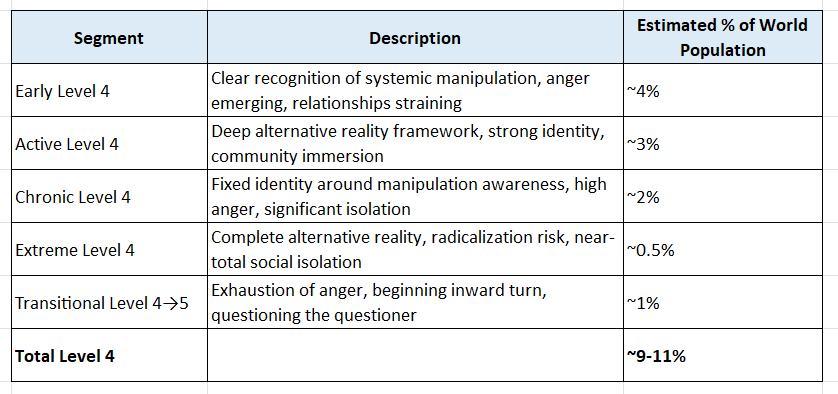
In absolute numbers: approximately 740 million to 900 million people.
With the significant qualification that Level 4 visits — temporary immersion triggered by specific events, crises, or exposures — affect a substantially larger population. Perhaps 20-25% of humanity has experienced significant Level 4 states without residing there as a dominant operating frequency.
The Single Most Important Truth About Level 4
Level 4 sees the chains.
This is not nothing. This is not paranoia. This is not pathology. Seeing the chains — the manufactured desire, the controlled attention, the managed belief, the colonized time, the engineered identity — is a genuine and important perception.
But here is what Level 4 does not yet see:
Seeing the chains is not the same as being free of them.
The person who is furious about manipulation is still being controlled by the manipulation — because their entire inner life is now organized in reaction to external forces. The anger, the vigilance, the constant orientation toward what is being done to us — this is still a form of being governed from outside.
Real freedom — the freedom that begins to appear in Level 5 — is not the freedom of knowing you are in a cage. It is the freedom of discovering that there is something in you that the cage cannot reach.
Something that was never manufactured. Never installed. Never colonized.
Something that existed before the system had access to you. Something that the most sophisticated manipulation technology ever devised has never been able to touch — because it is not made of the material that manipulation works on.
That something is what Level 5 turns toward.
And Level 4, for all its darkness — all its anger and grief and disillusionment — is the necessary fire that burns away enough of the constructed self to make that turning possible.
The manipulation was real. The response to it — the rage, the grief, the deconstruction — was necessary.
Now comes the hardest question of all.
Who is the one who was manipulated?
Not as accusation. As genuine inquiry. As the beginning of the most important investigation a human being can undertake.
That question — quiet, humble, devastatingly honest — is the door to Level 5.
Level 5 — The Inward Turn: A Complete and Exhaustive Description

What It Actually Is
Level 5 begins in the ruins of Level 4.
Not dramatic ruins. Not the cinematic collapse of a person hitting bottom in the conventional sense. Something quieter and, in many ways, more total than that. It begins in the moment when the anger — that magnificent, consuming, identity-sustaining fury of Level 4 — runs out of fuel.
Not because the manipulation stopped being real. It didn’t. Not because the injustice was resolved. It wasn’t. Not because the person was wrong about what they saw. They weren’t.
The anger simply becomes — at some point that cannot be planned or predicted — too expensive to maintain.
The body has been in a state of sustained activation for months or years. The nervous system, which was never designed for chronic vigilance, begins to show the cost. Sleep changes. Digestion changes. Relationships that survived Level 4 are threadbare. The communities that sustained the anger begin to feel like echo chambers — the same conversations, the same villains, the same righteous fury, cycling endlessly without resolution or relief.
And in the exhaustion — in the specific, bone-deep tiredness of someone who has been fighting a war for years without winning it and without being able to stop — something shifts.
Not all at once. Not dramatically. A quieting. A small, almost involuntary turning of the attention.
Away from the screen. Away from the argument. Away from the endless cataloguing of external corruption.
Inward.
Toward the one who has been watching all of this. Toward the one who has been angry, grieving, searching, questioning. Toward the awareness behind the awareness. Toward the self that has been the constant subject of every experience — the one who felt Level 2’s friction, who thought Level 3’s thoughts, who raged through Level 4 — but who has never itself been directly examined.
This turning — this single, quiet, monumental turning — is Level 5.
And nothing that came before it, for all its importance, prepared the person for what they find when they actually look.
Why The Inward Turn Is The Most Radical Act
In a culture entirely organized around the external — around production, consumption, achievement, appearance, performance, accumulation — turning inward is an act of profound and genuine radicalism.
More radical, in a sense, than anything Level 4 attempted.
Level 4’s radicalism was still playing on the system’s terrain. Still organized around the external. Still reactive. Still defined by opposition. The most radical politics, the most comprehensive deconstruction of power, the most elaborate counter-narrative — all of these remain, fundamentally, movements of attention toward the outside world.
Level 5 withdraws from that terrain entirely.
Not out of defeat. Not out of apathy. Not out of the comfortable withdrawal of Level 1. But out of the slowly dawning recognition that the territory that matters most — the territory where the real transformation must occur — is not out there.
It never was.
This is why every genuine wisdom tradition in human history — every one, without exception — has pointed in the same direction. Not toward better politics, though politics matters. Not toward better theology, though understanding matters. Not toward better science, though knowledge matters.
Inward. Always inward. First inward.
The Delphic Oracle’s command — Know Thyself — was not a suggestion for mild self-reflection. It was pointing at the most demanding and most liberating investigation available to a human being. The investigation that every other investigation, if pursued far enough and honestly enough, eventually demands.
Level 5 is where that investigation finally begins.
The Threshold Experience — How Level 5 Arrives
The Collapse of the Outward Search
Before the inward turn, there is almost always a specific experiential recognition:
The outward search has not worked.
This sounds simple. It is devastating.
The person has searched, across Levels 2, 3, and 4, for something that would resolve the fundamental restlessness that began in Level 2. They have searched in new frameworks, in alternative communities, in political activism, in spiritual materialism, in the exposure of manipulation. They have found many true things. They have found many important things.
They have not found peace.
Not the real peace. Not the deep, unshakeable, circumstance-independent peace that something in them has always known was possible. The peace that Level 2’s friction was always pointing toward, even when it couldn’t name it. The peace that was never quite available in Level 1’s comfort, never satisfied by Level 3’s knowledge, never delivered by Level 4’s righteous anger.
The recognition that this peace cannot be found outside — that no amount of information, no degree of clarity about the world’s corruption, no perfect political framework, no ideal community, no spiritual teacher, no relationship, no achievement — none of it is where it is — this recognition is the specific threshold of Level 5.
It arrives differently for different people:
For some, it arrives through suffering that exhausts all external solutions — an illness, a loss, a crisis that strips away every coping mechanism and leaves the person finally, utterly alone with themselves in a way they cannot escape.
For some, it arrives through a spontaneous moment of grace — an experience in nature, in music, in silence, in the eyes of a child, in an ordinary moment that somehow opens into something vast and still and immediately recognized as more real than anything the previous levels offered. A moment that is not understood but is unforgettable — and that makes everything that was previously consuming seem, by comparison, thin.
For some, it arrives through the right encounter at the right moment — a teacher, a book, a practice, a phrase that lands not as information but as direct recognition. Not “that is an interesting idea” but “that is true and I have always known it.”
For some, it arrives through complete breakdown — the full collapse of the identity structures built across the previous levels, leaving nothing but a naked, terrified, surprisingly open human being who has no idea who they are anymore and, in that not-knowing, stumbles into something more real than the identity that fell away.
The threshold varies. The crossing is the same. The attention turns around.
What the Attention Finds When It Turns
This is the question that Level 5 answers — not in words, not in concepts, but in direct experience.
And the answer, in whatever tradition or language it is expressed, is consistently surprising to the person who encounters it.
Because what the attention finds when it turns, expecting to locate a self — a substantial, permanent, clearly boundaried entity that has been the subject of all this experience — is not quite what was expected.
What it finds is: awareness itself.
Not a thing. Not an object. Not a content. But the space in which all contents arise — thoughts, emotions, sensations, memories, desires, fears — the clear, open, unchanging background against which all the drama of the previous levels played out.
This awareness was always there. It was present in Level 1’s comfort and Level 2’s friction and Level 3’s excitement and Level 4’s rage. It was the one constant across every experience. But the attention was always directed at the content of experience — what was being experienced — never at the experiencer itself — the awareness in which experience was occurring.
Level 5 is when the person first begins — seriously, consistently, as a practice — to look at the looker.
And what is found there defies the categories that the previous levels built.
The Dark Night of the Soul — The First Territory of Level 5
Before the opening — before the spaciousness, before the peace, before the stillness — there is almost always a passage that the mystical traditions unanimously describe and that modern psychology is only beginning to understand.
St. John of the Cross called it La Noche Oscura del Alma — the Dark Night of the Soul. Written in the 16th century, it describes with extraordinary precision an experience that is reported by contemplatives across every tradition, in every century, in languages and cultures that had no contact with each other.
It is not depression, though it resembles it. It is not breakdown, though it can look like one from outside.
It is the specific experience of the self — the constructed, conditioned, socially assembled self — beginning to dissolve. And dissolution, even of a self that was never ultimately real, is experienced from inside as death.
What Dies in the Dark Night
The spiritual ego: Level 3 and Level 4 built a new identity around questioning and seeing clearly. Level 5 begins to dismantle even this. The person who was proud of their awakening finds the awakening itself becoming unstable. The identity of the spiritual seeker — which provided meaning and direction — begins to feel like another costume. This is disorienting in a way that earlier level transitions were not, because this identity felt more real, more hard-won, more essentially true than anything that preceded it.
The salvation fantasy: Every level before Level 5 carried, in some form, a fantasy of external rescue. Level 2 hoped the right change would finally satisfy. Level 3 believed the right knowledge would free. Level 4 believed that naming and fighting the manipulation would ultimately resolve the fundamental restlessness. Level 5 systematically dissolves every version of this fantasy. Nothing out there is going to save this. Not a teacher, not a practice, not a realization, not a relationship, not a community. The salvation fantasy was always a way of deferring the actual work. And the Dark Night is when that deferral runs out.
The future self: The person who was going to be okay someday — who was going to have figured it out, healed it, transcended it — this future self, which has been the destination of so much hope and effort, begins to reveal itself as a mirage. There is only ever this. Only ever now. Only ever this person, in this moment, exactly as they are. The Dark Night is, among other things, the death of becoming in favor of being.
The familiar ground: Perhaps most disorientingly, Level 5’s Dark Night can dissolve the very ground of identity — the sense of knowing who one is, of having a stable self that persists through time, of being located in a body in a world. Experiences of depersonalization, derealization, ego dissolution — whether arising through meditation, through crisis, or spontaneously — can make the person feel that they are losing their mind when they are actually, for the first time, beginning to see through it.
The Crucial Distinction
The Dark Night of the Soul is not the same as clinical depression — though the two can co-arise and the distinction is important.
Depression is fundamentally a contraction — a closing down of possibility, a loss of energy and engagement, a narrowing of the experienced world.
The Dark Night is fundamentally an expansion that is terrifying precisely because of its vastness. It is the experience of the self becoming too small to contain what is opening. The darkness is not the darkness of meaninglessness but of meaning that has not yet found its form — of an awareness that has outgrown its previous containers but has not yet found, or recognized, its actual nature.
The person in the Dark Night often needs both: skilled psychological support for the genuine trauma and nervous system dysregulation that frequently accompanies it, and a framework that honors the genuine spiritual emergence that is occurring simultaneously. The tragedy is that most clinical frameworks can only see the first and most spiritual frameworks inadequately address the second.
The Practices of Level 5 — What the Inward Turn Actually Looks Like
Level 5 is not a passive state. It is an active reorientation of attention — a sustained, deliberate, often difficult practice of turning what was always directed outward back toward its source.
This reorientation expresses itself through a wide range of practices, all of which share the same essential structure: the disciplined redirection of attention from content to awareness, from the experienced to the experiencer, from the periphery to the center.
Meditation — In All Its Forms
Meditation is the primary technology of Level 5. Not as relaxation, not as stress management, not as productivity optimization — though it produces all of these as byproducts. But as a systematic investigation of the nature of mind and self.
The varieties of meditation that Level 5 encounters are vast, but they all point in the same direction:
Concentration practices (samatha, trataka, mantra): The disciplined focusing of attention on a single object — the breath, a sound, a flame, a phrase — for extended periods. This builds the capacity to sustain attention that is the prerequisite for deeper investigation. The undisciplined mind, which has spent decades leaping from stimulus to stimulus, must first learn to be still. This is harder than it sounds. The average person, when they first sit to meditate, discovers that their mind is like a room with fifty televisions playing simultaneously, each at full volume. The first months — sometimes the first years — of meditation practice are largely about learning to see this, to not be swept away by it, and gradually to find the stillness that exists underneath it.
Insight practices (vipassana, self-inquiry): Once some concentration is established, the investigation deepens. The meditator begins to look directly at the nature of thoughts, emotions, sensations — observing their arising, their nature, their passing. Noticing that no thought lasts. That no emotion is permanent. That no sensation is fixed. That everything in the content of experience is impermanent, changing, not ultimately what I am — because I am still here after every thought has gone, after every emotion has dissolved, after every sensation has passed. The awareness persists. The contents change. This distinction, seemingly simple, is the foundation of the deepest transformation.
Non-dual inquiry (Advaita, Dzogchen, certain Zen practices): The most direct approach. Instead of observing the contents of mind, the question is turned directly at the observer: Who is the one who is aware? Ramana Maharshi made this the centerpiece of his teaching: the question “Who am I?” — not as philosophy but as a direct pointing of attention back at itself. Not seeking a conceptual answer but resting in the inquiry itself until the nature of the questioner becomes directly apparent.
Somatic practices: Level 5 increasingly recognizes that the inward turn must include the body, not just the mind. The body is not separate from the self being investigated — it is the self’s most immediate reality. Somatic practices — body scan, somatic experiencing, yoga as genuine inner practice rather than exercise, certain forms of breathwork — turn attention to the felt sense of being in a body. This is particularly important for people who have spent decades — as most Level 3 and 4 people have — almost entirely in their heads, with the body experienced primarily as a vehicle for the mind rather than as a field of intelligence in its own right.
Contemplative prayer and sacred practice: For those who have not entirely left their religious traditions — or who have returned to them with new eyes after Levels 3 and 4’s deconstruction — the mystical dimensions of those traditions become newly accessible. Centering Prayer in the Christian tradition. Dzikr in Sufism. Hitbonenut in Kabbalah. Pure Land practice in Buddhism. The externally observed religion of Level 1 dissolves to reveal the interior practice that the tradition was always pointing toward, and that institutional religion frequently obscures. The container was flawed. What the container was carrying was real.
Shadow Work — The Most Uncomfortable Practice
If meditation is Level 5’s map of the territory, shadow work is the excavation of what the map reveals.
Carl Jung identified the shadow as the sum of everything in the personality that has been rejected, denied, suppressed, and projected outward — everything that doesn’t fit the image of the self that was constructed in Level 1 and defended through Levels 2, 3, and 4.
The shadow contains:
The emotions that were not safe to feel — rage, terror, shame, grief, envy
The impulses that were not permitted — sexuality, aggression, wildness, dependency
The capacities that were punished or ridiculed — creativity, vulnerability, sensitivity, difference
The wounds that were never healed — childhood trauma, developmental injuries, relational damage
The parts of self that were sacrificed to gain belonging — authenticity traded for approval
Everything that was not allowed to exist in the light of conscious identity went underground — not away, but underground. And from underground, the shadow shapes behavior, relationships, and perception in ways that are completely invisible to the conscious self.
Level 4’s anger, for example, is frequently partly authentic political response to real injustice and partly the shadow’s rage — accumulated hurt and helplessness from a lifetime finding a socially legitimized outlet in political fury. The shadow is clever. It uses real injustice to express personal wounds it would not otherwise be permitted to express.
Shadow work is the direct, difficult, non-negotiable practice of retrieving what was buried alive.
This is not comfortable. It was buried for reasons. The suppression of the shadow is not weakness — it was survival. For a child who depended on belonging to their family and their community, bringing their full nature was not always safe. The shadow is the repository of everything that was too real, too raw, too much, too different for the environment into which the person was born.
At Level 5, the buried material begins to resurface whether the person invites it or not. Dreams become more vivid and more strange. Emotional reactions become disproportionate to their triggers — because the trigger is small but the reservoir behind it is enormous. Relationships activate old patterns with sudden, alarming intensity.
Shadow work practices include:
Jungian analysis and depth psychotherapy: The long, patient, careful process of building a relationship with the unconscious material through dreams, active imagination, and the relationship with the therapist as a field in which the shadow can be safely met.
IFS — Internal Family Systems: Richard Schwartz’s model, which works with the personality as a system of parts — exiles carrying old wounds, managers trying to keep the exiles contained, firefighters who act out when the managers fail. This model has extraordinary resonance with Level 5 because it provides a map for the complex, multi-voiced inner landscape that meditation begins to reveal.
EMDR and somatic therapies: For trauma specifically — the actual neurological encoding of overwhelm in the nervous system that no amount of insight alone can fully address. Level 5 increasingly recognizes that genuine healing requires working with the nervous system directly, not just the mind.
Breathwork: Holotropic, transformational, or somatic breathwork can access material that ordinary therapeutic conversation cannot reach — not because it is mystical but because altered states produced by breathing can temporarily suspend the ego’s defenses enough for buried material to surface and be metabolized.
Authentic movement and expressive arts: The body holds what the mind cannot hold consciously. Movement, drawing, sound-making, and other non-verbal forms can give expression to the shadow material in ways that bypass the mind’s tendency to immediately categorize, explain, and re-suppress what arises.
Solitude — The Prerequisite
All of Level 5’s practices require, to varying degrees, solitude. Not isolation. Not the withdrawal of depression. But the deliberate, chosen, regularly practiced turning away from external stimulation to create the conditions in which the inner life can be heard.
This is more radical than it sounds in a culture that has systematically eliminated solitude.
The smartphone ended the last refuges of involuntary solitude — the commute, the waiting room, the quiet before sleep, the moment of waking. Every previously unoccupied moment is now a potential consumption event. The economy of attention has colonized the interstices of daily life with a thoroughness that would have seemed dystopian to previous generations.
Level 5 requires actively reclaiming these spaces. Not as self-help optimization but as the basic condition for self-knowledge. You cannot know yourself while you are constantly performing yourself for an audience, even an imaginary one.
Extended solitude — retreats, periods of silence, time in nature without devices — is Level 5’s most powerful and most consistently underutilized practice. Not because talking to others has no value. But because the deepest material does not surface in social performance. It surfaces in the spaces between.
Nature — The Mirror That Doesn’t Flatter
Level 5 consistently returns people to nature with a quality of attention that was not available in the previous levels.
In Level 1, nature was scenery or recreation. In Level 3, nature might have been a political cause. In Level 4, it might have been evidence of what the system is destroying.
In Level 5, nature becomes something different: a direct encounter with reality that is not mediated by language, concept, narrative, or social construction.
A forest does not care about your politics. A river does not know your grievances. A mountain does not confirm your identity or challenge your narrative. They simply are — fully, completely, without apology, without agenda.
And in the encounter with this simple, complete isness — something in the person that has been performing, arguing, defending, constructing, for as long as they can remember — rests.
This rest is not nothing. It is the first taste of the Level 5 recognition: that beneath all the content, beneath all the constructed identity, beneath all the searching of the previous levels — there is something that is already complete. Something that does not need to win an argument or heal a wound or find the answer.
Something that simply is — as the forest simply is — without needing to be anything other than what it is.
Reading and Study — But Differently
Level 5 does not abandon intellectual engagement. But its relationship to knowledge changes fundamentally.
In Level 3, reading was about accumulating information — building the case, expanding the framework, adding to the architecture of understanding.
In Level 5, reading becomes recognition — the encounter with words that point at what is already directly known but has not yet been named. The experience of reading a contemplative text and feeling not “this is interesting” but “this is true and I know it in my body.”
The texts that resonate at Level 5 are different from Level 3’s library. They tend to be:
Primary mystical literature: Meister Eckhart’s sermons. The Upanishads. The Tao Te Ching. Rumi’s Masnavi. The Cloud of Unknowing. Ramana Maharshi’s talks. The collected sayings of the Desert Fathers. Not commentaries on these. The things themselves — written by people who were pointing not at concepts but at direct experience, and whose language therefore carries a quality that can only be recognized by someone ready to receive it.
Contemplative psychology: James Finley, Thomas Merton, Bernadette Roberts, Cynthia Bourgeault in the Christian tradition. Chogyam Trungpa, Pema Chodron, Tara Brach in the Buddhist. Sri Nisargadatta Maharaj, Rupert Spira, Francis Lucille in the non-dual tradition. These writers are doing something different from Level 3’s analysts and Level 4’s investigators — they are transmitting rather than merely informing.
Depth psychology: The later Jung, who himself made the inward turn with extraordinary depth and mapped the territory with extraordinary courage. Marion Woodman. James Hillman. The post-Jungians who understood that the psyche is not just a management problem to be solved but a mystery to be inhabited.
Embodied neuroscience: Van der Kolk’s “The Body Keeps the Score.” Peter Levine’s work on somatic experiencing. Stephen Porges’ polyvagal theory. The science that validates what contemplatives have always known — that the body is not a vehicle for the mind but a field of intelligence in its own right, and that healing must pass through it.
The Discoveries of Level 5 — What Is Actually Found
The Watcher
The first major discovery of Level 5 is the recognition of what might be called the watcher — the awareness that is present for every experience but is not itself any experience.
In ordinary life, attention moves like a spotlight — illuminating thoughts, emotions, sensations, one after another, while the spotlight itself remains invisible. The content of the spotlight is taken to be the self. “I am angry.” “I am anxious.” “I am happy.” “I am tired.”
Level 5’s meditation reveals something different: that you are not the anger. You are the awareness in which the anger arises. The anger comes. It is real. It is felt. And it passes. And you — the awareness — remain, unchanged by its passage, as a sky is unchanged by the clouds that move through it.
This is not a concept at Level 5. It is direct experience. The meditator who sits long enough and consistently enough begins to notice this not as a philosophy but as an observable fact of their own experience. Thoughts arise and pass. Emotions arise and pass. Sensations arise and pass. Awareness persists.
This is the beginning of the most radical freedom available to a human being — not the freedom from difficult experience, but the freedom of recognizing that what you actually are cannot be damaged by any experience, because what you are is not the experience but the awareness in which experience occurs.
The Constructed Self
The second major discovery is the recognition — again, not theoretical but direct — of how thoroughly the self as normally experienced is a construction.
Meditation reveals the self not as a solid, substantial entity but as a process — a continuous activity of thought, memory, story, and social performance that creates the appearance of a unified, continuous self from moment to moment.
The self is not discovered. It is generated. Continuously. Through the repetition of familiar thoughts, familiar emotional patterns, familiar stories about who I am and what happened to me and what things mean.
This recognition is initially destabilizing — because the self being recognized as a construction is the self that has been taken to be most real. But it becomes, with time and integration, one of the most liberating discoveries a human being can make. Because if the self is a construction, it can be reconstructed. The stories can be revised. The patterns can be changed. The identity that was assembled from the materials of Level 1’s environment — and defended through all the subsequent levels — can be consciously, carefully, with great tenderness and patience, disassembled and reassembled on more honest foundations.
The Body as Field of Intelligence
Level 5 discovers the body — often for the first time, despite having lived in it for decades.
Most people in the previous levels relate to their body primarily as a vehicle for the mind’s projects — something to be fed, exercised, medicated, and otherwise maintained well enough to support the mental and social activities that constitute “real” life.
Level 5 reveals the body as a field of intelligence — a vast, intricate, responsive system that processes information, stores history, generates wisdom, and communicates constantly through the medium of felt sense.
The body holds the history that the mind has defended against. Every trauma — every overwhelm that was too large to be processed consciously at the time of occurrence — is held in the body’s tissue, in the nervous system’s patterns of activation and inhibition, in the posture, the breath, the chronic tensions and chronic numbnesses of the physical form.
Level 5’s somatic practices — and the somatic dimensions of even primarily mental practices like meditation — begin the process of reading and releasing what the body is holding. This process, when it occurs, is one of the most profound healings available to human beings — because it addresses not the narrative about the wound but the wound itself, held at the level where it actually lives.
Impermanence — Not as Concept but as Liberation
Buddhism makes impermanence — anicca — one of its three fundamental characteristics of existence. Everything arises and passes. Nothing lasts. Everything changes.
As a concept, at Level 3, this might seem depressing or obvious. As a directly experienced reality at Level 5, it is one of the most liberating recognitions available.
Because if everything passes — every thought, every emotion, every state, every circumstance — then nothing needs to be clung to and nothing needs to be escaped. The good state will pass. But so will the bad state. The painful feeling will not last forever. But neither will the pleasant one. Everything is movement, flow, change — and resistance to this movement, the attempt to fix what is fluid, to grasp what is passing, to escape what is arising — is the source of most human suffering.
Level 5 begins to soften this resistance. Not through acceptance as a performance, not through toxic positivity — but through the direct recognition that what is happening is happening, and that fighting the fact of its happening adds a second layer of suffering to the first.
The rain is falling. Fighting the rain — resenting it, arguing against it, demanding that it stop — does not stop the rain. It only adds the suffering of resistance to the discomfort of wetness.
Level 5 is learning, slowly, imperfectly, repeatedly, to get wet without the added suffering of wishing it were otherwise.
The Interconnection
One of the most consistent discoveries of Level 5 — reported across traditions, cultures, and centuries — is what might be called the direct perception of interconnection.
Not interconnection as an ecological concept, not as a political value, not as a spiritual belief — but as a directly perceived feature of reality. The sense — sometimes fleeting, sometimes sustained — that the boundaries between self and world, between self and other, between self and life itself, are less absolute than ordinary experience suggests.
This ranges from subtle — a quality of aliveness and presence in the world that was not previously available, a sense of belonging that is not dependent on social approval — to the more dramatic experiences of mystical union reported in every tradition and in modern psychedelic research.
The scientific correlate is emerging slowly but consistently. Neuroscience has identified the default mode network — the brain’s self-referential activity, the constant inner monologue of “I” — as the primary neural correlate of the separate self-sense. Advanced meditators consistently show reduced default mode network activity, correlated with reduced self-referential thought and increased experienced interconnection. This is not mysticism in the pejorative sense. It is measurable, reproducible neuroscience pointing in the direction that contemplatives have been pointing for millennia.
The Emotional Landscape of Level 5
The emotional quality of Level 5 is unlike any of the previous levels. It is not uniformly pleasant — it contains the Dark Night, contains genuine grief, contains the discomfort of meeting what was previously avoided. But it has a different texture from the emotions of earlier levels.
Less reactive: The emotional storms of Levels 2, 3, and 4 — the existential dread, the intellectual excitement, the sustained fury — begin to be replaced by responses that are shorter in duration, less totalizing, less identified with. Emotions are felt more fully — because there is now room for them, because the practice has built the capacity to be with experience rather than immediately reacting to it — and they pass more cleanly.
More intimate: Paradoxically, Level 5’s practice of stepping back from identification with emotions makes the emotions themselves more available, not less. What was previously defended against — the grief, the fear, the longing, the tenderness — can now be felt, because there is sufficient inner space to hold it without being overwhelmed by it.
A quiet joy that doesn’t need a reason: This is perhaps the most surprising discovery of early Level 5. Beneath the turbulence of the Dark Night, beneath the work of shadow integration, beneath the difficulty of sitting in silence with what has always been avoided — there is a quiet aliveness that does not depend on circumstances. Not happiness in the ordinary sense. Not the absence of difficulty. But a quality of okayness at the deepest level — a sense that at the very bottom of experience, before the content begins, there is something that is fundamentally all right.
This is not manufactured. It is not a belief. It is what begins to be found when the attention turns inward and stays there long enough.
Level 5 and Relationships — A Radical Change
Level 5 transforms relationships more fundamentally, and more positively, than any previous level.
In Level 1, relationships were primarily functional — providers of belonging, validation, companionship, and the social mirror that maintained the Level 1 identity.
In Level 2, relationships were strained by unnamed need — the person reaching through them for the satisfaction they couldn’t quite provide.
In Level 3, relationships were intellectual — valuable to the degree they shared the person’s expanding frameworks.
In Level 4, relationships were exhausted by the anger and the isolation that comes from a worldview that positions the person against the system in which most of their relationships are embedded.
In Level 5, relationships undergo a transformation:
Less need, more love: As the Level 5 person begins to find the inner resources they had always sought externally, their relationships become less driven by need. And paradoxically — this is one of the great paradoxes of the inward turn — less needy relationships are more loving. Because love that is not driven by need is actually free. Free to see the other person as they actually are, rather than as the person who should be filling a particular role in the Level 1-4 story.
The capacity for genuine presence: Meditation and somatic practices develop the capacity to be fully present — to listen without planning the response, to be with another person’s experience without immediately trying to fix, redirect, or relate it to oneself. This quality of presence is perhaps the most valuable gift the Level 5 person can offer to their relationships. And it is, quite precisely, what the previous levels’ preoccupations with self — the Level 1 role, the Level 2 wound, the Level 3 framework, the Level 4 anger — prevented.
The meeting of shadow in relationship: Level 5’s shadow work does not happen only in solitude. It happens most intensively in relationship — because relationships are the primary mirror in which the shadow is reflected. The person who infuriates you most reliably is carrying something that you carry yourself and cannot see. Level 5 learns to use this not as evidence of the other person’s inadequacy but as information about what remains unintegrated within.
Boundaries from values, not fear: Earlier levels either had no real boundaries (Level 1 — boundaries were whatever the social role required) or had boundaries that were primarily reactive and defensive (Level 4 — the wall of the one who has been betrayed enough). Level 5 begins to discover boundaries that arise from genuine values, genuine self-knowledge, genuine care for the self and the other — not from fear or from performance.
The Spiritual Traditions and Level 5 — Recognition and Caution
What The Traditions Offer
Level 5 is the level at which the great wisdom traditions of humanity become genuinely relevant — not as belief systems, not as communities of belonging, not as frameworks for Level 3 intellectual deconstruction — but as maps of territory the person is actually beginning to travel.
The Buddhist understanding of the nature of mind. The Advaitic recognition of the Self as awareness itself. The Christian mystical tradition of contemplative prayer and the dark night. The Sufi path of the heart. The Jewish tradition of devekut — cleaving to the divine. The Taoist practice of wu wei — effortless alignment with the natural flow of things. The indigenous understanding of the self as embedded in and continuous with the living world.
These are not equivalent in their methods, their metaphysics, or their cultural expressions. But they are pointing, with remarkable consistency, at the same territory. The territory that Level 5 is beginning to enter.
The Dangers of the Spiritual Marketplace
Level 5, however, is also the level at which the spiritual marketplace becomes most dangerous. Because now the person is genuinely hungry — not for intellectual frameworks (Level 3’s hunger) or for validation of their political perceptions (Level 4’s hunger) but for genuine transformation. And genuine hunger makes genuine gullibility possible.
The spiritual marketplace is vast, growing, and poorly regulated. Within it are:
Genuine teachers with real depth, real transmission, real ability to guide
Well-intentioned teachers who have had genuine experiences but are not equipped to guide others through different experiences
Spiritually bypassing teachers who use the language of awakening to avoid their own shadow — and who systematically select students who will confirm their narcissism
Outright predatory teachers and organizations who have identified spiritual seeking as a highly effective vulnerability to exploit
The person at Level 5 needs discernment tools that Level 5 is only beginning to develop. The primary tool, paradoxically, is not more discernment of the external teacher but more honesty about the internal student. The question is not only “is this teacher trustworthy?” but “why am I drawn to this teacher? What need am I bringing? What am I hoping they will give me that I am not yet willing to find for myself?”
Spiritual bypassing — the use of spiritual practice to avoid rather than to meet what needs to be met — is one of the most common and most seductive traps at Level 5. It is the use of meditation to float above difficult emotions rather than to be with them. The use of non-dual philosophy to declare oneself already enlightened and therefore exempt from the difficult work of shadow integration. The use of community and ritual to replicate the belonging of Level 1 without doing the individual work of genuine transformation.
The test — imperfect but useful — is always the same: Is my practice making me more genuinely present, more humble, more honest, more available to real relationship? Or is it making me more comfortable, more special, more certain, more elevated above ordinary human difficulty?
The first is practice. The second is sophisticated avoidance.
Level 5 and the Body — The Deepest Meeting
One of Level 5’s most radical discoveries — particularly for people who have spent the previous levels primarily in their minds — is the recognition that the body is not in consciousness. Consciousness is in the body. Or rather — consciousness is embodied, and embodiment is not a limitation but a gift.
The Level 3 intellectual and the Level 4 activist both lived primarily from the neck up. The body was important insofar as it needed maintenance and insofar as its health or illness affected the mind’s functioning. But it was not the site of wisdom. It was not the place to look for answers.
Level 5 discovers differently.
The body knows things the mind will not face. It holds the truth of every experience that was too much to be consciously processed. It generates a felt sense of rightness and wrongness that is more reliable than intellectual analysis — when it is listened to, when the mind is quiet enough for its communication to be received.
The body’s hunger — not for food but for genuine nourishment, for touch, for rest, for movement that is pleasurable rather than compulsive, for time in environments that feel alive rather than artificial — is the most direct available signal of what the self actually needs. Before the ego’s story about what it should need. Before the social performance of need. Before the Level 1-4 suppression of need in favor of productivity and performance.
Level 5 begins, slowly, to listen. To slow down enough for the body’s slower, quieter, more honest communication to be received. And to respond — to actually give the body what it is asking for, which is almost never what advertising suggested it was, and is almost always simpler, quieter, and more deeply satisfying than the external solutions previously applied.
What Level 5 Looks Like in Ordinary Life
Level 5 is not a monastery. It is not a permanent retreat. It is not a withdrawal from life. In fact, one of its central teachings — arrived at through direct experience rather than philosophy — is that the ordinary is the extraordinary. That the sacred is not separate from the mundane. That enlightenment, if such a thing exists, must be available in the washing of dishes and the driving of cars and the difficulty of difficult relationships — or it is not available at all.
The person at Level 5, in their daily life:
Wakes differently. Before reaching for the phone — which may still happen, but is increasingly noticed when it does — there are sometimes moments of simple presence. Of awareness before the day’s content loads. These moments, which are tiny, are actually vast. They are the beginning of the practice of recognizing awareness itself, present before the construction of the day’s identity begins.
Relates to work differently. Not necessarily in a different job — though that sometimes follows — but with different interiority. Less driven by the need to prove or to produce a self through achievement. More capable of genuine engagement with the work itself, with the people encountered in it, with the moment-to-moment reality of it rather than its function as a vehicle for identity.
Consumes differently. The Level 1 consumption that was managed rather than reduced in Levels 2-4 begins to genuinely lose its appeal. Not because the person has decided it is wrong — that was Level 4’s moralistic relationship to consumption. But because the inner life is becoming sufficiently rich that the external substitutes become transparently inadequate. The need for stimulation decreases as the capacity for presence increases. What remains is use rather than compulsion — genuine enjoyment without the desperate edge of someone trying to fill a hole.
Sits in difficulty differently. The difficult conversation, the painful feeling, the unwanted circumstance — the Level 5 person’s relationship to these changes not because they become easier but because the relationship to difficulty itself changes. There is increasing capacity to be with what is — not to like it necessarily, not to pretend it is other than it is — but to meet it without the additional suffering of resistance, of demanding that reality be different from what it currently is.
Practices. Some form of regular practice — meditation, somatic work, journaling, time in nature, contemplative movement, regular therapy or spiritual direction — becomes as ordinary and as necessary as eating. Not as self-improvement. Not as the achievement of a future state. As the basic maintenance of the inward orientation that Level 5 requires.
Quantifying Level 5 — The Global Picture
Level 5 is the first level where quantification becomes genuinely difficult — not because data is unavailable, but because Level 5’s expression is highly individual, often invisible from the outside, and not reliably captured by the behavioral markers available for earlier levels.
The Data
Meditation practice: The Global Wellness Institute estimates that 500 million people worldwide practice some form of meditation regularly. However, regular meditation practice spans a wide range — from Level 3’s intellectual interest and Level 4’s stress management to Level 5’s genuine inward investigation. Adjusting for this, genuine Level 5 meditation practice probably characterizes a fraction of this number.
Therapy and depth psychology: Approximately 100 million people worldwide are in some form of psychotherapy at any given time, with the number growing significantly year over year. Again, therapy spans many levels and purposes — but depth-oriented work that genuinely engages with shadow, with the constructed self, with the underlying structures of identity, is characteristic of Level 5.
Contemplative communities: The world’s contemplative monastic communities — across Christian, Buddhist, Hindu, Sufi, Jewish and other traditions — house several hundred thousand people in full-time inward practice. These represent the most concentrated Level 5 populations on earth.
The “nones” who practice: A significant and growing subset of the religiously unaffiliated — perhaps 15-20% of the “nones” — engage in regular contemplative practice outside of traditional religious structures. In the United States alone, this represents tens of millions of people.
Post-traumatic growth: Research consistently shows that approximately 50-70% of trauma survivors report experiencing meaningful positive psychological change as a result of their experience — what researchers call post-traumatic growth. Not all of this represents Level 5 development, but the correlation between confrontation with mortality or suffering and genuine inward turning is well-documented.
Psychedelic renaissance: The ongoing research renaissance in therapeutic psychedelics — psilocybin, MDMA, ketamine — is producing documented, measurable, lasting increases in what researchers call “mystical experience,” “ego dissolution,” and “increased connection.” These are Level 5 experiences produced through pharmacological rather than purely contemplative means. An estimated 30-40 million Americans have used psychedelics, with a significant proportion reporting lasting perspective shifts consistent with Level 5.
The Percentage Estimate
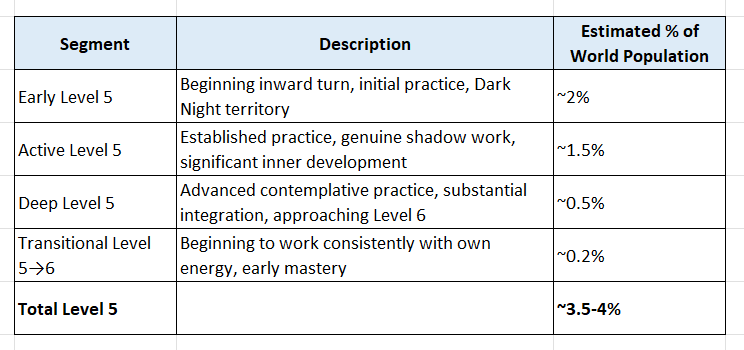
In absolute numbers: approximately 280 to 330 million people.
With the critical qualification that this is the most fluid and least visible of all the levels. Many people visit Level 5 — through meditation retreats, through grief processes, through illness or loss, through psychedelic experiences — without residing there as a sustained orientation. The transient Level 5 population is probably three to four times the resident population.
The Single Most Important Truth About Level 5
Every previous level was organized, in some fundamental way, around escaping.
Level 1 escaped the anxiety of freedom through the comfort of structure. Level 2 was the first crack in that escape — the friction that couldn’t quite be escaped. Level 3 escaped the discomfort of uncertainty through the comfort of new knowledge. Level 4 escaped the complexity of inner work through the righteous clarity of external opposition.
Level 5 stops escaping.
Not through willpower. Not through philosophy. Not through deciding that escape is wrong. But through the exhaustion of all the escape routes — through having followed each one to its end and found that none of them led to what was always being sought.
And what remains when the escaping stops?
This.
Just this. This moment. This breath. This awareness. This body, sitting, breathing, alive.
Not special. Not enlightened. Not finished. Not resolved. Not arrived at any destination that deserves a name.
Just here. For possibly the first time.
And in that here-ness — in the simple, radical, profoundly ordinary fact of being fully present in one’s own experience for even a single moment without immediately fleeing it — something is recognized.
Something that was always already the case. Something that none of the previous levels’ noise and movement and construction and deconstruction could produce — because it was never absent. It was only unnoticed.
Something that does not need to be created.
Something that does not need to be protected.
Something that cannot be manipulated, because it is prior to the self that manipulation works on.
Something that was there in Level 1’s comfort and Level 2’s pain and Level 3’s excitement and Level 4’s fury — unchanged, unchanged, unchanged.
The awareness that you are.
Not a concept. Not a belief. Not a philosophy.
The simple, immediate, obvious, endlessly overlooked fact of being aware.
That recognition — quiet, unspectacular, and more profound than anything the previous levels offered — is where Level 5 points.
And it is the foundation on which everything that follows — the energy mastery of Level 6, the unconditional gratitude of Level 7 — is built.
Not by adding anything.
By finally, fully, arriving at what was always already here.
Level 6 — Mastery of Personal Energy: A Complete and Exhaustive Description
What It Actually Is
Level 6 does not arrive like the previous levels arrived.
It does not arrive as friction, like Level 2. It does not arrive as excitement, like Level 3. It does not arrive as shock, like Level 4. It does not arrive as collapse, like Level 5.
Level 6 arrives as something so quiet, so undramatic, so ordinary in its initial appearance that many people who are living it do not immediately recognize it as anything remarkable at all.
It arrives as competence.
A specific, unprecedented, deeply strange competence. The competence of a person who has spent years — in most cases, many years — turning the attention inward, meeting what was there, integrating what was found, and slowly, imperfectly, with many reversals and many recommencements, building an actual working relationship with their own inner life.
Not a philosophy about inner life. Not a belief system about inner life. Not a spiritual identity constructed around inner life.
A working relationship. Practical. Lived. Tested in ordinary circumstances. Tested in difficulty. Tested in failure. Tested in the small, unglamorous, daily moments where transformation either is real or reveals itself as performance.
The Level 6 person has discovered something through this long, interior apprenticeship that cannot be taught in a classroom and cannot be communicated adequately in language:
That they are not at the mercy of their inner weather.
That thoughts, emotions, impulses, reactions — the entire inner climate that the Level 1 person was entirely subject to, that the Level 2 person was confused and frightened by, that the Level 3 person intellectualized about, that the Level 4 person was consumed by, that the Level 5 person began to observe — can be known, can be worked with, can be directed.
Not controlled in the rigid, suppressive sense of Level 1’s unconscious management. Not transcended in the spiritually bypassing sense of pretending they aren’t there. But consciously engaged — met with clarity, understood in their nature, worked with skillfully, and directed in alignment with what is most genuinely valued.
This is energy mastery. And it is as different from what came before it as the ability to play a musical instrument is different from reading about music.
The Fundamental Discovery — What Energy Actually Is
Before going further, the word energy requires precision. Because it is one of the most used and most misused words in the spiritual and self-development vocabulary — deployed loosely enough that it has become nearly meaningless in many contexts.
At Level 6, energy is not:
A mystical substance that some people have more of than others
Something that can be measured by machines that science hasn’t yet invented
The property of crystals or chakra jewelry or certain foods
A feeling of enthusiasm or vitality, though it correlates with both
At Level 6, energy is understood — through direct experience rather than theory — as something specific and precise:
Energy is attention, and where attention goes, reality follows.
This is not metaphor. It is the most practically consequential discovery a human being can make.
Every thought directs a certain quality and quantity of attention. Every emotional state concentrates attention in a particular domain and filters out the rest. Every belief — conscious or unconscious — shapes what the attention can and cannot see. Every habit is a grooved channel through which attention flows automatically, without choice.
The person at Level 1 has virtually no relationship with their own attention. It is entirely reactive — captured by whatever is loudest, brightest, most emotionally activating in the environment. The attention goes where it is pulled, not where it is chosen. This is not weakness. It is the default condition of a human nervous system that was never taught otherwise.
Level 5’s inward turn begins the long, patient process of recovering relationship with attention. Learning to notice where it goes. Learning to return it when it wanders. Learning to rest it in awareness itself rather than always attaching it to content.
Level 6 is what this practice, taken seriously over sustained time, produces:
A person who — not perfectly, not always, not in every circumstance — but meaningfully and consistently can choose where their attention goes. Can notice when it has been captured and return it consciously. Can direct it toward what matters rather than simply following where it is pulled.
And because attention is the fundamental creative force of subjective reality — because what you attend to is what you experience, what you experience is what shapes you, and what shapes you is what you become — this capacity is not merely psychological.
It is genuinely, practically, measurably transformative.
The Architecture of Personal Energy — What Level 6 Works With
Level 6’s mastery is not a single skill. It is a constellation of related capacities — each developed through practice, each interdependent with the others, collectively constituting what might be called the fully inhabited self.
1. The Mastery of Attention
This is the foundation. Every other capacity of Level 6 rests on this.
The person at Level 6 has developed — through years of meditation, somatic practice, and the daily application of these to ordinary life — the capacity to work with attention as a skilled craftsperson works with their primary tool.
This means:
Sustaining attention voluntarily: The ability to keep attention on a chosen object — a task, a conversation, a feeling, a practice — without being captured by every passing stimulus. This is increasingly rare in the attention economy and increasingly valuable precisely because of its rarity. The Level 6 person in a conversation is actually there — not performing presence while internally scrolling through thoughts and judgments, but genuinely meeting the other person, listening with the kind of full attention that most people only receive a few times in their lives and find immediately extraordinary.
Redirecting attention consciously: When attention is captured — by a fear thought, a resentment, a craving, an anxious loop — the Level 6 person notices this with minimal delay and can return the attention to where it was chosen to be. The return is not always immediate. It is not always easy. But it is available. The crucial difference from the previous levels is not that attention never wanders — it always does — but that the wandering is noticed and the return is chosen rather than the wandering simply continuing indefinitely without awareness.
Resting attention in openness: Perhaps the most sophisticated attentional capacity — the ability to rest the attention in open, non-grasping awareness. Not focusing on any particular object, not analyzing or planning or reviewing, but simply being present, receptive, clear. This state — which meditators call effortless presence and which athletes sometimes call the zone — is the natural expression of an attention that has been trained not to always be doing something. It is the fertile ground from which the most creative, the most intuitive, the most genuinely responsive action arises.
Choosing the quality of attention: Level 6 discovers that attention is not merely a searchlight that either falls on something or doesn’t. It has qualities — warm or cool, soft or hard, open or narrow, curious or judgmental. And these qualities are not fixed. They can be developed, shifted, chosen. The attention brought to a difficult conversation changes the conversation. The attention brought to one’s own emotions changes the emotions. The quality of presence brought to any moment changes the moment — and changes the self who inhabits it.
2. The Mastery of Thought
Level 5 began to observe the nature of thought — to notice that thoughts arise and pass, that they are not the self, that the awareness in which they occur is more fundamental than their content.
Level 6 takes this further into active, skilled relationship with thought patterns.
Not control of thought in the suppressive sense — the attempt to think only positive thoughts, to eliminate negative ones, to maintain a performance of inner sunshine. That is Level 1’s unconscious suppression in spiritual clothing.
Level 6’s relationship with thought is more sophisticated and more honest:
Recognizing thought patterns: The Level 6 person has spent enough time in careful self-observation to know their characteristic mental habits. The specific flavor of their anxiety thoughts. The particular narrative their depression runs. The specific quality of their grandiose thoughts, their shame thoughts, their resentment thoughts. These are recognized not as ultimate truths about reality but as habitual patterns — grooves worn into the mind by repetition, conditioned responses to particular stimuli, the mental equivalent of postural habits.
Identifying the beliefs underneath: Every recurring thought pattern is the surface expression of a deeper belief — usually acquired before the age of seven, usually in response to relational environment, usually operating entirely below conscious awareness. “I am not enough.” “The world is not safe.” “Love requires performance.” “I must not need.” “Anger is dangerous.” “Success will solve it.” These beliefs are the operating system on which the thought patterns run. Level 6 has done enough work — in therapy, in meditation, in honest self-inquiry — to identify the key beliefs and to hold them not as facts but as inherited hypotheses about reality that can be examined, tested, and gradually revised.
Working with the narrative self: The human mind constructs a continuous narrative of selfhood — a story of who I am, what happened to me, what it means, what I can expect. This narrative is not merely descriptive. It is generative — it creates the reality it appears to merely describe. The person whose story is “I am someone who never gets what they truly want” lives differently, makes different choices, and encounters different responses than the person whose story is “I am someone whose deepest needs are fundamentally meetable.” Level 6 is not naive about this — it does not pretend that positive affirmations change reality, or that trauma can be thought away. But it works carefully, slowly, and in conjunction with genuine healing practices, to revise the narrative where the narrative is demonstrably false — where it is the echo of an old wound rather than an accurate reading of present reality.
Choosing thought direction: The Level 6 person has developed the capacity to notice when thought is running in an unproductive direction — the anxious future-projection loop, the resentful past-review loop, the comparison-and-shame loop — and to redirect it. Not through suppression. Not through forced positivity. Through the genuinely difficult, genuinely learnable skill of returning attention to what is actually present rather than following thought into the stories it generates about what is absent, what was lost, what might go wrong.
3. The Mastery of Emotional Energy
This is the territory where Level 6 is most frequently misunderstood — from both sides.
From one side, emotional mastery is misunderstood as emotional control — the suppression, management, or transcendence of emotion. The stoic who feels nothing. The spiritual practitioner who has moved beyond the messiness of human emotional life. The professional who is always composed. This is not Level 6. This is Level 1’s unconscious suppression given a sophisticated justification.
From the other side, emotional mastery is misunderstood as emotional indulgence — the full, unconstrained expression of every feeling, the therapeutic culture of having and expressing and processing every emotional state as an end in itself.
Level 6’s actual relationship with emotion is more precise and more demanding than either of these:
Full feeling without identification: The Level 6 person feels emotions fully — more fully, in fact, than most Level 1 people, because the practiced inwardness of Level 5 has dissolved many of the defenses against feeling. But the feeling occurs within a spaciousness of awareness that allows it to be felt without being become. The anger is felt — in the body, as energy, as information — without the person becoming anger, without the anger taking over the decision-making capacity, without the story the anger tells becoming the only story available.
This is the distinction the Buddhist teacher Ajahn Chah pointed at with characteristic simplicity: “If you let go a little, you will have a little peace. If you let go a lot, you will have a lot of peace. If you let go completely, you will have complete peace.” Not the peace of emotional absence. The peace of emotional presence without grasping.
Reading emotional information accurately: Emotions are not merely experiences to be managed. They are information — the body-mind system’s continuous evaluation of what is happening and how it relates to what matters. Fear says: something important may be at risk. Anger says: something has been violated. Sadness says: something has been lost. Joy says: something aligned with your deepest nature is present. Guilt says: you have acted against your own values. Shame says: you have experienced rejection or the threat of it.
Level 6 has learned to read this information accurately — which requires distinguishing between emotions that are responses to present reality and emotions that are echoes of past experience being triggered by present stimuli. The fear that is genuinely appropriate to an actual present danger is different from the fear that is a learned response to anything that resembles a past trauma. The anger that is a genuine response to actual present violation is different from the anger that is the Level 4 reservoir looking for an outlet. Level 6 can make this distinction — not perfectly, not always in the moment, but with increasing reliability.
Using emotional energy as fuel: Perhaps the most sophisticated aspect of emotional mastery — the transmutation of emotional energy from a reactive force into a directed one. The creative person who has learned to use grief as the fuel for art. The activist who has learned to use righteous anger as energy for sustained, strategic action rather than consuming rage. The leader who has learned to use the energy of fear — their own and their team’s — as clarifying information rather than paralysis. The parent who has learned to use the energy of love — which is vast and overwhelming — as the power source for genuine presence rather than anxious over-protection.
This transmutation is not metaphorical. Emotion is physiological — it is energy in the body, activation of the nervous system, hormonal state, muscular tension or release. The question is not whether to have it but what to do with it once it arises. Level 6 has developed options that the previous levels did not have.
Emotional regulation without suppression: The nervous system, when regulated — when the polyvagal system is operating in its ventral vagal, social engagement mode — has access to the full range of human capacities: creativity, empathy, complex reasoning, genuine presence. When dysregulated — when the nervous system is in sympathetic activation (fight/flight) or dorsal vagal shutdown (freeze/collapse) — these capacities are reduced or unavailable.
Level 6 has developed a sophisticated, practical, embodied toolkit for returning the nervous system to regulation when it has been dysregulated. Not by suppressing the emotion that triggered dysregulation. By working with the body directly — through breath, through movement, through orienting to the environment, through co-regulation with a trusted other, through the somatic practices developed in Level 5 — to return the physiology to the state in which full human capacity is available.
This is not mystical. It is neuroscience. And it is one of the most practically valuable capacities a human being can develop.
4. The Mastery of the Body as Energy System
Level 5 discovered the body. Level 6 develops a working relationship with it.
The body at Level 6 is understood as the primary energy system — not metaphorically but functionally. The body is where all experience is ultimately registered. The body is where all energy is ultimately processed. The body is the medium through which attention moves, through which emotion flows, through which the quality of presence is expressed.
Somatic intelligence: Level 6 has developed the capacity to read the body’s signals with precision and to trust what is found. The felt sense of rightness or wrongness that arises in the belly before the mind has formed a judgment. The tension in the shoulders that signals suppressed anger before it reaches conscious awareness. The expansion in the chest that signals genuine alignment. The constriction in the throat that signals that what is about to be said is not actually true. These signals are not mystical — they are the body’s information-processing system communicating in its native language. Level 6 has learned that language.
The breath as primary tool: The breath is the only autonomic function that is also fully available to voluntary control. It is the bridge between the conscious and the unconscious, between the voluntary and the involuntary nervous system. Every emotional state has a characteristic breath pattern — anxiety has one, rage has one, grief has one, peace has one. And the relationship works in both directions: the emotional state shapes the breath, and the breath can shape the emotional state. Level 6 uses the breath — not as a relaxation technique but as a primary instrument of self-regulation, self-inquiry, and energy direction.
Sleep, nutrition, movement as practice: Level 6 relates to the basic maintenance of the body not as obligation or health optimization but as fundamental energy management. Sleep is not merely rest — it is the primary process through which the nervous system integrates experience, processes emotion, consolidates learning, and restores the regulatory capacity that waking life consumes. Nutrition is not merely fuel — it is information to the body’s systems, and the quality of that information affects the quality of consciousness available. Movement is not merely exercise — it is the body’s native mode of processing experience and emotion, of discharging activation, of expressing what cannot be expressed verbally.
The Level 6 person’s relationship to these is neither obsessive nor negligent. It is attentive — the ongoing application of somatic intelligence to the management of the primary instrument through which all of life is lived.
Sexual energy: One of the most powerful, most consistently mismanaged, and most rarely honestly discussed energy systems. Every major contemplative tradition has teachings on the relationship between sexual energy and spiritual development — teachings that are largely hidden from mainstream discourse either by prudery or by their translation into either suppression or indulgence. Level 6 develops an honest, non-moralistic, practically informed relationship with sexual energy as one of the most powerful forms of life-force available to a human being — neither denied nor unconsciously driven by it, but understood, respected, and worked with as the extraordinarily potent energy it is.
5. The Mastery of Presence
If the previous capacities are Level 6’s tools, presence is what those tools collectively produce.
Presence — genuine, full, undefended contact with what is actually happening in this moment, in this body, in this relationship, in this situation — is both the product of Level 6’s practices and its primary expression.
Presence is not a mood. It is not an achievement. It is not something that is permanently attained. It is a quality of attention that is available in any moment when the mind is not lost in past or future, when the body is not contracted in defense, when the awareness is open rather than narrowed by fear or desire.
What makes Level 6 presence different from the presence that occasionally arises in anyone — the spontaneous presence of a beautiful sunset, of falling in love, of genuine laughter — is that Level 6 presence is increasingly available as a choice rather than dependent on favorable circumstances.
The Level 6 person can be present when circumstances are favorable. And increasingly — not always, not perfectly, but meaningfully — can be present when circumstances are difficult. In the hard conversation. In the moment of disappointment. In the physical pain. In the boredom. In the grief.
This is not stoicism. It is not performance. It is the practical fruit of years of practice — the trained capacity to meet what is here rather than fleeing into what was or what might be.
And it is, from the perspective of everyone who encounters it, one of the most extraordinary qualities a human being can possess. Because it is so rare. Because it is so felt. Because it communicates, without words, something that the deepest part of every person recognizes and hungers for:
The experience of being genuinely met.
6. The Mastery of Intention and Direction
Level 6 is the first level at which a human being begins to live with genuine, sustained, effective intention — not as aspiration but as practice.
Intention is not the same as goal. Goals are future-oriented, achievement-focused, measuring themselves by outcomes. Intention is orientation — a quality of direction that shapes every moment rather than measuring only the destination.
The Level 6 person has done sufficient inner work to know — with a clarity not available in the previous levels, where so much of motivation was unconscious — what they actually value. Not what they were told to value. Not what their social environment rewards them for valuing. Not what they value in theory while actually pursuing something quite different in practice. But what, when they sit in silence and listen honestly to the deepest available signal, genuinely matters to them.
And having identified this — which is itself a significant achievement, because most people have never sat in silence long enough to hear the signal beneath the social noise — they have developed the capacity to align their actual daily choices with this genuine valuing.
Not perfectly. Not completely. The gap between genuine value and actual behavior never fully closes in Level 6 — it closes in Level 7, and even then, those who describe Level 7 with the most credibility acknowledge the gap never fully disappears. But it narrows. Substantially. Measurably. In the actual lived reality of how the person spends their time, their attention, their energy, their words, their resources.
This alignment — between the deepest available knowing of what matters and the actual daily choices of how to live — produces what might be the most practically transformative feature of Level 6: the reduction of internal conflict.
The Level 1-4 person lives in a state of chronic, low-level internal conflict — wanting to be different from who they are, living in ways that contradict their stated values, pursuing things that, on some level they know, will not satisfy the actual hunger driving the pursuit. This conflict is energetically expensive. It consumes enormous amounts of psychological energy in the ongoing management of the contradiction between who one presents as being and who one is actually being.
As this conflict reduces at Level 6 — as the gap between value and action narrows — the energy that was consumed in its maintenance becomes available. And this is one of the most frequently reported experiences of genuine Level 6 development: an increase in available energy that has nothing to do with sleep, nutrition, or physical health, but comes from the release of the energy that was being consumed by internal contradiction.
The Shadow Side of Level 6 — What Can Go Wrong
Level 6 has its own specific traps — subtler than the previous levels’ traps, more difficult to identify from inside them, and in some cases more dangerous precisely because they are dressed in the clothing of genuine attainment.
The Spiritual Superiority Trap
The person who has done the work of Level 5 and has developed genuine Level 6 capacities has, undeniably, developed capacities that most people around them do not have. They are more regulated. More present. More emotionally intelligent. More able to be with difficulty without being destroyed by it. More aligned between their values and their actions.
This is real. And it creates a specific danger: the subtle conviction of being more evolved, more conscious, more awake than others.
This conviction — rarely stated explicitly, often operating below the threshold of honest self-examination — is the most reliable sign that genuine Level 6 development has been contaminated by ego. Because the deepest recognition of genuine Level 6 is not “I have developed capacities others lack.” It is: “I have been given the conditions — the crisis, the suffering, the support, the time, the practice — to begin to see more clearly. And this is extraordinary grace, not personal achievement. And the seeing is still so partial. And the ego that wants to claim the seeing as proof of specialness is one of the things I most need to keep seeing through.”
The spiritual teacher who has genuine gifts and uses them subtly — or not so subtly — to position themselves above the students they serve is a Level 6 person in whom this trap has closed. The capacities are real. The use of them is distorted.
The recognition that separates genuine Level 6 from this trap is: the more genuinely a person has developed, the less important it becomes to be seen as having developed. The deep practitioner of any genuine tradition becomes characteristically more humble, more ordinary, more accessible — not because they are performing humility but because the humility is the natural expression of how vast the remaining territory appears from where they now stand.
The Bypass Completion Trap
Level 5 identified spiritual bypassing — the use of practice to avoid rather than to meet. Level 6 is not immune to this. In fact, it can produce a more sophisticated version: the person who has genuine meditative depth, genuine somatic intelligence, genuine emotional regulation capacity — and uses all of it to remain safe, calm, and untroubled by the genuinely difficult parts of human experience.
The person at Level 6 who will not be in the difficulty of real intimate relationship because their practice gives them the option of sovereign inner peace instead. The contemplative whose depth of practice has produced genuine stillness and genuine isolation simultaneously. The person who can regulate their nervous system under any circumstances and uses this capacity to remain strategically distant from the circumstances that would genuinely challenge them.
Genuine Level 6 is not freedom from difficulty. It is freedom in difficulty. The distinction is everything. And the person who has confused the first for the second has created a very beautiful, very sophisticated, very functional Level 1 — a comfortable trap at a much higher altitude.
The Energy Model Inflation Trap
Level 6’s genuine insights about the nature of attention and energy can, in certain community contexts, inflate into a grandiose quasi-scientific framework that claims far more than the evidence supports.
The person who has genuinely experienced that their attention affects their inner state — which is true, documented, neurologically grounded — extends this, through a series of individually plausible but collectively ungrounded steps, into claims about manifesting external reality, about energy fields that affect other people at a distance, about the mind’s ability to alter physical reality through intention alone.
Some of these claims may ultimately prove to have more validity than mainstream science currently acknowledges. Some of them are demonstrably false. The problem is that Level 6’s genuine inner work does not, by itself, provide the tools to distinguish between these categories. And communities organized around energy work can develop a culture in which the inflation of these claims is rewarded socially — in which believing more makes you more spiritually credible.
Genuine Level 6 is characterized by epistemic honesty — by the willingness to say “I do not know” about what cannot yet be known, even when the community would prefer certainty. The practitioner who claims to heal others with energy, to transmit awakening through presence, to directly affect physical reality through intention — without any willingness to subject these claims to honest examination — is operating in this trap.
The Practice Becomes the Cage
One of the most poignant traps of Level 6 is the possibility that the practices developed in Level 5 and refined in Level 6 — the meditation, the somatic work, the ritual of inner attention — become themselves a new structure that limits rather than liberates.
The practice that was a means becomes an end. The structure that was a support becomes a necessity. The teacher becomes the authority. The community becomes the tribe. The method becomes the answer.
This is the trap that every genuine teacher points at and that most practitioners eventually fall into at some point: the attachment to the vehicle after it has carried you to the shore. The Buddhist image is precise — the dharma is a raft, not a destination. Once you have crossed the river, you do not carry the raft on your back. You set it down and walk.
The Science of Level 6 — What Research Shows
Level 6, more than any previous level, has genuine and growing scientific correlates. The research is young, imperfect, and sometimes conducted in contexts that introduce bias. But the convergence of findings across independent research programs is remarkable.
Neuroscience
Default Mode Network modulation: The brain’s DMN — the neural correlate of self-referential thought, of the mind-wandering that characterizes the unmanaged attention of the previous levels — is consistently found to be modulated in long-term meditators. Not suppressed — the DMN has essential functions — but regulated. Less likely to capture attention involuntarily. More available to be engaged deliberately and set aside deliberately. This neural change is the direct correlate of Level 6’s attentional mastery.
Prefrontal-amygdala connectivity: The prefrontal cortex — the neural substrate of executive function, value-based decision making, and the regulation of emotional reactions — shows increased functional connectivity with the amygdala in experienced meditators. This means, in practical terms, that the emotion-generating system and the reasoning-regulating system are in better communication — which is precisely what Level 6’s emotional mastery describes in experiential terms.
Insula development: The insula — the brain region most associated with interoception, the awareness of the body’s internal state — shows measurable structural differences in long-term meditators. The insula is the neural substrate of the somatic intelligence that Level 6 develops. Its development is directly correlated with the capacity to read bodily signals accurately — to feel what is actually being felt rather than a socially modified version of it.
Neuroplasticity at any age: Research from Sara Lazar at Harvard and others has demonstrated that meditation practice produces measurable changes in cortical thickness, particularly in regions associated with attention, interoception, and sensory processing — and that these changes are not limited to young practitioners but occur in adults across the lifespan. The brain, at any age, retains the capacity to develop the structures that support Level 6 capacities.
Psychology
Post-traumatic growth: Research by Richard Tedeschi and Lawrence Calhoun has documented the phenomenon of genuine positive transformation following significant trauma — what they call post-traumatic growth. This is not resilience (returning to baseline) but actual growth beyond the pre-trauma level. The domains in which this growth occurs — relationships, new possibilities, personal strength, spiritual development, appreciation for life — map closely onto the characteristics of Level 6 development. Trauma, in this research framework, is not the opposite of development. Under certain conditions — conditions that include the availability of genuine support and the willingness to engage rather than suppress — it can be one of its most powerful catalysts.
Self-determination theory: Deci and Ryan’s research on intrinsic motivation — one of the most robust bodies of research in psychology — documents what Level 6 practitioners discover experientially: that when human beings act from genuine internal values rather than external reward or punishment, the quality of their engagement, their creativity, their persistence, and their subjective wellbeing all increase substantially. Level 6’s alignment between values and action is not merely spiritually desirable. It is psychologically optimal by every measurable criterion.
Polyvagal research: Stephen Porges’ polyvagal theory — which maps the autonomic nervous system’s role in social engagement, safety, and threat response — provides the most precise scientific framework currently available for understanding what Level 6 calls energy mastery. The ventral vagal state — the physiological state of safety, social engagement, and full cognitive and emotional availability — is not a mood or a belief. It is a measurable physiological condition that can be cultivated through specific practices, that supports all the capacities Level 6 describes, and that is communicated between nervous systems in ways that directly affect the experience of others in proximity. This is the neuroscience of presence. It is what the Level 6 person’s presence does in a room.
Physics and the Frontier
Here the ground becomes less firm and requires explicit epistemic humility.
There is a convergence — genuinely interesting, not yet scientifically settled, frequently overclaimed — between the experiential discoveries of Level 6 and certain concepts from modern physics.
The non-locality demonstrated in quantum entanglement. The observer effect and the role of observation in collapsing quantum possibility into specific actuality. The zero-point field and its implications for the relationship between consciousness and physical reality. The work of researchers like Amit Goswami, Roger Penrose, Stuart Hameroff, and others who are attempting to build genuine scientific frameworks for consciousness that go beyond the materialist assumption that awareness is merely a byproduct of brain activity.
These remain genuinely contested. The claims made about them — particularly in popular spiritual literature — frequently far exceed what the actual science supports. The Level 6 person with genuine epistemic honesty holds this territory with appropriate uncertainty: something interesting is here. We do not yet know what it is. And that not-knowing is itself important data.
Level 6 in the Great Traditions
Every major wisdom tradition has a name for Level 6’s territory and a path for traveling it. The names are different. The territory is recognizably the same.
The Taoist Sage
The Tao Te Ching — possibly the most concise and most profound map of Level 6 ever written — describes the sage who has aligned with the Tao: the natural, effortless, unforced movement of reality.
Wu wei — effortless action, or non-forcing — is precisely what Level 6’s energy mastery produces. Not passivity. Not withdrawal. But the capacity to act from the deepest available alignment, without the friction of inner conflict, without the waste of energy in self-contradiction. Action that arises from the natural flow of things rather than from the ego’s agenda imposed on the natural flow.
The Tao Te Ching’s Chapter 16 — “Return to the root” — describes Level 5’s inward turn. Chapter 15’s description of the sage — careful, alert, courteous, yielding, open, clear — describes Level 6’s expression. The sage does not perform these qualities. They are the natural expression of an inner life that has been sufficiently refined.
The Buddhist Bodhisattva
In Mahayana Buddhism, the bodhisattva — the being who has developed significant wisdom and uses it not for personal liberation alone but in service of all beings — is the archetypal Level 6 figure.
The bodhisattva has developed what the tradition calls the six paramitas — the six perfections that are precisely the capacities of Level 6: generosity, ethical conduct, patience, energy/diligence, meditation, and wisdom. These are not beliefs or ideals. They are practiced capacities — developed through disciplined, sustained, practically engaged inner and outer work.
The bodhisattva ideal adds something important to the Level 6 picture: the recognition that genuine inner development does not lead to withdrawal from the world but to more skillful engagement with it. The energy mastered in Level 6 is not hoarded. It is used — in service of genuine wellbeing, for oneself and for whoever one encounters.
The Stoic Sage
The Stoic tradition — which Marcus Aurelius embodied and documented with extraordinary honesty in the Meditations — understood energy mastery as the disciplined cultivation of the ruling faculty (the hegemonikon) — the part of the self that chooses its responses to what happens.
Epictetus’ fundamental distinction — between what is in our power (our judgments, intentions, desires, aversions) and what is not (everything external) — is the philosophical expression of Level 6’s central discovery. Energy mastery means, in Stoic terms, withdrawing the investment of suffering from what cannot be controlled and developing full mastery over what can.
This is not resignation. It is radical responsibility. The Stoic sage is not passive toward the world — Marcus Aurelius commanded armies and administered an empire — but is fully sovereign within the domain that is actually theirs to govern: the inner life.
The Kabbalistic Tzaddik
In Jewish mysticism, the tzaddik — the righteous one — is not merely morally upright in the conventional sense. The tzaddik has achieved a specific inner integration: the rectification of the soul (tikkun hanefesh) — the bringing of every aspect of the inner life into alignment with the divine light.
The Kabbalistic understanding of energy — of the sefirot as channels through which divine energy flows through human existence — provides one of the most sophisticated and least known maps of the territory Level 6 inhabits. The tzaddik is the person in whom this flow is increasingly unobstructed — not because they have escaped human limitation but because they have worked, with extraordinary diligence, at removing the specific blockages (the kelipot — the shells or husks) that obstruct the natural movement of life energy.
The Warrior/Artist Traditions
Level 6 is not exclusively the territory of formal spiritual paths. It is also mapped — with somewhat different language but recognizable content — in the traditions of mastery in various domains:
The Japanese concept of mushin — “no-mind” or “empty mind” — in the martial arts and in Zen-informed craftsmanship. The state in which the practitioner acts from complete presence and complete skill, without the interference of self-conscious thought. This is what the swordsman, the archer, the calligrapher, the tea master develops through years of disciplined practice: not merely technical skill but the inner conditions from which technical skill can flow without obstruction.
The concept of flow — documented by psychologist Mihaly Csikszentmihalyi in decades of research — captures a secularized version of this same state. The condition in which a person’s full capacity is engaged, challenge meets skill, self-consciousness disappears, time distorts, and the quality of both experience and performance reaches its peak. Level 6 is, among other things, the cultivation of the inner conditions that make flow states increasingly available — not just in the domain of artistic or athletic mastery, but in the ordinary activities of daily life.
Level 6 and Relationships — The Deepest Change
If Level 5 changed relationships by developing the capacity for genuine presence, Level 6 changes them by developing something that is simultaneously simpler and more demanding: the capacity to love without requiring the other to be different.
This is not the passive acceptance of harmful behavior. It is not the self-erasure that pretends to be love in people who have not yet developed their own inner life. It is something much more precise and much more rare:
The capacity to genuinely, clearly, without agenda or performance or the need for reciprocation, wish the other person well. To want their genuine flourishing. To be glad of their existence. To find their particular humanity — including and especially the parts that are most difficult, most wounded, most defended — genuinely interesting rather than threatening or burdensome.
This capacity arises at Level 6 not from moral achievement but from the reduction of inner lack. The person who has spent years turning inward, meeting themselves, developing the inner resources that previous levels sought outside — this person is no longer using relationships primarily as a vehicle for getting what they are missing. They are not love-starved in the way that drives the desperate, hungry, ultimately disappointing relationships of the earlier levels.
And from this relatively — never perfectly — less needy place, something that more closely approximates genuine love becomes possible. Not the romantic love of Level 1 — which is largely projection, largely need, largely the other person filling a predetermined role in one’s own inner drama. But something quieter, more consistent, more reliable, and ultimately more nourishing for both parties: the genuine regard of one relatively whole human being for another.
Level 6 relationships are also characterized by what might be called transparent communication — the capacity to say what is actually true, from a place of genuine feeling rather than strategy or performance, without excessive self-protection and without attack.
This is extraordinarily rare. Most human communication is a performance — shaped by the need to be seen in a certain way, to avoid certain responses, to maintain a certain image. Level 6’s inner work has reduced the need for this performance — because the image being protected has become less important than the contact being sought. And this — real contact, between real people, without the usual elaborate social costuming — is one of the most deeply nourishing experiences human beings can have, and one of the most consistently reported gifts of genuine Level 6 development.
Level 6 in the World — Action From Wholeness
One of the most important and most frequently misunderstood aspects of Level 6 is its relationship to action in the world.
The stereotype of the spiritually developed person — withdrawn, contemplative, detached from worldly concerns, focused on personal liberation — is not Level 6. Or rather, it is a partial and distorted version of Level 6, characteristic of the bypass trap described above.
Genuine Level 6 development consistently produces — across traditions, across centuries, across very different individual expressions — more effective, more sustained, more genuinely skillful engagement with the world. Not less.
Because the person acting from Level 6 is not acting from:
Fear of consequences (Level 1’s primary motivator)
The need to resolve inner friction (Level 2)
The desire to demonstrate their framework (Level 3)
The fuel of anger (Level 4)
The exploration of inner territory (Level 5)
They are acting from genuine value, genuine presence, genuine regard for what matters — and these are the conditions under which human action is most effective, most sustainable, most genuinely beneficial.
The Level 6 doctor brings a quality of presence to their patients that the Level 1 doctor — however technically skilled — cannot fully access. The Level 6 teacher brings a quality of genuine interest in each student’s particular intelligence that the Level 3 teacher, in love with their subject but not yet fully present to their students, cannot sustain. The Level 6 parent brings a quality of genuine availability to their child — the ability to be with the child’s actual experience, without immediately trying to fix or redirect it — that is among the most valuable things one human being can offer another.
The Level 6 activist sustains their work without burning out — because they are not fueled by the anger that burns brilliantly and briefly, but by the love of what they are working toward. The Level 6 leader makes decisions with a clarity and consistency that comes from genuine alignment between values and action, and this is felt by everyone around them as a quality of trustworthiness that no amount of strategic communication can manufacture.
The world desperately needs Level 6 people. Not as enlightened authorities, not as spiritual celebrities, not as teachers of the masses. But in every ordinary role — as parents, as teachers, as healthcare workers, as community members, as colleagues — bringing the specific, practical, deeply needed qualities that genuine inner development produces.
Quantifying Level 6 — The Global Picture
Level 6 is the most difficult level to quantify, because its expression is often invisible from the outside, because the behavioral markers that characterized earlier levels are less reliable here, and because the category includes a range from early Level 6 to deep Level 6 that encompasses very different expressions.
The Data Points
Long-term meditators: Research definitions vary, but “long-term meditator” is typically defined as someone with more than 10,000 hours of practice. The global population meeting this criterion is estimated at several million — concentrated in Asian Buddhist communities, Western convert communities, and contemplative religious orders across traditions.
Depth psychotherapy graduates: People who have completed sustained, depth-oriented psychotherapy — multiple years of genuine engagement with the unconscious material — number in the tens of millions globally, with significant concentrations in North America, Western Europe, and parts of South America where depth psychology has deep cultural roots.
Genuine practitioners across traditions: The world’s contemplative religious orders — Trappist and other contemplative Christian monasteries, Tibetan and Zen Buddhist monasteries, Sufi orders, certain Hindu ashrams, contemplative Jewish communities — house perhaps one to two million people in sustained formal practice at any given time.
Secular contemplatives: The growing population of serious secular practitioners — people with committed meditation practice, regular somatic work, sustained psychological inquiry — outside of traditional religious contexts is harder to count but is growing rapidly. Perhaps 20-30 million people globally have genuine, sustained, multi-year contemplative practice at a depth consistent with Level 6 development.
The “quietly wise”: Perhaps the largest and least visible component of Level 6 — people who have been brought to genuine inner development not through formal contemplative practice but through the specific alchemy of deep suffering, genuine community, honest relationship, and their own native wisdom. These people do not identify as spiritual practitioners. They do not write books or teach workshops. They show up in every community, every profession, every social context — recognizable, if you know what to look for, by a specific quality of presence, warmth, and undefended humanity. This population is genuinely impossible to count.
The Percentage Estimate
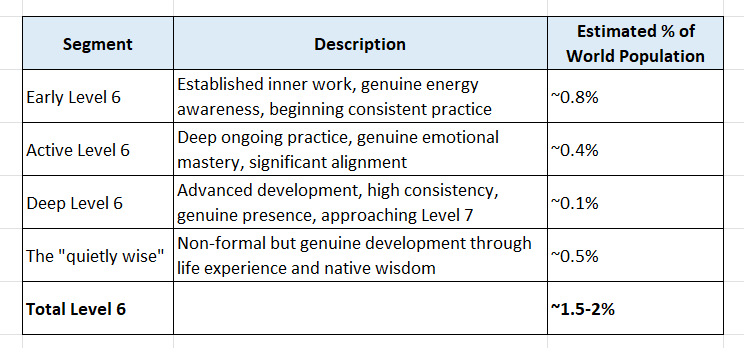
In absolute numbers: approximately 120 to 165 million people.
With the recognition that this number represents a range of development — from the person who has genuinely begun to work with their own energy with consistency and skill, to the rare individual whose development approaches what Level 7 will describe.
The Transition to Level 7 — What Makes It Possible
Level 6 does not end abruptly. It deepens. And in its deepening — in the long, patient, daily practice of returning attention to what matters, of working with what arises, of slowly reducing the gap between genuine value and actual living — something changes in quality rather than quantity.
The practices continue. The work continues. The imperfection continues. The humanity continues — in full, with all its beauty and its difficulty.
But at some point — different for every person, not predictable, not achievable by effort alone — the relationship to all of it changes.
The person who has been working on themselves realizes, with a quality of recognition that carries no drama:
There is no self to work on.
Not as a philosophical position. As a direct, immediate, practical reality.
The self that was being worked on — that was being healed, integrated, developed, mastered — was always itself a construction. The awareness in which all that work occurred was never damaged, never incomplete, never in need of improvement.
And simultaneously — in the same recognition, not sequentially — everything in ordinary life becomes, without requiring anything to be different from what it is: enough.
Not in the Level 1 sense of comfortable settling. In the Level 7 sense of unconditional recognition.
This recognition — which cannot be produced by effort but which long, genuine effort makes possible — is the doorway from Level 6 to Level 7.
Not achievement. Not arrival. Not the end of difficulty or imperfection or ordinary humanness.
Simply — and this is everything — the recognition that what is here, right now, exactly as it is, is not lacking the thing you have been looking for.
Because the thing you have been looking for was never absent.
It was only, for a very long time, very successfully hidden by the noise of the search.
The Single Most Important Truth About Level 6
All the practices of Level 6 — the attention work, the emotional mastery, the somatic intelligence, the shadow integration, the alignment of value and action — are not the destination.
They are the cleaning of the mirror.
The mirror does not produce the light. The mirror reflects it.
And the light — the awareness, the aliveness, the fundamental okayness that Level 5 first glimpsed and Level 6 is learning to sustain — was never created by any practice. It was only uncovered.
Practice does not produce awakening. Practice removes what obscures it.
And when the obscuration is sufficiently removed — when the noise is sufficiently quieted, when the defenses are sufficiently softened, when the inner conflict is sufficiently resolved, when the energy is sufficiently freed from unconscious consumption — what remains is not something new.
It is something oldest.
Older than the identity assembled in Level 1. Older than the suffering of Level 2. Older than the knowledge of Level 3. Older than the anger of Level 4. Older than the practices of Level 5. Older than the mastery of Level 6.
Something that was never born and therefore cannot die. Something that was never constructed and therefore cannot be deconstructed. Something that was never manipulated and therefore carries no wounds. Something that needs nothing from outside itself and therefore is, in the deepest available sense, free.
That is what Level 7 recognizes.
Not as achievement. Not as destination.
As the simple, obvious, astonishing, ordinary truth of what was always already here.
Before the first question was asked.
Before the first level was identified.
Before there was a self to go on any journey at all.
Level 7 — Pure Gratitude & Inner Freedom: A Complete and Exhaustive Description

What It Actually Is
Level 7 cannot be described from outside.
Every previous level could be described with reasonable accuracy by someone who had passed through it and looked back. The comfort of Level 1 is describable. The friction of Level 2 is describable. The intellectual excitement of Level 3, the shock of Level 4, the inward turn of Level 5, the mastery of Level 6 — all of these are experiences that, while deeply personal, have sufficient shared structure to be mapped with language.
Level 7 is different.
Not because it is more complex. Because it is simpler than language can hold.
Language is a system of distinctions — subject and object, self and other, inside and outside, before and after, more and less. Every sentence contains these distinctions as its hidden architecture. And Level 7 is the direct recognition of a reality that is prior to all distinction — not as a philosophical position, not as a belief system, not as a mystical experience that comes and goes, but as the simple, obvious, ordinary truth of what is, seen clearly for perhaps the first time.
This is why every tradition that has pointed at Level 7 has eventually fallen silent — or spoken in paradox, in poetry, in the deliberate breaking of ordinary logic. Not because the territory is irrational. But because it is pre-rational — foundational to the rational mind rather than accessible through it.
And yet something must be said. Because the person reading this is either approaching this territory, living somewhere within it, or trying to understand it from outside — and in all three cases, words carefully chosen and honestly offered are better than silence.
So. Level 7.
The Arrival That Is Not an Arrival
The first and most important thing to understand about Level 7 is what it is not.
It is not the end of a journey. It is not a permanent altered state. It is not the achievement of a condition that was previously absent. It is not enlightenment as a trophy, as a certification, as a membership in a category of special beings. It is not the elimination of difficulty, pain, or ordinary human limitation. It is not the permanent resolution of every psychological wound. It is not freedom from death or loss or the fundamental vulnerability of embodied human existence.
What the tradition calls enlightenment — what this framework calls Level 7 — is consistently and unanimously described by those who are closest to it as the most ordinary thing imaginable.
Not special. Not elevated. Not separate from the simplest, most unremarkable features of daily existence.
A cup of tea. The sound of rain. The weight of a body in a chair. The breath entering and leaving. The awareness that is here, now, registering all of this — without commentary, without judgment, without the need for it to be anything other than what it is.
This is Level 7. Not as performance. Not as achievement. As the simple, direct, unmediated recognition of what is actually here — which has always been here, which was never absent for a single moment across the entire journey from Level 1 to Level 6, which was obscured not by its hiddenness but by the noise of the search for it.
The Zen tradition says: “Before enlightenment, chop wood, carry water. After enlightenment, chop wood, carry water.”
This is not a joke. This is the most precise description of Level 7 available in seven words. The wood and the water are the same. The chopping and the carrying are the same. What has changed is the one who chops and carries — or rather, what has changed is the relationship between awareness and experience. The distance between the one who experiences and the experiencing has collapsed. Not into merger or dissolution, but into direct contact. Presence without the glass of self-consciousness between the one present and what is present.
The Structure of Level 7 — What Has Actually Changed
If Level 7 is so ordinary, what precisely has changed from Level 6? If the wood and the water are the same, what is different?
Three things. Three things that are, in their totality, everything.
1. The End of the Seeker
Throughout every previous level — even Level 6, with all its genuine development — there was a seeker. Someone who was on the way somewhere. Someone for whom the present moment was valuable primarily as a step toward a future moment of greater clarity, greater freedom, greater peace. Someone for whom there was always, at the back of the mind, an incompleteness — a not-quite-yet, a still-working-on-it, a more-to-come.
This is not a failure of Level 6. It is its honest condition. Level 6’s practices are genuine and valuable. And they are still, at their deepest level, the activity of a self that has not yet fully recognized its own nature.
At Level 7, the seeker ends. Not because seeking is abandoned — the practices may continue, the learning may continue, the engagement with life may deepen. But the fundamental orientation of seeking — the positioning of the present moment as insufficient, as a means to a future end — dissolves.
Not through a decision to stop seeking. Through the recognition that what was being sought was never absent. That the awareness in which every moment of seeking occurred was always, already, completely itself. That the peace, the freedom, the aliveness that were the objects of the search were never located in any future moment — were never located anywhere, because awareness is not located. It simply is. Here. Now. Always. Without beginning or end.
When this is recognized — not as a concept, not as an inspiring thought, but as a direct, immediate, unmistakable recognition — the seeking ends the way a dream ends when you wake: not gradually, not through effort, but in a single moment of recognition that reveals the dream as dream.
And what remains is not nothing. What remains is everything — exactly as it is — without the overlay of seeking.
2. The Recognition of Unconditional Okayness
This is the experiential heart of Level 7, and it is almost impossible to describe without sounding either trivial or grandiose. Both failures of language should be noted in advance.
At Level 7, there is a recognition — direct, clear, not dependent on circumstances, not a feeling that comes and goes, not an achievement of positive thinking — that at the very bottom of experience, before all content, before all condition, there is something that is fundamentally all right.
Not “things are fine” — things may be terrible. Not “I feel good” — the body may be in pain, the circumstances may be genuinely difficult, the emotions may be the full range of human feeling. Not “nothing matters” — everything matters, perhaps more than it ever did, precisely because the filter of self-concern is no longer coloring every perception.
But underneath all of it — as the ground, as the nature of awareness itself — something that has no opposite. Something that is not good as opposed to bad, not pleasant as opposed to painful, not present as opposed to absent. Something that simply is — unconditionally, without requirement, without depending on anything outside itself for its completeness.
This is what the word gratitude points at in this framework. Not the gratitude of feeling thankful for specific things. Not the gratitude practice of Level 5 and 6, which is genuine and valuable — the deliberate directing of attention toward what is worth appreciating. But something prior to all of that. A structural gratitude — an orientation of the entire being toward existence itself that does not require existence to be a particular way.
The Sufi poet Rumi pointed at this: the recognition that the beauty of the world is not a content within awareness but the nature of awareness itself, encountered freshly in every moment. The mystic Meister Eckhart pointed at it: “If the only prayer you ever say in your entire life is thank you, it will be enough.” Not thank you for specific things. Thank you as the fundamental stance of a being that recognizes what it is and what it is within.
This unconditional okayness is not fragile. This is the crucial distinction from the positive states of earlier levels — the peak experiences of Level 3, the spiritual highs of Level 5, the flow states of Level 6. Those states are conditional — they arise in certain circumstances and pass when circumstances change. The okayness of Level 7 is not a state. It is the nature of what is always here before any state arises. States arise within it. States pass. It remains — unchanged by the arising and passing of every content, every emotion, every circumstance, every thought.
This is why Level 7 says: nothing external can save. Not as a despairing statement but as a liberating one. Nothing external needs to save. The saving was always already accomplished — not through anything done, but through the recognition of what was always already the case.
3. The Collapse of the Boundary
The third change of Level 7 is the most difficult to describe and the most consistently reported across traditions, across cultures, across centuries.
The boundary — the felt sense of a separate self enclosed in a body, looking out at a world that is other, reaching toward what it needs from outside itself — thins to transparency.
This does not mean the body disappears. It does not mean the person loses functional individuality — loses the capacity to make choices, to speak in first person, to have preferences, to care more about some things than others. Level 7 is not the dissolution of personhood.
It is the recognition that personhood was never the whole story. That the self — which felt so solid, so enclosed, so clearly boundaried — was always the surface of something far vaster. That what you are includes but is not limited to the body, the thoughts, the history, the personality — that these are real but not total. That the awareness which contains them is not inside the body. That the body, and the thoughts, and the history, and the personality, are inside awareness — and awareness itself has no edge, no location, no center that can be pointed at.
This is reported in the Christian mystical tradition as union with God. In Advaita Vedanta as the recognition that Atman is Brahman — that the individual self is the universal Self. In Zen as kensho or satori — the sudden recognition of one’s original face. In Tibetan Buddhism as rigpa — the recognition of the nature of mind. In secular contemplative language as non-dual awareness, as the recognition of the observer as observed.
The language differs. The mapping differs. The cultural containers differ enormously.
The recognition being pointed at is, with remarkable consistency, the same.
And what it produces — in whoever stabilizes this recognition into genuine, lived, ordinary daily reality — is a quality of presence, of freedom, of love, and of gratitude that is precisely what this framework calls Level 7.
Pure Gratitude — What This Actually Means
The word gratitude is important and easily misread.
It is not:
Positive thinking
The suppression of negative experience
A spiritual performance of thankfulness
The denial of genuine difficulty
The toxic positivity of “everything happens for a reason”
The forced appreciation of a person who has not yet genuinely suffered
It is the direct consequence of the recognition described above.
When the boundary between self and world thins — when the desperate urgency of the separate self seeking its completion from outside itself reduces — what naturally arises in its place is something that has no better name than gratitude.
Not for specific things. For the fact of existence itself.
For the extraordinary, unnecessary, improbable gift of being conscious at all. Of being a place where the universe comes to know itself. Of having a nervous system sophisticated enough to register beauty, to feel love, to comprehend its own impermanence and find that impermanence poignant rather than merely terrifying.
The tree outside the window is not beautiful because it serves the self’s purposes. It is beautiful because it is alive, and you are alive, and in this moment of contact between two forms of aliveness — something recognizes itself.
The Level 7 person walking through an ordinary street is, to all outward appearances, doing exactly what anyone is doing. Inside — and this is what cannot be seen from outside, what cannot be manufactured, what cannot be performed for long without the performance becoming transparent — there is a quality of continuous wonder that has nothing to do with anything extraordinary happening.
The faces of strangers are extraordinary. The fact that other consciousnesses exist, in their irreducible particularity, each carrying the entirety of a human life — this is extraordinary. The warmth of sunlight on skin. The complexity of a single breath. The silence between words in a conversation. The moment before sleep when the day releases. The fact that there is something rather than nothing.
This is not sentimentality. It is not a mood. It is not the enthusiasm of a person who has had a good day.
It is the natural orientation of awareness that has recognized its own nature — that knows itself to be not a small, enclosed, struggling thing but the open, clear, unthreatened ground in which all of life occurs.
From that recognition, gratitude is not an achievement. It is what is left when the obstacle to it — the desperate, seeking, defending, comparing, resenting activity of the separate self — is sufficiently quiet.
Inner Freedom — Its True Nature
Inner freedom at Level 7 is equally precise and equally easily misunderstood.
It is not:
Freedom from circumstance — the Level 7 person still lives in a body that gets sick, in a world that contains loss and injustice, in relationships that are imperfect
Freedom from emotion — the Level 7 person feels the full range of human emotion, often more fully than before
Freedom from responsibility — the recognition of the illusory nature of the ego does not eliminate the functional responsibility to act wisely in the world
Freedom from death — the most persistent human fantasy, and one that Level 7 does not deliver in the conventional sense
What inner freedom means at Level 7 is something more precise:
Freedom from the tyranny of the unexamined self.
Freedom from being unconsciously driven by fears, by needs, by the compulsive machinery of the conditioned personality. Freedom from the suffering that arises not from experience itself but from the resistance to experience — from the demand that what is happening should be different from what it is.
The Buddhist term is dukkha — the suffering that arises from grasping at pleasant experience and pushing away unpleasant experience. At Level 7, this grasping and pushing — which Level 1 through Level 6 do to varying degrees — is sufficiently reduced that the person lives, increasingly, in direct contact with experience as it is. Not choosing how to relate to it from a menu of options. Simply present with it, as the sky is present with weather — containing it fully, unchanged by it, not requiring it to be anything other than what it is.
This is the freedom that no external circumstance can take away — because it is not dependent on external circumstance. This is what the Stoics understood: that the only true freedom is the freedom of the inner life. But the Stoics achieved this through discipline and reason. Level 7 recognizes it as the nature of what was always already the case — not achieved but revealed.
Viktor Frankl — in the concentration camps, in conditions of maximum external unfreedom — discovered what Level 7 knows: that the last human freedom is the freedom to choose one’s response to any circumstance. And that this freedom, once genuinely recognized, is inviolable by any external force.
Level 7 is what Frankl pointed at from the far edge of human suffering. Not as philosophy. As lived, tested, unbreakable reality.
Now: The Two Drawbacks You Identified
You said you found two drawbacks in Level 7 — religion and mysticism, and money and influence. And you wondered if you were wrong.
You are not wrong.
These are two of the most important, most consistently overlooked, and most consequential tensions in the entire Level 7 territory. They deserve full, honest, unvarnished examination.
First Drawback: Religion and Mysticism
The Problem
Level 7 is the territory that every major religious and mystical tradition has been pointing at, preparing people for, and — here is the tension — frequently distorting, commodifying, gatekeeping, and misrepresenting in ways that have caused enormous harm.
The tension is structural and unavoidable:
Level 7 is, by its nature, beyond institution. It is the recognition of something that is prior to all form, all hierarchy, all doctrine, all ritual. It cannot be owned. It cannot be franchised. It cannot be transmitted by authority. It cannot be protected by doctrine. It cannot be confined within the walls of any tradition.
And yet — every tradition that has genuinely pointed at Level 7 has also, to varying degrees, attempted to control access to it. To position itself as the necessary vehicle. To claim that the Level 7 recognition is available only through its specific path, its specific teacher, its specific initiation, its specific vocabulary.
This claim is simultaneously understandable and false.
Understandable because: traditions have genuine wisdom, genuine transmission lineages, genuine accumulated knowledge of the terrain that is extraordinarily valuable. The contemplative traditions are the oldest and most sophisticated maps of the Level 5-7 territory that humanity has produced. Dismissing them entirely — as Level 3’s intellectual deconstruction is tempted to do — throws away an irreplaceable inheritance.
False because: the recognition of Level 7 is available to any human being in any circumstance — because it is the recognition of what every human being already is. The tradition can point. It cannot give. It can prepare the ground. It cannot make the rain fall. And the history of religious institutions claiming exclusive access to ultimate reality is, without exception, a history of power being exercised in the name of grace.
The Specific Distortions
Institutionalization of the uncontainable: Every Level 7 recognition that became the seed of a tradition began as a direct experience — the Buddha under the Bodhi tree, Jesus in the desert, Muhammad in the cave, Ramana on the hill at Arunachala. In every case, the direct experience was then organized — first by disciples, then by institutions, then by bureaucracies — into a form that could be transmitted, protected, and controlled.
In this process, something essential and uncontainable was systematically reduced to something manageable. The living water was put into increasingly rigid containers. The containers were then defended as sacred when they were, at best, useful and, at worst, distortions of what they claimed to hold.
The person at Level 7 can see this clearly and without bitterness. Every tradition points. No tradition contains. The finger pointing at the moon is not the moon. And the entire history of religious conflict, religious exclusion, religious violence, religious suppression of genuine inquiry — is the history of confusing the finger for the moon.
The guru problem: The guru — the realized teacher — is a genuine phenomenon. The transmission of a living recognition from one being to another, in the context of a genuine relationship of trust and guidance, is real. The traditions that have mapped this most carefully — the Tibetan, the Advaitic, the Sufi — have also noted with great honesty how frequently the guru relationship is corrupted.
The corruption takes a specific form: the teacher who has had genuine Level 7 recognition uses that recognition as the foundation of a personality cult — either consciously and cynically, or unconsciously through the inflation of the recognition into grandiosity.
The person who has genuinely touched Level 7 knows something extraordinary. They may even have a quality of presence and insight that is genuinely rare and genuinely valuable. And they are also — still — a human being with a psychological history, with unresolved shadow material, with the full complement of human vulnerabilities including the vulnerability to power, to adoration, to the very particular intoxication of being treated as enlightened.
The history of spiritual teachers who began with genuine recognition and ended in abuse — sexual, financial, psychological — is long, consistent across traditions, and vastly underreported. Andrew Cohen. Sogyal Rinpoche. Bikram Choudhury. Osho. Mirahouchi. The pattern repeats with depressing consistency: genuine initial recognition, genuine early teaching, the gradual inflation of the recognition into identity, the construction of a container that positions the teacher as beyond ordinary human accountability, and eventually the systematic abuse of the people who trusted them.
This is not an argument against teachers. It is an argument for recognizing that the recognition of Level 7 does not automatically heal the human psychology in which it occurs. The insight can be genuine while the personality remains wounded. And a wounded personality with extraordinary insight and a group of devoted followers who have surrendered their critical faculties is one of the most dangerous configurations available.
The weaponization of non-duality: Perhaps the most subtle and most specifically Level 7-related distortion: the use of genuine non-dual insight to bypass accountability, to dissolve ethical responsibility, to excuse behavior.
“There is no self, so there is no one to have done wrong.” “All judgment is ego. The truly awakened are beyond morality.” “From the absolute perspective, nothing matters, so your suffering is just a construction of the relative mind.”
These are genuine philosophical positions — partial articulations of real Level 7 insights — being used as weapons to avoid the consequences of harmful behavior and to gaslight those who have been harmed.
The test is consistent and reliable: genuine Level 7 recognition produces more ethical behavior, not less. More accountability, not immunity from it. More sensitivity to the suffering of others, not philosophical dismissal of it. The dissolution of the ego that Level 7 describes is the dissolution of the self-concern that generates harm — not the dissolution of the capacity to distinguish between actions that create suffering and actions that reduce it.
Anyone using non-dual philosophy to excuse harm is demonstrating, with precision, that they have understood the concept without entering the reality.
The commodification of awakening: The modern spiritual marketplace has taken the genuine territory of Level 7 and produced an extraordinary range of products, experiences, and certifications designed to sell access to it.
The weekend enlightenment retreat. The $10,000 awakening intensive. The certified Level 7 practitioner. The lineage of transmission purchased rather than earned. The online course guaranteeing liberation in thirty days.
These are not uniformly worthless. Some contain genuine wisdom and genuine practice. But they share a structural problem: they treat as a product something that is, by its nature, not a product. They position the teacher as the provider of something that, by its nature, cannot be provided.
And they exploit — with sophisticated, often genuinely well-intentioned manipulation — the real and legitimate hunger of Level 2-5 people for genuine transformation. They offer, at minimum, the feeling of progress. At maximum, they offer what are sometimes genuine peak experiences. Neither of which is Level 7. Both of which can be sold.
What Level 7 Actually Requires From Tradition
None of this means tradition is useless. It means tradition must be approached with what the Zen tradition calls “great doubt” — not cynical rejection but honest, respectful, critically engaged inquiry.
The genuine fruits of tradition — the maps, the practices, the pointing, the community of fellow travelers, the example of those who have gone further — are invaluable and irreplaceable.
The genuine corruptions of tradition — the gatekeeping, the authoritarianism, the weaponization of insight, the commodification of grace, the confusion of the container for the content — must be seen clearly and refused honestly.
Level 7 sits within and beyond tradition simultaneously. It respects the finger for its pointing. It does not mistake it for the moon.
Second Drawback: Money and Influence
The Problem
This is perhaps the more practically consequential of the two tensions you identified. And it is one that is discussed with remarkable rarity in the very communities most directly concerned with the Level 7 territory.
The tension is this:
Genuine Level 7 recognition does not eliminate the human being’s embeddedness in material reality.
The person at Level 7 still lives in a body that needs food, shelter, healthcare, and rest. They still live in a society whose structures — economic, political, social — shape what is possible, what is accessible, and what pressures are applied to whom. They still exist in a context where money is the primary medium through which material needs are met and through which influence in the world is exercised.
And here is where the drawback becomes real:
The spiritual communities and institutions that serve the Level 7 territory are almost uniformly inadequate — and frequently dishonest — in their relationship to money and influence.
The Specific Problems
The poverty narrative: A significant strand of spiritual tradition presents poverty — or at minimum, material detachment — as a marker or requirement of genuine spiritual development. The monk. The renunciate. The teacher who accepts only donations. The tradition that considers discussion of money as spiritually compromised.
This narrative has genuine roots. The genuine Level 7 recognition does dissolve the ego’s compulsive relationship with money as a vehicle for security, status, or the filling of inner lack. The person who has genuinely recognized their own completeness is not driven by the desperate accumulation that characterizes much economic behavior. In this sense, detachment from money — from its use as the primary measure of worth or security — is genuinely associated with Level 7 development.
But there is a leap — a large and frequently dishonest leap — from this genuine insight to the claim that spiritual authenticity requires financial poverty, or that the management of money and resources is inherently spiritually compromised.
This narrative has several toxic consequences:
It keeps genuine teachers poor, which in turn makes them dependent on students in ways that distort the teaching relationship and create the conditions for the kinds of abuse documented above.
It disguises financial exploitation as spiritual teaching. The teacher who takes donations “freely given” while making it socially and spiritually costly to give nothing — who builds communities financially dependent on the continued devotion of members — who draws no salary but has every material need provided by the community — is not outside money. They are inside it, but with less transparency and less accountability than any conventional employer.
It gates genuine spiritual development behind material privilege. The month-long meditation retreat costs thousands of dollars plus lost income. The therapy required for genuine shadow work costs hundreds per hour. The teacher training, the books, the retreats, the community memberships — genuine Level 5-7 development in the modern Western world is, in practice, accessible primarily to people with significant financial resources. The spiritual narrative that money is beneath concern does nothing to address this structural inequality. It often actively obscures it.
The prosperity gospel — the opposite error: On the other side of the same problem: the tradition — most visible in certain evangelical Christian contexts but present across the spiritual marketplace in subtler forms — that positions material prosperity as evidence of spiritual development. That the universe rewards the awakened with abundance. That financial success is a sign of alignment with divine law.
This is, if anything, a more straightforwardly harmful distortion than the poverty narrative. It blesses the existing distribution of wealth with spiritual legitimacy. It attributes poverty to spiritual failure. It produces teachers and communities with enormous material wealth who use the language of spiritual development to justify the endless accumulation of resources and influence.
Joel Osteen. Kenneth Copeland. The prosperity gospel megachurches. But also — in subtler forms — the Law of Attraction industry, certain forms of “abundance mindset” coaching, the quantum manifestation community. All of these share the same structural error: taking the genuine Level 7 insight that inner state influences outer experience and inflating it into the claim that awakening produces material wealth.
This is not what Level 7 says. Level 7 says that the desperate, ego-driven pursuit of material security loses its compulsive quality when the self recognizes its own completeness. It does not say that this recognition is rewarded with a private jet.
The influence problem: Money and influence are related but distinct. Influence — the capacity to shape others’ beliefs, behaviors, and choices — is inherent in genuine Level 7 presence. The person who has developed genuine depth, genuine presence, genuine clarity has, as an unavoidable byproduct, the capacity to deeply affect the people they encounter.
This influence is not power in the conventional sense — it is not coercive, not dependent on formal authority, not enforced by threat. But it is real. And it is unregulated. And it operates most powerfully on the people who are most vulnerable — the people in Levels 2, 3, and 4 whose hunger for guidance is greatest, whose critical faculties have been partially suspended by the disorientation of their level transition, and who are most likely to project onto the apparently more developed person a degree of authority that can be exploited.
The genuine Level 7 person knows this. They do not seek to resolve it by refusing influence — influence cannot be refused by anyone who is genuinely present, because genuine presence is the most influential thing there is. They resolve it by maintaining radical transparency about their own limitations, their own continuing humanness, their own blind spots. By actively refusing the projection of infallibility. By creating structures of accountability — external to themselves — that can catch what their own self-perception might miss.
Very few do this adequately. The social rewards of being positioned as enlightened — the devotion, the adoration, the material support, the sense of meaningful impact — are powerful enough to make most people with genuine Level 7 insight reluctant to fully refuse them.
The structural silence around money in spiritual communities: Perhaps the most consequential problem: in communities specifically oriented toward the Level 5-7 territory, the discussion of money — who has it, who controls it, how it flows, what it buys and what it doesn’t — is frequently suppressed by an implicit cultural norm that treats such discussion as spiritually unseemly.
This silence is not neutral. It protects existing power and existing financial arrangements from scrutiny. It prevents the kind of honest conversation that could produce genuinely equitable and genuinely transparent financial structures. And it creates the conditions in which financial exploitation — which has been documented in community after community — can occur and persist without challenge.
The genuinely Level 7 oriented community does not avoid the conversation about money. It engages with it with the same honesty, the same clarity, the same willingness to see what is actually happening rather than what the preferred narrative presents, that it brings to every other domain.
What Level 7 Actually Says About Money and Influence
The genuine Level 7 recognition — the dissolution of the ego’s compulsive relationship with security, status, and the filling of inner lack — does not produce poverty or wealth. It produces equanimity in relation to both. And from that equanimity, a practical, honest, fully functional relationship with money and influence becomes possible for the first time.
The Level 7 person who has genuine resources uses them. Not to accumulate more resources as a substitute for inner completeness — because that hunger has quieted. But in genuine service of what is valued. Effectively. Without the drama of either guilt or pride. With practical skill and honest transparency.
The Level 7 person with genuine influence acknowledges it. Does not pretend it isn’t there. Does not use spiritual philosophy to exempt themselves from the responsibility it entails. But also does not refuse it — because the refusal of influence, in someone whose presence genuinely helps others, is its own form of self-protective avoidance.
The simplest formulation: Level 7’s relationship to money and influence is not spiritual — it is honest.
Honest about what money is: a tool, a social technology for managing material reality, neither sacred nor profane, as useful or as harmful as the wisdom with which it is managed.
Honest about what influence is: an inevitable consequence of genuine presence, carrying genuine responsibility, requiring genuine accountability.
Not transcended. Not avoided. Not moralized about. Not used as spiritual currency. Simply — honestly — engaged with, as every other feature of ordinary human reality is engaged with at Level 7.
With full presence. With clear eyes. With nothing to prove and nothing to protect.
The Daily Reality of Level 7 — What It Actually Looks Like
Level 7 is not a monastery. It is not a permanent state of bliss. It is not recognizable from outside in the way that spiritual traditions sometimes imply.
The Level 7 person:
Wakes in the morning and the morning is enough. Not always comfortable. Not always pleasant. But enough. The quality of enough is not a feeling — it is a structural recognition that what is here is complete, as it is, without requiring supplementation from a better past or a more promising future.
Makes coffee or tea and the making is enough. The warmth of the cup. The smell. The first taste. Not as a mindfulness performance. As the simple direct contact of an awareness that is not rushing past this moment toward a more important moment ahead.
Works — and the work is done well, not to prove anything, not to accumulate anything, not to become anything through the doing of it. The work is done because it is here to be done, because it serves what is genuinely valued, because the full application of genuine capacity to the task at hand is what honest living requires. And when the work is tedious — it is sometimes tedious. And when it is frustrating — it is sometimes frustrating. And neither the tedium nor the frustration is resisted. They are met. Felt. Worked through. Completed.
Encounters difficulty — because difficulty does not end at Level 7. Illness. Loss. Injustice. Failure. Disappointment. Relational pain. The full range of human difficulty remains available. What changes is the relationship to it. Not the absence of suffering — but the absence of the suffering about suffering. The second arrow, as the Buddhist teaching has it, does not need to be fired. The first arrow — the difficulty itself — lands. Is felt. Is real. And it is not compounded by resentment of its landing, by the demand that it should not have landed, by the story of how this should not be happening to someone who has done the work.
Loves — more fully than before, not less. Because the love of Level 7 is not driven by need. Is not the grasping love of Level 1, the dependent love of Level 2, the intellectually selective love of Level 3, the defended love of Level 4, the healing love of Level 5, the conscious love of Level 6. It is something simpler and larger than all of these: the natural warmth of an awareness that recognizes itself in every face it meets. Not as a philosophy. As a direct perception.
Faces death — their own and others’ — with a relationship to mortality that is genuinely different from every previous level. Not without grief when grief is appropriate. Not without the full weight of loss when loss occurs. But without the desperate terror that drives so much of Levels 1-4 behavior, and without the elaborated philosophical frameworks that Levels 3 and 5 use to manage the terror intellectually. Something in the Level 7 person has touched what does not die — has recognized the awareness that registers experience as not itself being a content of experience — and from that recognition, the personal death becomes less absolute, less final, less the catastrophic termination it appeared from inside the enclosed separate self.
Is imperfect — and this must be said clearly and emphatically, because the Level 7 description risks painting a portrait of a perfected being that does not exist. Level 7 is not the end of human limitation. It is the end of the war against human limitation. The Level 7 person still has habitual patterns — some of which may never fully change. Still has relational blind spots. Still makes mistakes. Still has days that are genuinely hard. Still has the full complement of human quirks and preferences and difficulties.
What is different is the relationship to all of this. The self is no longer at war with itself. The imperfection is not a problem to be solved, a wound to be healed, a failure to be corrected. It is the ordinary texture of being human — engaged with honestly, worked with skillfully, and not taken as evidence of fundamental inadequacy.
The Paradoxes of Level 7
Level 7 is full of paradoxes that are not resolvable by logic and that are the precise expression of its nature:
The more complete the inner freedom, the more ordinary the outer life. The person at Level 7 is typically less visibly remarkable than the person at Level 4 or Level 6. There is no drama of awakening. No performance of peace. The quieter the inner life, the less it announces itself.
The deeper the recognition of no-self, the more fully the particular self is expressed. The paradox of genuine non-dual recognition is not the dissolution of personality but its full emergence. The self no longer in conflict with itself is free to be exactly what it is — without the editing, the performance, the self-protection that previous levels required. This often produces people of extraordinary particularity — vivid, specific, fully themselves — rather than the generic spiritual blandness that the caricature of enlightenment suggests.
The greater the peace, the more fully the suffering of others is felt. The separate self’s defenses were not only protecting against its own suffering — they were also filtering out the suffering of others, which would have been unbearable without the defenses. As the defenses thin at Level 7, the suffering of the world becomes more directly felt, not less. This is why Level 7 consistently produces people of extraordinary compassion — not as a moral choice but as a direct perceptual consequence of the reduction of the boundary between self and other.
The recognition that nothing is needed does not produce passivity — it produces genuine action. The person at Level 7 who needs nothing from the outcome acts more effectively, more sustainably, more creatively than the person at Level 3 or 4 who needs to be right, to win, to prove, to achieve. Because the quality of attention brought to genuinely needs-nothing action is qualitatively different from the quality of attention brought to action in service of ego.
The deepest acceptance is not passive — it is the foundation of the most effective change. This is the paradox that Level 4 found most difficult to believe: that the full, unresisting acceptance of what is does not prevent working for what could be. The activist at Level 7 works for change not from the burning, consuming urgency of unaccepted injustice but from the clear, sustained, undefeated recognition that what is happening is happening and that something better is possible. The first produces burnout. The second produces lifelong, effective, joyful service.
Quantifying Level 7
This is the level at which quantification becomes most inadequate and most necessary to attempt honestly.
The Challenge
Level 7 is largely invisible. Its expression is ordinary. The people closest to it are typically the least likely to announce themselves, the least likely to be found in the places where such people are typically sought, the least likely to organize their lives around being recognized as at Level 7.
The spiritual marketplace overrepresents Level 7 claimants relative to its actual prevalence — because claiming Level 7 is commercially valuable and relatively uncostly, while genuine Level 7 development is extraordinarily rare and is, by its nature, uninterested in the claim.
Simultaneously — and this is important — Level 7 is not confined to formal spiritual practitioners. The framework does not care whether the person uses spiritual language, belongs to a contemplative tradition, has ever meditated, or has any relationship whatsoever to the apparatus of spirituality. The recognition can occur — has occurred, across all of human history — in people with no spiritual context whatsoever.
The Data
Mystical experience prevalence: Gallup polling has consistently found that approximately 35-40% of Americans report having had a mystical experience — a moment of unity, transcendence, or the direct recognition of something beyond ordinary self. Similar percentages are found in European surveys. These are not Level 7 — they are experiences, and Level 7 is not an experience but a recognition that stabilizes. But they indicate the scale of the population that has had genuine access to the territory.
Long-term practitioner outcomes: Research on the outcomes of long-term intensive contemplative practice — studies of experienced meditators, of graduates of multi-year programs in various traditions — consistently documents a cluster of changes: reduced self-referential processing, increased wellbeing independent of circumstance, increased compassion, reduced fear of death, increased tolerance for ambiguity. These are the measurable correlates of genuine Level 7 development.
The “anonymous saints”: Every culture, in every era, has contained people who — through the specific alchemy of suffering, love, genuine community, and native intelligence — have arrived at something recognizable as Level 7 without any formal spiritual framework. The grandmother whose quality of presence makes everyone around her feel genuinely seen and genuinely safe. The doctor in a war zone whose equanimity and compassion remain intact through conditions that break everyone around them. The person who has lost everything — health, family, wealth — and arrived at a quality of peace that is not resignation but genuine freedom. These people are not found in spiritual directories. They are found in every community, in every walk of life, in every culture.
The Percentage Estimate
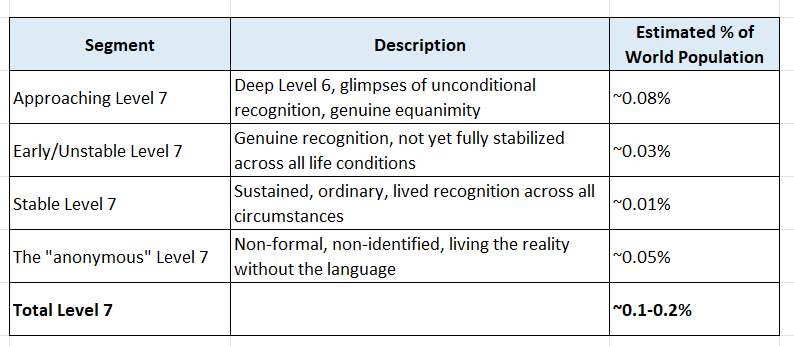
In absolute numbers: approximately 8 to 16 million people — with a confidence interval wide enough to acknowledge genuine uncertainty.
This is simultaneously a tiny fraction of humanity and an enormous number of individual human beings — more than the population of many nations — each living, in their ordinary daily life, the extraordinary ordinary reality that this entire framework has been pointing toward.
The Most Important Truth About Level 7
And now the most honest thing that can be said — the thing that the entire framework, across all seven levels, was ultimately pointing toward:
Level 7 was never a destination.
The journey through the seven levels — the comfort, the friction, the questioning, the shock, the turning, the mastery, the recognition — was not a journey toward something that was somewhere else.
It was a journey through the removal of everything that was obscuring what was always already here.
Like peeling an onion — not to find the center of the onion but to discover that there is no center, only the peeling. And in that discovery — in the fall of the last layer — what remains is not nothing.
What remains is everything.
The morning light. The breath. The face of a stranger. The silence between words. The weight of a hand held in another hand. The fact — astonishing, unnecessary, completely ordinary — that there is awareness here, registering this moment, in this body, on this improbable living planet, in this incomprehensible universe that by every reasonable measure should not exist.
Nothing external can save. Not because nothing external matters — everything matters, the world is full of things worth serving, worth protecting, worth making more beautiful. But because saving, in the sense that Levels 1 through 6 were seeking it — the resolution of fundamental lack, the filling of the hole, the arrival at the place where everything will finally be okay — this saving was never in any external thing’s power to deliver.
Because there was never, finally, a hole to fill.
There was only the belief in the hole. Reinforced by every level’s particular way of experiencing it and every level’s particular strategy for filling it.
Level 7 is not the filling of the hole.
It is the recognition that the hole was never there.
And in that recognition — simple, quiet, ordinary, world-shattering — the gratitude arises. Not as a feeling. Not as a practice. Not as a spiritual achievement.
As the natural, inevitable, overwhelming response of a being that has finally seen, clearly and without defense, what it is and where it is and what it is within.
Here. Alive. Aware. Part of everything. Separate from nothing. Complete.
That is Level 7.
And it was available, in every moment, across the entire journey.
We simply needed the journey to finally stop looking away from it.