The Hallucinogenic Toreador
The Hallucinogenic Toreador (1969-1970) executes Dalí's paranoiac-critical method as deterministic visual architecture. 28 Venus de Milo statues construct the hidden bullfighter via negative space—a phantom generated by debris. Symbolism encodes personal trauma: Gala's disapproval, dying bull Islero (victim/victor paradox) morphing into Cap de Creus, gadflies (critics) forming attire, young Dalí witnessing his own future death. The toreador is Dalí's public persona—a hallucination sustained by belief. Masculine identity defined by feminine absence. Time collapses: child contains man, man contains corpse. A requiem for loneliness, where illusion becomes truth visible only at the correct distance. Reality is not static; it is becoming. Value flows from individual verification—seeing the phantom requires viewer participation. Dalí inserts himself into the arena of death not as fighter, but as spectacle.
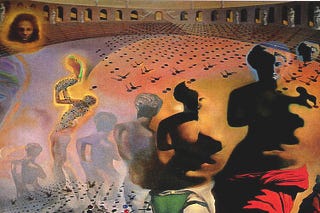
Genesis of a Masterpiece (1969-1970)
Salvador Dalí painted The Hallucinogenic Toreador at a pivotal moment in his late career, between 1969 and 1970 . It is an enormous work, a testament to his ambition, measuring approximately 4 meters tall and 3 meters wide (398.8 x 299.7 cm) . The painting is the culmination of Dalí’s lifelong fascination with optical illusions, psychoanalysis, and his Spanish heritage. It is currently the crown jewel of the Salvador Dalí Museum in St. Petersburg, Florida .
The painting’s creation is deeply rooted in Dalí’s own “paranoiac-critical method,” a process he developed to harness his subconscious for artistic creation. This technique involved inducing a state of paranoid delusion to perceive multiple, often hidden, images within a single form .
In this work, Dalí masterfully used this method to create a complex visual puzzle where the landscape, figures, and still lifes all conspire to form the hidden portrait of a bullfighter. An academic analysis of the work highlights this structural multiplicity, noting that a single image can contain several, sometimes contrasting, layers of meaning.
Decoding the Double Image: The Hidden Toreador
The central drama of the painting is the “hallucinogenic” appearance of the toreador, which is not immediately obvious to the viewer. Dalí guides the eye using negative space and repeated motifs. The key to the illusion lies in the 28 silhouettes of the Venus de Milo that populate the canvas . Dalí’s inspiration for this came from a mundane source—a box of pencils with a reproduction of the Greek statue that he bought on a visit to New York .
When viewed from a distance, these Venus figures dissolve and reconfigure. The shadows and highlights of their classical forms create the face and torso of the bullfighter. The statue’s breasts become his nose, her face transforms into his eye, and their long skirts merge to form his white shirt and the iconic red scarf.
A distinct green necktie, visible near the center of the canvas, helps to lock the illusion of the toreador’s figure into place . A tear can be seen slipping from the toreador’s eye, formed by a soft white area within the Venus’s face, adding a layer of melancholy to the brave figure .
A Catalogue of Symbolism
Beyond the central illusion, the painting is a rich tapestry of personal and cultural symbols, all set within the red and yellow hues of a Spanish bullfighting ring, reminiscent of the Spanish flag .
Gala’s Disapproval: In the upper left corner, a small, serious portrait of Dalí’s wife and muse, Gala, looks down upon the scene. Her detached and rigid expression is a pictorial representation of her well-known dislike for the spectacle of bullfighting .
The Bull and the Landscape: In the lower left, beneath a mesmerizing grid of colorful circles, lies the head of a dying bull, believed to be Islero, the famous bull that killed the legendary matador Manolete . Blood and saliva drip from its mouth, pooling to form a sheltered bay. From this pool, a figure drifts on a yellow raft. The bull’s form then metamorphoses into the iconic, craggy landscapes of Cap de Creus near Dalí’s home in Catalonia. Some suggest Dalí incorporated this landscape as a nod to the growing tourism industry in the region .
The Gadflies of Saint Narcissus: Swarms of gadflies (or flies) march in precise, parallel lines across the arena. These are not random insects but refer to the legend of Saint Narcissus of Girona, whose tomb was said to be protected by swarms of flies. In the painting, these flies coalesce to form the toreador’s montera (hat), his hairnet, and even elements of his cape .
The Young Dalí: In the lower right corner, observing the entire hallucinatory spectacle, is a young boy dressed in a sailor’s suit. This is Dalí as a child, holding his favorite toy hoop and a fossilized bone, watching the scene with the detached curiosity of a dreamer witnessing his own vision .
Reception and Legacy
When the painting was first exhibited as a work-in-progress at a New York gallery in the late 1960s, Dalí famously provided the audience with a guide. The painting was accompanied by an illustration that matted out the extraneous areas, explicitly showing viewers “How to see the toreador” . This playful yet instructional approach highlights Dalí’s desire for the viewer to actively participate in the act of seeing.
The Hallucinogenic Toreador stands as a monumental achievement in surrealist art. It is not merely a painting but a complex, interactive experience.
By combining the rigorous technique of the old masters with the psychological depth of surrealism, Dalí created a self-portrait of his artistic mind.
It encapsulates his obsessions—his wife, his homeland, death, illusion, and the boundless potential of the subconscious—making it a truly definitive work of his career .
The History of an Obsession: The Toreador as a Self-Portrait
The standard interpretation tells you that the face of the toreador is an optical illusion made of Venuses. That is technically true, but it misses the point: the toreador is Dalí.
By 1970, Dalí was no longer the young revolutionary who had been expelled from the Surrealist movement. He was “Avida Dollars,” the sell-out, the clown who appeared on game shows and designed Chupa Chups logos. He was also facing a profound crisis: his muse and wife, Gala, was increasingly obsessed with her own young lovers, leaving Dalí isolated, depressed, and terrified of death.
In this painting, Dalí does not just paint a bullfighter; he paints himself as a tragic, enduring icon. Look at the necktie—a distinctly modern, bourgeois accessory that a matador would never wear. That is Dalí’s tie. He inserts himself into the arena of death, but he is not the one fighting. He is the spectacle. The single tear falling from the toreador’s eye (visible only when you step back) is Dalí crying over the loss of Gala’s attention, over the passage of time, and over the fact that he is trapped in a ring of his own making.
The Venus de Milo Assembly Line: Kitsch vs. Classicism
The use of the 28 Venuses is not just a clever trick. It is a statement about the industrialization of art and desire. Dalí purchased the Venus pencil sharpener in New York—a piece of kitsch, a mass-produced souvenir. He transforms this cheap object into the foundation of high art.
But there is a violent eroticism here. The Venus de Milo is armless, a symbol of mutilated beauty. Dalí multiplies her, creating an army of fragmented goddesses. They are arranged in strict, grid-like rows, reminiscent of Andy Warhol’s factory production, which Dalí both envied and despised. The torero’s face is formed by the negative space between these goddesses. In other words, the masculine identity (the Toreador) is defined by the absence of the feminine (the Venuses). Gala is gone, and without her, Dalí is just a void shaped like a man.
The Dying Bull and the Portrait of the Artist as a Corpse
The bull in the bottom left, bleeding out onto the sand, is specifically identified as Islero—the bull that killed Manolete. This is crucial. Manolete was the god of bullfighting, killed in the ring in 1947. By painting the bull that killed the greatest matador, Dalí is playing with the ultimate paradox: the victor becomes the victim.
The bull’s blood flows into the shape of a bay, where a figure floats on a raft. This is a direct reference to Gala on the raft in his 1944 masterpiece Dream Caused by the Flight of a Bee. But here, the raft is drifting away from the bull (death) and towards the shore. It is ambiguous whether Gala is escaping Dalí, or if Dalí is sending her away to save her from the horror of the ring.
Furthermore, the bull’s form morphs into the rocks of Cap de Creus. Dalí is literally stating that the landscape of his childhood is built upon the corpse of the bull. The earth itself is made of blood and death.
The Gadflies: The Return of the Repressed
The gadflies are not just a legend of Saint Narcissus. In psychoanalysis (Dalí’s favorite playground), flies are often symbols of decay and annoyance, but also of persistence. They swarm over the face of the toreador, forming his hairnet.
These flies represent the critics. Throughout his career, Dalí was swarmed by accusations of fakery and commercialism. In this painting, he weaponizes the annoyance. He turns the buzzing nuisances into the very fabric of his hero’s attire. He is saying, “Your criticism is part of my costume. It adorns me.”
The Most Disturbing Detail: The Boy in the Sailor Suit
In the bottom right, young Dalí watches. He holds a hoop, a symbol of childhood circles and games. But look closer. The hoop is resting against a bone. A fossil.
Young Dalí is not just watching a bullfight. He is watching a vision of his own future death. He is standing on the “shore” of the painting, separated from the arena by a thin strip of sand. He is the audience. But he is also the actor. The painting posits that the child contains the man, and the man contains the corpse. The hallucination is not just visual; it is temporal. Time collapses. The boy watches the man he will become, dying in the ring formed by the absence of the woman he will love.
Conclusion: The Hallucination as a Requiem
The “history” of this painting is the history of Dalí’s final acceptance of his own mythology. It is a monument to his loneliness. While the world saw the crazy-eyed showman, Dalí was painting a meticulous, mathematically precise depiction of his own heartbreak.
It is called The Hallucinogenic Toreador because the image of the toreador is not real—it is a phantom generated by the landscape, by the statues, by the flies. It exists only if you believe it exists. For Dalí, by 1970, his public persona—the Toreador of Art—was just such a phantom: a hallucination generated by the debris of his life, visible only to those standing at the correct distance.