Quantum negative group delay (NGD)
Quantum Negative Group Delay (NGD) occurs when a pulse peak exits a medium before the input peak enters, resulting from anomalous dispersion where refractive index changes rapidly with frequency. It distinguishes phase velocity (wave crests) from group velocity (pulse envelope); NGD implies negative group delay via specific phase shifts calculated as change in phase divided by change in frequency. Observed in quantum tunneling (Hartman Effect), tunneling time becomes independent of barrier thickness beyond a certain point, allowing calculated group velocities to exceed light speed. Causality remains intact: the signal front never exceeds light speed. The effect results from pulse reshaping (preferential attenuation of the wave's rear), not time reversal. Applications include timing jitter compensation, pulse compression, and weak measurements. "Negative time" is a mathematical artifact of defining arrival by peak probability rather than signal front; it represents negative delay, not chronological reversal.
Quantum negative group delay (NGD) is a phenomenon where the peak of a pulse or a quantum wave packet appears to exit a medium before the peak of the input pulse has even entered it. This effect occurs in specific “anomalous dispersion” regions of a material, where the refractive index changes rapidly with frequency.
In classical physics, this is often seen in electronic circuits or specialized optical fibers. In the quantum realm, it relates to how probability amplitudes and wave functions propagate through barriers or through media with complex atomic transitions.
1. The Mechanics of Group Delay
To understand negative group delay, you have to distinguish between different types of velocity:
Phase Velocity This is the speed at which the individual ripples—the crests and troughs of a wave—move forward.
Group Velocity (vg) This is the speed at which the envelope or the overall shape of the pulse travels. In most cases, this is the speed at which information or energy is actually carried.
Group Delay (tg) This is the time it takes for that pulse shape to travel through a medium. It is defined mathematically as the change in phase shift divided by the change in angular frequency.
Plain Text Formula: Group Delay = (Change in Phase) / (Change in Frequency)
In a vacuum or a normal transparent material, the Group Delay is a positive number. In Negative Group Delay (NGD), the way the material responds to the wave causes the phase to shift in a specific way that makes the Group Delay value negative.
2. Quantum Tunneling and Superluminality
Quantum negative group delay is most famously observed during quantum tunneling. This happens when a particle hits a barrier that it normally shouldn’t be able to cross, but it “tunnels” through to the other side anyway.
The Hartman Effect Experiments on photons and electrons show that the time a particle spends inside a barrier can become independent of the barrier’s thickness.
In the macroscopic world: If a wall is twice as thick, it takes twice as long to walk through a door.
In the quantum NGD world: Beyond a certain point, the time it takes to tunnel through a thick wall is the same as a thin one.
Because the particle appears on the other side almost instantly, the calculated Group Velocity can exceed the speed of light. This is what leads to the mathematical result of a negative group delay relative to a particle traveling through empty space.
3. Causality and the Re-shaping Principle
It is important to note that this does not violate the laws of physics or allow for time travel. Quantum NGD is a reshaping process.
Preferential Attenuation The barrier or medium does not actually push the particle faster. Instead, it acts like a filter:
It blocks or reflects the back half of the wave packet.
It allows only the very front tip of the wave packet to pass through.
Because the back is gone and the front remains, the center point (the peak) of the wave appears to have jumped forward.
The Signal Front The very first bit of energy—the absolute start of the signal—never moves faster than the speed of light. Information cannot be sent faster than light because the “front” of the wave is not shifted forward; only the “peak” is moved by the filtering effect.
4. Experimental Applications
Quantum NGD is not just a theoretical curiosity; it has practical implications in high-speed quantum information processing:
Timing Jitter Compensation: NGD circuits are used to cancel out delays in electronic and quantum paths, ensuring signals arrive at logic gates simultaneously.
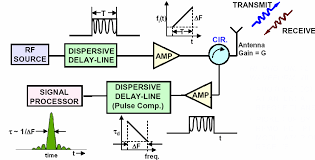
Pulse Compression: It helps in maintaining the integrity of quantum bits (qubits) as they travel through dispersive environments.
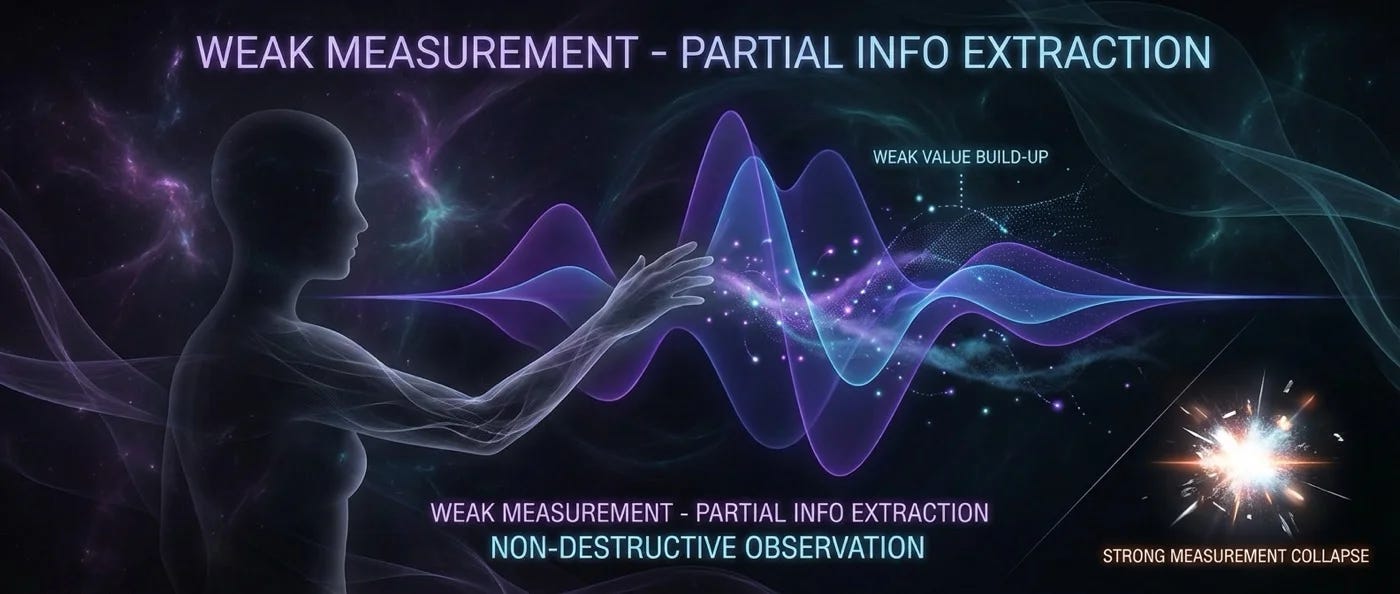
Weak Measurements: Researchers use NGD to study the “tunnelling time” of particles, a topic that remains one of the most debated areas in quantum mechanics.
Negaitve Time?
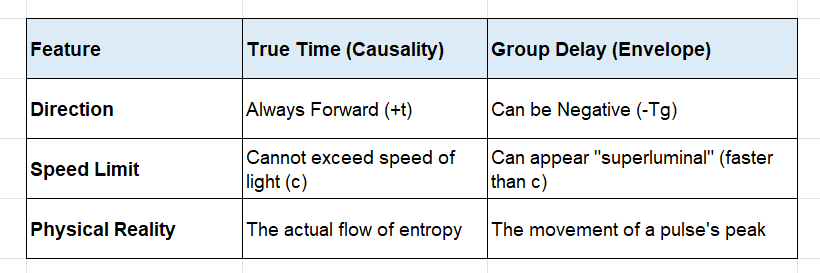
Conceptually, it is tempting to view it as “negative time,” but in quantum mechanics, it is more accurate to describe it as negative group delay rather than a reversal of the arrow of time.
In a vacuum, time $t$ is always positive as a particle moves from point A to point B. In a medium with negative group delay, the peak of the particle’s wave packet effectively “exits” before it “enters” in a relative sense, but this does not mean the particle traveled backward through time.
1. The Re-shaping vs. Reversing Distinction
To understand why this isn’t “time travel,” we have to look at how the wave packet is handled by the barrier or medium:
Pulse Re-shaping: The medium acts like a highly intelligent filter. It “eats” the back half of the wave packet and lets the very front tip pass through. This makes the center of the pulse appear much further ahead than it should be.
The “Causal Front”: Even in experiments showing negative group delay, the very first “ripple” of the wave—the absolute start of the signal—never arrives earlier than the speed of light would allow.
2. Is it “Effective” Negative Time?
In the context of Quantum Tunneling, some physicists use the term “apparent” or “effective” negative time. If you were to set a stopwatch based strictly on when the peak of the pulse passes two sensors, the math would indeed show a negative value.
However, this is generally considered a mathematical artifact of how we define the “arrival” of a quantum object. Because a quantum particle is a spread-out wave of probability rather than a single point, “arrival” is a statistical average. Negative group delay simply shifts that average forward.
3. The Hartman Effect
The most famous example of this “negative time” sensation is the Hartman Effect. It suggests that for a sufficiently thick barrier, the tunneling time becomes independent of the thickness.
Classical View: If a wall is twice as thick, it should take twice as long to cross.
Quantum NGD View: The particle “appears” on the other side almost instantaneously, regardless of thickness.
Summary Table: Time vs. Delay