Fertile Crescent and Mediterranean Cultures - Chapter 5
The Thinite Period established Egypt's centralized nation-state under Narmer, standardizing power symbols like the Serekh and burying kings in mud-brick mastabas at Abydos. Although grave robbing left pyramids empty, skeletal fragments and granite sarcophagi prove their use as tombs. Concurrently, the Mesopotamian Apkallu myth describes seven fish-headed sages emerging from the fresh-water Abzu to deliver civilization's divine blueprints, the Me, while holding the banduddu and mullilu. This systemic organization culminated in the Sumerian language developing a complex logosyllabic script where cuneiform signs operated dynamically as logograms, syllabograms, or determinatives to manage expanding urban administrative networks.
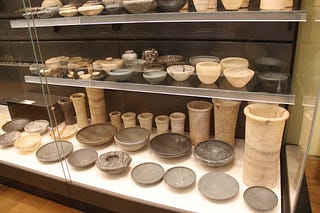
Egypt - Thinite Period
The Thinite Period (also known as the Early Dynastic Period, c. 3100–2686 BCE) is the Egyptian equivalent of the “Heroic Age” of Kish and Uruk. It comprises the First and Second Dynasties.
It is called “Thinite” because the rulers hailed from This (Thinis), a city near Abydos in Upper Egypt. While Memphis was the administrative capital, Thinis remained the spiritual and ancestral heart of the kingship.
1. The Unification (The “Narmer” Event)
Around 3100 BCE, the various chiefdoms of the Naqada III culture were consolidated into a single state.
The Vestige: The Narmer Palette is the primary record of this. It shows a king wearing the White Crown of Upper Egypt on one side and the Red Crown of Lower Egypt on the other.
The “First” King: Depending on the source (Manetho or the Abydos King List), the first king is called Menes, Narmer, or Aha. Most modern scholars believe these names likely refer to the same individual or a very close succession of “Founding Fathers.”
2. The Royal Necropolis of Abydos
If you are looking for the physical “DNA” of this epoch, you find it at Umm el-Qa’ab in Abydos.
The Mastaba: Unlike the later Pyramids, Thinite kings were buried in Mastabas (flat-topped, rectangular mud-brick structures).
Subsidiary Burials: A dark vestige of the First Dynasty is human sacrifice. In the tombs of kings like Djer, hundreds of servants were buried simultaneously to serve the king in the afterlife. This practice was abandoned by the Second Dynasty.
3. The Invention of the “Pharaonic” Brand
During the Thinite epoch, the iconography of power was perfected. Everything we associate with Pharaohs was “standardized” here:
The Serekh: Before the oval “Cartouche,” kings wrote their names inside a Serekh, a rectangular frame representing a palace facade topped by the Horus falcon.
The Titulary: The concept of the “Two Ladies” (the vulture and cobra) representing a unified Egypt was established.
The Sed Festival: The ritual of the King running a course to prove his physical fitness and “renew” his right to rule began in the First Dynasty.
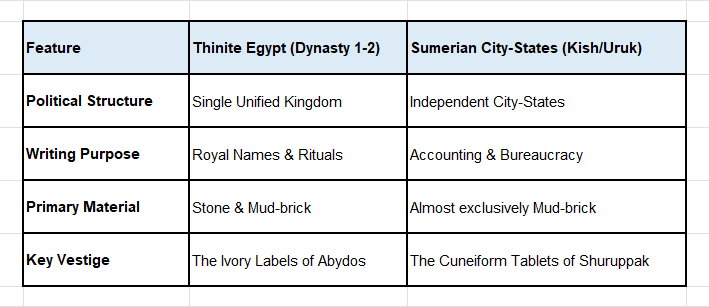
4. Comparison: Thinite Egypt vs. Early Dynastic Sumer
While Sippar, Kish, and Uruk were fighting each other as independent city-states, the Thinite Kings were doing something different: they were creating a centralized nation-state.
The Thinite Period (also known as the Early Dynastic Period, c. 3100–2686 BCE) is the Egyptian equivalent of the “Heroic Age” of Kish and Uruk. It comprises the First and Second Dynasties.
It is called “Thinite” because the rulers hailed from This (Thinis), a city near Abydos in Upper Egypt. While Memphis was the administrative capital, Thinis remained the spiritual and ancestral heart of the kingship.
1. The Unification (The “Narmer” Event)
Around 3100 BCE, the various chiefdoms of the Naqada III culture were consolidated into a single state.
The Vestige: The Narmer Palette is the primary record of this. It shows a king wearing the White Crown of Upper Egypt on one side and the Red Crown of Lower Egypt on the other.
The “First” King: Depending on the source (Manetho or the Abydos King List), the first king is called Menes, Narmer, or Aha. Most modern scholars believe these names likely refer to the same individual or a very close succession of “Founding Fathers.”
2. The Royal Necropolis of Abydos
If you are looking for the physical “DNA” of this epoch, you find it at Umm el-Qa’ab in Abydos.
The Mastaba: Unlike the later Pyramids, Thinite kings were buried in Mastabas (flat-topped, rectangular mud-brick structures).
Subsidiary Burials: A dark vestige of the First Dynasty is human sacrifice. In the tombs of kings like Djer, hundreds of servants were buried simultaneously to serve the king in the afterlife. This practice was abandoned by the Second Dynasty.
3. The Invention of the “Pharaonic” Brand
During the Thinite epoch, the iconography of power was perfected. Everything we associate with Pharaohs was “standardized” here:
The Serekh: Before the oval “Cartouche,” kings wrote their names inside a Serekh, a rectangular frame representing a palace facade topped by the Horus falcon.
The Titulary: The concept of the “Two Ladies” (the vulture and cobra) representing a unified Egypt was established.
The Sed Festival: The ritual of the King running a course to prove his physical fitness and “renew” his right to rule began in the First Dynasty.
4. Comparison: Thinite Egypt vs. Early Dynastic Sumer
While Sippar, Kish, and Uruk were fighting each other as independent city-states, the Thinite Kings were doing something different: they were creating a centralized nation-state.
FeatureThinite Egypt (Dynasty 1-2)Sumerian City-States (Kish/Uruk)Political StructureSingle Unified KingdomIndependent City-StatesWriting PurposeRoyal Names & RitualsAccounting & BureaucracyPrimary MaterialStone & Mud-brickAlmost exclusively Mud-brickKey VestigeThe Ivory Labels of AbydosThe Cuneiform Tablets of Shuruppak
5. Transition to the Old Kingdom
The Thinite period ended when Djoser (the first king of the Third Dynasty) decided to stack several mastabas on top of one another.
This created the Step Pyramid at Saqqara.
This architectural leap marked the end of the Thinite “Epoch of Foundations” and the beginning of the “Age of Pyramids” (the Old Kingdom).
Gemini said
The Thinite Period (also known as the Early Dynastic Period, c. 3100–2686 BCE) is the Egyptian equivalent of the “Heroic Age” of Kish and Uruk. It comprises the First and Second Dynasties.
It is called “Thinite” because the rulers hailed from This (Thinis), a city near Abydos in Upper Egypt. While Memphis was the administrative capital, Thinis remained the spiritual and ancestral heart of the kingship.
1. The Unification (The “Narmer” Event)
Around 3100 BCE, the various chiefdoms of the Naqada III culture were consolidated into a single state.
The Vestige: The Narmer Palette is the primary record of this. It shows a king wearing the White Crown of Upper Egypt on one side and the Red Crown of Lower Egypt on the other.
The “First” King: Depending on the source (Manetho or the Abydos King List), the first king is called Menes, Narmer, or Aha. Most modern scholars believe these names likely refer to the same individual or a very close succession of “Founding Fathers.”
2. The Royal Necropolis of Abydos
If you are looking for the physical “DNA” of this epoch, you find it at Umm el-Qa’ab in Abydos.
The Mastaba: Unlike the later Pyramids, Thinite kings were buried in Mastabas (flat-topped, rectangular mud-brick structures).
Subsidiary Burials: A dark vestige of the First Dynasty is human sacrifice. In the tombs of kings like Djer, hundreds of servants were buried simultaneously to serve the king in the afterlife. This practice was abandoned by the Second Dynasty.
3. The Invention of the “Pharaonic” Brand
During the Thinite epoch, the iconography of power was perfected. Everything we associate with Pharaohs was “standardized” here:
The Serekh: Before the oval “Cartouche,” kings wrote their names inside a Serekh, a rectangular frame representing a palace facade topped by the Horus falcon.
The Titulary: The concept of the “Two Ladies” (the vulture and cobra) representing a unified Egypt was established.
The Sed Festival: The ritual of the King running a course to prove his physical fitness and “renew” his right to rule began in the First Dynasty.
4. Comparison: Thinite Egypt vs. Early Dynastic Sumer
While Sippar, Kish, and Uruk were fighting each other as independent city-states, the Thinite Kings were doing something different: they were creating a centralized nation-state.
FeatureThinite Egypt (Dynasty 1-2)Sumerian City-States (Kish/Uruk)Political StructureSingle Unified KingdomIndependent City-StatesWriting PurposeRoyal Names & RitualsAccounting & BureaucracyPrimary MaterialStone & Mud-brickAlmost exclusively Mud-brickKey VestigeThe Ivory Labels of AbydosThe Cuneiform Tablets of Shuruppak
5. Transition to the Old Kingdom
The Thinite period ended when Djoser (the first king of the Third Dynasty) decided to stack several mastabas on top of one another.
This created the Step Pyramid at Saqqara.
This architectural leap marked the end of the Thinite “Epoch of Foundations” and the beginning of the “Age of Pyramids” (the Old Kingdom).
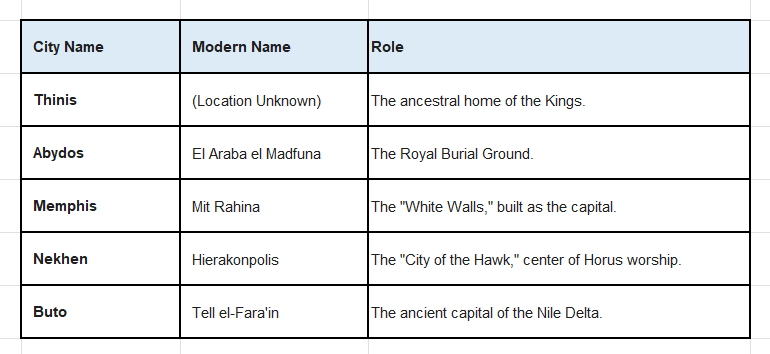
List of Major Thinite Cities
The “classic” image of a pristine mummy resting in a sarcophagus inside a pyramid is almost never what archaeologists find. When the Great Pyramids were first entered in the modern era, they were largely empty.
However, the reason for this is a matter of historical record rather than a lack of original intent. To be precise about the “vestiges” found:
1. The Reality of Grave Robbing
Almost every pyramid was broken into within a few centuries of being sealed—often during the “Intermediate Periods” of civil unrest.
The Evidence: Archaeologists find “robbers’ tunnels” cut through solid masonry, bypasses around granite portcullis blocks, and smashed sarcophagus lids.
The Result: Anything of value—gold, jewelry, and the resin-soaked mummies themselves (which were sometimes burned for light or stripped for amulets)—was taken long ago.
2. What Was Found (The Fragments)
While complete, intact mummies are rare in pyramids, human remains definitely exist in the archaeological record of these sites:
Pyramid of Unas: Fragments of a mummy, including a skull and right arm, were found in the burial chamber.
Pyramid of Djoser: Multiple skeletal remains were found in the subterranean galleries, including a hip bone of a young woman from the Saqqara “Step Pyramid” era.
Pyramid of Neferefre: Hand fragments and pieces of a mummy were found in the burial chamber.
The Red Pyramid: Human remains were found in the burial chamber of this pyramid built by Sneferu.
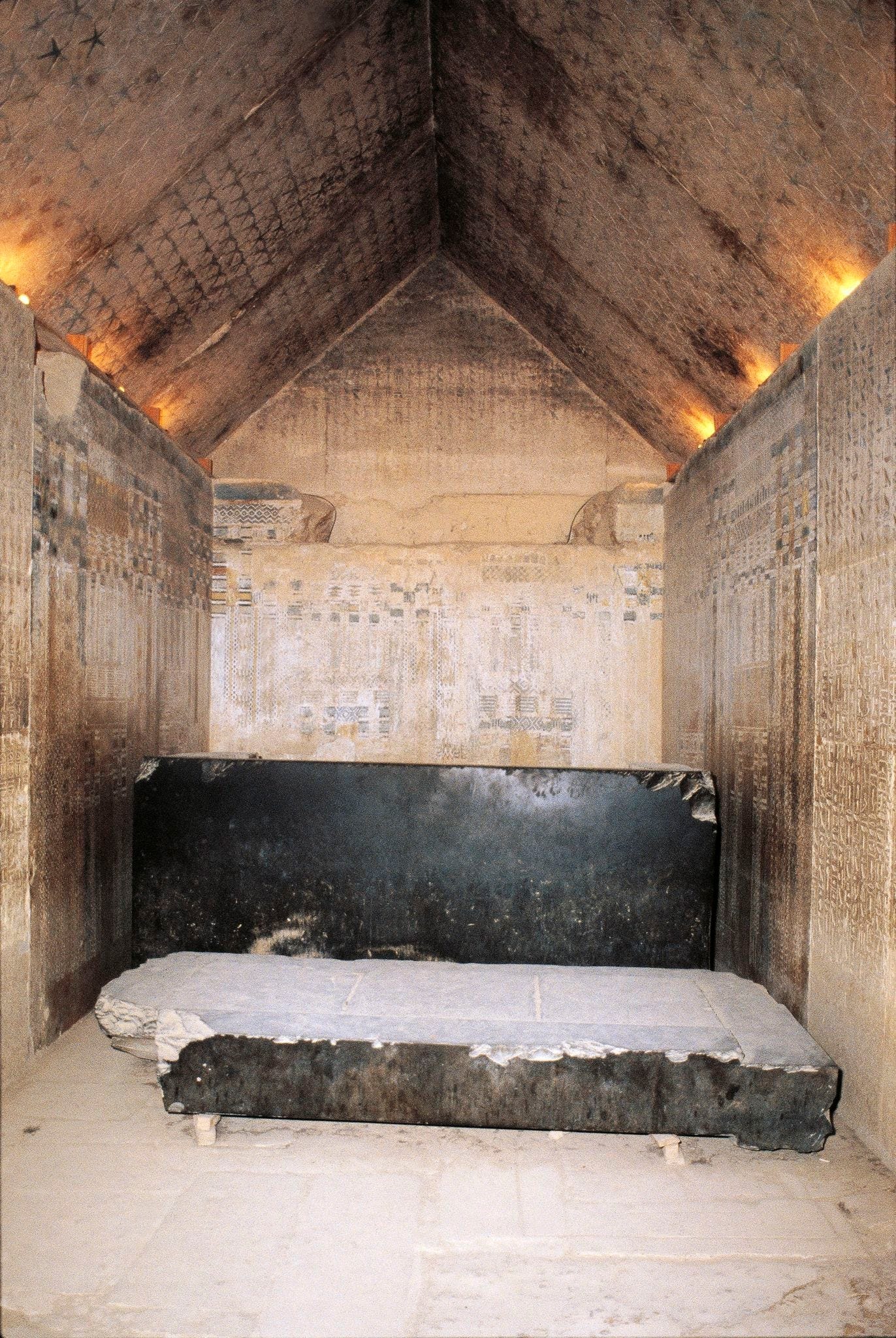
Egypt, Cairo, Ancient Memphis, Saqqara necropolis, Unas’ pyramid interior, burial chamber and sarcophagus
3. The “Intact” Exception: Hetepheres
The most famous “empty” mystery is the tomb of Queen Hetepheres I (mother of Khufu). Her hidden tomb was found intact with all her gold furniture, but her sarcophagus was empty. This led to the theory that her original tomb had been robbed and her son reburied her empty casket to hide the scandal from the court.
4. The Sarcophagi
If pyramids were not meant for bodies, the presence of sarcophagi—often carved from single blocks of Aswan granite and sunken into the floor—remains the primary architectural “vestige.”
In the Great Pyramid, the “King’s Chamber” contains a granite box that is slightly too wide to fit through the door, meaning it was placed there during construction.
It is sized exactly for a human-shaped coffin.
The Comparison: Pyramids vs. Valley of the Kings
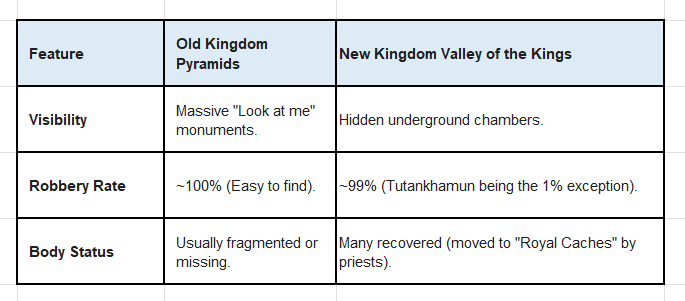
The "nonsense" often comes from the idea that because the bodies are gone now, they were never there. In the context of the Thinite Epoch and the Old Kingdom, the pyramid was the "House of Eternity." The body was the anchor for the Ka (spirit), and the massive stone structure was the fortress built to protect it—a fortress that, unfortunately, failed against the persistence of ancient looters.
The Apkallu myth (Abgal)
The Apkallu (Sumerian: Abgal) represent the absolute intersection of Sumerian biology, technology, and theology. In the “Black-Headed People’s” worldview, humanity did not “evolve” civilization—it was an external gift, brought up from the depths of the Abzu (Akkadian: Apsu).
1. The Source: The Abzu (Apsu)
In Mesopotamian cosmology, the Abzu was not just “the sea.” It was the primeval reservoir of fresh water that existed deep beneath the earth.
The Domain of Enki: The god Enki (Ea) lived in the Abzu in a palace called the E-Abzu.
The Reservoir of Knowledge: The Abzu was the literal home of the Me—the divine blueprints of civilization (the laws of kingship, the art of the scribe, the craft of the smith, and even the “art of the kiss”).
The Living Waters: Because fresh water meant life in a desert, the Abzu was seen as the source of all fertility and wisdom.
2. The Abgal: The Seven Sages
The Abgal were sent by Enki to “civilize” the world during the Antediluvian (Pre-Flood) era. They are described as being “of the same nature” as Enki himself.
Their Physical Form
They are almost always depicted in three ways:
The Fish-Man: A human figure wearing the skin of a carp, with the fish’s head as a hood and the scales as a cloak.
The Bird-Headed Man: Human bodies with the heads of eagles and wings (often associated with cleansing rituals).
The Fully Human: Often depicted with “long hair” or specialized robes, representing the “Sage” in a more relatable form.
The “Bucket and Cone” (Banduddu and Mullilu)
In almost every relief, the Apkallu hold two objects:
The Banduddu (Bucket): Held in the left hand, believed to contain “holy water” from the Abzu.
The Mullilu (Pinecone/Purifier): Held in the right hand. It was used to sprinkle the water, or perhaps to represent the “pollen” used in the artificial fertilization of date palms—a core technology of the Black-Headed People.
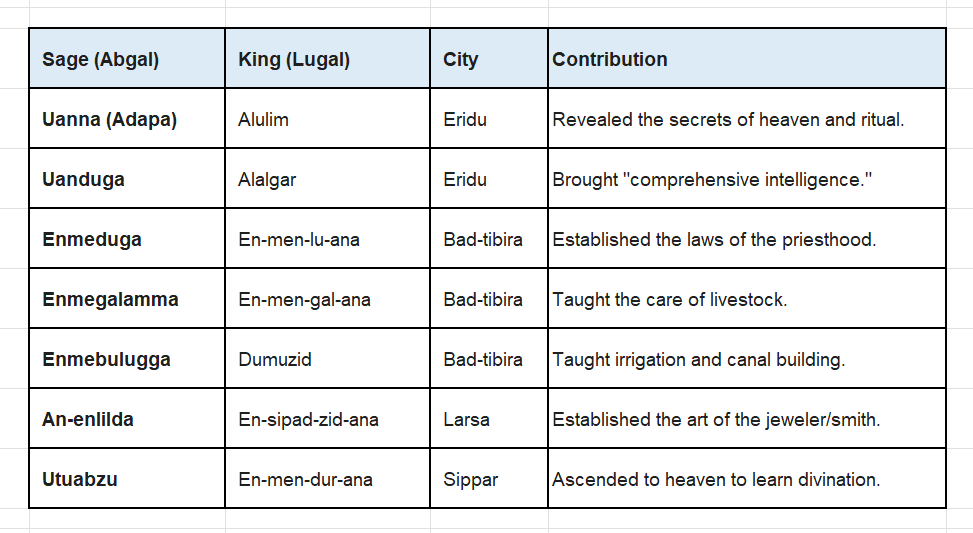
3. The Seven Sages and Their Kings
The myth states that each of the first seven kings of the Sumerian King List had an Abgal advisor. They provided the “brain” to the King’s “power.”
4. The “Fall” of the Apkallu
The myth takes a dark turn after the Great Flood.
The Pre-Flood Sages: Were purely divine/supernatural beings from the Abzu.
The Post-Flood Sages: After the flood, the Sages were said to be of “human descent” (two-thirds god, one-third human).
The Exile: In some myths (like the Poem of Erra), Enki becomes angry with humanity and orders the original Apkallu to return to the Abzu forever, sealing the door behind them. This explains why “modern” humans (post-2000 BCE) no longer have direct access to the primordial wisdom—we are living on the “cached” knowledge they left behind.
5. The “Vestiges” in the Soil
While the Apkallu are mythological, the archaeology reflects the myth:
Foundation Figures: Beneath the floors of houses in Ur, Nineveh, and Nimrud, archaeologists found small clay figurines of the Abgal (the Fish-Men). These were “apotropaic” devices—magic tech used to keep the house from “leaking” its luck or being invaded by demons.
The Enki Temple at Eridu: Excavations of the earliest levels (Ubaid period) found massive deposits of fish bones (specifically carp) around the altar. This suggests that the “Fish-Sage” myth was already active 7,000 years ago.
The Abgal represent the Sumerian answer to the question: “How did we know how to do all this?” Their answer was simple: “We didn’t. The Deep Water told us.” How does this “Deep Water” origin for the Sages compare to the Egyptian idea of knowledge coming from the Ibis-headed Thoth?
The Sumerian language is a linguistic isolate, meaning it has no known relatives. Its writing system, cuneiform, evolved from the pictograms we discussed into a sophisticated logosyllabic system.
To understand how the “Black-Headed People” represented their world, you have to look at the three ways a single cuneiform sign could function.
1. The Three Layers of a Sign
A Sumerian scribe didn’t just write “letters.” A single wedge-mark ($Gesh$) could be:
Logogram (Word-Sign): The sign represents a whole concept.
Example: The sign KA originally looked like a head with a mouth. As a logogram, it simply means “Mouth.”
Syllabogram (Sound-Sign): The sign represents a phonetic sound (Vowel, CV, VC, or CVC).
Example: The sign KA is used for the sound ka. If the scribe wanted to write a word that sounded like “ka” but had nothing to do with mouths, they used this sign.
Determinate (Category-Marker): A silent sign placed before or after a word to tell the reader what kind of thing it is.
Example: The sign DINGIR (a star) placed before a name indicates “This is a God.”
2. Syllabic Structure
Sumerian is agglutinative. Instead of changing the word itself (like “run” to “ran”), they glued “syllable-bricks” onto a main root.
Example: “To the Kings”
Lugal (King)
-ene (Plural marker: “Kings”)
-ra (Direction marker: “To”)
Result: Lugalenera (To the kings)
Each of these parts was represented by a specific syllabic sign. This made it very “easy” for a trained scribe to build complex sentences by stacking these phonetic blocks.
3. The Challenge: Polyphony and Homophony
Because the Sumerians used a limited number of sounds, they had a “Representation Problem”:
Homophony: Many different signs had the same sound.
Scholars number these: $gu$ (thread), $gu_{2}$ (neck), $gu_{3}$ (voice). To the ear, they sounded similar; to the eye, the signs were totally different.
Polyphony: One sign could have multiple meanings and sounds.
The sign AN could mean “Sky” (pronounced an) or “God” (pronounced dingir). Context was everything.
4. Representation in the “Edubba” (Tablet House)
Scribes were trained using Syllabaries. These were “dictionaries” that listed signs by their phonetic value.
The “Easy” Path: For basic accounting (grain, sheep), they used simple logograms. 10 sheep = [Sign for 10] + [Sign for Sheep].
The “Complex” Path: For the Epic of Gilgamesh or the myths of the Abgal, they switched to full syllabic writing to capture the nuances of grammar, prefixes, and suffixes.
5. Why Cuneiform “Won”
The reason cuneiform lasted for 3,000 years is its flexibility. Because it was syllabic, it didn’t just work for Sumerian.
When the Akkadians arrived, they kept the Sumerian signs but used them to write their own Semitic language phonetically.
It was like using the Latin alphabet to write English, French, or Turkish. The “Black-Headed People” created a software (the script) that outlived their own civilization.