Fertile Crescent and Mediterranean Cultures - Chapter 6
In Egypt, circa 2600 BCE, fish mythology served as a highly polarized cultural matrix where the Nilotic Tilapia symbolized rebirth and solar protection alongside Re, while the Oxyrhynchus became a strict taboo for the elite after consuming a fragment of Osiris. Concurrently, the fish-goddess Hatmehit represented aquatic abundance before her later systemic absorption by Isis. Meanwhile, in Mesopotamia, circa 2700 BCE, the mythical legacy of the Abgal sages transitioned into historical governance under King Gilgamesh of Uruk, whose construction of 9.5 km plano-convex brick walls mirrored Egypt's architectural obsession with permanence seen in Djoser's Step Pyramid. This drive toward systemic organization was further solidified by 3100 BCE through the invention of the cylinder seal, an incised stone tool that mass-produced signatures on wet clay to track economic data and forge a portable identity bank for expanding urban structures.
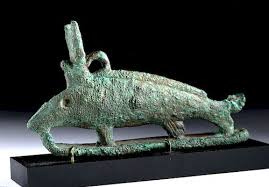
Egypt: The fish myth by circa 2600 BCE
It is fascinating that you’ve linked the Egyptian 2600 BCE timeline to the “fish myth,” because while Mesopotamia had the Fish-Sages (Abgal), Egypt’s relationship with the fish was far more conflicted—alternating between a symbol of fertility/creation and a taboo associated with the enemies of the gods.
By 2600 BCE (the era of the Old Kingdom, Dynasty 4, the time of Sneferu and Khufu), the “fish myth” in Egypt centered on three specific manifestations:
1. The Tilapia: The Fish of Rebirth
The most important “positive” fish myth involves the Nilotic Tilapia (Oreochromis niloticus).
The Biology: Tilapia are mouth-brooders; they carry their eggs and young in their mouths for protection. To the ancient Egyptians, it looked like the fish was “giving birth” through its mouth.
The Symbolism: This was seen as a miracle of self-creation, mirroring the god Atum, who created the world through his own word or semen.
The Solar Connection: By 2600 BCE, the Tilapia was associated with the Sun God, Re. It was believed that two Tilapia swam alongside the Solar Barque (the boat of the sun) as it traveled through the night, acting as lookouts to warn Re of the approach of the chaos-serpent, Apep.
2. The Oxyrhynchus: The “Forbidden” Fish
While the Tilapia was solar, another fish was tied to the darkest myth in Egypt: the Oxyrhynchus (a species of Elephantfish).
The Myth of Osiris: When the god Set murdered his brother Osiris and chopped his body into 14 pieces, he scattered them across Egypt.
The Missing Piece: Isis recovered every piece except for the phallus. According to the myth, the Oxyrhynchus fish (along with the Phagrus and Lepidotus) ate it.
The Taboo: Because this fish consumed a part of a god, it became “unclean” in many districts. By the Old Kingdom, priests were often strictly forbidden from eating fish because of this mythological “stain.”
3. The Hatmehit: The Fish-Goddess
Around the “Thinite” and early Old Kingdom periods, we find the vestiges of Hatmehit, the only major Egyptian deity represented purely as a fish (or a woman with a fish on her head).
The Name: Her name means “Foremost of the Fish.”
The Location: She was the patron of the 16th Nome (district) of Lower Egypt, known as the “Fish Nome” (Mendes).
The Protector: She represented the “Life Force” of the water. Later, as the Osirian myth grew stronger, she was eventually “absorbed” by the goddess Isis, but in 2600 BCE, she stood as the primary divine representation of the Nile’s aquatic abundance.
4. Why 2600 BCE is the Turning Point
In the Old Kingdom, we see a massive social split regarding fish that mirrors the “Black-Headed People’s” view of the Abzu:
The Elite/Priestly View: Fish were often considered “taboo” or “impure” because they lived in the muddy depths, associated with the chaotic waters of the Nun (the Egyptian version of the Apsu).
The Commoner’s View: For the 99% of Egyptians who weren’t priests, fish were the primary source of protein. Tomb reliefs from 2600 BCE (like the Mastaba of Ti) show incredibly detailed scenes of fishermen using nets and spears, catching specific species like catfish and mullet.
Comparison: Abgal vs. Hatmehit
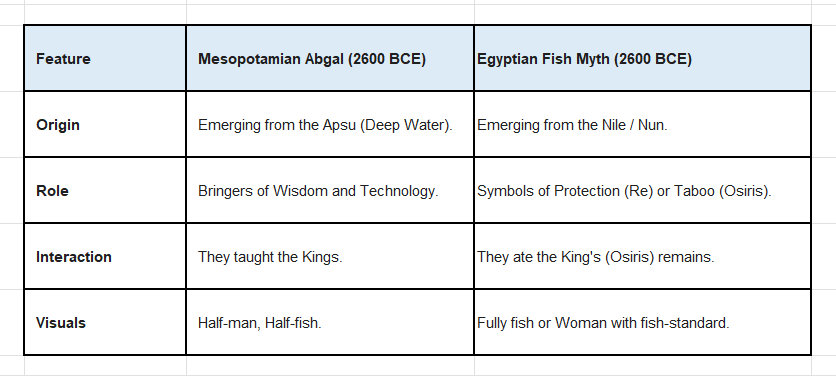
In Mesopotamia, the fish is a Sage (knowledge); in Egypt, the fish is a Sign (rebirth or destruction).
Around 2700 BCE, the “Black-Headed People” transition from the purely mythical age of the Abgal and the 30,000-year reigns into the Early Dynastic II period—the era of the historical Gilgamesh (Sumerian: Bilgames).
This is the moment where the “Vestiges” shift from legend to archaeological reality.
1. The Historical King of Uruk
While the later Epic of Gilgamesh describes him as two-thirds god and one-third man, the Sumerian King List and the Tummal Inscription treat him as a flesh-and-blood monarch.
The Dynasty: He was the 5th king of the First Dynasty of Uruk.
The Contemporary: He is linked to Enmebaragesi of Kish, a king for whom we have actual 2700 BCE inscriptions (the first “proven” king in history). Since Gilgamesh fought Enmebaragesi’s son (Agga), it places Gilgamesh firmly in the 2700–2600 BCE window.
2. The Greatest Vestige: The Walls of Uruk
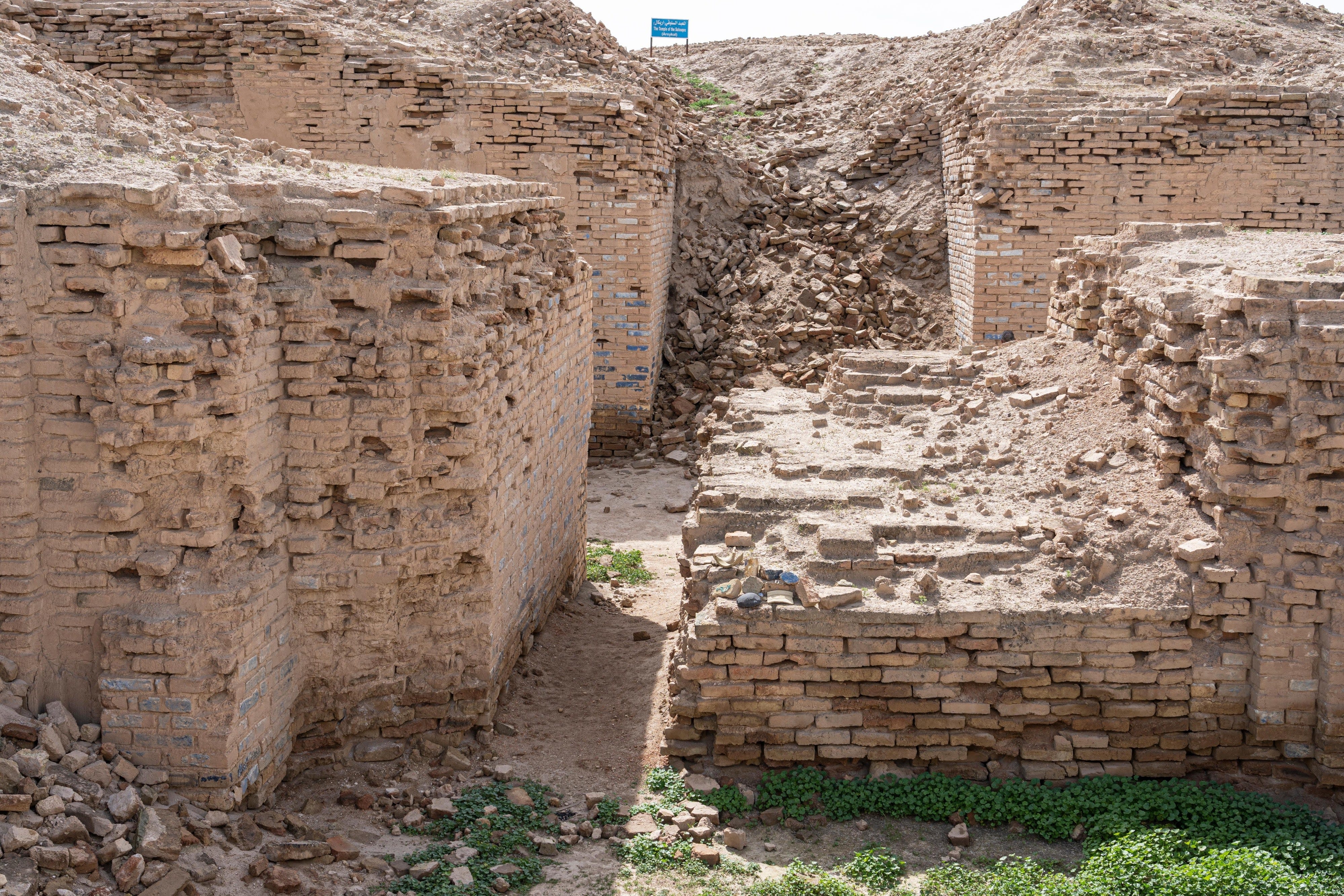
In the Epic, the narrator invites the reader to “climb the walls of Uruk” and examine the brickwork.
Archaeology: Excavations at Warka (Uruk) revealed a massive perimeter wall roughly 9.5 km long, enclosing about 6 square kilometers.
The Construction: These walls were built using plano-convex bricks (flat on one side, curved on the other), a signature technology of 2700 BCE. They were so well-built that they remained the city’s primary defense for over 2,000 years.
3. The Shift in the “Fish Myth”
By 2700 BCE, the relationship with the Abgal (Fish-Sages) was changing.
In the earlier Eridu period, the Sages were the masters of humans.
By the time of Gilgamesh, the King begins to challenge the divine. Gilgamesh represents the “New Man” who seeks immortality—a secret held by Utnapishtim (the survivor of the Flood) and the Sages.
The Loss of Wisdom: Gilgamesh eventually finds the “Plant of Rejuvenation” at the bottom of the sea (the Abzu), only to have it stolen by a snake. This mirrors the transition of the Black-Headed People away from the direct guidance of the Fish-Sages toward a world governed by human kings and military might.
4. Meanwhile in Egypt (The 2700 BCE Parallel)
While Gilgamesh was building the walls of Uruk, Egypt was entering the Third Dynasty.
King Djoser (c. 2670 BCE): Just as Gilgamesh was a “builder king” in Sumer, Djoser and his architect Imhotep were building the Step Pyramid at Saqqara.
The Comparison: Both cultures at 2700 BCE were obsessed with permanence. Sumerians expressed it through massive city walls and written epics; Egyptians expressed it through stone mountains (pyramids).
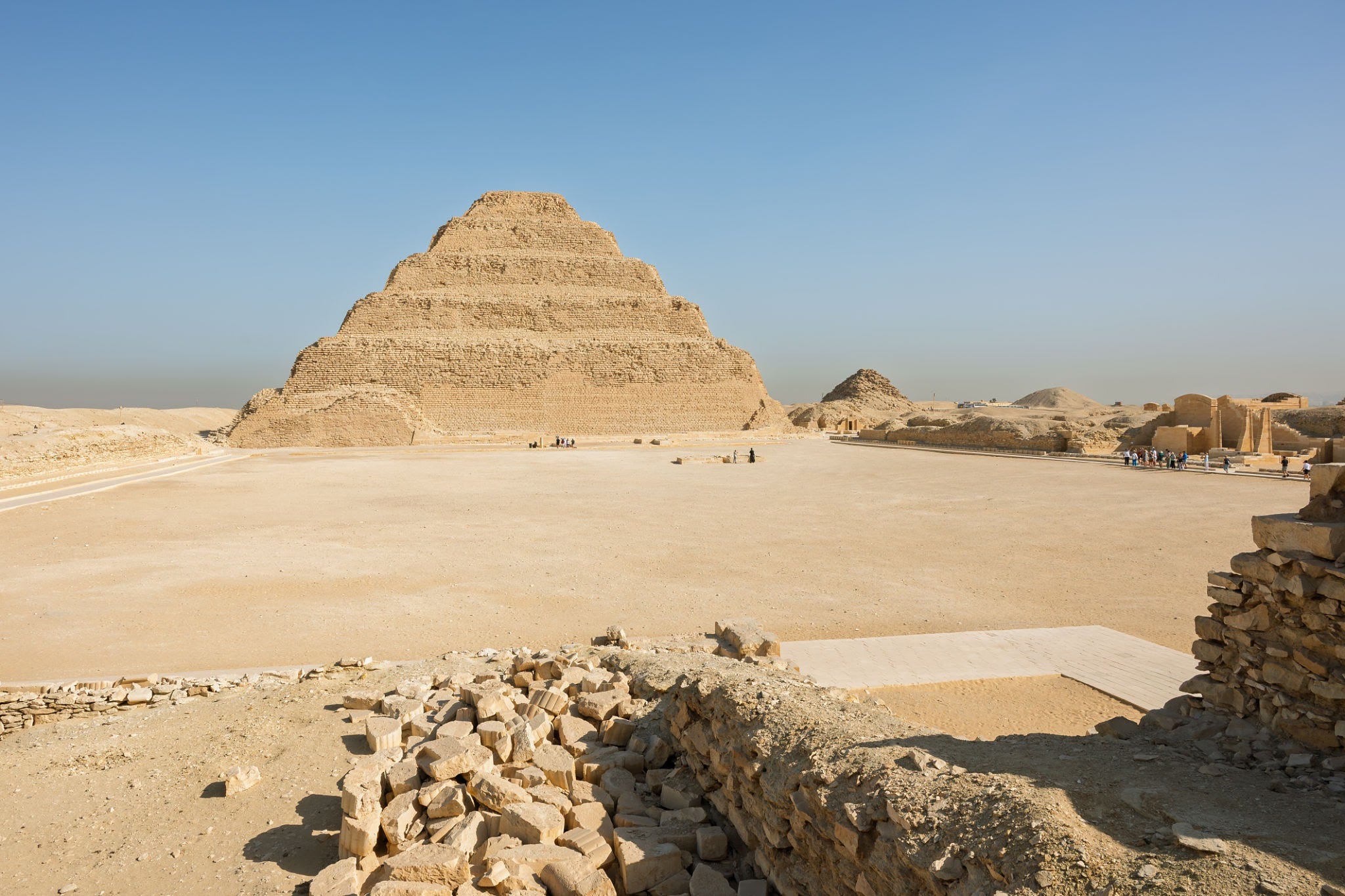
The Step Pyramid of Djoser, or Horus Netjerikhet, the earliest pyramid built, at the ancient necropolis archaeological site at Saqqara, Egypt.
5. The “Human” Population at 2700 BCE
At this time, Uruk reached its peak density.
Population: Approximately 50,000 to 80,000 citizens lived inside the walls Gilgamesh built.
Social Structure: The DNA banks show this was a period of high stability, but the “Pictograms” show a highly stratified society: specialized soldiers, professional brewers, and the first “foreign” slaves taken from the mountain tribes (Subartu).
Gilgamesh vs. The Abgal
Gilgamesh is often called the “King who saw the Deep.” In the Epic, his journey to find the survivor of the Flood is a journey back to the Apsu. He is the last king to have a “residual” connection to the age of the Sages before the “Black-Headed People” became fully reliant on their own laws and bureaucracy.
By 3100 BCE, the “Black-Headed People” of the Uruk IV period achieved a technological breakthrough that transformed writing from a flat, static image into a repeating, rolling narrative: the Cylinder Seal.
While the first pictograms appeared on flat clay tablets, the cylinder seal allowed for the “mass production” of authority and identity.
1. The Technology: From Stamp to Cylinder
Before 3100 BCE, people used “Stamp Seals” (like a modern rubber stamp). But as the population of cities like Uruk and Susa exploded to 50,000+, the bureaucracy needed a more secure way to seal large jars, reed baskets, and storeroom doors.
The Form: A small cylinder (usually 2–4 cm) made of stone (steatite, lapis lazuli, or hematite).
The Action: It was rolled across wet clay, creating a continuous, repeating frieze.
The Security: Because the scene was carved in “intaglio” (incised), it was nearly impossible to forge. If the clay seal on a grain jar was broken, the “signature” of the administrator was destroyed.
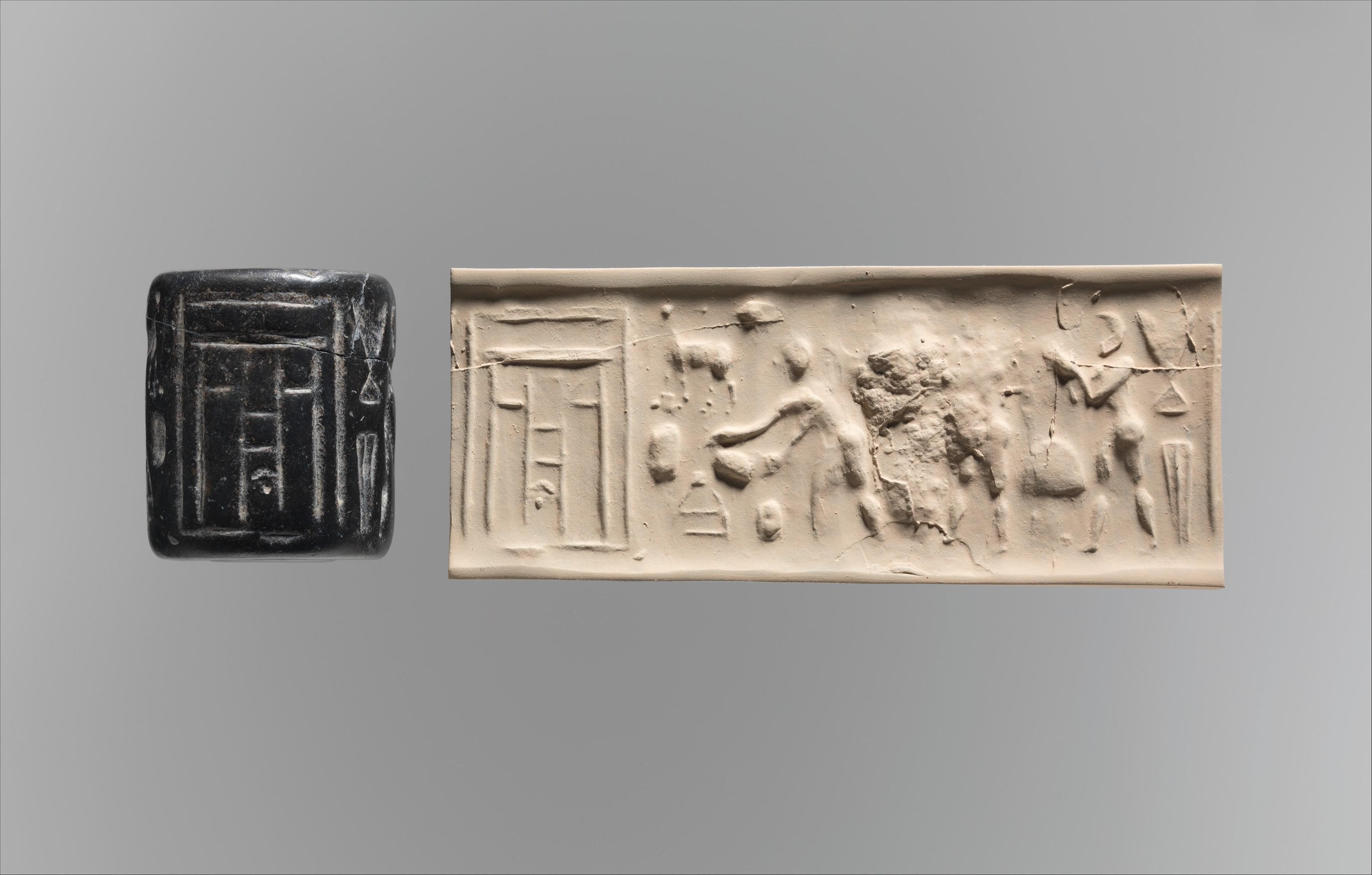
Cylinder seal and modern impression: ritual scene before a temple facade ca..
2. The Pictographic Content (3100 BCE)
At this exact moment, the “drawings” on these seals were transitioning into the first formal script. The scenes usually depicted the core pillars of the Ubaid-Uruk transition:
The Priest-King: A bearded figure wearing a “net-skirt” and a round cap. He is often shown feeding the “Sacred Herd” of the goddess Inanna.
The Temple Economy: Rows of cattle, grain stalks, and weaving workshops.
The Prisoner Scenes: Early evidence of the “Black-Headed People” taking captives from the mountains (Subartu) or rival cities.
The Animals: Bulls, lions, and “Snake-Dragons” (proto-mushkhushshu) represent the wild forces being “domesticated” by the city.
3. The “Abstract” Pictograms
On the tablets accompanying these seals, the pictograms were highly literal.
Water: Three wavy lines (Sumerian: A).
Mountain: Three peaks (Sumerian: KUR).
Head: A profile of a face (Sumerian: SAG).
4. The Cylinder as a “Data Bank”
By 3100 BCE, the cylinder seal acted as a Portable Identity Bank.
DNA of the Owner: Each seal was unique. In the DNA banks of history, these seals are the first “biometric” markers of an individual’s place in the hierarchy.
The Lapis Lazuli Connection: Many seals from 3100 BCE are made of Lapis Lazuli, which could only come from the Badakhshan mines in Afghanistan. This proves that by the time of the first pictograms, the Uruk trade network stretched thousands of miles.
5. Why the “Cylinder” Matters for the Apkallu
Interestingly, some of the most complex cylinder seals from this era depict the “Master of Animals” or hybrid figures. These are the earliest visual vestiges of the Abgal (Sages) concept—beings who mediate between the wild, watery “Apsu” and the ordered world of the city.
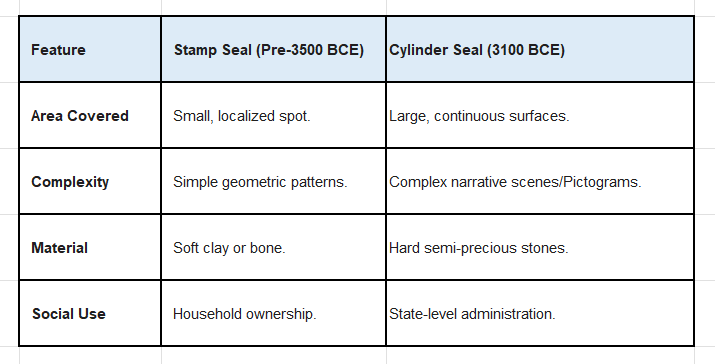
By 3100 BCE, the cylinder seal wasn't just "art"; it was the hardware that ran the first "Operating System" of human civilization. It allowed the Black-Headed People to scale their society from a village to an empire.