Fertile Crescent and Mediterranean Cultures - Chapter 9
The architectural 6,000-year evolution of the Ziggurat reflects shifting Mesopotamian authority from religious leaders to absolute kings. What began as humble, single-room Neolithic shrines transformed into elevated platforms at Eridu, shimmering monumental structures in Uruk, and fortified hubs during the Early Dynastic period. This progression culminated in the classical, multi-tiered Great Ziggurat of Ur, engineered with water-resistant fired bricks and weep holes to connect earth and sky. Politically, this era witnessed a monumental transition with the rise of Sargon of Akkad, who established the world's first empire through sweeping centralization, a standing army, and technological innovations like the composite bow. His daughter, Enheduanna, became the first named author by blending Sumerian and Akkadian pantheons to stabilize the territory, while his grandson, Naram-Sin, claimed divine status. Despite intense military prowess, a severe century-long drought, ongoing internal revolts, and incoming tribal invasions triggered the empire's ultimate collapse.
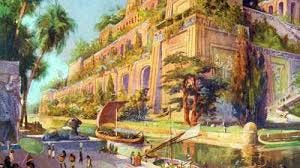
The Ziguratt evolution from 8.000 to 2.000 BCE
The evolution of the Ziggurat is the physical record of the “Black-Headed People” moving from small communal shrines to massive “stairways to heaven.” This 6,000-year architectural journey reflects the shifting power from the En (Priest) to the Lugal (King).
1. The Neolithic Germination (8000–5000 BCE)
Before the Ziggurat, there was the Shrine.
The Concept: Early farmers in the Levant and the Zagros foothills built small, one-room structures of sun-dried mud.
The Vestige: At sites like Jericho and Çatalhöyük, we find “cult rooms” with plastered skulls and bull horns. There is no “elevation” yet; the sacred space is at the same level as the home.
2. The Ubaid High Platform (5000–4000 BCE)
This is the “Birth of the Mountain.” The people moved into the southern marshes and began to elevate their gods above the floodwaters.
The Site: Eridu (Temple XVI–VII).
The Evolution: Archaeologists found 18 levels of temples built one on top of the other. As a temple crumbled, they didn’t clear the debris; they leveled it and built a new one on top.
The Result: By 4000 BCE, the temple sat on a man-made hill (the Temenos). This was the first time the “Divine” was physically higher than the “Human.”
3. The Uruk Monumentality (4000–3100 BCE)
The “Black-Headed People” now had the bureaucracy to organize thousands of laborers.
The White Temple (Uruk): A massive high platform (13 meters high) topped by a gleaming white-washed temple.
The Innovation: They began using Cone Mosaics—thousands of colored clay cones pressed into the wet plaster to create geometric patterns. This protected the mud-brick from erosion and gave the “Mountain of God” a shimmering, supernatural skin.
4. The Early Dynastic “Temple Oval” (2900–2350 BCE)
As the Lugal (King) rose to power, the Ziggurat became a fortress.
The Shape: Temples like the one at Khafajah were enclosed in massive oval walls.
The Separation: The “sacred precinct” was now a “city within a city,” separated from the common people by heavy gates and guard towers.
5. The Classical Ziggurat: Ur-Nammu (2100–2000 BCE)
This is the “Final Form” of the Ziggurat, perfected during the Ur III period. The King Ur-Nammu standardized the architecture we recognize today.
The Three Stages: It was no longer just a platform; it was a multi-tiered tower (usually three levels).
The Materials: A core of sun-dried mud-brick encased in a thick “shell” of fired bricks set in bitumen (natural asphalt). This made it waterproof and permanent.
The Weep Holes: They engineered small holes in the exterior to allow moisture to escape from the mud core, preventing the “mountain” from exploding or collapsing.
The Zenith: The Great Ziggurat of Ur, dedicated to the Moon God Nanna. It featured three massive staircases that met at a central landing.
Summary of Evolution
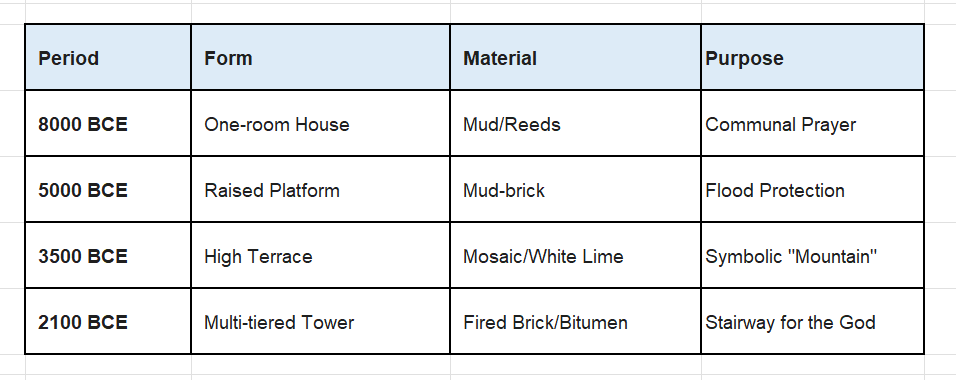
The “Apsu” Connection
The Ziggurat was called the “Bond between Heaven and Earth” (Dur-an-ki). The base of the Ziggurat was believed to be rooted in the Apsu (the deep fresh waters of Enki), while the top touched the sky (Anu). By climbing the stairs, the King was literally bridging the gap between the physical world and the “Knowledge” of the Sages.
2324 - 2154 BCE Sargon and the Akkadioans
The transition from the Early Dynastic period to the Akkadian Empire (c. 2334–2154 BCE) represents the most significant political shift in human history: the birth of the World’s First Empire.
For the “Black-Headed People,” this was a period of cultural synthesis. The Sumerian “Knowledge” was not destroyed; it was absorbed by a new, dynamic, Semitic-speaking power centered in the north.
1. Sargon of Akkad: The “True King”
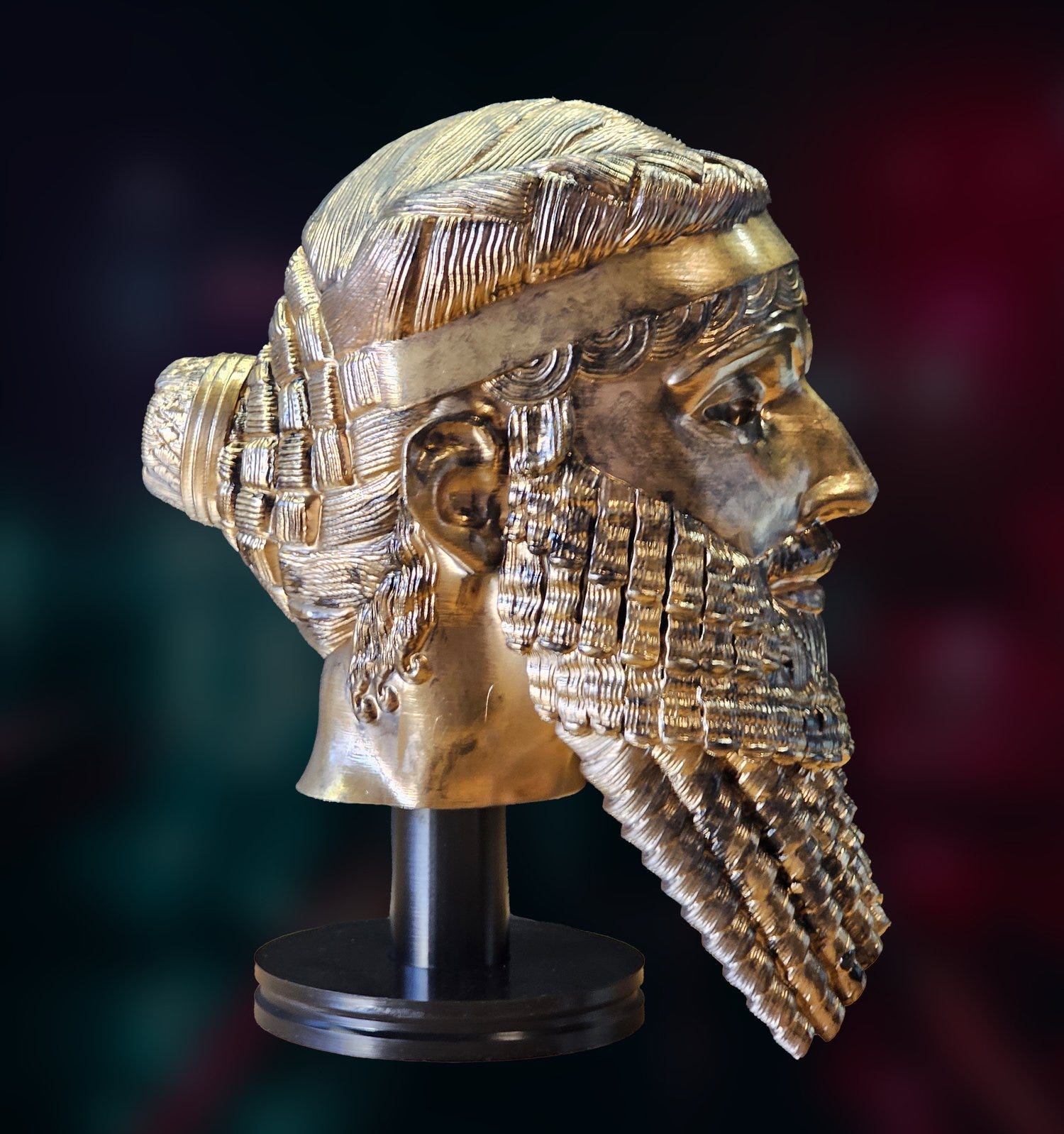
Around 2334 BCE, a man named Sargon (Akkadian: Sharru-kin, meaning “The King is Legitimate”) rose from the court of the King of Kish.
The Origin Myth: Like later stories of Moses, Sargon was said to be a foundling set adrift in a basket of reeds on the Euphrates, rescued by a gardener, and loved by the goddess Ishtar.
The Conquest: He defeated Lugalzagesi of Uruk (the last great Sumerian King), marched him in a neck-stock to the gates of Nippur, and declared himself the ruler of all Mesopotamia.
The Capital: He built a new city, Agade (Akkadian: Akkad). Its exact location remains one of the greatest “lost” vestiges of archaeology, likely buried under the modern suburbs of Baghdad.
2. Imperial Innovation (The “State” DNA)
Sargon and his successors didn’t just rule cities; they invented Imperialism.
Centralization: They replaced local Ensis (governors) with Akkadian officials—”Sons of Akkad.”
Standardization: They created a unified system of weights and measures to facilitate trade across the empire.
Bilingualism: While Akkadian became the language of administration, Sumerian was preserved as the language of high religion and science.
The Standing Army: Sargon claimed that “5,400 men ate bread daily before him,” representing the first professional, permanent military force in history.
3. Enheduanna: The First Named Author
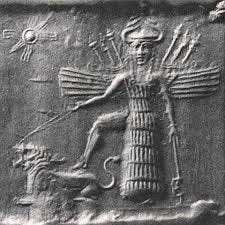
Sargon’s daughter, Enheduanna, provides one of the most vital “Human Knowledge” links.
The Role: Sargon appointed her as the En-Priestess of Nanna at Ur.
The Achievement: She is the first individual in recorded history to sign her name to a literary work. She wrote the Exaltation of Inanna, a sophisticated theological poem that merged the Sumerian Inanna with the Akkadian Ishtar.
The Legacy: Her work stabilized the empire by uniting the northern (Akkadian) and southern (Sumerian) religious systems.
4. Naram-Sin: The God-King (c. 2254–2218 BCE)
Sargon’s grandson, Naram-Sin, took the “Lugal” concept to its extreme.
Divinity: He was the first king to officially deify himself during his lifetime. He added the Dingir (star) prefix to his name and wore the “Horned Helmet” of a god.
The Victory Stele: This famous vestige shows him climbing a mountain, trampling his enemies, while suns (gods) shine down on him.
The Curse: Later myths (The Curse of Agade) claimed that Naram-Sin destroyed the temple of Enlil at Nippur, leading the gods to abandon Akkad and call in the “Gutian” mountain tribes to destroy the empire.
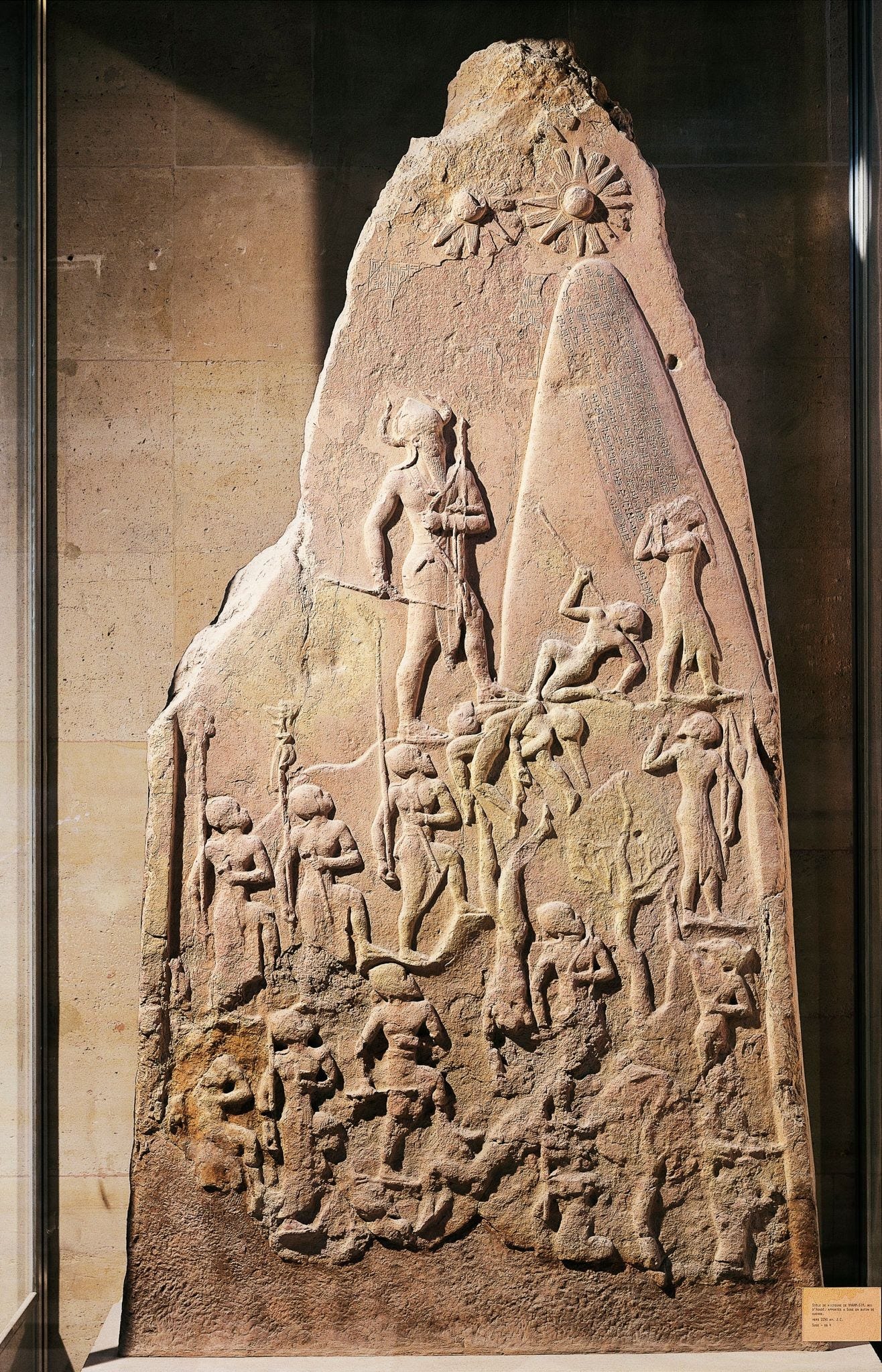
Victory Stele of Naram-Sin, king of Akkad, from Shush (ancient Susa), Iran
5. The Akkadian Military Machine
The “Black-Headed People” under Akkad moved away from the slow-moving Sumerian phalanx.
The Composite Bow: The Akkadians perfected the composite bow (made of wood, horn, and sinew), which had a much longer range and higher penetration than the simple bows used previously.
Light Infantry: They utilized mobile, unarmored troops who could maneuver in the mountains and deserts, allowing the empire to stretch from the Persian Gulf to the Mediterranean Sea and into Anatolia (modern Turkey).
6. The Collapse and the “Dark Age” (c. 2154 BCE)
The empire lasted roughly 180 years. Its fall was caused by a “Perfect Storm”:
Climate Change: The “4.2 kiloyear event”—a severe, century-long drought that caused the agricultural system to fail.
Internal Revolts: The Sumerian cities (Ur, Lagash) never truly accepted Akkadian rule and revolted constantly.
The Gutians: Pastoralist tribes from the Zagros Mountains invaded, leading to a period of chaos where “no one knew who was king.”
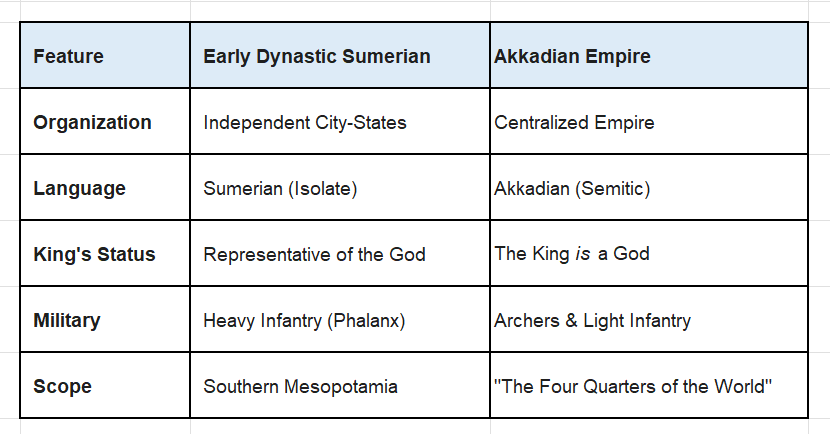
Comparison: Sumerian vs. Akkadian
The “Apkallu” and Akkad
During the Akkadian period, the Abgal myths were standardized into the Akkadian language. The Sages were no longer just Sumerian spirits; they became the universal foundations of Ea’s (Enki’s) wisdom. The Akkadians saw themselves as the “rightful heirs” to the knowledge brought up from the Apsu, using that ancient technology to forge a new world order.