1.5.4 — The Einstein Field Equations: Deriving G_mu_nu = (8πG/c⁴) T_mu_nu
This text outlines the derivation of the Einstein field equations, demonstrating how matter and energy sculpt spacetime geometry. To maintain consistency with local conservation laws and the classical Newtonian limit, the framework requires a generally covariant, second-order tensor equation. While using the Ricci tensor alone fails due to non-vanishing divergence, applying the twice-contracted Bianchi identity isolates the divergence-free Einstein tensor (G_mu_nu). Through Lovelock's theorem, this representation is proved unique in four dimensions up to an optional, additive cosmological constant (Lambda), which modern data uses to explain cosmic acceleration. The final coupling constant is fixed at 8piG/c^4 to reduce cleanly to Poisson's equation. Ultimately, this produces ten non-linear differential equations, where four components represent coordinate gauge freedom, leaving six physical dynamical equations to dictate gravitational evolution.
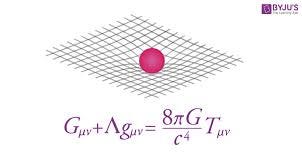
By the end of 1.5.3 we hold the right half of the story: free particles follow geodesics of a spacetime whose metric g_mu_nu is, for the moment, given. What remains is the left half — the determination of g_mu_nu itself. A theory of gravity in the relativistic sense must answer the inverse question: how is geometry shaped by what occupies spacetime? The equivalence principle showed that gravity is geometry; the geodesic equation showed how geometry guides matter; now we need the converse statement, how matter sculpts geometry. This is the content of the Einstein field equations. The path to them is one of the most striking passages in twentieth-century physics: the derivation is nearly forced, once the desiderata are stated honestly. Nature, here, did not have very many choices.
The Desideratum
We require a tensor equation, local in character, relating the geometry of spacetime at a point to the matter-and-energy content at that point. The conditions are stringent and not negotiable:
Tensorial. The equation must hold in every coordinate system — general covariance demands it. Both sides must be tensors of the same rank.
Second-order in the metric. The metric g_mu_nu plays the role formerly played by the Newtonian potential Φ. Since Newtonian gravity is governed by a second-order equation, ∇²Φ = 4πGρ, continuity with the limit we must recover forces a second-order differential equation in g_mu_nu.
Reduction to the Newtonian limit. When |h_mu_nu| << 1 and velocities are non-relativistic, the equation must reproduce ∇²Φ = 4πGρ, with Φ identified as in 1.5.3 by h_00 = -2Φ/c².
Source-driven. The right-hand side must represent matter and energy — not rest mass alone, but every form of energy, momentum, pressure, and stress that Poincaré-invariant physics counts. Special relativity taught us that E = mc² is not a slogan but an identity; therefore all of it must gravitate.
Consistent with local conservation. Whatever stands on the right must have vanishing divergence, ∇^μ (source)_μν = 0, because energy and momentum are locally conserved. This will force the left-hand side to have vanishing divergence as well, and this is the constraint that does most of the work.
That is the whole list. The surprising fact is that it nearly determines the answer.
The Stress-Energy Tensor
The source we need is already familiar from special relativity: the stress-energy tensor T_mu_nu. It packages, into a single symmetric rank-two tensor, the energy density (T_00), the momentum density and energy flux (T_0i), and the internal stresses (T_ij) — pressure along the diagonal, shear off it. For a perfect fluid of rest-frame density ρ and pressure p, with four-velocity u^μ,
T_mu_nu = (ρ + p/c²) u_μ u_ν + p g_mu_nu.
For electromagnetism T_mu_nu is built from F_mu_nu and the metric; for a scalar field, from ∂_μ φ and the potential; for every matter Lagrangian there is a corresponding T_mu_nu. In every case, local conservation reads
∇^μ T_μν = 0,
covariantly, once we are in curved spacetime. This is not an added postulate. It is an identity that any matter theory consistent with general covariance must satisfy, as Noether’s theorem will show in 1.5.5 when we apply it to diffeomorphism invariance. What matters here is that T_mu_nu is the source. Not ρ alone, but the full tensor. Pressure gravitates. Shear gravitates. The energy stored in an electromagnetic field gravitates. The radiation pressure of starlight bends spacetime, in principle, just as the mass of the star does — feebly, but in principle. This is already a departure from Newton, who knew only ρ. It is the first sign that the new theory will diverge from the old not only in the strong field but also in the very list of things that can act as a source of gravity.
Why the Ricci Tensor Alone Will Not Do
The natural first guess — and Einstein’s first guess, in the Entwurf theory of 1913 — is that the left-hand side should simply be the Ricci tensor R_mu_nu. It is symmetric, it is second-order in the metric, it is built from the Riemann tensor by the contraction R_mu_nu = R^ρ_μρν, and it vanishes in flat spacetime. Writing
R_mu_nu = κ T_mu_nu
for some constant κ, one has a tensor equation of the right general shape.
It does not work. The reason is a single, fatal fact: in general,
∇^μ R_μν ≠ 0.
The Ricci tensor is not divergence-free. Setting it proportional to T_mu_nu — which is divergence-free — therefore forces a contradiction in all but the most trivial configurations. Either matter fails to conserve its energy and momentum, or the geometry forbids matter from doing what matter must. One might try to patch the problem by imposing ∇^μ T_μν = 0 and hence ∇^μ R_μν = 0 as an extra constraint, but this over-determines the system and is incompatible with the ten independent metric components. The fix is not a further constraint on top; it is a reorganisation of the left-hand side itself.
The Einstein Tensor and the Bianchi Identity
The key comes from an identity that is purely geometric — the twice-contracted Bianchi identity, introduced in 1.5.2:
∇^μ (R_μν - ½ g_μν R) = 0.
This is not a dynamical equation. It is a differential identity satisfied by the curvature tensor of any metric, on any manifold, without reference to any field equation. It states that the combination
G_mu_nu ≡ R_mu_nu - ½ g_mu_nu R
— the Einstein tensor — is automatically, identically, divergence-free.
This is the object we need. G_mu_nu is symmetric (both R_mu_nu and g_mu_nu are symmetric). It is second-order in the metric (both R_mu_nu and R are). It is divergence-free by the Bianchi identity, with no auxiliary assumptions. And it is the unique such combination, up to an additive term proportional to g_mu_nu, which we will reinstate in a moment as Λ g_mu_nu. This uniqueness is not a heuristic remark. Lovelock’s theorem, proved by David Lovelock in 1971, closes the loop: in four dimensions, the most general symmetric, divergence-free, rank-two tensor constructible from g_mu_nu and its derivatives up to second order is
A_mu_nu = α G_mu_nu + β g_mu_nu,
with α and β constants. There is nothing else. Once the language has been fixed — four dimensions, second-order in the metric, symmetric, divergence-free — the grammar permits only this one kind of sentence. Einstein in 1915 had not proved Lovelock’s theorem; it would wait fifty-six years. But he had already walked the path that the theorem would later retroactively pave.
The Einstein field equations, provisionally, and before we fix the constants, are therefore
G_mu_nu = κ T_mu_nu,
and the Bianchi identity on the left is now mutually consistent with local conservation on the right. Neither is imposed as a further postulate; the geometry and the matter theory each bring their own divergence identity, and the two match. This is the pivotal move. It is the reason the theory closes at all.
Fixing the Coupling: The Newtonian Limit
The constant κ is determined by requirement (3) — the Newtonian limit. The calculation deserves being walked through at least once.
In the weak-field, slow-motion regime, g_mu_nu = η_mu_nu + h_mu_nu with |h_mu_nu| << 1. The dominant component of the stress-energy is T_00 ≈ ρc², with T_0i and T_ij smaller by powers of v/c. The metric perturbation relates to the Newtonian potential by h_00 = -2Φ/c², as established in 1.5.3.
The cleanest route to κ is to trace-reverse the tentative field equations. Taking the trace of G_mu_nu = κ T_mu_nu gives R = -κT (in four dimensions), so
R_mu_nu = κ (T_mu_nu - ½ g_mu_nu T).
In the Newtonian limit, T ≈ -ρc² (in the signature η = diag(-,+,+,+)) and T_00 - ½ g_00 T ≈ ½ρc². On the geometry side, a direct computation yields R_00 ≈ ∇²Φ / c² in the static, slow-motion limit. Setting the two sides equal,
∇²Φ / c² = (κ/2) ρc²,
and comparing with Poisson’s equation ∇²Φ = 4πGρ fixes
κ = 8πG/c⁴.
This is the celebrated coupling. It is breathtakingly small — G/c⁴ is of order 10⁻⁴⁴ in SI units — which is why spacetime is stiff, why astronomical quantities of energy are required to produce gravitational waves at amplitudes our detectors can register, and why gravity appears so feeble next to the other interactions even though it is perfectly universal. The field equations are, at last,
G_mu_nu = (8πG/c⁴) T_mu_nu,
or, equivalently, R_mu_nu - ½ g_mu_nu R = (8πG/c⁴) T_mu_nu. In the units theorists prefer, G_mu_nu = 8πG T_mu_nu with c = 1, or G_mu_nu = 8π T_mu_nu with c = G = 1.
Geometry on the left, matter on the right. Wheeler’s compressed slogan — matter tells spacetime how to curve, spacetime tells matter how to move — is the entire theory in one line. The second clause is the geodesic equation of 1.5.3. The first clause is the equation we have just written.
The Cosmological Constant
Lovelock’s theorem left one term undetermined: the additive Λ g_mu_nu. Einstein’s original 1915 equations did not contain it. In 1917, faced with the conviction — shared by essentially every physicist of the time — that the universe must be static, Einstein added the term on the left-hand side:
R_mu_nu - ½ g_mu_nu R + Λ g_mu_nu = (8πG/c⁴) T_mu_nu.
With an appropriately chosen positive Λ, a matter-filled universe could be held in (unstable) static equilibrium. Friedmann in 1922 and Lemaître independently in 1927 had shown that the equations admit expanding and contracting solutions without any Λ, and Hubble’s galactic-recession data in 1929 made the expansion empirical. Einstein, on learning of Hubble’s result, reportedly called the cosmological term his greatest blunder — the phrasing comes via George Gamow and its literal authenticity has been questioned, but the substance of the regret is not in doubt. Λ was set to zero, or simply ignored, for most of the twentieth century.
It returned in 1998. The two independent supernova campaigns — Perlmutter’s Supernova Cosmology Project and the High-Z Supernova Search Team of Riess and Schmidt — using type Ia supernovae as standard candles, showed that the cosmic expansion is not decelerating under gravitational attraction, as everyone had assumed, but accelerating. The simplest explanation, and still the leading one, is a small positive Λ: the cosmological constant reinstated, not as a convenience for a static cosmos but as the driver of an accelerating one. Its observed value, in Planck units, is of order 10⁻¹²² — a number we will confront again in 1.5.11 as the single worst quantitative prediction in all of physics.
The cosmological constant can be placed on either side of the field equations. On the left, it is a geometric term — a correction to the Einstein tensor, tolerated by Lovelock’s theorem, present from the beginning of the grammar. On the right, absorbed into an effective stress-energy T^(Λ)_μν = -(Λc⁴/8πG) g_μν, it is a species of matter: a perfect fluid with equation of state p = -ρc², a negative pressure exactly cancelling its positive energy density. This ambiguity of placement is more than bookkeeping. It is the opening through which the whole dark-energy question enters cosmology — and it is unresolved. A geometric Λ is a fixed constant of nature, like c or ℏ. A matter Λ is a vacuum energy, and quantum field theory has something to say about vacuum energies; what it says disagrees with observation by 120 orders of magnitude. We return to this in due course.
Ten Equations, Four Gauge, Six Dynamical
G_mu_nu = (8πG/c⁴) T_mu_nu is, as a symmetric rank-two equation in four dimensions, a system of ten coupled, non-linear, second-order partial differential equations for the ten independent components of g_mu_nu. That would appear to be a perfectly determined system. It is not.
The field equations are generally covariant. If g_mu_nu(x) is a solution, and φ is any diffeomorphism of the manifold, then the pushed-forward metric φ_* g_mu_nu is also a solution, representing the same physical spacetime expressed in different coordinates. The four arbitrary functions parameterising a diffeomorphism represent gauge freedom: they correspond to relabelling coordinates, which is not a physical change. Four of the ten equations, accordingly, are not independent dynamical statements but constraints that enforce gauge invariance. Equivalently, four of the ten components of g_mu_nu can be set arbitrarily by choice of coordinate system; only six are physical.
The count works on both sides:
On the field side: ten components of g_mu_nu, minus four gauge functions, equals six physical components.
On the equation side: ten components of G_mu_nu = (8πG/c⁴) T_mu_nu, minus four constraints from the Bianchi identity ∇^μ G_μν ≡ 0, equals six dynamical equations.
Six equations for six physical components — a well-posed system. The four constraints, when restricted to a spacelike hypersurface, become initial-value constraints that the Cauchy data must satisfy; the remaining six are the evolution equations proper. This structure was made explicit by the 3+1 (ADM) formalism of Arnowitt, Deser, and Misner in 1959, and the well-posedness of the Cauchy problem — in a suitable gauge — was established by Yvonne Choquet-Bruhat as early as 1952. We will meet this apparatus again in 1.5.10 when global structure enters.
Gauge freedom is not a defect of the theory. It is the imprint, in the mathematical structure, of the fact that motivated us from 1.5.1 onwards: there are no preferred coordinates in spacetime. The equations cannot determine which coordinates the observer chooses; they determine only what is invariant under the choice. The four missing equations are not missing. They are the signature, in the formalism, of the principle that founded the theory.
What We Have and What We Do Not
We have, in a single line,
G_mu_nu + Λ g_mu_nu = (8πG/c⁴) T_mu_nu,
a tensor equation, generally covariant, second-order in the metric, reducing to Newtonian gravity in the weak-field slow-motion limit, with a geometric left-hand side automatically consistent with covariant conservation of the matter source on the right. The construction was nearly forced. Lovelock’s theorem tells us that in four dimensions, under the stated assumptions, no other equation was available. Wheeler’s slogan fits in one line because the structure itself fits in one line.
What we do not yet have, in this section, is the deeper justification for why these equations should issue from a variational principle, why ∇^μ T_μν = 0 is guaranteed rather than imposed, and why T_mu_nu is the particular object it is for each matter theory. That is the work of 1.5.5. The Einstein-Hilbert action will re-derive the field equations as the Euler-Lagrange equations of the simplest non-trivial scalar built from the metric, and the conservation of T_mu_nu will fall out of Noether’s theorem applied to diffeomorphism invariance. The derivation by constraints, performed here, and the derivation by variation, performed there, converge on the same equations from opposite directions — and that convergence is itself evidence that the equations are the right ones, and perhaps the only possible ones.
We also do not yet have solutions. The ten equations are non-linear; the non-linearity means that the superposition of two solutions is generally not a solution, and the solution space is vast and largely unexplored. What we do have, nevertheless, is a handful of exact solutions of extraordinary physical importance — Schwarzschild, Kerr, Friedmann-Lemaître-Robertson-Walker — and these will occupy 1.5.6 through 1.5.8.
One final historical observation. The equations were published in their final form on 25 November 1915, after a month of intense work in which Einstein corrected earlier versions that had been almost right. The correction consisted precisely of the -½ g_μν R term — without which the Bianchi identity does not work, and local conservation fails. The date matters because David Hilbert, working in parallel in Göttingen, submitted his own derivation from a variational principle on 20 November 1915, five days earlier. For decades, the priority was disputed. Examination in the 1990s of the printer’s proofs of Hilbert’s paper showed that his final version, containing the full field equations, was revised after Einstein’s submission; the present consensus is that Einstein arrived at the final form first, while Hilbert arrived independently and by the more elegant route. Both paths lead to the same place. The one we have taken here — constraints first — is Einstein’s. Hilbert’s is next.