1.5.9 Gravitational Waves
Gravitational waves are propagating ripples in the spacetime metric predicted by Einstein in 1916 and directly detected in 2015 via GW150914. Sourced by a time-varying mass quadrupole moment, these waves travel at the speed of light and possess two polarisations (plus and cross), reflecting the spin-2 nature of the theoretical graviton. Early indirect proof came from the Hulse-Taylor binary pulsar orbital decay. By 2025, the Gravitational-Wave Transient Catalog (GWTC-4) compiled 218 confident events, including black hole and neutron star mergers like GW170817. Additionally, pulsar timing arrays detected a nanohertz stochastic background from supermassive black hole binaries. These observations allow precise strong-field tests of General Relativity, validating Hawking's area theorem and the no-hair theorem during black hole ringdowns. Despite classical successes, the interacting quantum sector remains unresolved due to non-renormalisability.
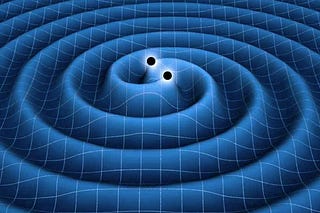
## Ripples in the Metric
The exact solutions of §§1.5.6–1.5.7 are stationary: the Schwarzschild and Kerr geometries do not change with time. The cosmological solution of §1.5.8 is dynamic but globally smooth: the FLRW geometry evolves as the universe expands but does so homogeneously. What is missing from this catalogue is the *wavelike* sector of gravity — the propagating ripples in the metric that the field equations admit as solutions in their own right. These ripples are gravitational waves, predicted by Einstein in 1916, indirectly confirmed by Hulse and Taylor in the 1970s, and directly detected for the first time on 14 September 2015. They are the subject of this section.
The structural fact about gravitational waves is that they are gravity speaking to itself. A binary black hole inspiralling toward merger is a gravitational source whose gravitational radiation is detected, billions of years later and across cosmological distances, by another gravitational instrument. The signal carries information about strong-field geometry that no electromagnetic measurement can supply: black holes do not emit photons, but their orbital dance shakes the metric of spacetime in a pattern that can be reconstructed from the strain seen at our detectors. Gravitational-wave astronomy is therefore a wholly new observational channel, structurally distinct from anything available before September 2015. The first decade of operation has produced a catalogue of more than 200 detections, ranging from binary black hole mergers (most events) through neutron-star mergers (with electromagnetic counterparts) to events near the boundary of what was thought possible. The decade of 2015–2025 closed the loop on Einstein’s 1916 prediction.
## Linearised gravity
To find wavelike solutions, expand the metric around flat space:
(1) g_μν = η_μν + h_μν , |h_μν| ≪ 1
where η_μν is the Minkowski metric and h_μν is a small perturbation. Substitute this into the Einstein field equations and keep only terms linear in h. The Christoffel symbols, Ricci tensor, and Einstein tensor become linear functions of the perturbation; the field equations reduce to a linear PDE.
There is a coordinate freedom that is convenient to fix. Define the **trace-reversed perturbation**
(2) \bar{h}_μν := h_μν - ½ η_μν h , h := η^{μν} h_μν
named for the property \bar{h} := η^{μν} \bar{h}_μν = -h. Choose the **Lorenz gauge** (also called harmonic or de Donder gauge) by imposing
∂^μ \bar{h}_μν = 0 .
This is four conditions on the ten components of h_μν, reducing the count to six. In Lorenz gauge, the linearised Einstein equation takes the wave-equation form:
(3) □ \bar{h}_μν = - (16πG / c^4) T_μν
where □ := η^{μν} ∂_μ ∂_ν = -c^{-2} ∂_t^2 + ∇^2 is the d’Alembertian operator. *This is the wave equation for gravitational radiation in vacuum (T_μν = 0) sourced by the matter stress-energy in the radiation zone.* The structural parallel with electromagnetism (□ A_μ = -μ_0 J_μ in Lorenz gauge) is exact: gravitational radiation propagates at the speed of light and is sourced by mass-energy currents in essentially the way electromagnetic radiation is sourced by electric currents.
The Lorenz gauge does not fix the gauge completely. There is a residual freedom corresponding to gauge transformations h_μν → h_μν + ∂_μ ξ_ν + ∂_ν ξ_μ for any ξ^μ satisfying □ ξ^μ = 0. This residual freedom can be used in vacuum to impose additional conditions: the **transverse-traceless** (TT) gauge.
## Transverse-traceless gauge and the two polarisations
In vacuum (T_μν = 0), the residual gauge freedom in Lorenz gauge can be used to set:
- **Trace-free:** h = η^{μν} h_μν = 0.
- **Transverse:** h_{0μ} = 0, and ∂^i h_{ij} = 0 for the spatial components.
With these conditions, only six (Lorenz) minus four (residual gauge) = two physical components remain. These two are the **plus** and **cross** polarisations of the gravitational wave:
(4) h^{TT}_{ij}(t, x) = [ [ h_+ , h_× , 0 ], [ h_× , -h_+ , 0 ], [ 0 , 0 , 0 ] ]_{ij}
for a wave propagating in the z-direction. The names come from the deformation pattern these components produce on a ring of test masses transverse to the propagation direction:
- **Plus polarisation** (h_+): stretches along one transverse axis, compresses along the perpendicular transverse axis, with sign flipping every half period. Pattern: “+”.
- **Cross polarisation** (h_×): same pattern as plus, but rotated by 45°. Pattern: “×”.
The two polarisations are independent. In the geometrically clean way to read this, the gravitational wave produces a quadrupolar tidal deformation; the two independent quadrupoles in two transverse dimensions correspond to the two polarisations. *The reason there are exactly two polarisations is that the graviton is a massless spin-2 field*, and a massless spin-s field has exactly two helicities (±s) regardless of s. For s = 1 (photons, gluons), the two are circular polarisations; for s = 2, the two are plus and cross.
The 45° rotation between plus and cross encodes the spin-2 character: the field returns to itself under a 180° rotation about the propagation axis, not a 360° rotation. (For comparison: photons return after 360°; spin-½ fermions return only after 720°; spin-2 gravitational waves return after 180°.) The polarisation pattern is therefore the most direct kinematic evidence for the spin-2 character of the graviton.
## The quadrupole formula
The leading source of gravitational radiation is the time-varying mass quadrupole moment of the source. In the linear-perturbation approximation, the gravitational-wave field at distance r from a compact source is
(5) h^{TT}_{ij}(t, x) = (2G / (c^4 r)) \ddot{Q}_{ij}^{TT}( t - r/c )
where Q_{ij} is the (traceless part of the) mass quadrupole moment of the source:
Q_{ij}(t) = ∫ ρ(x,t) ( x_i x_j - ⅓ δ_{ij} |x|^2 ) d^3x .
The structural fact: *a static or time-varying mass distribution radiates gravitational waves only if its mass quadrupole moment is changing in time, and only at second time derivative*. Spherically symmetric pulsations radiate nothing (Birkhoff’s theorem, §1.5.6). A perfect cylinder rotating about its symmetry axis radiates nothing (the moment of inertia tensor is constant). The minimum dynamical configuration capable of producing gravitational radiation is a binary system, where two masses orbit each other, and Q_{ij}(t) varies sinusoidally as the orbit proceeds.
Compare with electromagnetism. The leading EM radiation is dipole; gravitational dipole radiation is forbidden because the gravitational analogue of charge is mass-energy, and conservation of momentum prevents the centre-of-mass dipole moment from oscillating. Gravitational radiation is therefore quadrupole at leading order, two multipoles weaker than electromagnetic radiation. This is why gravitational waves are extraordinarily faint: the quadrupole formula carries an extra factor of (v/c)^2 compared to the dipole formula, making typical strain amplitudes at the Earth of order h ~ 10^{-21} for the strongest astrophysical events.
The total power radiated as gravitational waves by a system with mass quadrupole Q_{ij}(t) is
(6) P_GW = (G / (5 c^5)) ⟨ \dddot{Q}_{ij} \dddot{Q}^{ij} ⟩
where the angle brackets denote a time average and \dddot{Q} is the third time derivative. The prefactor G/c^5 has units of inverse power; its inverse c^5/G ≈ 3.6×10^52 W is the **Planck luminosity**, the natural maximum gravitational-wave luminosity that any system can radiate. As we will see, the peak luminosity of GW150914 reached ~10^{-3} of this absolute upper bound.
## Indirect detection: the Hulse–Taylor binary pulsar
The first compelling evidence for gravitational radiation came from a binary system whose orbital decay can be measured precisely. Russell Hulse and Joseph Taylor discovered PSR B1913+16 in 1974 at Arecibo Observatory: a pulsar in a tight ~7.75‑hour orbit with another neutron star. Each neutron star is a compact object of ~1.4 M_⊙; their orbit is dynamically clean, with the orbital period and other parameters measurable through the pulsar’s timing.
If GR is correct, the system loses energy to gravitational radiation, the orbit shrinks, and the orbital period decreases. The quadrupole formula gives the rate of orbital decay precisely:
dP_orb/dt = - (192π/5) ( 2πG M_chirp / (c^3 P_orb) )^{5/3} F(e)
where M_chirp is the chirp mass of the binary (defined below) and F(e) is a function of the orbital eccentricity. For PSR B1913+16, GR predicts dP_orb/dt = -2.402×10^{-12} (dimensionless rate). The observed value, accumulated over half a century of timing data (Weisberg & Huang 2016): dP_orb/dt = -2.4056(51)×10^{-12}. Agreement to ~0.16%. *Gravitational radiation is real, and it carries energy at exactly the rate the quadrupole formula predicts.* The 1993 Nobel Prize in Physics was awarded to Hulse and Taylor for this discovery; subsequent decades of observation have only refined the agreement.
The Hulse–Taylor result is indirect: it measures the energy loss to gravitational radiation, not the gravitational waves themselves. The waves emitted by PSR B1913+16 have frequency ~70 μHz (twice the orbital frequency) and are too low-frequency to be detected at the Earth. But the orbital decay implies their existence; from the 1970s onward, the question of whether gravitational waves exist was effectively settled. What remained was direct detection.
## Direct detection: GW150914 and what followed
On 14 September 2015 at 09:50:45 UTC, the Advanced LIGO interferometers at Hanford, Washington and Livingston, Louisiana — newly upgraded and entering their first observing run — recorded a coincident chirp-shaped signal lasting approximately 0.2 seconds. The signal’s frequency swept upward from ~35 Hz to ~250 Hz, with a peak strain of ~1.0×10^{-21}. It matched, with extraordinary precision, the waveform predicted by GR for the inspiral, merger, and ringdown of two black holes orbiting each other with masses of approximately 36 M_⊙ and 29 M_⊙, at a luminosity distance of ~410 Mpc.
This was **GW150914**, the first direct detection of a gravitational wave, announced 11 February 2016. The signal carries the structural fingerprint of GR in three regimes:
**Inspiral.** The pre-merger waveform follows the post-Newtonian expansion of the orbital dynamics. Each successive orbit is faster and closer; the gravitational wave’s frequency increases (chirp) and its amplitude grows. The chirp rate determines the binary’s *chirp mass* M_chirp := (m1 m2)^{3/5} / (m1 + m2)^{1/5}, the single combination of binary masses that controls the leading-order gravitational radiation. For GW150914, M_chirp ≈ 28 M_⊙.
**Merger.** The post-Newtonian expansion fails near the black holes’ encounter. Numerical relativity — direct numerical solution of the full Einstein equations on a computer, a programme matured in the 2000s after decades of stalling — supplies the merger waveform. The agreement between the observed GW150914 signal and the numerical-relativity prediction, in the merger phase, is at the percent level.
**Ringdown.** After merger, the final black hole settles into the Kerr geometry by emitting damped oscillations at the quasi-normal-mode frequencies. The frequencies and damping times are completely determined by the Kerr mass and spin: this is the *no-hair test* (§1.5.7). For GW150914, the final black hole has mass ~62 M_⊙ and spin ~0.7 (GM/c^2); the ringdown is consistent with this.
The energy radiated as gravitational waves is the difference: 36 + 29 - 62 ≈ 3 M_⊙ c^2 over a fraction of a second. The peak gravitational-wave luminosity briefly exceeded ~3.6×10^49 W — comparable to or exceeding the total electromagnetic luminosity of all the stars in the observable universe combined. *This stupendous power, lasting fractions of a second, was nevertheless invisible to every electromagnetic telescope; the entire event proceeded silently, in the gravitational sector alone.*
The 2017 Nobel Prize in Physics was awarded to Rainer Weiss, Barry Barish, and Kip Thorne for the conception and execution of LIGO. The first observing run produced three confident detections; subsequent runs — O2 (2016–2017), O3 (2019–2020), O4 (May 2023 – November 2025) — expanded the catalogue dramatically.
### The catalogue through O4
The Gravitational-Wave Transient Catalog (GWTC) is the LIGO–Virgo–KAGRA Collaboration’s curated list of confident detections. The latest published version, GWTC‑4.0 (released August 2025), reports the events from the first segment of O4 (O4a: May 2023 – January 2024) and brings the total to 218 confident events. The remaining segments of O4 (O4b and O4c) are still under analysis; preliminary candidate counts suggest the total will exceed 350 by the time the catalogue is final. O4 ended on 18 November 2025.
A few representative events:
- **GW170817** (17 August 2017): the first binary neutron star merger and the first multi‑messenger gravitational‑wave detection. Distance ~40 Mpc. The gamma‑ray burst GRB 170817A was detected by Fermi‑GBM 1.7 s after the gravitational‑wave signal; the kilonova AT 2017gfo was identified the next day in the optical. From the GW‑EM coincidence, the propagation speed of gravitational waves equals that of light to |c_GW - c|/c < 10^{-15} — a constraint that ruled out a substantial fraction of modified‑gravity theories at a stroke.
- **GW230529_181500** (29 May 2023): a coalescence involving a compact object with mass 2.5–4.5 M_⊙, in the long‑rumoured “mass gap” between the heaviest neutron stars and the lightest black holes. Whether this object is a neutron star, a black hole, or something more exotic remains debated.
- **GW231123_135430** (23 November 2023): the highest‑mass binary black hole merger yet observed. Total mass ~190–265 M_⊙, with component masses each in or above the “upper mass gap” where pulsational pair‑instability supernovae are expected to suppress black‑hole formation. The implication is that at least one component may have formed from a previous merger (a hierarchical formation channel).
- **GW250114** (14 January 2025): a high signal‑to‑noise binary black hole merger used to perform the most precise tests yet of Hawking’s area‑law theorem (the final‑black‑hole horizon area exceeds the sum of the initial areas) and the no‑hair theorem (the ringdown is consistent with Kerr).
The population emerging from GWTC‑4 is dominated by binary black holes (~95% of events), with a smaller number of binary neutron stars and neutron‑star–black‑hole binaries. Component‑mass distributions, spin distributions, and merger‑rate evolutions are now mapped well enough to constrain formation‑channel theories. *The gravitational‑wave universe is open, and we are filling in its census.*
### Pulsar timing arrays and the stochastic background
A complementary observational channel operates at much lower frequencies: *pulsar timing arrays*. By precisely timing the pulse arrivals from an array of millisecond pulsars distributed across the galaxy, one can search for the characteristic correlated timing residuals induced by a passing low‑frequency gravitational wave (frequencies in the nanohertz to microhertz range, corresponding to wavelengths of light‑years).
The Hellings–Downs correlation pattern — a specific angular correlation between pulsar pairs as a function of their angular separation in the sky — is the unmistakable signature of a stochastic gravitational‑wave background. In June 2023, the NANOGrav, EPTA, PPTA, and CPTA collaborations independently announced detections of evidence for this correlation at the ~3–4σ level. The signal is consistent with the stochastic background expected from a population of supermassive black hole binaries (10^8–10^10 M_⊙) inspiralling at the centres of galaxies after galactic mergers. Some of the signal could also be cosmological in origin (cosmic strings, inflation, phase transitions in the early universe), but the supermassive‑binary interpretation is most natural and is becoming the working hypothesis.
The pulsar timing arrays operate at frequencies ~10^{-9} Hz, the LIGO band at 10–10^4 Hz; the planned space‑based detector LISA, scheduled for launch in the mid‑2030s, will fill the gap at 10^{-4}–10^{-1} Hz, accessing supermassive black hole mergers at cosmological distances and extreme‑mass‑ratio inspirals around supermassive black holes (§1.5.7). The full gravitational‑wave spectrum will, by the late 2030s, span twelve orders of magnitude in frequency.
## The graviton question
In QFT, every fundamental field is associated with a particle. The gravitational field corresponds to a massless spin‑2 particle, the *graviton*. The two polarisations of gravitational waves (eq. 4) are the classical correlate of the graviton’s two helicities. The detection of gravitational waves is, in this sense, a classical‑limit detection of vast numbers of gravitons.
Whether individual gravitons are detectable is a separate, much harder question. The cross‑section for a graviton to be absorbed by an atomic nucleus is approximately σ_g ~ G^2 ω^2 / c^6, absurdly small at any astrophysical or laboratory frequency. Dyson (2013) argued that no realistic detector could measure the absorption of a single graviton; if true, single‑graviton detection is in principle impossible, leaving the graviton an intrinsically classical‑collective phenomenon detectable only as macroscopic gravitational waves. This argument has been disputed; the question of whether the graviton is in some operational sense as “real” as the photon is open and is probably a philosophical question dressed in physical language.
The *theoretical* status of the graviton is also delicate. Quantising the linearised theory eq. (3) produces a perfectly well‑behaved free quantum field on a fixed background, with a spin‑2 quantum and the expected propagator. But interactions are forbidden: the perturbative quantum theory of GR is non‑renormalisable, with infinities that proliferate as one goes to higher loops. The first divergent correction to graviton scattering appears at two loops; the theory is thus only an effective field theory, valid below some Planck‑scale cutoff. A consistent quantum theory of gravity, applicable at all scales, requires a UV completion — the central goal of programmes like string theory, loop quantum gravity, and asymptotic safety, all flagged as forward threads to the quantum gravity domain.
## Tests of GR using gravitational waves
Gravitational‑wave observations have provided the strongest tests of general relativity available. Three categories:
**Propagation tests.** GW170817 + GRB 170817A constrained |c_GW - c|/c < 10^{-15}, ruling out classes of modified‑gravity theories. Tests of dispersion relations (whether different gravitational‑wave frequencies travel at different speeds) constrain the graviton mass to m_g c^2 < 10^{-23} eV.
**Strong‑field tests.** The inspiral, merger, and ringdown waveforms of binary black holes are computed in GR by post‑Newtonian theory and numerical relativity. Observed signals match GR predictions across the entire parameter range probed; tests at each post‑Newtonian order constrain higher‑derivative or modified‑gravity corrections.
**No‑hair‑theorem tests.** The ringdown phase of every binary black hole merger probes whether the final black hole is Kerr. So far, every observed ringdown is consistent with Kerr at the precision of the measurement; departures from Kerr ringdown would signal modifications of GR or new black‑hole hair. GW250114 is the most precise such test to date.
The picture as of 2026: *General relativity passes every gravitational‑wave test that has been performed, in regimes where curvature is comparable to that of the source bodies’ Schwarzschild radii.* Regimes outside the test range — extreme curvature near Planck scales, ultra‑low‑frequency cosmological signals — remain to be explored.
## The three vertical axes
**Information.** Each gravitational‑wave signal carries information about the source: component masses, spins, distance, sky location, and (for nearby events) the inclination of the orbital plane. The information per event is finite but rich; the catalogue of ~250 events through O4 is now being analysed for population properties, allowing inference of the formation channels of stellar‑mass black holes, the equation of state of nuclear matter (from neutron‑star tidal deformations), and the rate of mergers as a function of cosmic time. The information content of gravitational‑wave astronomy is fundamentally non‑electromagnetic: it provides knowledge of the strong‑field gravitational sector of objects that emit no light.
**The Second Law.** Hawking’s area theorem (§1.5.7) is now observationally tested in real time. Every binary black hole merger detected by LIGO produces a final black hole whose horizon area exceeds the sum of the initial areas, in agreement with the area theorem. GW250114 in particular has provided the most precise such test to date. *The Second Law of black‑hole mechanics is observed event by event in the LIGO catalogue.*
**Gravity.** Gravitational waves *are* gravity radiating into vacuum. They are the dynamical degrees of freedom of the metric tensor that propagate independent of any matter source. The detection of gravitational waves was the closing argument: gravity is a physical field, not a geometric fiction, with its own propagating excitations. Every other observation of gravity (Solar‑System tests, lensing, cosmology) probes the geometry sourced by matter; gravitational‑wave observations probe gravity itself, freed from its source.
## Where this picture breaks down
1. **Linearised regime.** The wave equation (3) is the leading‑order approximation. At second order in h, gravitational waves source themselves: the non‑linearity of the Einstein equations means that gravitational waves carry an effective stress‑energy that contributes to the source on the right‑hand side. For the actual numerical‑relativity merger phase, the linear approximation breaks down and full non‑linear GR is required.
2. **Non‑stationary backgrounds.** The decomposition g_μν = η_μν + h_μν assumes a flat asymptotic spacetime. In FLRW backgrounds, the analogue is g_μν^{FLRW} + h_μν, and the wave equation acquires Hubble‑friction terms. At horizon‑crossing scales the perturbative analysis is more subtle.
3. **Quantisation.** The linearised theory quantises straightforwardly to give a free graviton; the interacting theory does not. GR is non‑renormalisable; the leading two‑loop divergence in graviton scattering signals the breakdown of the perturbative description at energies approaching the Planck scale (~10^19 GeV).
4. **Single‑graviton observation.** Whether single gravitons are in any practical sense detectable is unsettled. Dyson (2013) argued they are not; opposing arguments exist. The classical‑collective regime is well‑understood; the genuinely quantum regime is not.
5. **Backreaction and cosmological gravitational waves.** The energy‑momentum of gravitational waves is gauge‑dependent at second order; only when averaged over many wavelengths does it acquire a clean physical meaning (the Isaacson stress‑energy tensor). For sub‑horizon waves, this is fine; for horizon‑scale or super‑horizon cosmological waves, the gauge ambiguities become subtle.
6. **Strong cosmic gravitational background.** The stochastic gravitational‑wave background detected by pulsar timing arrays (NANOGrav, EPTA, PPTA, CPTA, 2023) is consistent with supermassive black hole binaries but could also have a cosmological component (cosmic strings, primordial gravitational waves from inflation, first‑order phase transitions). Distinguishing these is the subject of active analysis.
7. **Modified‑gravity alternatives.** Theories with extra polarisations (some modified‑gravity theories predict scalar or vector polarisations in addition to the GR plus and cross), with massive gravitons, or with modified dispersion relations remain candidates that gravitational‑wave observations can constrain. Currently, no observation requires modification.
## Closing assessment
Gravitational waves are the dynamical sector of gravity. They are predicted by Einstein’s 1916 calculation, indirectly verified by Hulse and Taylor in the 1970s, and directly detected by LIGO in 2015. The 2015–2025 decade closed the loop on a century‑old prediction and opened a wholly new observational channel. The catalogue of more than 200 confident detections now spans binary black holes from ~5 M_⊙ to over 200 M_⊙, binary neutron stars, neutron‑star–black‑hole binaries, and (provisionally) the stochastic background of supermassive binary mergers at the centres of galaxies.
The successes of gravitational‑wave astronomy are structural: every observation has been consistent with general relativity, including the tightest tests of black‑hole horizon geometry available; the Hawking area theorem is observed in real time; the propagation speed of gravitational waves equals that of light to extreme precision; the inspiral‑merger‑ringdown structure of binary black hole signals validates the strongest tests of the Kerr‑Newman family.
What remains unresolved is the quantum sector. The graviton is a well‑defined free quantum field; the interacting theory is non‑renormalisable; the question of whether single gravitons are detectable is unsettled. These questions move us out of §1.5.9 and toward the deeper ones — causal structure (§1.5.10), and the breakdown of GR itself (§1.5.11). Gravitational waves, paradoxically, are the place where classical GR triumphs most spectacularly while pointing simultaneously toward the regime where it must fail.