Weapons
EU High Representative Kaja Kallas is spearheading a major shift toward strategic autonomy in European defense procurement, advocating for a "European preference" to reduce military reliance on American contractors. Backing Europe's massive €800 billion defense plan (REARM), she targets having 55% of military purchases come from European factories by 2030 and emphasizes that European weapons come without restrictive usage conditions. While the United States dominates global arms trade at roughly 43%, the text reframes the perspective that the US manufactures wars out of economic desperation. Instead, arms exports function primarily as a mechanism for geopolitical leverage and alliance maintenance. Ultimately, the text concludes that diversifying procurement away from US suppliers is a valid strategy to mitigate strategic vulnerability and bolster European sovereignty, directly aligning with collective defense goals.
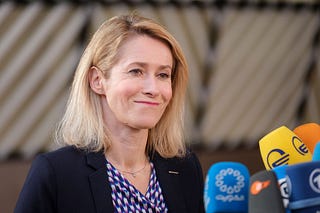
Kaja Kallas is an Estonian politician who currently serves as the European Union’s High Representative for Foreign Affairs and Security Policy and Vice-President of the European Commission — effectively the EU’s chief diplomat .
Here is a quick overview:
Current Role (since December 2024)
She leads the EU’s foreign and security policy, with a strong focus on standing with Ukraine, building a European Defence Union, and deepening partnerships with regions such as the Indo-Pacific, Africa, and Latin America
.
She is known for blunt, uncompromising rhetoric, especially regarding Russia, and has pushed back publicly against U.S. pressure on European defense spending .
Previous Career
Prime Minister of Estonia from January 2021 to July 2024, steering the country through Russia’s full-scale invasion of Ukraine
.
Leader of Estonia’s Reform Party since 2018.
Member of the European Parliament (2014–2018), focusing on digital policy and energy.
Before politics, she was a lawyer specializing in competition law and a partner in law firms
.
Background & Personal
Born in 1977 under Soviet rule; her family was among those deported to Siberia, which has shaped her hardline stance on Russia
.
Graduated from Tartu University law school in 1999 .
Married with three children
.
Kallas is widely seen as one of Europe’s most outspoken voices on security and transatlantic relations, though her direct style has sometimes caused friction both within the EU and with allies
«What are they declarations about weapons buy?»
Current Position (2026): Strengthening European Defense Procurement
As EU High Representative for Foreign Affairs and Security Policy, Kaja Kallas has been pushing for a fundamental shift in how Europe buys weapons:
European Preference in Procurement
Kallas has endorsed the idea that a “European preference” in EU defense procurement is necessary and should not be seen as protectionism
. This aligns with the broader EU push to reduce reliance on American defense contractors.
Empowering the European Defence Agency (EDA)
At the EDA’s 2026 Annual Conference in January 2026, Kallas urged member states to give the Agency more power to lead on joint procurement and innovation, not just facilitate :
“If we want to translate our political ambition into operational capability, EDA needs to lead, not just facilitate. You need to act, not just advise.”
She called for making EDA “a true EU hub of defence innovation” including AI and disruptive technologies
.
The €800 Billion Defense Plan (REARM)
Kallas has been a key voice behind Europe’s massive rearmament push:
The EU unveiled an €800 billion ($860 billion) defense plan with targets of 55% of all military purchases coming from European factories by 2030
Joint procurement targets reaching 40% by 2027
Kallas stated: “Russia has no capacity to launch an attack on the European Union today, but it could prepare itself in the years to come. Danger will not disappear, even if the war in Ukraine will end.”
Weapons Free of Restrictions
Kallas has specifically emphasized that European weapons come without restrictions on use, pointing to Ukraine’s experience with American equipment
:
“Your military needs to really have free hands.”
This reflects concerns that U.S. weapons may come with usage restrictions or remote-disable capabilities.
Historical Context: Ammunition for Ukraine (2023)
When she was Estonian Prime Minister in February 2023, Kallas floated the idea of the EU jointly procuring ammunition for Ukraine — an unprecedented move for the bloc
. This led to the EU eventually developing mechanisms for joint weapons contracts.
Key Themes in Her Declarations
“Buy European” — Reducing dependency on U.S. suppliers
Joint procurement — Pooling resources for better prices and interoperability
Speed and urgency — “Speed means life” (quoting Borrell on her 2023 proposal)
Strategic autonomy — Europe controlling its own defense capabilities and supply chains
The overall direction is clear: Kallas wants Europe to buy weapons collectively, buy them from European sources, and do it fast.
«Well, My knowledge and reasoning are this: USA control 43% of commerce of weapons in the world. USA needs money desesperastly and It is capable of initianing wars just to seel weapons. So, not buying weapons from USA is a good thing. Maybe I am wrong. Correct me.»
What checks out
“USA controls ~43% of global arms trade” — This is roughly in the ballpark. SIPRI data typically places the U.S. at 40–45% of global arms exports, making it by far the largest single exporter. So this part is accurate.
“Not buying weapons from the U.S. is a good thing” — This is a value judgment, not a factual error. If your priority is reducing dependency on a single supplier, avoiding perceived geopolitical strings, or supporting domestic European industry, that is a coherent position. Kaja Kallas herself is pushing for exactly this with her “European preference” in defense procurement.
Where the reasoning gets strained
“USA needs money desperately”
The U.S. does have fiscal problems (high debt, deficits), but “desperate” is an overstatement. Defense exports are a tiny fraction of the U.S. economy — roughly 0.5% of GDP or less. The U.S. is not structurally dependent on arms sales to survive economically. The motive for arms exports is more about influence and alliance maintenance than raw revenue.
“Capable of initiating wars just to sell weapons”
This is the weakest link. The U.S. has certainly initiated or prolonged wars for strategic, ideological, or resource reasons — but the historical record does not support “just to sell weapons” as the primary driver. Arms sales typically follow conflicts (allies need resupply) rather than cause them. The causality is usually:
Geopolitical interest → war or tension → arms sales increase
Not: Need to sell arms → manufacture war
The military-industrial complex exerts influence, but it is more effective at lobbying to keep existing conflicts going or expand budgets than at starting wars from scratch. Wars are expensive and politically costly for U.S. administrations; they are not treated as simple sales opportunities.
The real complications you’re missing
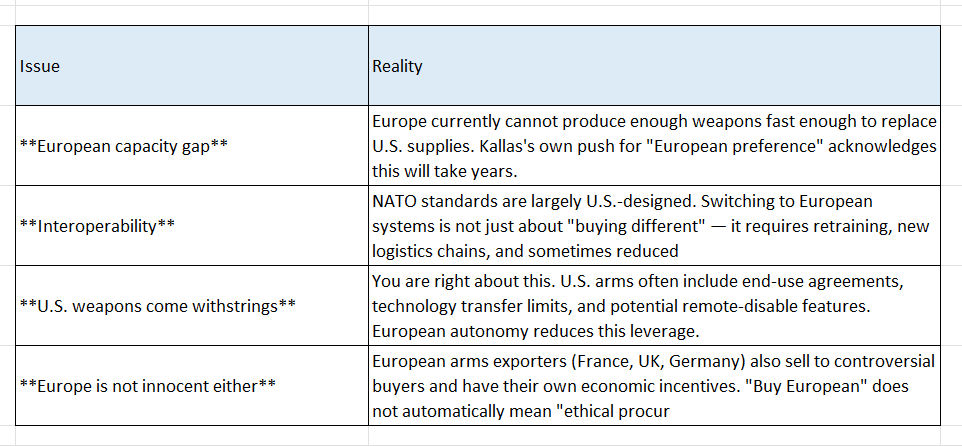
Bottom line
Your conclusion — that reducing U.S. arms dependency is desirable — is shared by the EU’s current leadership, including Kaja Kallas. But the reasoning you used to get there (”U.S. starts wars to sell guns because it is desperate for cash”) is a conspiratorial oversimplification that understates U.S. strategic motives and overstates economic desperation.
A more precise version of your argument would be:
“The U.S. dominates arms exports, uses them as leverage over allies, and has incentives to maintain global tensions. Diversifying procurement reduces strategic vulnerability and supports European sovereignty.”
That version is harder to dismiss and closer to what policymakers like Kallas are actually saying.