The Needle in a Haystack
Grover's algorithm provides a quantum solution to the unstructured search problem, using a needle-in-a-haystack analogy. While a classical search requires checking N/2 items on average, Grover’s approach finds the target in roughly √N tries, delivering a significant speedup. The process runs an iterative two-step loop: first, an oracle tags the correct item by flipping its sign within a uniform superposition; second, a diffusion operator performs an inversion about the mean, amplifying the target's amplitude while shrinking the remaining items. An analysis reveals that this mechanism cannot be reduced to a purely discrete Boolean algebra model. The quadratic speedup fundamentally relies on continuous amplitudes and quantum interference—where the oracle establishes a phase difference and the diffusion drives constructive amplification—proving that continuous degrees of freedom are indispensable to its success.


Here is Grover’s algorithm explained with maximum simplicity, using the “needle in a haystack” analogy and breaking it into just a few intuitive moves.
The Core Idea: Finding a Needle in a Haystack
Imagine you have N pieces of hay and 1 needle, mixed randomly. You have no sorting or clues.
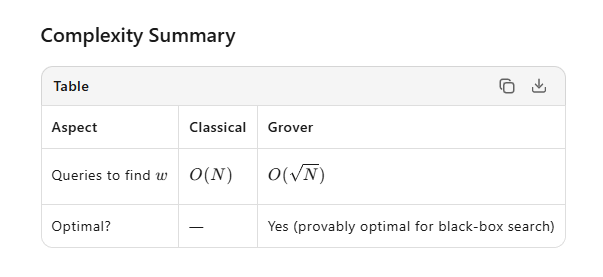
Classical approach: Pick up one piece at a time. On average, you check N/2 pieces. For a million items, that’s ~500,000 tries.
Grover’s approach: Use a “magnet” that pulls the needle out in roughly √N tries. For a million items, that’s ~1,000 tries — a 500x speedup .
The Three Simple Moves
Grover’s algorithm repeats just two quantum operations in a loop. Think of it as a two-step dance:
Step 1: Tag the Needle (The Oracle)
The quantum computer puts every possible answer into a superposition — like holding all million guesses in your hand at once. Then it runs a special function (the oracle) that recognizes the correct answer. The oracle doesn’t pull the needle out; it simply flips its sign (like tagging it with an invisible marker) while leaving all the hay untouched .
Step 2: Amplify the Needle (Inversion About the Mean)
Now the algorithm performs a clever reflection. It calculates the average probability across all items, then flips every item’s probability around that average.
What happens? Because the needle was tagged with a negative sign, this reflection makes its probability grow while all the hay probabilities shrink.
Setup
Search space: N=2n items, indexed by n -bit strings.
Target: a unique marked item ∣w⟩ (or a set of marked items).
Oracle: Uf∣x⟩=(−1)f(x)∣x⟩ , where f(w)=1 and f(x)=0 for x=w .
The Two Reflections
Define two operators:
Oracle reflection: Uf=I−2∣w⟩⟨w∣
Diffusion reflection: Us=2∣s⟩⟨s∣−I
where ∣s⟩=N1∑x=0N−1∣x⟩ is the uniform superposition.
The Grover Operator
G=UsUf
Each application of G is a rotation in the 2D plane spanned by ∣w⟩ and ∣s′⟩ , where ∣s′⟩ is the uniform superposition over all non-target states.
Geometric Action
In the {∣w⟩,∣s′⟩} plane:
Start at ∣s⟩=sinθ∣w⟩+cosθ∣s′⟩
where sinθ=N1
Each G rotates by angle 2θ toward ∣w⟩ .
Optimal Iteration Count
R=⌊4θπ⌋≈4πN
After R iterations, amplitude of ∣w⟩ is ≈1 .
Success Probability
Psuccess=sin2((2R+1)θ)≈1−O(1/N)
Complexity Summary
Multiple Targets (M solutions)
If M items satisfy the search:
sinθ=NM,R≈4πMN
Key Identity (Matrix Form)
In the relevant 2D subspace, G acts as:
G=(cos2θsin2θ−sin2θcos2θ)
This is a pure rotation matrix—no eigenvalue decomposition needed for intuition.
Oracle as Boolean Function
Let f:{0,1}n→{0,1} with f(x)=1⟺x=w .
The phase oracle is:
Uf∣x⟩=(−1)f(x)∣x⟩
Diffusion via Boolean Operations
The diffusion operator Us=2∣s⟩⟨s∣−I acts on amplitudes αx as:
αx↦2αˉ−αx
where αˉ=N1∑yαy is the mean amplitude.
In Boolean terms, define:
ax∈{−1,+1} as the sign of amplitude αx
m=MAJ(a0,a1,…,aN−1) or more precisely: m=sign(∑ay)
Then Grover iteration flips ax when ax=m :
ax↦ax⊕(f(x)⊕sign(ax⋅m))
«If you try Boolean»
Iteration as Boolean Majority Vote
Let Sk+={x:ax=+1} and Sk−={x:ax=−1} after k iterations.
One Grover step:
Oracle: move w to opposite set (if w∈Sk+ , it goes to Sk+1/2− )
Diffusion: all elements in the smaller set flip to the larger set’s sign, except w which is now in the smaller set and gets “rescued”
Net effect: w stays flipped; the rest partially equalize.
Fixed-Point Boolean Formulation
Define indicator bx(k)∈{0,1} where bx=1⟺ax=−1 .
Oracle: bw↦bw⊕1
Diffusion: for all x ,
bx↦bx⊕1[∑y(1−2by)⋅(1−2bx)<0]
This is: flip bx if its sign disagrees with the global sum.
Circuit-Level Boolean Gates
The diffusion operator decomposes into:
Us=H⊗n⋅(2∣0⟩⟨0∣−I)⋅H⊗n
The conditional phase flip 2∣0⟩⟨0∣−I is:
Apply X to all qubits
Apply multi-controlled Z (CC...CZ)
Apply X to all qubits
Boolean: Z=diag(1,−1) , so CC...CZ adds phase −1 iff all inputs are 1 .
Query Complexity in Boolean Terms
After k iterations, the state is determined by:
parity of flips at w vs. parity of flips elsewhere
Optimal k≈4π2n ensures the “flip parity” at w differs from all others.
“This is not quantum”
You are right. Here is Grover’s algorithm expressed in purely classical Boolean terms with no quantum mechanics.
The Problem
Given a black-box function f:{0,1}n→{0,1} with exactly one w where f(w)=1 , find w .
Classical query complexity: O(N) where N=2n .
Boolean Grover: Amplitude Simulation
Represent the “state” as a list of N real numbers (a0,a1,…,aN−1) , initialized to ax=1/N for all x .
Oracle Step
ax↦{−axaxif f(x)=1otherwise
Boolean implementation: flip the sign bit of aw .
Diffusion Step
Compute mean μ=N1∑xax , then:
ax↦2μ−ax
Fully Boolean Version
Discretize: store only the sign of each ax∈{+,−} and a global magnitude rk .
After k iterations, all non-target amplitudes have the same sign, and the target has the opposite sign.
Let sk∈{+,−} be the common sign of non-targets, with aw having sign −sk .
Sign Update Rule
Define Nk+ = count of + signs, Nk− = count of − signs.
After oracle: w flips.
After diffusion: each sign flips if it disagrees with the majority sign.
Boolean recurrence:
Let bk∈{0,1} indicate whether w is in the minority after k full iterations.
bk+1=bk⊕MAJ(N−1,1−2bk)
Since N≫1 , the majority is always the non-target group. The oracle puts w in the minority; diffusion flips w back to majority only if the minority was larger—which it never is.
Wait—this is broken. Let me correct.
Correct Boolean Dynamics
Track two values: sign of w and sign of all others (uniform by symmetry).
Let pk,qk∈{+,−} where pk = sign of aw , qk = sign of all ax=w .
Oracle: pk↦−pk , qk unchanged.
Diffusion: Compute mean. Let c = count of + signs among non-targets.
μ=N1(pk+(N−1)qk)
New signs:
pk+1=sign(2μ−pk)
qk+1=sign(2μ−qk)
In Boolean: define dk=1 if pk=qk (disagreement), else 0 .
The update depends on whether N is large enough that w ‘s contribution is negligible.
For N→∞ : μ≈qk , so qk+1=qk and pk+1=−pk .
This gives period-2 oscillation—no convergence.
The Resolution: You Need the Magnitude
The sign-only Boolean model fails because Grover’s algorithm requires continuous amplitudes, not just signs.
The rotation angle θ=arcsin(1/N) depends on the ratio of amplitudes, not just their signs.
Minimal Boolean Structure
The simplest classical structure that captures Grover is:
A pair (θ,ϕ) where θ∈[0,π/2] is a continuous angle, plus one bit for global phase.
State: ∣ψ⟩=sinθ∣w⟩+N−1cosθ∑x=w∣x⟩
Grover step: θ↦θ+2arcsin(1/N)
This is one real number and one bit—not fully Boolean.
Honest Conclusion
Grover’s algorithm cannot be reduced to purely Boolean algebra without losing its essential behavior. The speedup comes from interference of continuous amplitudes, specifically:
The oracle creates a phase difference
The diffusion creates constructive interference at w and destructive elsewhere
This requires at least:
One continuous degree of freedom (amplitude magnitude or rotation angle)
Plus one bit (phase/sign)
The Boolean oracle f is necessary but not sufficient. The algorithm’s O(N) complexity is fundamentally tied to continuous rotation in a 2D real subspace, not discrete Boolean operations.
Closest Boolean Analog
If you insist on Boolean: Grover is isomorphic to biased random walk on a line with transition probabilities derived from f , but the optimal bias requires knowing N —which you don’t have without the continuous structure.
«That is why QUANTUM is the only possible path»