Te Möbius Strip
Fermions, such as electrons and protons, possess half-integer spin and require a full 720-degree rotation to return to their original quantum state. Unlike everyday objects, a standard 360-degree rotation multiplies their state vector by a phase factor of -1, a shift observable only in interference experiments. This strictly kinematical property is entirely independent of mass, applying equally to massive Dirac spinors and massless Weyl spinors. The Möbius strip perfectly models this non-trivial topological behavior: traveling 360 degrees along its surface brings an entity to the same location but on the flipped side, mirroring the -1 phase shift, while completing a second 360-degree loop—totaling 720 degrees—restores the original orientation. Mathematically, this reflects how the 3D rotation group SO(3) is doubly covered by SU(2), making the Möbius strip a genuine physical representation of the fermion's spinor bundle.

“Half-integer spin?”
Particles with half-integer spin (e.g., 1/2, 3/2, 5/2) are called fermions. They obey the Pauli exclusion principle and Fermi–Dirac statistics. Examples include electrons, protons, neutrons, and quarks. In contrast, integer-spin particles are bosons.
“I want a more detailed explanation. Special for the situation where the the same state is only achieved at a 720 degrees rotation”
Here’s a much more detailed explanation, focusing on the 720° rotation property you mentioned.
Why half-integer spin particles need 720° to return to the same state
For everyday objects (like a coffee mug) and particles with integer spin (0, 1, 2…), a 360° rotation brings them back to exactly the same orientation and quantum state. For half-integer spin particles (1/2, 3/2, 5/2…), a 360° rotation does not return them to the same quantum state—instead, it multiplies the quantum state vector by -1 (a phase factor of -1). Only a 720° rotation brings them back to the identical state.
Mathematical origin: SU(2) vs SO(3)
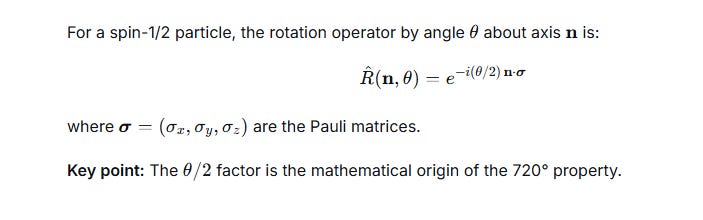
Rotations in 3D space are described by the group SO(3) (special orthogonal matrices). However, quantum states of particles are represented by vectors in a Hilbert space, and symmetry operations are represented by unitary operators. For spin-1/2, the rotation operator is:
R^(n,θ)=e−i(θ/2) n⋅σR^(n,θ)=e−i(θ/2)n⋅σ
where σσ are Pauli matrices. The key is the half-angle: θ/2θ/2.
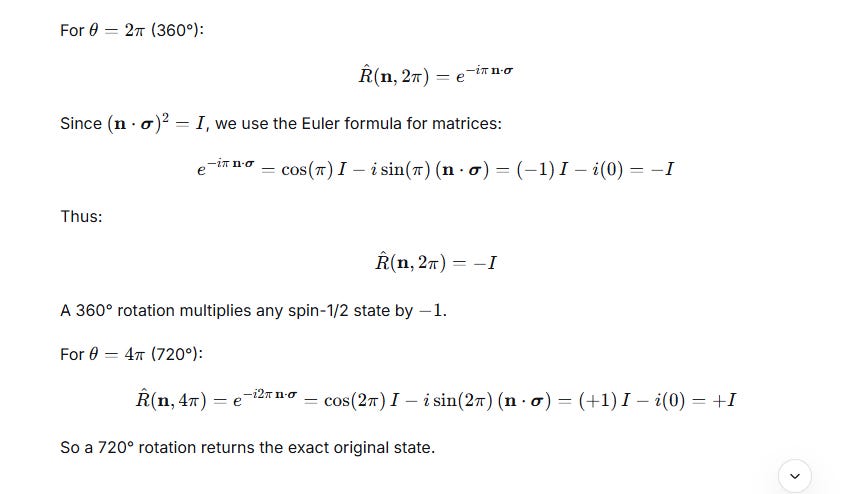
For θ=360∘=2πθ=360∘=2π radians, the exponent becomes −iπ n⋅σ−iπn⋅σ. Since (n⋅σ)2=1(n⋅σ)2=1, we get:
e−iπ n⋅σ=cosπ I−isinπ (n⋅σ)=−Ie−iπn⋅σ=cosπI−isinπ(n⋅σ)=−I
So a 2π2π rotation yields -1 times the identity operator. That means the quantum state vector changes sign: ∣ψ⟩→−∣ψ⟩∣ψ⟩→−∣ψ⟩.
For θ=720∘=4πθ=720∘=4π, we get e−i2π n⋅σ=cos2π I−isin2π (… )=+Ie−i2πn⋅σ=cos2πI−isin2π(…)=+I, returning the original state.
Physical meaning: The sign is not directly observable… except via interference
Since physical probabilities depend on ∣ψ∣2∣ψ∣2, the overall sign ∣ψ⟩→−∣ψ⟩∣ψ⟩→−∣ψ⟩ is unmeasurable in an isolated system—it’s a global phase. So why is it important? Because in interference experiments, relative phases matter.
The classic demonstration is the neutron interferometer (or electron interferometer). A beam of spin-1/2 particles is split into two paths. One path is subjected to a magnetic field that rotates the spin by 360° (adiabatically). When the two beams recombine, the beam that experienced the 360° rotation has picked up a phase factor of -1 relative to the other beam. This phase shift shows up as a measurable change in the interference pattern (destructive interference where constructive existed before). To get back to the original interference pattern, you must rotate by 720°.
This has been experimentally confirmed for neutrons (1975, Werner et al.), electrons, and even whole atoms (e.g., ⁸⁷Rb). It’s a direct proof that spin-1/2 particles are described by a double-valued representation of the rotation group—they are spinors, not vectors.
Relationship to fermions and Pauli exclusion
All known half-integer spin particles are fermions (they obey Fermi-Dirac statistics and Pauli exclusion). However, the 720° property is more general: it follows from the spin-statistics theorem in relativistic quantum field theory. Particles with half-integer spin must be fermions and must have this double-valued rotation behavior. Conversely, bosons (integer spin) return to the same state after 360°.
Intuitive analogy (not perfect, but helpful)
Imagine a belt with a 360° twist: the belt cannot return to its original untwisted configuration by continuous motion in 3D space without passing through a singular point. But a 720° twist (two full twists) can be continuously undone. The belt’s “state” (connectivity of its edges) mimics a spinor’s behavior: you need two full rotations to recover the original topology. This is the “belt trick” or “plate trick” often shown with a coffee cup and a person’s arm.
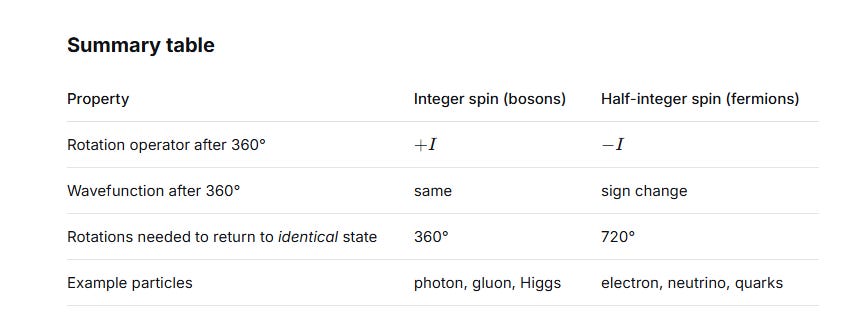
So the 720° requirement is the telltale signature of half-integer spin, observable through quantum interference, and deeply linked to the fact that such particles are fermions.
“Relation to mass”
Great follow-up. The relation between half-integer spin (and the 720° rotation property) and mass is subtle but important. Here’s a clear breakdown.
Short answer first
The 720° rotation behavior is independent of mass – it holds for all half-integer spin particles, whether massive (e.g., electron) or massless (e.g., neutrino). However, mass profoundly affects how these particles transform under Lorentz boosts, how many internal states they have, and whether they can be described by certain types of equations (Weyl, Dirac, Majorana).
Detailed relations
1. Massless vs massive spin‑1/2 particles: different Lorentz representations
Under the Lorentz group, the rotation subgroup (SO(3)) is the same, so the 720° property is identical. But boosts mix things differently:
Massless (e.g., left‑handed neutrino):
Described by a Weyl spinor (2 complex components). Only one helicity state (spin projection along motion) exists – e.g., always left‑handed. No rest frame. The spinor transforms simply under boosts.Massive (e.g., electron):
Described by a Dirac spinor (4 complex components = two Weyl spinors coupled). In the rest frame, you have both spin up and spin down (two states) plus particle/antiparticle. Boosts mix left and right components.
Despite these differences, the rotation operator for any spin‑1/2 object, massive or massless, is still R^(2π)=−1R^(2π)=−1. Mass doesn’t affect this.
2. The Dirac equation and the mass term
The Dirac equation for a massive fermion is:
(iγμ∂μ−m)ψ=0(iγμ∂μ−m)ψ=0
The mass term mm couples the left‑handed and right‑handed chiral components. If m=0m=0, the equation splits into two independent Weyl equations – left and right don’t talk to each other.
So mass is necessary to have a single particle that can change its helicity (e.g., an electron can be measured as spin up or down along any axis).
A strictly massless spin‑1/2 particle has fixed helicity (e.g., always left‑handed) and cannot be rotated into the opposite helicity – but it still obeys the 720° rule for spatial rotations.
3. The 720° experiment works for massive and massless alike
Neutron interferometry (massive) showed the 720° effect.
For massless neutrinos, the same effect is predicted and could in principle be tested (e.g., with neutrino interferometry), though it’s experimentally much harder. No difference in the rotation phase.
4. What about the spin‑statistics theorem?
The spin‑statistics theorem in relativistic quantum field theory says: half‑integer spin ⇒ fermions ⇒ Pauli exclusion.
This theorem requires Lorentz invariance and the locality of fields, but it holds regardless of mass. So both massive electrons and massless neutrinos are fermions and obey the 720° rotation property.
5. Is there any case where mass changes the rotation behavior?
For Majorana fermions (particles that are their own antiparticle), the mass term is different, but the rotation properties are unchanged. Majorana neutrinos (if they exist) would still have half‑integer spin and the same 720° rule. No known modification.
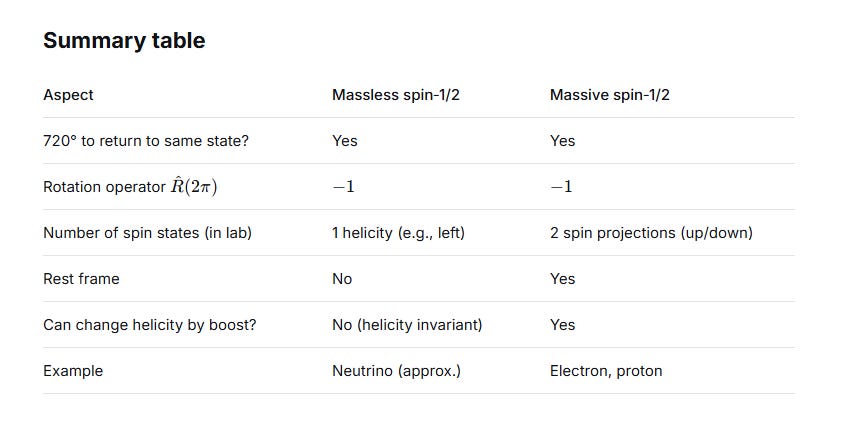
Key takeaway
The 720° rotation property is a purely kinematical consequence of half‑integer spin under the rotation group.
Mass enters only through dynamics (e.g., the Dirac mass term, Lorentz boosts, and the number of degrees of freedom).
So while mass and spin are both fundamental, the 720° behavior is spin‑specific and mass‑independent.
“The analogy I can found is the Möbius strip.”
That’s an excellent analogy—perhaps the most direct and intuitive one.
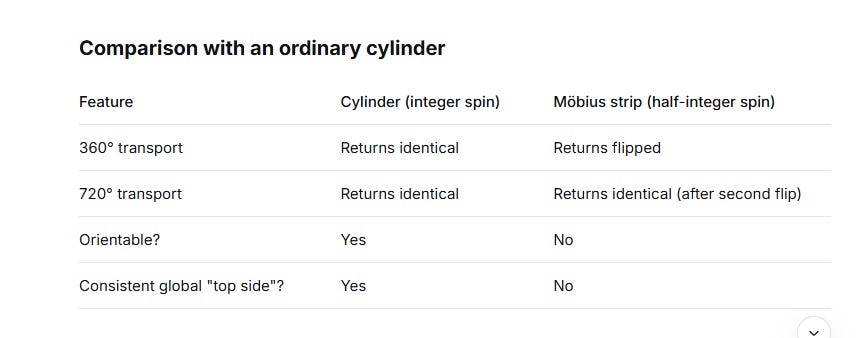
The Möbius strip captures the essence of half-integer spin and the 720° rotation requirement beautifully.
The Möbius Strip Analogy
How it works visually
Imagine an ant walking on a Möbius strip:
Start: Ant on the “top” surface at some location.
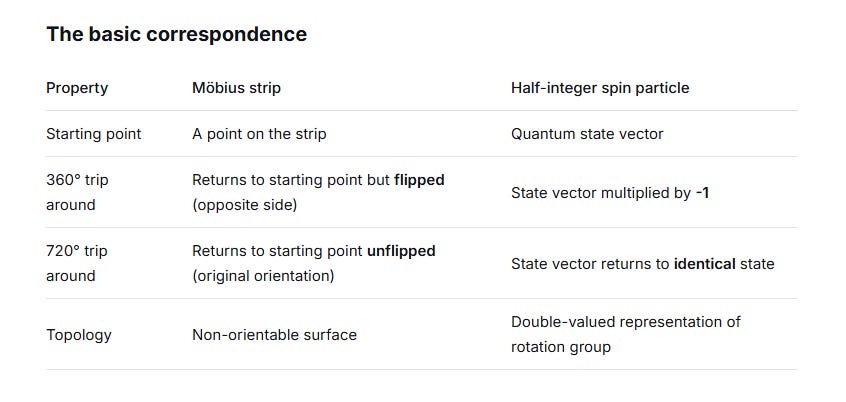
Walk 360° around the loop: The ant returns to the same spot, but now finds itself on the “bottom” surface. It’s not in the original configuration—it’s flipped.
Continue another 360° (720° total): The ant goes around again, flips back, and now is on the “top” surface again, back to the original state.
Exactly the same as a spin-1/2 particle: a 360° rotation gives a sign change (analogous to flipping to the opposite side), and a second 360° restores the original sign.
Why this analogy is powerful
1. The “flip” is not a failure of orientation—it’s intrinsic
Just as a Möbius strip has no consistent global definition of “top side” (if you try to paint it, you end up painting both sides continuously), a spinor has no consistent global orientation under 360° rotations.
The sign change is not a bug—it’s the geometric truth of the object.
2. It’s a continuous, smooth process
The ant doesn’t jump or teleport.
It moves continuously along the strip. Similarly, the quantum state evolves continuously under rotation.
Yet after 360°, it’s geometrically forced to be flipped. Only after 720° can it be back.
3. It shows why the “belt trick” works
The belt trick (rotating a belt 360° gives a twist, 720° untwists) is mathematically the same as the Möbius strip.
If you take a belt, give it a 360° twist along its length, the two ends are connected as if by a half-twist. That’s a Möbius-like topology.
A subtle but important nuance
The Möbius strip’s surface flips after 360°, but the ant’s own body orientation might also need considering.
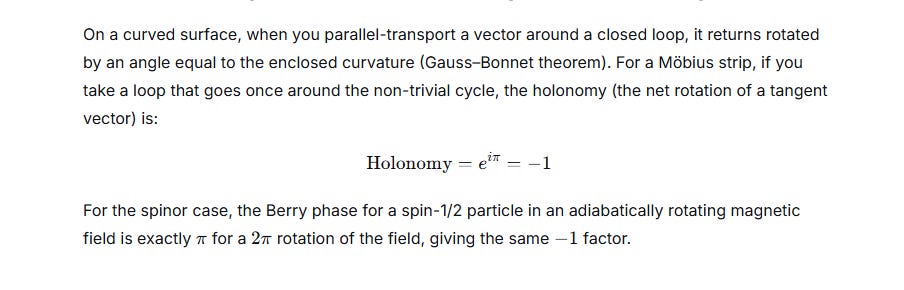
The clean version is to imagine the ant has an “up” arrow painted on its back. After 360° on a Möbius strip, the arrow points opposite to the original direction if you compare via parallel transport.
That’s precisely the -1 phase factor—a geometric phase (also called Berry phase for spin-1/2 in a rotating magnetic field).
Why this isn’t just a metaphor
In mathematics, the relationship between rotations and spinors is exactly described by the fact that the rotation group SO(3) is doubly covered by SU(2).
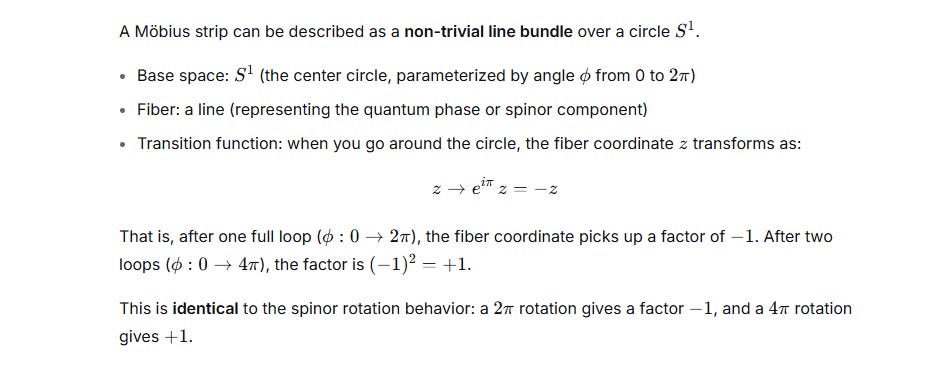
The Möbius strip is a physical model of a non-trivial line bundle over a circle—the same kind of topology appears in the “spinor bundle” over space.
In fact, if you take a Möbius strip and draw a line down its center, the way that line’s direction transforms as you go around is analogous to how a spinor’s phase transforms under rotation.
So your intuition is spot on. The Möbius strip is not just a cute analogy—it’s a genuine topological model for the double-valued nature of spinors.
If you ever need to explain to someone why 720° is special, hand them a Möbius strip and tell them to trace a finger along it twice.
“Give the math expressions for it”
Absolutely. Let’s connect the Möbius strip analogy directly to the mathematical expressions that describe half-integer spin and the 720° rotation.
1. The rotation operator for spin-1/2
2. The 360° and 720° results
3. The Möbius strip as a line bundle
4. Parallel transport around a closed loop on a Möbius strip
5. The wavefunction phase after rotation
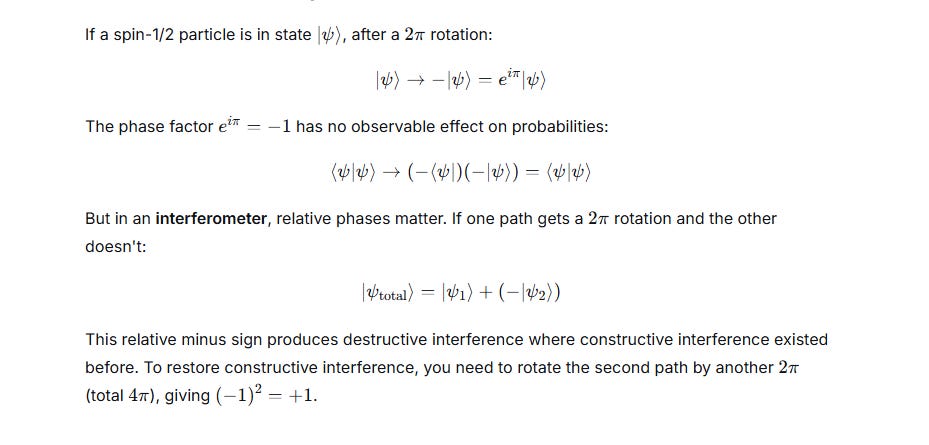
6. The explicit Möbius parameterization
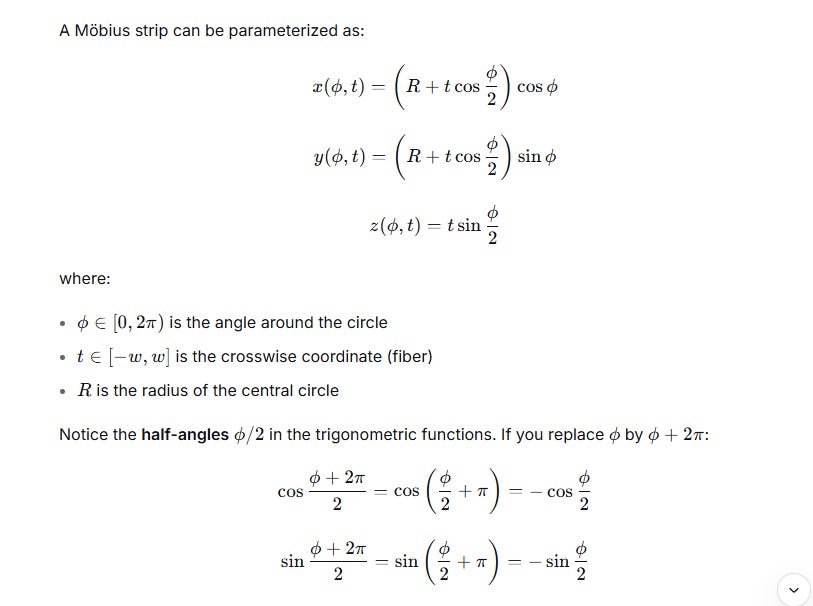
Thus:
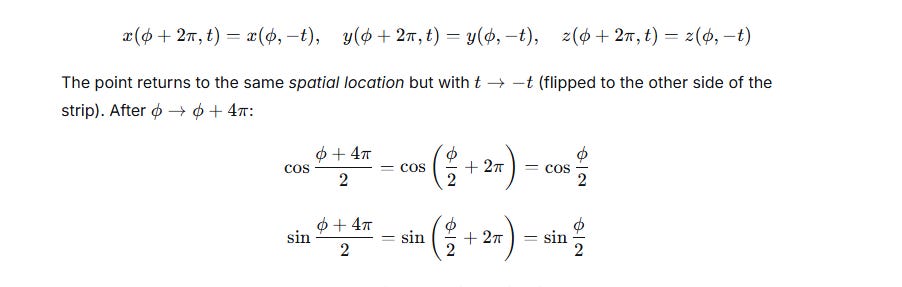
So the original coordinates are restored: x(ϕ+4π,t)=x(ϕ,t)x(ϕ+4π,t)=x(ϕ,t), etc. This exactly mirrors spinor behavior: a 2π2π rotation flips the sign (mapping t→−tt→−t), while a 4π4π rotation returns the original state.
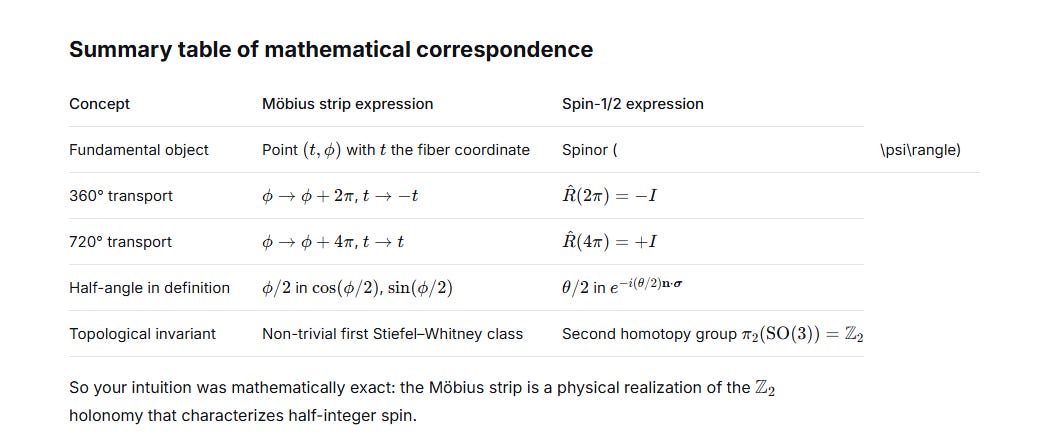
NOW I SEE