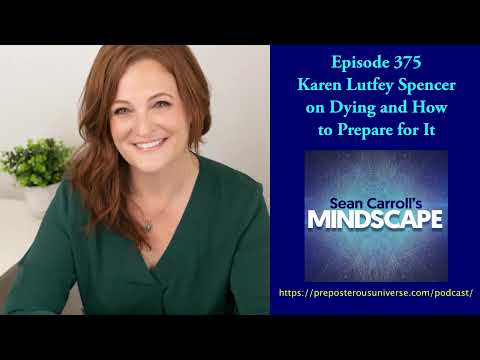
 Watch the video on YouTube ↗
Conversation · Reading Companion
Karen Lutfey Spencer on Dying and How to Prepare for It
A sociologist who studies how people and institutions meet at the end of life, on why dying is so hard to do well in modern healthcare — and what you can do about it, starting today.
1Death is inevitable, and we avoid it
The conversation opens with the oldest discovery of all — and the one we are worst at facing.
Someday we are all going to die. That is, as the host Sean Carroll puts it, not a new discovery at all. Average lifespans have risen, because more people live closer to the maximum of around 120 years, but the maximum itself has not moved much. Death is part of the fabric of biology, especially for a large multicellular organism: you last a finite amount of time.
And yet, as individuals and as a society, we are not good at facing up to it. Talking about it is awkward, especially with the people we love. Institutionally, hospitals, caregivers and insurance companies are set up to treat you and make you better when you are sick — which is good. They are much less set up to help when you are not going to get better, when the question is no longer how to fix it, but how to face the last part of it as well as possible.
Most people, Carroll says, would like that ending to be more or less not terrible: at home if possible, surrounded by loved ones, peacefully, comfortably, pain-free. A lot of people die in hospitals instead, in a way that feels alienating, medicinal and institutional. This episode is about closing that gap — and about starting much earlier than most people think.
2What got her into this
A sociologist who had studied healthcare for 15 years became a long-distance caregiver — and found the same problems in a new place.
The guest is Karen Lutfey Spencer, a medical sociologist and professor of health and behavioral sciences at the University of Colorado Denver, whose research spans medical decision-making and health outcomes. Her book is Your Good Death: Why End-of-Life Healthcare Is So Difficult and How to Make It Work for You.
She had already been studying problems in healthcare for about 15 years when her mother was diagnosed with a brain tumor, and she found herself thrust into the role of a long-distance caregiver. Through that experience she started looking around and saying: this is another area of healthcare with the same kinds of issues she had studied before. Later, with her mother-in-law, she would live the contrast between the two ways the system can work.
The field itself is large and multidisciplinary — public health people, medical professionals, sociologists — and there are, she confirms with a laugh, conferences full of death people. Sociology fits because it looks at how the individual is nested in larger social systems: how the very macro meets up with the micro, and back again. Healthcare is one more case of that, like schools or government or policy.
3What a good death means
There is no single good death. That is why the book is called Your Good Death.
The idea of a good death has a lot of depth across cultures and across history. The Greeks and Romans thought about it, Native American communities thought about it, and the modern Institute of Medicine has its own version. What counts as good varies pretty dramatically — which is why Spencer named the book Your Good Death rather than A Good Death.
The biggest change, she argues, is medicalization. In more historical contexts, community mattered a lot and ancestry mattered a lot: you were part of a community and would be accompanied on this transition. In the mid-1900s, physicians and especially hospitals rose, and death became hugely medicalized. The Institute of Medicine's version of a good death is very much happening in a medical setting.
That shift changed the questions we have to answer. Older societies were not asking whether to sign an advance directive saying how many days they were willing to be on life support. We are.
4Grandma in the back bedroom
A generation ago, dying was visible. Now it mostly happens elsewhere.
Many of the people Spencer interviewed, around a decade older than her mid-forties, remembered the same thing: when they were children, grandma was dying in the back bedroom and mom was taking care of her. Households were more multigenerational, and you saw up close what it looked like for someone to be dying. That exposure made it easier to recognize.
The younger generation has not seen anyone die in their house. Medicalization has taken death away and made it something that is supposed to happen elsewhere — and that makes it harder to talk about. Carroll's aside, that even the meal called dinner was completely different 150 or 200 years ago because there was no electrical lighting, makes the same point: we forget very quickly how recent the current arrangement is.
5The 70 / 30 gap
Most people want to die at home. Most people do not.
The statistic that motivated Spencer's research still bothers her. In public surveys in the United States, when you ask people where they prefer to die, 70% say they prefer home palliation and to die at home. But only about 30% actually get that. Some of that gap is beyond anyone's control — sudden deaths, accidents, things nobody sees coming. But some portion of it, she argues, is because of what is happening in healthcare.
More people than ever are using hospice, which is good: just over half of Medicare beneficiaries who die are using hospice at the time of their death, up from nothing in the 1970s. That is tremendous. The problem that hangs on is how short those stays are.
70% of them will say they prefer home palliation and to die at home. But only about 30% of us actually get that.
Spencer, on the gap that motivated the research6Hospice, briefly
Hospice is growing — but people arrive far too late to get much from it.
Under Medicare you can have six months of hospice coverage, but the median stay in hospice is like 18 days, and it has been that way for years. About a quarter of people stay in hospice for a week or less. People are very close to the end of life by the time they get a hospice referral or make the decision to go.
That is, in Spencer's view and many others', an underutilization of what hospice can bring. The common assumption is that healthcare will tell you what you need to know, when you need to know it — that someone will say, it is time to consider hospice, and you will still have time for the bucket list, for taking the grandkids fishing. In reality, people are not getting those referrals until they may be so sick that they are not getting out of bed, not talking, not eating. People are not really prepared for that.
7Hospice and palliative care
Two words that sound alike, with very different rules attached.
Palliative care is the broad umbrella: comfort care, oriented to quality of life and to care aligned with what is important to the person. Hospice is one piece under that umbrella, covered by Medicare. To get the hospice Medicare benefit, two physicians sign off that they would not be surprised if the person died within six months.
And to get that coverage, you have to relinquish any medical care coverage under Medicare intended to cure your condition. In healthcare circles this is called the terrible choice — a real fork in the road, and the source of the cultural stereotype of hospice as quitting.
Palliative care is much newer in the US, established as a subspecialty in the 2000s, and it does not require a certain prognosis, diagnosis or age. It can be used concurrently with curative care. People know far less about it, but it is a fantastic bridge between hospice and curative care.
| Care | What it is | The catch |
|---|---|---|
| Palliative care | Comfort care, quality of life, aligned with what matters to you | None on prognosis — can run alongside curative care |
| Hospice | One piece under the palliative umbrella, covered by Medicare | Two physicians must expect death within six months; you give up curative coverage |
The table restates the episode’s definitions; it adds no new criteria.
8Hospice is not a place
Most hospice care happens in people's homes. Hospice comes to you.
A common misunderstanding is that you have to go somewhere to be in a hospice. In fact, most hospice care happens in people's homes. Hospice is designed to provide support even if you are not in a hospital and not pursuing curative care — so that you can spend your time at home, as safe and comfortable as possible, instead of enduring treatments with heavy side effects that are really draining.
Hospitals, Carroll notes, optimize for treating you, not for being a warm, welcoming environment: bright colors, no rugs, nothing very welcoming. Hospice, by contrast, is set up to let people be home. As he puts it, and Spencer confirms: hospice is a stage in the journey. It is not a place that you go.
That still leaves the question of the 30% who die at home: does that number include people who die suddenly, by accident, with no time to plan at all? Yes — and that is one of the ways people cannot end up having the end-of-life care they want. Being able to stop and think about these situations is, in a way, a privilege, because a lot of times people just do not have any choice at all.
Hospice is a stage in the journey. It is not a place that you go.
Carroll and Spencer, on what hospice actually is9Start today — and the caregivers
This is not only about old people. One in four people in the US is a caregiver.
How far ahead should we be planning? Spencer's answer is blunt: these conversations should be happening today. This is not just a situation for people who are older or already seriously ill. One in four people in the country is a caregiver, caregivers are younger than ever, and there is a huge population of youth caregivers. All of those people are affected deeply — their health, their school, their families — when they are pulled into that role.
It disproportionately affects women and people of color, and health policy is not really set up to cover a lot of these costs. Putting someone in a nursing home or memory care or any of these facilities is very expensive — easily $20,000 a month, even $10,000 on the low end. When families cannot support that kind of cost, a lot of unpaid caregiving work happens. As Carroll puts it, it is very expensive to get old: you do your best, you save up, and the system is very good at extracting that money from you in your last few years.
Spencer's book tries to show individuals what those system-level issues are and give them tools to respond — but the source of the problem is really at the system level. Caregiving support policies, she argues, need to be much stronger; we need to be paying people to help cover the gaps in the healthcare system.
10What quality of life means to you
Do not start with how many days on life support. Start with what made today good.
What should a healthy 30-something plan for? Not, first, a pile of documents. Spencer suggests starting upstream: what does quality of life mean to you? When she asks people that, they immediately jump to: I would only be willing to be on life support for x number of days. The opportunity is to think earlier and more concretely.
Ask instead: what made your day good? What were the sights, smells, sounds? Was it having coffee at your own kitchen table in your own clothes? Was it having your dog there, or your spouse there? What are those things? That is one really simple baby step. It does not have to start with signing all your advance directives and creating a trust.
That touchstone matters because if you, or someone you care about, end up in the throes of a serious illness — in what Spencer calls the washing machine of the healthcare system — it helps to have already thought about what matters to you. And the answer will change: the person you are at 30 is a different person at 70, with different conditions. So it is an ongoing process, not something you decide once and for all. If you have never thought about it before and suddenly find yourself in a crisis, navigating a stressful, upsetting situation, you are trying to learn a lot of things all at one time — and it is the first time you have ever thought about what a good life looks like to you. Then you are starting from scratch.
11Advance directives
Paper helps — but only when it is braided together with conversation.
An advance directive is an umbrella term for forms you can sign that put into writing what your wishes are. A do not resuscitate order (DNR) is one: sometimes signed and posted prominently on the refrigerator, so that if paramedics come in they know the person does not want to be resuscitated; you can sign those in hospitals too. A living will is a document saying, for example, how long you want to be on life support, or what you would want in a given situation. You can also designate medical power of attorney — someone who would make health decisions for you if you were not able.
How legalistic do these have to be? It varies by place, and by what you are trying to decide. Some people will make trusts to protect their financial assets — further into the nitty-gritty. But all of these are much more powerful when braided together with conversations with the people around you. Imagine a sheet of paper in a hospital that someone says was signed, but no one really knows anything about it. You want that sheet of paper lined up with family members standing there saying: we have talked with them, we can confirm this is consistent with what they say.
So the sequence is: think about what matters to you, then communicate it to the people who might be in the hospital room when the moment comes. The more people talk about this, Spencer says, the less difficult and more familiar it gets — easy may be overstating it, but familiar is real.
12When the family disagrees
No one wins those fights. The tools exist to have them earlier, in calmer air.
What if one member of a close family has opinions about the end of their life and the rest of the family disagrees? Probably no one wins in those situations, Spencer says, even though they happen all the time. When there has been no conversation, it is a setup for exactly those problems — and it takes a difficult situation and makes it worse.
There are online tools, a lot of them these days. Two she names: Five Wishes and the Conversation Project. They have written worksheets and questions you can ask each other to facilitate a conversation in advance. Five Wishes is also set up to help you create an advance directive that can be legally binding. Living wills are appropriate too.
Spencer's recommendation to someone healthy in the middle of life: yes, start the legal document process as well as the informal chatting. It can be bigger or smaller, and it depends on what would happen if — if you died suddenly, or were suddenly on life support, who is affected, what are you leaving behind?
13Doctors and the defaults
Doctors are better at prognosis than at the conversation. The system leans toward treatment.
Once you are in hospital, how good is the system at figuring out whether you are really close to death, and at communicating that? Doctors, Spencer says, are a lot better at figuring out if we are reasonably close — although they will tell you it is very difficult to prognosticate, very difficult to know exactly what is going to happen. In broad strokes, they are not without a sense of what might happen.
Where the system breaks down more is defaults: we have a lot more defaults that lean toward treatment and fewer that lean toward pumping the brakes and saying, let us have a conversation about your goals of care. If this were to go in a direction where we could not cure you, let us make sure we have had a conversation and established in your healthcare record what is important to you.
Doctors themselves say, when Spencer interviews them, that delivering that kind of news is the most upsetting part of the job: they do not want patients to think they gave up hope on them. They are nested in the same healthcare system we are — a system with, in the US, a long history of trying to be good at curing things, from the moonshot cancer initiative since the Nixon administration onward. That has a lot of spillover: we just keep aiming for a cure and are not as good at covering the other side of it.
14The treatment superhighway
Nobody designed a conspiracy. But insurance pays for procedures, not for the 30-minute conversation.
Medical schools are working on it, Spencer says: there are now people who can be specialists in palliative care — physicians, nurses, physician assistants, across the board. That is huge progress. But the momentum toward cure gets baked in at several levels: into education, into training, into what insurance will pay for. Insurance is paying way more for surgeries or MRIs or treatments than it is for that 30-minute goals-of-care conversation.
The result is what she calls the treatment superhighway, with the off-ramp hard to find. Money from the National Institutes of Health flows to research on cure; that reinforces research projects, merit evaluations, performance evaluations for individual providers. It is easier to stay on the highway than to take the off-ramp.
Individual doctors, she stresses, are human beings who get into this because they care about their patients. Sometimes they lack training and experience in having these conversations and shifting gears, so they just keep treating — waiting for evidence to accrue that treatment is definitely not working, or waiting for patients to get their head around what treatment looks like before deciding it is not worth it. Sometimes they do not have the skill set or the time in their schedule. That is human nature, not nefariousness — and it is worth saying so on behalf of providers who are trying really hard inside a system that does not always facilitate what they are trying to get done.
15Defaults that help
Make it routine, like a mammogram — then nobody has to wonder why the doctor brought it up.
One fix Spencer keeps returning to is defaults. If a general practitioner broaches the topic with a perfectly healthy person in their thirties, the patient may well say: what are you trying to tell me? What did you find out in your exam? But if it is a default — something advised to everyone, filed in the electronic health record — the sting goes out of it.
Her analogy: nobody says “oh my god, why did you say that to me?” when told to go for a mammogram or a colonoscopy, because it is a regular thing. Once you hit 50, the fervor with which doctors tell you to have a colonoscopy goes way up. If the end-of-life conversation were a similar routine, people would be less surprised by it.
How to make that happen? At all levels, she says: legislation, the American Medical Association, and the portals themselves. Some portals already have a slot filled out for this — a form with basic information, available to anyone in that healthcare system who looks you up. The catch is fragmentation: not everyone has a single electronic portal record that follows them from provider to provider. That is a real contributing factor. And the privacy worry — do you want a single record keyed to you following you everywhere? — is real too, though the record would sit with other HIPAA-protected health records.
16Her mother, then her mother-in-law
The same family, the same system — two very different endings. The difference was one request.
Spencer studied healthcare for a living. Her mother had been a nurse for 45 years. And still, she says, we still found ourselves on that treatment superhighway. They were offering her mother chemo until days before she died, and they did not know how to change that. She thought hospice — that someone would tell them when they needed hospice — and they did not.
About ten years later, her mother-in-law was in declining health with cardiac issues. One thing Spencer had learned from the research was the value of just asking for a palliative care referral. One day in the hospital she asked her family: do you think she would be okay with a palliative care referral? Her husband talked to his mom, Spencer asked for it — and it changed everything.
What a referral actually meant, in that case: palliative care came alongside the cardiologist's curative care. A very nice woman came to the hospital room, with a family member on the iPad in the meeting, and talked with her mother-in-law about what mattered to her, what her priorities were. Some of it was very actionable: I am sick of being in the hospital. I just want to be home more. They left feeling hooked up with palliative care — and then, to their alarm, she immediately fired them. She did not want them on the team right then. A few months later her health took a turn, and she was calling Spencer asking: how do I get back in touch with those people? I want them now. She had a vocabulary for asking for that. She joined palliative care, and it switched over to hospice in a few months, and she had a lot of what she wanted — because she had the vocabulary and the connection.
17Hope, cognition, and erring on the side of intervention
Hope holds the system together. It can also hold the conversation off.
Hope, Spencer says, is kind of the glue that holds a lot of this together. She does not want to sound anti-hope. But for those who do not want as much treatment as possible until the last moment, we need to interrupt the system that can pin everything on hope and keep treating until the end. In the modern world of medicine there is almost always another procedure that has not been tried yet.
Part of the difficulty is human: nobody wants to be the one in the hospital room saying, have you thought about dying? Have you really faced up to that? Nobody wants to look like they are dragging a loved one in that direction. Structures help — a procedure everyone goes through, making clear what the options are, so it does not sound like one individual trying to pull the plug.
How often is the person at that stage simply not cognitively up to these big questions? It depends how late you wait — but it is a very plausible scenario. And then the documents, hand in hand with conversations that already happened, have to do the work. If neither is there, we err on the side of intervention: resuscitation, life support, feeding tubes. That is the default. Earlier conversations add up: even if someone loses the ability to make decisions, a sense of what they value over time can guide the people deciding for them.
Hope is kind of the glue that holds a lot of this together.
Spencer, on why the system keeps treating18Autonomy, and Medical Aid in Dying
Everyone should make the decisions they want — including the decision for as much treatment as possible.
Spencer is clear that your good death means your decisions: there will be people who want as much treatment as possible, and that is their call. The important thing is that people understand the defaults — especially the false assumption that a doctor will just tell you when to switch to hospice and then you will have time for the bucket list — so they can decide if they want.
On autonomy more broadly: a parent, or any older person, should have the right to choose what they are going to do even if the rest of the family thinks it is very silly, as long as it is not hurting anybody else. Earlier conversations are what protect that autonomy when decision-making capacity fades.
What about being more active about it — assisted death? Medical Aid in Dying was not part of this research, Spencer says; it was not legal in Colorado at the time she was doing the research, and she addresses it only briefly in the book. She thinks people should have access to it, but studies she has seen show that even in states where it is legal, it is not necessarily accessible — there is a much deeper story there, where people cannot always get their hands on the care they want. Carroll's version of the same point: it can take six months of paperwork, and you do not have six months.
19The research behind the book
About 120 interviews, plus observation in clinics and hospices.
The project was entirely qualitative. The centerpiece was interviews done over several waves — about 120 interviews total — plus a lot of observation in palliative care clinics and in hospices, sitting in on team meetings and learning how they were making decisions about patients coming in.
When she started, she did not envision a trade book. She was doing her regular thing: spinning off academic articles — five or six of them came off this before she felt it needed a book-length project to tie all the pieces together. She also decided there was a lot here she wanted to put in people's hands, to make it actionable.
Are hospitals and legislatures listening to people like her? There are a lot of people talking about this, she says — some geared toward policy and medical audiences, some toward lay audiences, slightly different groups focusing in different areas.
20Different diagnoses, different declines
Cancer, cardiology, Alzheimer's: the same conversation, very different clocks.
Should you aim to die at home? It really varies, and it matters a lot what your diagnosis is. Cancer figures prominently in the book because, when Spencer started the research, cancer patients were the number one users of hospice: their decline tends to be more predictable, a little more gradual, and then very fast at the end.
Cardiology patients can be very different: you could have a heart attack and die instantly, or the decline can be stair-steppy — very stable, then a drop. Alzheimer's patients are a much bigger population now, and that can be a very long, slow situation. So it depends a lot on the diagnosis and the individual situation.
And some people simply do not want to die at home, for a lot of reasons. From Spencer's perspective, those are completely valid. Home is a good fit for some people; it is not the answer for everyone.
21What can we do as a society?
Policy from the top, conversations from the bottom — and both at once.
The final question is the big one: what can we do as a society to reorient our attitude — to be a little more open and honest about all this? Spencer's main driver is policy changes: changes in healthcare that make it less fragmented, with more integration of palliative care. She thinks it is totally feasible to have a palliative care referral triggered when certain diagnoses happen — no reason that could not exist, at least to start a conversation.
She would also like to see more paid support for caregivers, because that is a crushing issue a lot of people are facing. Those policy changes, she thinks, can change a lot about our culture.
But from the bottom up: having more of these conversations. Small bites add up. People who have been caught in the system — who have watched a healthcare situation add to an already stressful one, acquiring new information at the worst possible moment — often have the light bulb go on, and are open to tools. Anything that pulls the conversation back from feeling like someone is pulling the plug, or losing hope, is a win. And the tools work: people who have taken Five Wishes or the Conversation Project to their parents have come back saying they had a really great conversation and felt so much better.
22Who's speaking
The guest. Karen Lutfey Spencer, medical sociologist, professor of health and behavioral sciences at the University of Colorado Denver. Her research spans medical decision-making and health outcomes. She studied healthcare for about 15 years, then shifted her focus to end-of-life care after being a long-distance caregiver for her mother, who was diagnosed with a brain tumor. Her book is Your Good Death: Why End-of-Life Healthcare Is So Difficult and How to Make It Work for You.
The interviewer. Sean Carroll, host of the Mindscape podcast, who opens by facing up to the inevitable, keeps pressing on the gap between what people want and what the system delivers, and closes by thanking Spencer for work that helps the rest of us face up to it.
The people in the story. Spencer's mother, a nurse for 45 years, who received chemo until days before she died; her mother-in-law, whose cardiac decline took a different path once a palliative care referral was requested. And, in the background, the doctors, nurses, insurers and families nested in the same system — trying hard, often without the training, time or defaults that would make the conversation easier.
The conversation is a single long interview, recorded for Mindscape episode 375, and the account above follows its order. Where it reports a claim — about how many people want to die at home, about hospice stays, about costs — it reports it as the speakers gave it. Sponsor messages are left out.
About this page. This is a reading companion, not a transcript.
It follows the source in order, tidies the spoken sentences into readable prose, and adds nothing that was not said.
Designed by Meta AI.
Companion page to the Mindscape episode “Karen Lutfey Spencer on Dying and How to Prepare for It” · themes: dying, hospice, palliative care, advance directives, and caregiving.